Let's Look at Simone Biles' Olympic Saga from Her Perspective, Not 'Ours'
Simone Biles is back—not for us, but for herself.
"I did this for me and nobody else," she told reporters after winning bronze in the balance beam final Tuesday in Tokyo.
Biles' third-place finish repeats her beam result at the 2016 Olympics in Rio. At the time, third place was categorized as a disappointing finish for a star gymnast at the top of her game. But Tuesday's bronze is a triumph—not over the mental block that plagued her since the start of the Games but over the weight of other people's expectations.
TOP NEWS
Seahawks trade for Colts' All-Pro OL

New NFL Power Rankings 📊
Report: Colts 'Actively Shopping' Buckner
If Biles was nervous coming into the beam final, she didn't show it. Her performance was everything a beam routine should be—solid, fluid and precise. It was a return to what we normally see from the greatest gymnast of all time.
Her set, featuring a double-pike dismount in place of her full-twisting double back, was good for third behind gold medalist Guan Chenchen and silver medalist Tang Xijing, who together capped an otherwise disappointing Olympics for the Chinese women's team.
With Biles' medal—her seventh overall and second at these Games—she completed the U.S. women's team's collection of one in each event in Tokyo.
The view of this bronze for Biles versus her bronze in the same event in Rio offers an encapsulation of a storyline that has led the U.S. headlines from Tokyo.
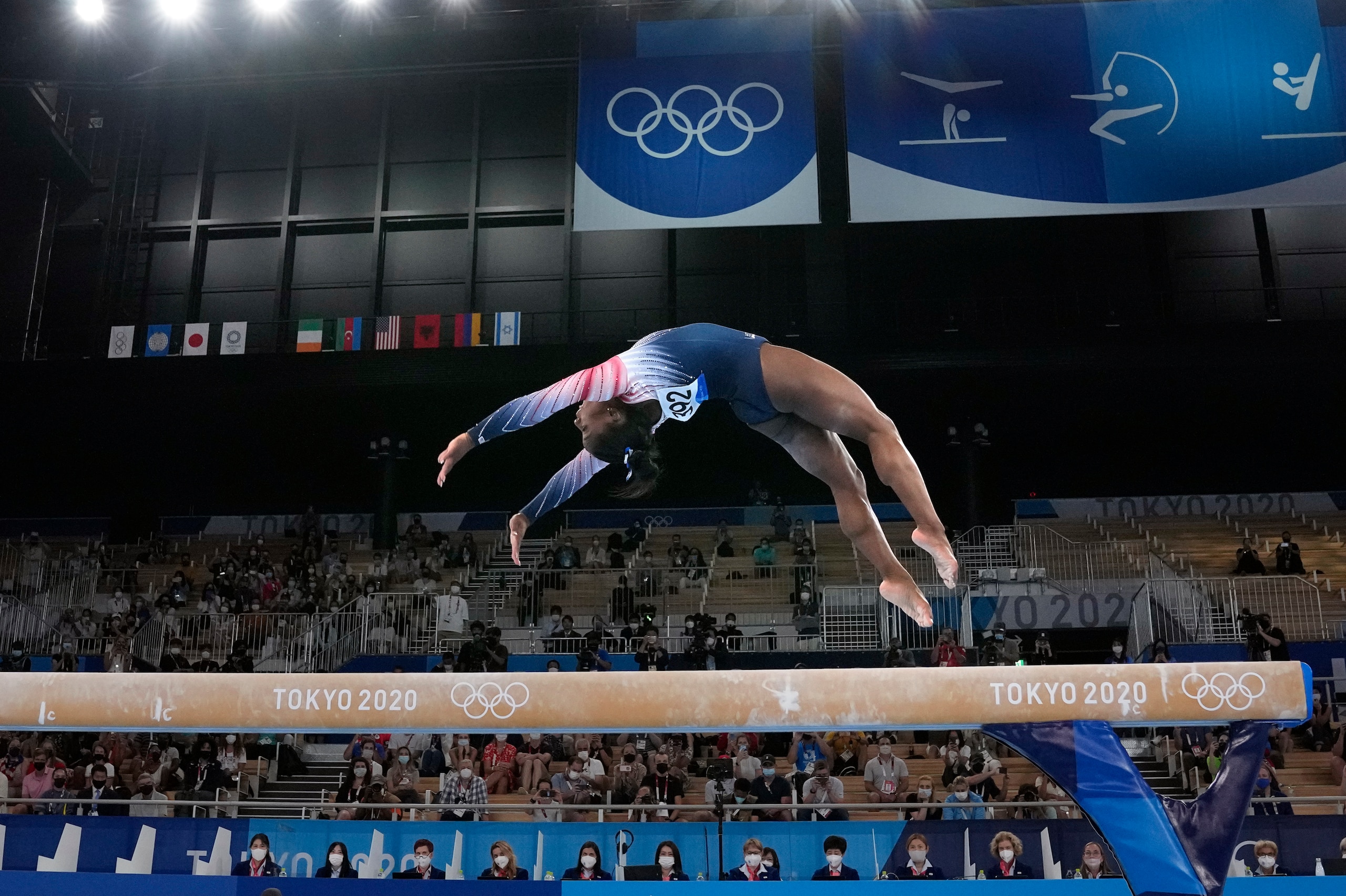
In Rio, having won four golds, she "missed" on her beam event final. She under-rotated a punch front, put her hand down on the beam and finished third. The errors came as a shock, and observers brought them up again and again as tarnishing Biles' otherwise impeccable Rio record.
The reaction foreshadowed what would come to be a devastating Tokyo Olympics for those who had put Biles on a pedestal. Biles was never disappointed in her Rio bronze. According to her, that was all a projection. "I think you guys want it more than I do," she said after the 2016 final.
Still, the response to that Rio performance affected her. "I remember finishing beam. I was super excited. … But I couldn't be happy, because nobody else was happy for me," she said during her Facebook docuseries Simone vs Herself, per Insider.com. "And so I just felt alone."
Similarly, in Tokyo, the thrust of Biles' words and actions was that all she wanted to do was her best. It was the weight of others' expectations that was bringing her down.
The contrast between "our" expectations and those of an athlete herself, or a team itself, has come up over and over in the days since Biles withdrew from the team final, where she was expected to lead her team to its third consecutive gold medal.
Biles made large errors in the qualification round, and the next day, she told reporters, she woke up and something was different. When she tried to do a skill, she would get lost. Biles' sense of air awareness was gone, forcing her to withdraw from the final after just one vault.
The public at large expected her to come to these Olympics and contend for five gold medals; now, she was barely fit to do an "easy" version of her vault. Biles withdrew from the all-around final, and, later, the vault, bars and floor finals.
The connection between Biles' loss of aerial awareness—or the "twisties," as it's called—and mental health is unclear. But her decisions sparked a conversation around the pressure placed on Olympic athletes and the effects superstardom has had on her mental state.
Biles is valued as a commercial business asset, and it's easy to treat her as just that—an asset. Her face has become synonymous with the Olympic Games, and lower prime-time ratings have been connected to her withdrawal. Some responded to her actions by arguing she was balking under the pressure to perform. Even during qualification, the presidents of the International Gymnastics Federation and the International Olympic Committee both came down for a chat, for sure knowing what was at stake in Biles' competition.
"I truly do feel like I have the weight of the world on my shoulders at times," Biles said in an Instagram post after qualifications.
Perhaps out of a desire to explain her actions, Biles later released videos on Instagram in which she struggled with skills that usually came easily to her. She tried to do a full-twisting double tuck off the uneven bars but came up short.
"For anyone saying I quit," she wrote, "I didn't quit. My mind and body are simply not in sync."
In Biles' absence, Sunisa Lee became the elite member of the U.S. team. She won gold in the individual all-around, taking the spotlight for herself—for better or worse. After the final, a video of photographers who surrounded Lee like a swarm of locusts circulated on Twitter.
Later, after Lee did not meet her usual execution standard on bars, still earning a bronze, she told the media, "I felt like I wanted to make everybody else happy." She said social media had been distracting, adding that she might delete Twitter to focus on the beam final.
As the most experienced member of the U.S. team, Biles has taken athletes like Lee under her wing. After pulling out in Tokyo, she supported them from the sidelines and from the stands. This leadership is an added weight that she carries as a survivor of a system that historically has prioritized medals and money over athlete welfare. Her actions in Tokyo should remind us that we're not watching a show pony—we're watching a person.
When athletes are asked what they plan on doing next, they usually answer with "pizza" or training for the next Olympic Games. When asked what is next for Simone Biles, coach Cecile Landi had a direct answer, telling reporters: "Therapy. Probably some for me too. It's been a hell of a week."