Ranking the NBA's All-Time Greatest Finals Starting Lineups
It took almost four months longer than usual to get there, but the 2020 NBA Finals have arrived.
On one side, the Los Angeles Lakers feature perhaps the game's best duo with LeBron James and Anthony Davis. Starting alongside them are three role players who make much of their impact on defense.
On the other side, the Miami Heat boast a balanced starting five headlined by two All-Stars, Jimmy Butler and Bam Adebayo.
This postseason, L.A. is plus-21.4 points per 100 possessions when LeBron and AD share the floor with Kentavious Caldwell-Pope and Danny Green (the starting center has changed on occasion). Miami is plus-10.5 points per 100 possessions when Butler and Bam share the floor.
But while these lineups are clearly two of the best in the NBA right now, they don't have quite the level of star power seen in Finals starting fives of years past.
We sometimes think of the "superteam" era as though it started when LeBron joined Dwyane Wade and Chris Bosh on the Miami Heat in 2010, but several championship squads from before the turn of the century started games with multiple All-Stars and Hall of Famers.
The very best can be found below.
Methodology and Honorable Mentions
1 of 6
Without the benefit of lineup data, which is only tracked back to the 1996-97 season, it's difficult to come up with an objective set of criteria for this list.
Stats like Hall of Fame Probability, MVP Shares and playoff win shares (since other catch-all metrics don't cover all of NBA history) were used as a guide, but the lineups weren't specifically sorted by any of the above.
Some groups, like the 1965 and 2008 Boston Celtics, were at the top of the list in combined Hall of Fame Probability, but nowhere near it in MVP Shares and playoff win shares. Others, like the Kobe Bryant and Shaquille O'Neal-led Lakers, piled up tons of playoff win shares while lagging behind in the other numbers.
The 2017 Golden State Warriors were an interesting case. They started four All-Stars and multiple MVPs with Stephen Curry, Klay Thompson, Draymond Green and Kevin Durant, but with time left in all of those careers, that group still has more climbing to do on the relevant leaderboards.
Finally, one more judgment call was made to preserve variety on the list. If two or three of the same stars led an organization to multiple Finals appearances, it was limited to only one entry in the top five. Without that limitation, five of Michael Jordan's six Chicago Bulls championship teams could make up the entire list.
This is all to say that objective measures were used to influence, but not determine, a subjective top five.
That means plenty of all-time great starting fives just missed the cut. Those which have arguments to be bumped up include:
- Five of the six MJ-led Bulls title teams;
- The 1984-85 Lakers;
- The 2000-01 Lakers (probably the biggest snub, but the Hall of Fame credentials of Derek Fisher, Rick Fox and Horace Grant were just too scant);
- The 1964-65 Celtics (tops in combined Hall of Fame probability);
- The 2007-08 Celtics (second in combined Hall of Fame probability);
- The 1971-72 Lakers (Wilt Chamberlain and Jerry West);
- The 1970-71 Milwaukee Bucks (Kareem Abdul-Jabbar and Oscar Robertson); and
- The 1982-83 Philadelphia 76ers (Moses Malone and Julius Erving)
Feel free to discuss more omissions in the comment section after examining the rest of the top five.
5. 1986-87 Boston Celtics
2 of 6
Starting Five: Danny Ainge, Dennis Johnson, Larry Bird, Kevin McHale, Robert Parish
Somehow, the least accomplished individual player from the 1986 Boston Celtics starting five was one-time All-Star Danny Ainge, who averaged double figures for his career and was one the game's top outside shooters of the era.
The other four from that lineup were all Hall of Famers.
Prior to joining the Celtics and accepting a smaller role in 1983, Dennis Johnson had made four All-Star teams and finished in the top 10 in MVP voting twice.
Kevin McHale spent the early portion of his career as perhaps the game's premier sixth man before moving into the starting lineup for the 1985-86 campaign. He finished his career with averages of 17.9 points, 7.3 rebounds and 1.7 blocks, two Sixth Man of the Year nods and seven All-Star appearances. During the season in question, he put up 21.3 points, 8.1 rebounds, 2.7 assists and 2.0 blocks.
Robert Parish, the unsung hero of the 1980s Celtics, averaged 17.7 points, 10.4 rebounds and 1.6 blocks over his first 10 years with Boston. By the end of his career, he'd made nine All-Star teams and two All-NBA teams.
Those four provided plenty of playmaking, scoring and defense, but this lineup was undoubtedly headlined by Larry Bird, who is arguably one of the five best players in NBA history.
In addition to three MVPs and two Finals MVPs, Bird had career averages of 24.3 points, 10.0 rebounds, 6.3 assists, 1.7 steals and 0.8 blocks. Among retired players, he trails only Michael Jordan, Magic Johnson and David Robinson in career box plus/minus.
For those more acquainted with today's game, Bird played like a hybrid of Nikola Jokic and Luka Doncic. No one could speed him up. He saw seemingly every player and angle from anywhere on the floor. And his skill level as a passer, shooter, ball-faker and more was unparalleled.
Surrounding him with an All-Star and three Hall of Famers unsurprisingly led to multiple titles, even in a decade in which the Lakers had two of the greatest players of all time.
4. 2011-12 Miami Heat
3 of 6
Starting Five: Mario Chalmers, Dwyane Wade, Shane Battier, LeBron James and Chris Bosh
Plenty of old-school NBA fans may already be feeling triggered, so let's address this particular Miami Heat squad topping the 1986 Celtics right off the bat.
The 2012 Heat's starting five, led by LeBron James, Dwyane Wade and Chris Bosh, top that Celtics lineup in combined Hall of Fame Probability, combined MVP Shares and combined playoff win shares. It's in the top five in all three categories. And if you sort the lineups sampled by the average of their ranks in those three categories, this Heat lineup trails only the top team on this list.
When you break Miami's starting five down by its individual players, it isn't hard to see why it performs so well in those numbers.
Mario Chalmers and Shane Battier are the weakest links of this chain, but they didn't break it. In the 2012 postseason, Chalmers averaged 11.3 points and shot 35.9 percent from three. Battier was a three-and-D stalwart whose career marks for three-point percentage, offensive box plus/minus and defensive box plus/minus are matched only by Danny Green, Jon Barry and John Stockton.
The biggest reason this lineup fared so well, though, was the Big Three.
Despite his career being cut short by health problems, Bosh made 11 All-Star teams. He averaged 19.2 points, 8.5 rebounds and 1.0 blocks per game across his 13-year career. And as a member of the Heat, he helped usher in the current era that features skilled centers who can space the floor for slashing wings and guards.
Despite being a dominant interior player with the Toronto Raptors, Bosh willingly shifted to an offensive role that was functionally like more of a traditional shooting guard with Miami to accommodate James and Wade. On the other end, he anchored of one of the game's best defenses.
Wade was the second surefire Hall of Famer in this lineup. Like Bosh, he accepted a lesser role for the benefit of the team, particularly in 2012.
"Taking a step back to Bron, that was the toughest part for me at the time," Wade told The Athletic's Michael Lee. "Obviously, before my injuries, I was a bad boy. It was my city, my team. (If) we win the Finals that year (in 2011), I'm arguably Finals MVP. I didn't need to ... but we got two out of the next three championships and I'd still do it all over again."
Even in a diminished role, Wade was critical to Miami winning the 2012 Finals. That postseason, he averaged 22.8 points and 4.3 assists. For his career, he made 13 All-Star teams, eight All-NBA teams and three All-Defensive teams.
Finally, there's LeBron, the player to whom Wade ceded control of the team.
The stats outlined in the methodology were combined for each of the lineups sampled. On an individual level, LeBron has 100 percent Hall of Fame Probability and is the NBA's all-time leader in both MVP Shares and playoff win shares.
And this was the year he broke through for his first championship. In the 2011 Finals, he fell short of both Wade and Dirk Nowitzki in average game score. He was widely panned for his performance in that series, but it seemed to refine him. He came back to utterly dominate in the 2012 Finals, averaging 28.6 points, 10.2 rebounds and 7.4 assists while leading one of the greatest lineups of all time.
3. 1995-96 Chicago Bulls
4 of 6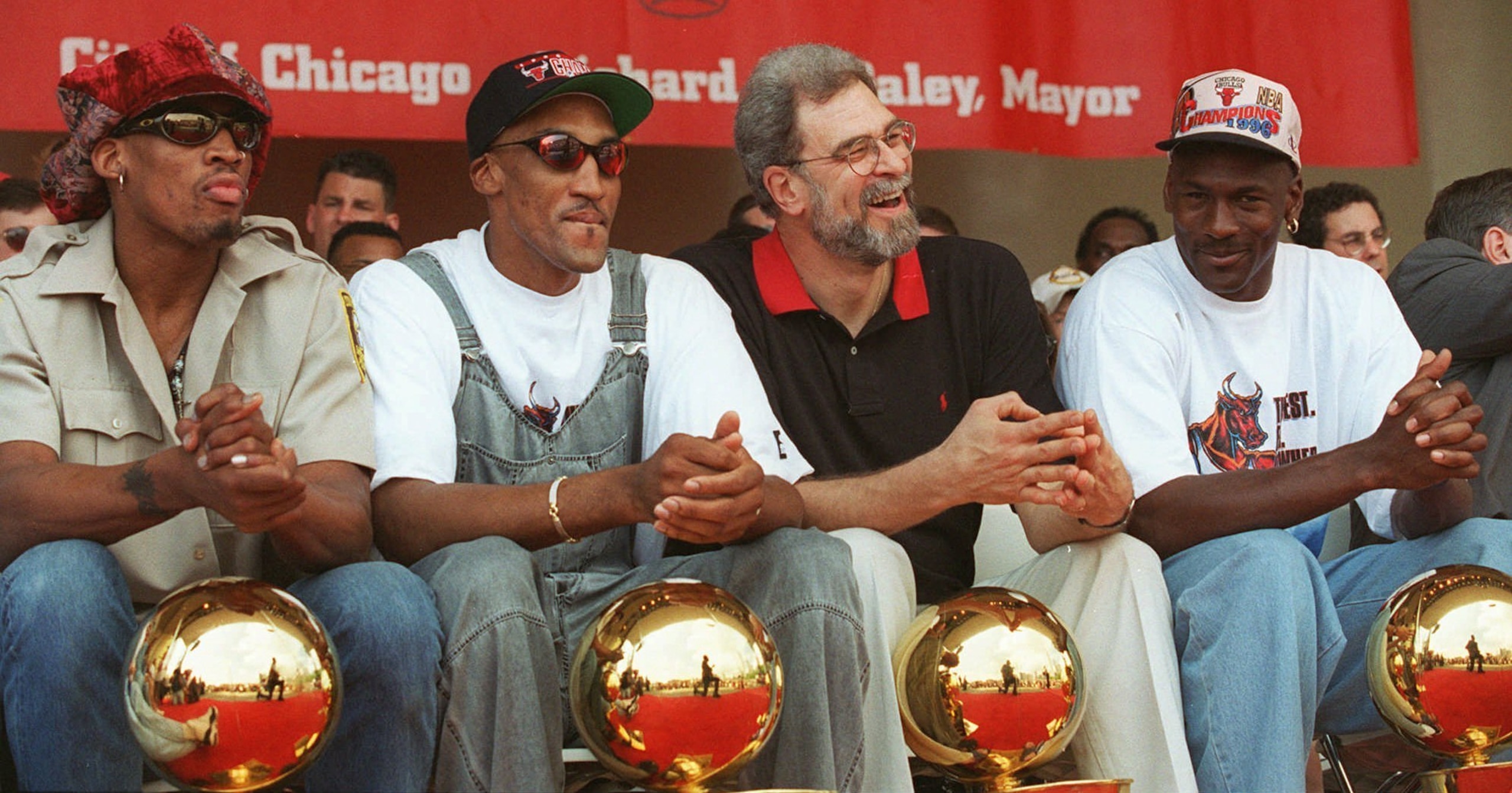
Starting Five: Ron Harper, Michael Jordan, Scottie Pippen, Dennis Rodman and Luc Longley
Any lineup with the GOAT is going to have an argument in an exercise like this. And this particular group was the Chicago Bulls' starting five in both the 1996 and 1997 Finals. We'll settle on the earlier year because it featured a slightly better version of Michael Jordan (according to regular-season and playoff box plus/minus).
During the 1995-96 postseason, Jordan averaged 30.7 points, 4.9 rebounds, 4.1 assists, 1.8 steals and 1.4 threes while shooting 40.3 percent from deep. Even as he entered the post-prime portion of his career, Jordan was the league's standard-bearer for team and individual excellence.
However, he didn't win this championship—or any of his six—alone.
Jordan had the luxury of playing with one of the greatest No. 2s ever. Scottie Pippen is arguably a top-25 player in NBA history, one who brought point forward skills that were way ahead of his time and Swiss army knife versatility that would make him one of the game's most coveted defenders in any era.
Over the 1995-96 and 1996-97 seasons, Pippen averaged 19.8 points, 6.5 rebounds, 5.8 assists and 1.8 steals. Throughout his career, he made seven All-Star teams, seven All-NBA teams and 10 All-Defensive teams. And Pippen and Jordan weren't the only defensive stalwarts in this group, either.
Dennis Rodman is one of the greatest rebounders of all time (second in career rebounding percentage and first among players his height or shorter). He made eight All-Defensive teams, two All-NBA teams and won two Defensive Player of the Year awards. For his career, he averaged 13.1 rebounds in 31.7 minutes per game (16.7 over the seven consecutive years in which he led the league in that category).
Then there was Ron Harper, who like several other players detailed on this list, was a star (or near star) who accepted a smaller role when joining a superteam.
Prior to joining the Bulls for the 1994-95 season, Harper averaged 19.3 points, 5.2 rebounds, 4.9 assists, 2.1 steals and 0.9 blocks. As a teammate of Jordan and Pippen, he no longer needed to provide that level of raw production, so he instead focused on defense. With those three and Rodman, Chicago had a modern, switchy lineup that caused fits for opponents.
Luc Longley helped on that end, too. His numbers don't jump off the page, but he was a solid rim protector (1.4 blocks in 1995-96) who knew his role and scored the occasional bucket inside.
2. 2016-17 Golden State Warriors
5 of 6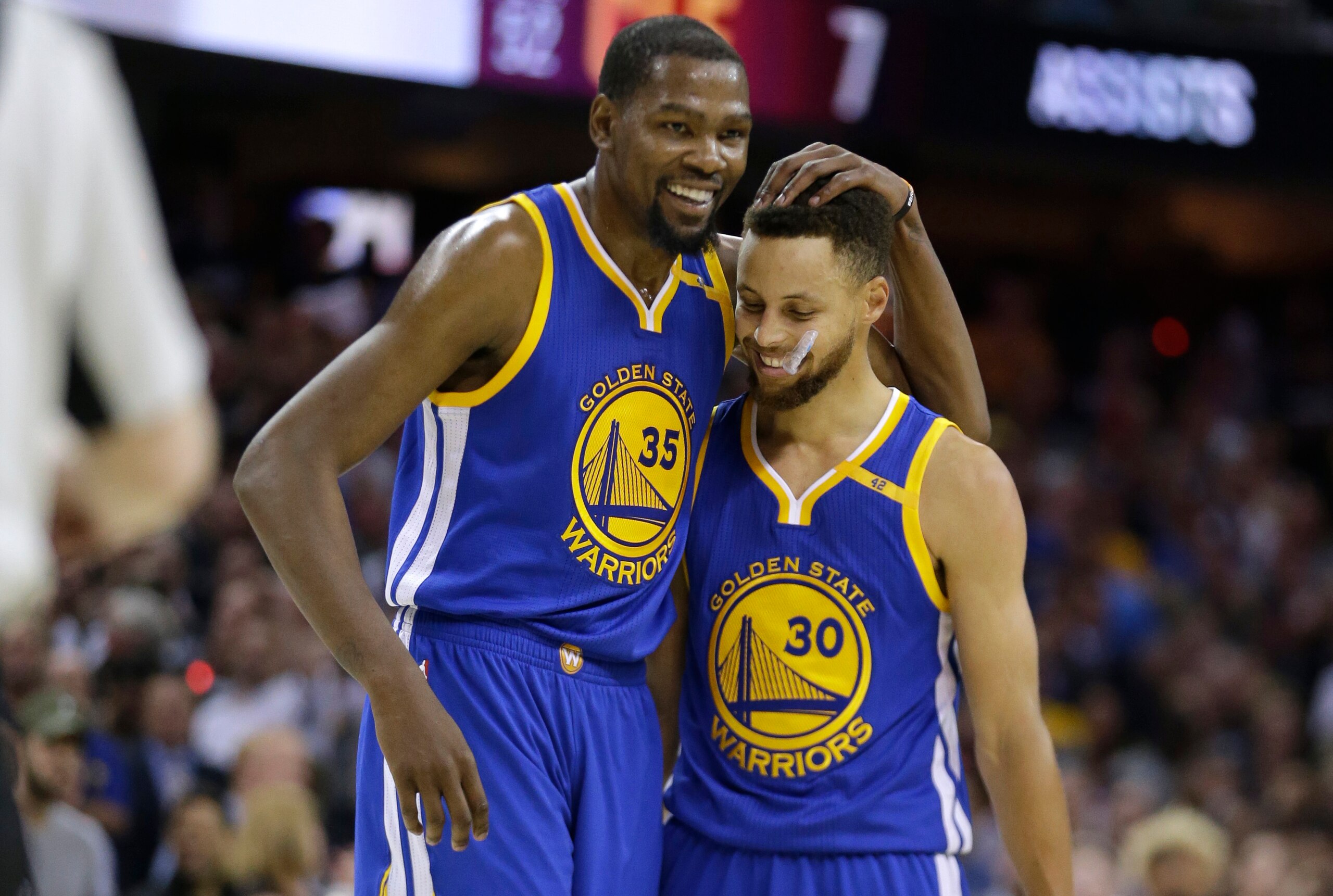
Starting Five: Stephen Curry, Klay Thompson, Kevin Durant, Draymond Green and Zaza Pachulia
As mentioned earlier, the 2017 Golden State Warriors' case is interesting since it is still being built (at least in terms of the criteria selected for this exercise).
For example, Stephen Curry and Kevin Durant are both already locks for the Hall of Fame, but they'll almost certainly add more playoff win shares and MVP Shares. Right now, Klay Thompson's Hall of Fame probability is 51.3 percent. Draymond Green's is 30.2 percent. Both of those numbers are likely to go up as well.
What really helps this group is modern analysis.
The Warriors were a whopping plus-23.5 points per 100 possessions with this lineup on the floor during the 2016-17 regular season and plus-16.5 in the playoffs. Over the three seasons in which Curry, Thompson, Green and Durant were teammates, Golden State was plus-15.9 points per 100 possessions in the regular season and playoffs combined when all four were on the floor.
Few (if any) All-Star groupings across league history fit as well together as this one. It's tough to find a comparable combination of shooting, playmaking and switchability on defense. And even those may not have been the most important ingredient.
There was a selflessness, particularly from the two-time MVP Curry, that made the whole thing work.
Curry trails only Michael Jordan, LeBron James and Durant in career offensive box plus/minus (he trails KD by an infinitesimally small number). His 2015-16 campaign is perhaps the best offensive season in league history. But when Durant joined the Warriors, he gladly ceded much of the offense to another all-time great.
Teamwork is a feature of all of the lineups detailed here, but it was on particularly vivid display with this Warriors squad.
1. 1986-87 Los Angeles Lakers
6 of 6
Starting Five: Magic Johnson, Byron Scott, James Worthy, A.C. Green and Kareem Abdul-Jabbar
James Worthy was a Hall of Famer and seven-time All-Star, and Byron Scott grew into a 20-point-per-game scorer shortly after the season in question. But the greatness of this lineup is driven largely by Magic Johnson and Kareem Abdul-Jabbar, perhaps the greatest NBA duo ever assembled.
Magic and Kareem are top-five players all-time whose games complemented each other brilliantly. The former's playmaking gave the latter countless good looks at the basket. And Kareem's ability to finish out of the post or around the rim made him one of the greatest receivers any basketball quarterback could want.
During their 10 seasons together, Magic averaged 19.5 points, 11.2 assists, 7.4 rebounds and 2.0 steals, while Kareem put up 20.6 points, 7.6 rebounds, 2.8 assists and 2.0 blocks.
Those two alone would've made this a daunting lineup, but there was another Hall of Famer in the mix, too.
In the 1986-87 season, Worthy averaged 19.4 points, 5.7 rebounds and 2.8 assists while shooting 53.9 percent from the field. If we're going to continue the football analogy, he was the downfield threat that really opened up the floor for the Showtime Lakers. And when he found space in transition, Magic found him.
Scott was a weapon as well. That season, he averaged 17.0 points and shot 43.6 percent from three as the league was still discovering the potency of that shot. With Magic on the roster, he wasn't required to do a ton of playmaking, but he certainly could in a pinch.
Finally, this group wouldn't be complete without iron man A.C. Green. Throughout his career, the one-time All-Star was a steady contributor for a number of organizations. And in 1986-87, he was an ideal gap filler for a lineup loaded with so much star power. That season, he put up 10.8 points, 7.8 rebounds, 1.0 blocks and 0.9 steals in 28.4 minutes per game.

.jpg?w=2560 "Cam Ward Says He's Not A Loser")
.jpg?w=2560 "Chargers Fall to 0-5 🤢")
.jpg?w=2560 "Viral Dan Campbell Presser 💙")