
Ranking the Greatest NBA Careers with a Single Franchise
It's a common complaint that modern NBA basketball is somehow diminished by constant player movement.
The criticisms generally include some combination of the following: Rivalries don't form as easily, fan loyalty can't reach bone-deep levels, and player legacies get complicated by time spent skipping between franchises.
Maybe some of that is true, but anyone lamenting a lack of stability is also ignoring an important fact. Eight players in NBA history logged careers of at least 16 seasons with a single team, and seven of those played into the 2000s. The top three longest single-team careers came from players who were still active within the last five years.
So while we're certainly seeing increased player movement in general, we haven't lost the one-team, one-career superstar. If anything, we've seen more of those recently than ever before.
We'll rank the best one-team careers on criteria that include team success, individual awards, significance to the city or sport and statistical achievements. Volume is a key component. Those with fewer than a dozen years played for a franchise won't show up in the top five, and making honorable mention without at least that much service time will be tough. Maybe that seems unfair, but the sheer number of years has a ton to do with a player's single-team legacy.
The one-team restriction eliminates a miles-long list of the game's all-time greats.
Michael Jordan, Kareem Abdul-Jabbar, Wilt Chamberlain, Shaquille O'Neal and Oscar Robertson are out. More recent stars like Kevin Garnett, LeBron James, Steve Nash, Kevin Durant, Chris Paul, James Harden and Russell Westbrook are also disqualified.
We've still got more than enough talent to choose from.
Copping Out: Bill Russell, Boston Celtics
1 of 7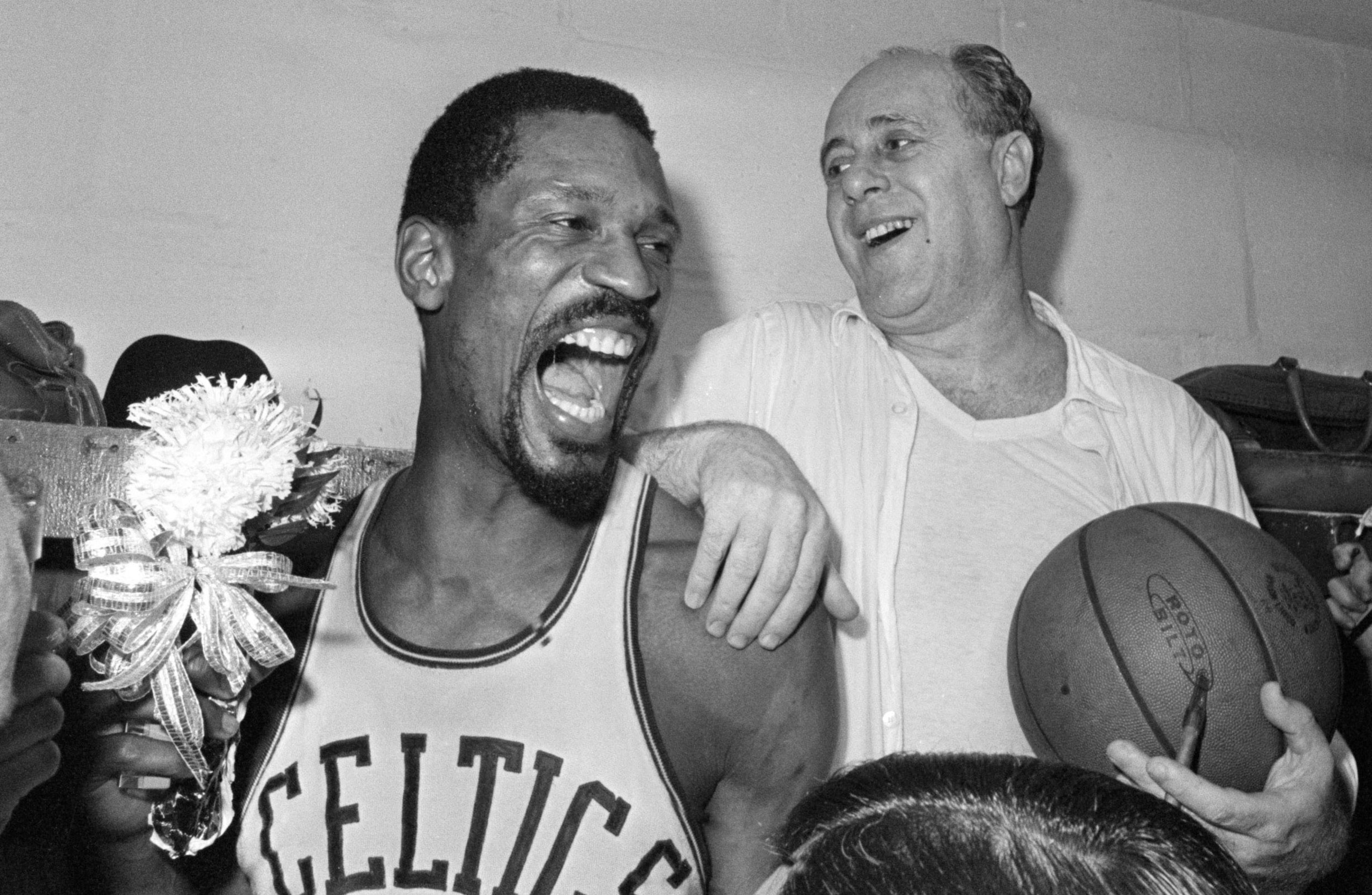
The more time that passes since Bill Russell's legendary career, the harder it becomes to correctly evaluate his achievements.
The league he dominated was smaller, composed of only eight teams for the first five years and never exceeding 14 during his career. The strategy and tone of the game were completely different. The records he amassed are almost impossible to contextualize properly. We're almost literally talking about a different sport—on the floor and in its business operations.
Free agency, for example, wouldn't resemble its current form until 1988, two decades after Russell retired. It used to be much easier for great teams to retain their great players for as long as they wanted them, and prior to the modern salary cap, there were basically no impediments to keeping one star player surrounded by others.
But then: 11 championships in 13 seasons, all for the Boston Celtics, and all with Russell as the team's most potent force.
What do we do with that? How do we compare his unprecedented dominance to players from the modern era?
Well, at least here, we don't. We're in apples-and-oranges territory.
If you think Russell was the greatest one-team player ever, you've got ample evidence to prove it. If you think the game he crushed for 13 years was just too different from the one we know today, it's hard to argue against that position.
Let's just agree that Russell was the greatest one-team player (and maybe just player, without the qualifier) of his time. There's no disputing that.
Honorable Mention
2 of 7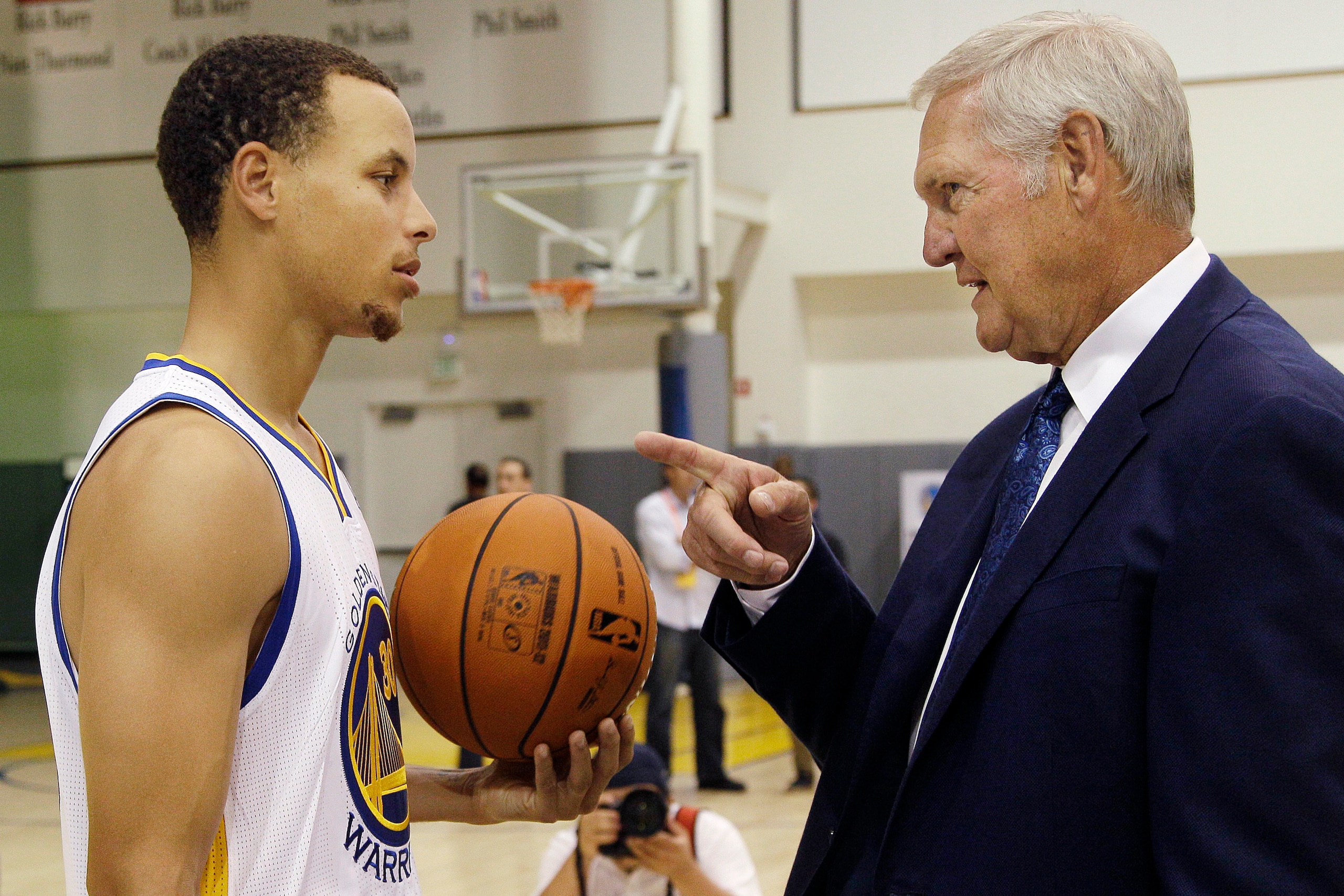
John Havlicek, Boston Celtics
Frank Ramsey deserves credit for essentially inventing the sixth-man role, but John Havlicek remains the standard against which sparkplug reserves are measured.
In 16 NBA seasons, all with the Boston Celtics, Havlicek racked up averages of 20.8 points, 6.3 rebounds and 4.8 assists, despite coming off the pine in each of his first seven seasons. He made an All-NBA team in 1963-64...as a reserve. That hadn't happened before and hasn't happened since.
Havlicek called it a career in 1978 as a 13-time All-Star, 11-time All-NBA team member, eight-time All-Defensive team member. He earned a Finals MVP award in 1974 and was a critical contributor in eight championship seasons with Boston.
He, like several others in this section (and Russell earlier), gets docked for playing during a bygone era that complicates modern comparisons. But don't worry, the Celtics will still be represented in the top five.
Isiah Thomas, Detroit Pistons
Isiah Thomas was an All-Star as a 20-year-old rookie with the Detroit Pistons and went on to earn that same distinction in each of the next 11 years. His final year in the league, 1993-94, was the only one in which he didn't make the NBA's midseason exhibition.
A back-to-back champ (Finals MVP in 1990) and a five time All-NBA performer, Thomas' grit was legendary. That toughness helped define the Bad Boys Pistons, who tussled with Magic Johnson's Lakers and toughened up a young Michael Jordan.
Stephen Curry, Golden State Warriors
There are only five one-team players with multiple titles and MVPs. Stephen Curry is far from done, but because he's already in a club that only includes Russell, Magic Johnson, Larry Bird and Tim Duncan, he's earned a spot here.
It feels like a matter of time until he displaces somebody from the top five, seeing as he triggered the league-altering three-point revolution, was the best player on a couple of the best teams of all time and presided over the most successful stretch in Golden State Warriors history.
Reggie Miller, Indiana Pacers
Reggie Miller spent 18 years with the Indiana Pacers, making five All-Star Games and three All-NBA teams. Added bonus for being a harbinger of the three-point revolution that would sweep the league nearly a decade after he retired in 2005.
If his career hadn't lined up so cleanly with Michael Jordan's, Miller might also have a championship trophy to his name.
Jerry West, Los Angeles Lakers
An All-Star in each of his 14 seasons with the Los Angeles Lakers, Jerry West won a scoring title in 1969-70, which was also the first of four straight years in which he'd make the All-Defensive first team. How's that for two-way play?
West landed on a dozen All-NBA teams, reached the Finals nine times (winning Finals MVP on a losing team in 1969) and earned a ring in 1971-72.
That's an unassailable resume, except for the fact that it covered much of the same time period as Russell's. For consistency's sake, we have to keep West out of the top five too.
Elgin Baylor, Minneapolis/Los Angeles Lakers
Elgin Baylor's career ended in 1971-72, but he's still fourth on the all-time Lakers scoring list, ahead of Magic Johnson and behind Kareem Abdul-Jabbar. The 6'5" forward played his first two seasons in Minneapolis before the franchise moved to L.A. in 1960-61, West's rookie year.
Baylor's era was one of inflated counting stats; he logged 40.0 minutes per game for his career in a faster-paced league. But career averages of 27.4 points and 13.5 rebounds are tough to ignore under any circumstances. The 1958-59 Rookie of the Year was an 11-time All-Star and had 10 All-NBA honors on his resume.
Most impressively, Baylor ranked in the top six in MVP voting eight times, including six straight from 1958-59 to 1963-64.
Julius Erving, Philadelphia 76ers
Julius Erving's five most productive seasons (and three of his MVP awards) all came in the uptempo, "defense? we don't really do defense" ABA. Fortunately, he was also good enough in his 11 NBA seasons, all with the Philadelphia 76ers, to sneak in here.
Erving was the 1980-81 MVP and led Philly to the 1982-83 title. He made the All-Star team every year of his career, redefined the game for a generation of fans with his aerial grace and still owns one of the most iconic old-school highlights in existence: a swooping (Dr. J swooped frequently) right-handed reverse from behind the backboard.
David Robinson, San Antonio Spurs
David Robinson's legacy takes an unfair hit because the franchise he played for ushered in an even more dominant big man just as the Admiral was heading out the door. But Robinson was fearsome in the 1990s from an awards standpoint and was, for my money, was one of the five best defensive players the league's ever seen.
He was Rookie of the Year in 1989-90, Defensive Player of the Year in 1991-92, won the scoring title in 1993-94 and was named MVP in 1994-95. That's quite a run.
Robinson "only" played 14 seasons with the San Antonio Spurs, a figure that falls short of almost everyone in the top five, and he was never the best player on a championship team. He's the second-best player to ever suit up for the Spurs, even if we remove the one-team requirement.
5. John Stockton, Utah Jazz
3 of 7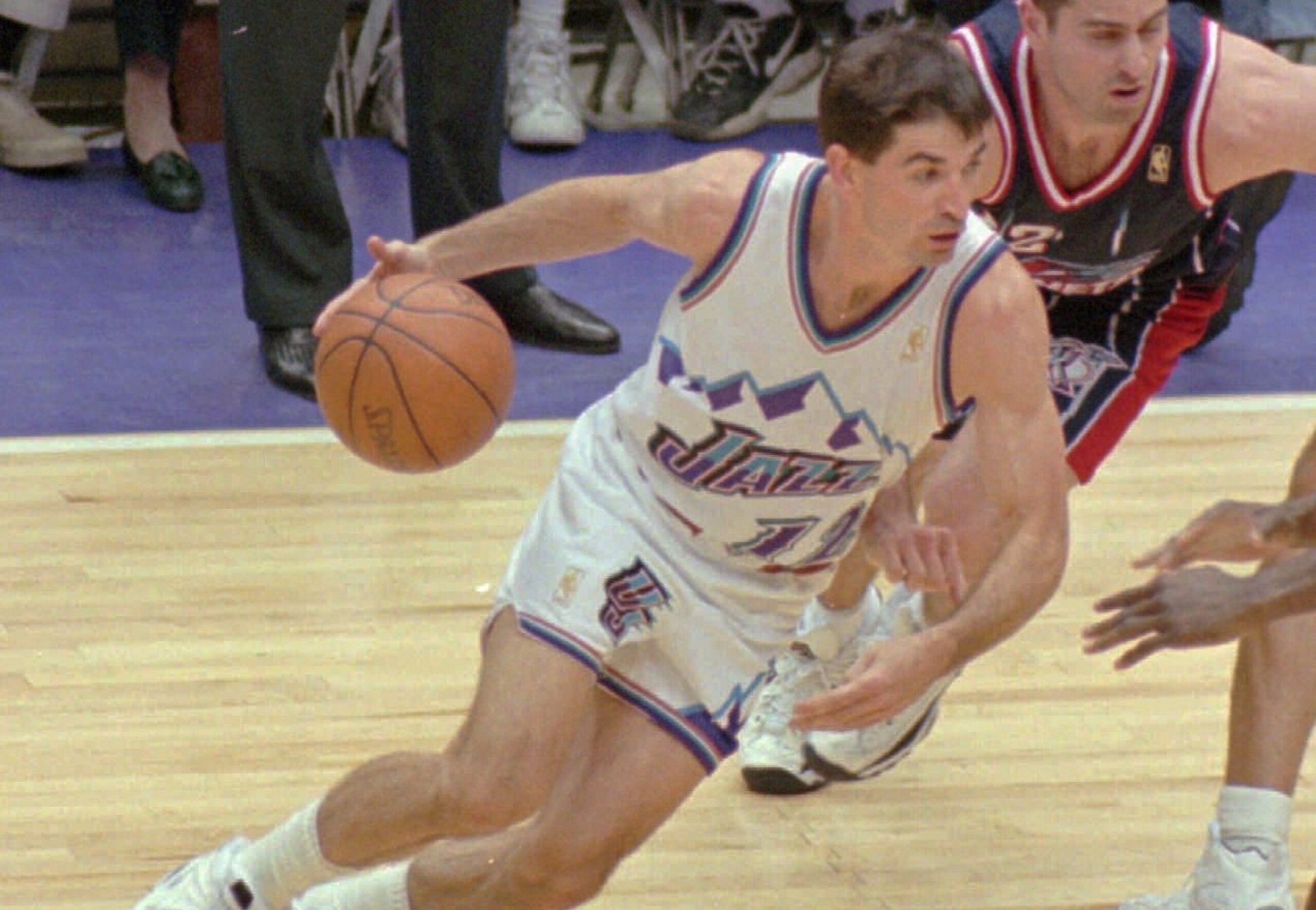
John Stockton's 207.7 career win shares are the most produced by a player who only suited up for one team. The most durable workhorse in NBA history, Stockton played all 82 games in 16 of his 19 years with the Utah Jazz, an iron-man record we'll never see broken.
Stockton is also the league's all-time leader in assists and steals, and no currently active player has a realistic shot of catching him in those categories.
An efficient scorer who shot 51.5 percent from the field for his career, Stockton also hit 38.4 percent of his threes, led the league in assists per game every year from 1987-88 to 1995-96 and, despite making five All-Defensive teams, never got his due as one of the game's most rugged (and often effectively dirty) stoppers.
From the endless reel of pick-and-roll setups to a daredevil full-court heave in the Finals, from series-clinching shots to elimination-avoiding salvation, Stockton was always there, right in the thick of his franchise's most meaningful moments. Whole chapters in the book of Jazz history belong to him.
Stockton never won a title or an MVP, and it's difficult to argue the 10-time All-Star was ever the best player on a team that also had Karl Malone. So this is as high as we can rank him in good conscience.
4. Dirk Nowitzki, Dallas Mavericks
4 of 7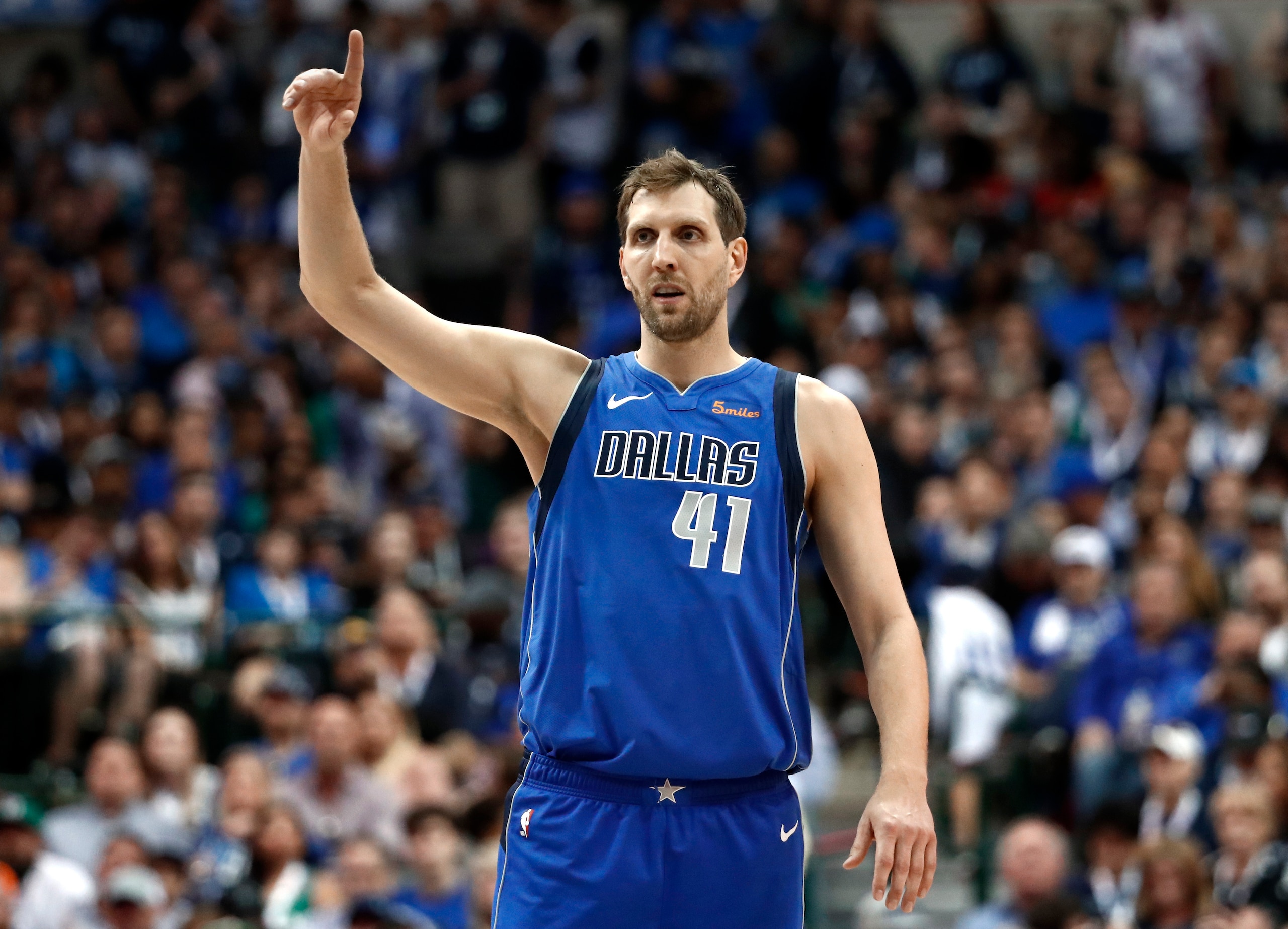
Dirk Nowitzki didn't have the absolute best one-team career in NBA history, but he had the longest one.
For 21 seasons, the greatest big-man shooter of all time suited up for the Dallas Mavericks, collecting an MVP award in 2007, reaching the Finals twice (2006 and 2011), winning a ring and racking up three seasons with at least 60 victories. During Nowitzki's highly decorated tenure from 1998-99 to 2018-19, Dallas went 987-687, good for a .590 winning percentage that ranked second in the NBA.
With 14 All-Star Games, 12 All-NBA nods (four first-team) and nine top-10 finishes in MVP voting, Nowitzki's presence all but assured a highly competitive product on the floor.
The lows were low: Steve Nash's departure, the title that got away in 2006 against the Miami Heat, the first-round exit delivered by the "We Believe" Warriors that made for an awkward MVP acceptance. But those heart-breakers only made the 2011 championship sweeter. Nowitzki's overwhelmed retreat to the showers immediately after Dallas reached the NBA mountaintop showed just how desperately the surefire Hall of Famer needed the redemption that championship delivered.
Maybe we're reading too much into things, but Nowitzki's example of consistent brilliance and loyalty might pay even longer-term dividends. Dallas' first season without Dirk was also its first with Luka Doncic playing at an MVP level. If the franchise's newest European cornerstone draws from his predecessor's commitment to a single franchise, the Mavs should be set for another two-decade stretch of excellence.
Nowitzki is the most iconic player in Mavs history, and it's not close.
This is how you get governor Mark Cuban to choke up during your retirement ceremony—while promising you a job for life, a retired jersey and the "biggest, most bad-ass statue ever...right in front of the arena."
3. Magic Johnson, Los Angeles Lakers, and Larry Bird, Boston Celtics
5 of 7
These two league-altering figures spent their entire careers linked as competitors, and a long list of parallels makes separating them feel wrong.
We're going with a tie.
Magic Johnson and Larry Bird both played 13 seasons, making the All-Star Game a matching 12 times. Their 10 All-NBA honors also line up, right down to an equal nine first-team spots. Each won three MVP awards.
Johnson has five rings to Bird's three and made nine Finals to Bird's five, but Bird made three All-Defensive teams, finishing his career with major edges in rebounds (8,974 to 6,559) and blocks (755 to 374). Magic never made an All-Defensive team. Bird was also the superior scorer, logging over 4,000 more career points than Johnson.
We should all be comfortable calling this comparison a wash.
As you'd expect for such an unbreakably connected pair, both players' historical standing suffers from a shared affliction. The Lakers and Celtics' pasts are so littered with iconic talents that, for many fans, neither Magic nor Bird have unanimous approval as the greatest players in their respective franchise's histories.
Johnson was preceded by the likes of Jerry West, Elgin Baylor and Kareem Abdul-Jabbar—and then followed by Kobe Bryant and Shaquille O'Neal. Bird's predecessors included Bill Russell and John Havlicek. Kevin Garnett and Paul Pierce returned the franchise to glory in the 2000s, and now there's a whole new contending core led by Jayson Tatum and Jaylen Brown.
Most of those players don't meet the one-team prerequisite to earn a spot in these rankings. But if part of the criteria for this exercise is being something of a symbol for an entire franchise, Magic and Bird have more competition than anyone else because of the success their teams enjoyed before and after their careers.
Though they didn't last as long with their teams as John Stockton or Dirk Nowitzki, Magic and Bird shone brighter than both in their primes. Add to that their superior championship and MVP clout, and there's no way to keep either out of the top three.
2. Kobe Bryant, Los Angeles Lakers
6 of 7
In a comparison pitting nothing but all-time greats against one another, you've got to search for any separators you can find. Kobe Bryant distinguishes himself by claiming status as an indispensable part of two completely different multi-title cores.
He and Shaquille O'Neal strung three consecutive championships together from 1999-00 to 2001-02, and then Bryant teamed with Pau Gasol (Lamar Odom and Andrew Bynum also helped) to collect back-to-back rings in 2009 and 2010. Derek Fisher was with Kobe for all five of those rings, but he was a low-end starting role player. Bryant was the most meaningful constant on two championship dynasties a decade apart.
Karl Malone tops Bryant in total points scored for one franchise, as his 36,374 points with the Utah Jazz exceeds Bryant's 33,643. But Malone spent his last year with Bryant and that weird Frankenstein's monster of a 2003-04 Lakers squad. If we narrow the parameters in search of the player who scored the most points for a franchise without ever playing for another, Kobe sits atop that heap.
Bryant won two scoring titles, an MVP and five championships. He piled up 18 All-Star seasons, hoisted two Finals MVPs and was a 15-time All-NBA selection. All of those exceed the totals John Stockton and Dirk Nowitzki produced, giving Bryant the edge despite fewer career win shares than either of them.
The Kobe-Shaq feud probably cost Los Angeles another couple of rings, and Bryant's farewell tour with the franchise may have set its rebuild back by several years. Don't forget the trade demand in 2007 that could have sent Bryant to the Cleveland Cavaliers. He also nearly became a member of the Detroit Pistons in that same offseason, and we can't overlook the two occasions on which Kobe was close to joining the Chicago Bulls.
Though Kobe came perilously close to leaving more than once, he never did. That's why he's widely regarded as the greatest player in franchise history—no small feat given the litany of icons in Lakers lore.
1. Tim Duncan, San Antonio Spurs
7 of 7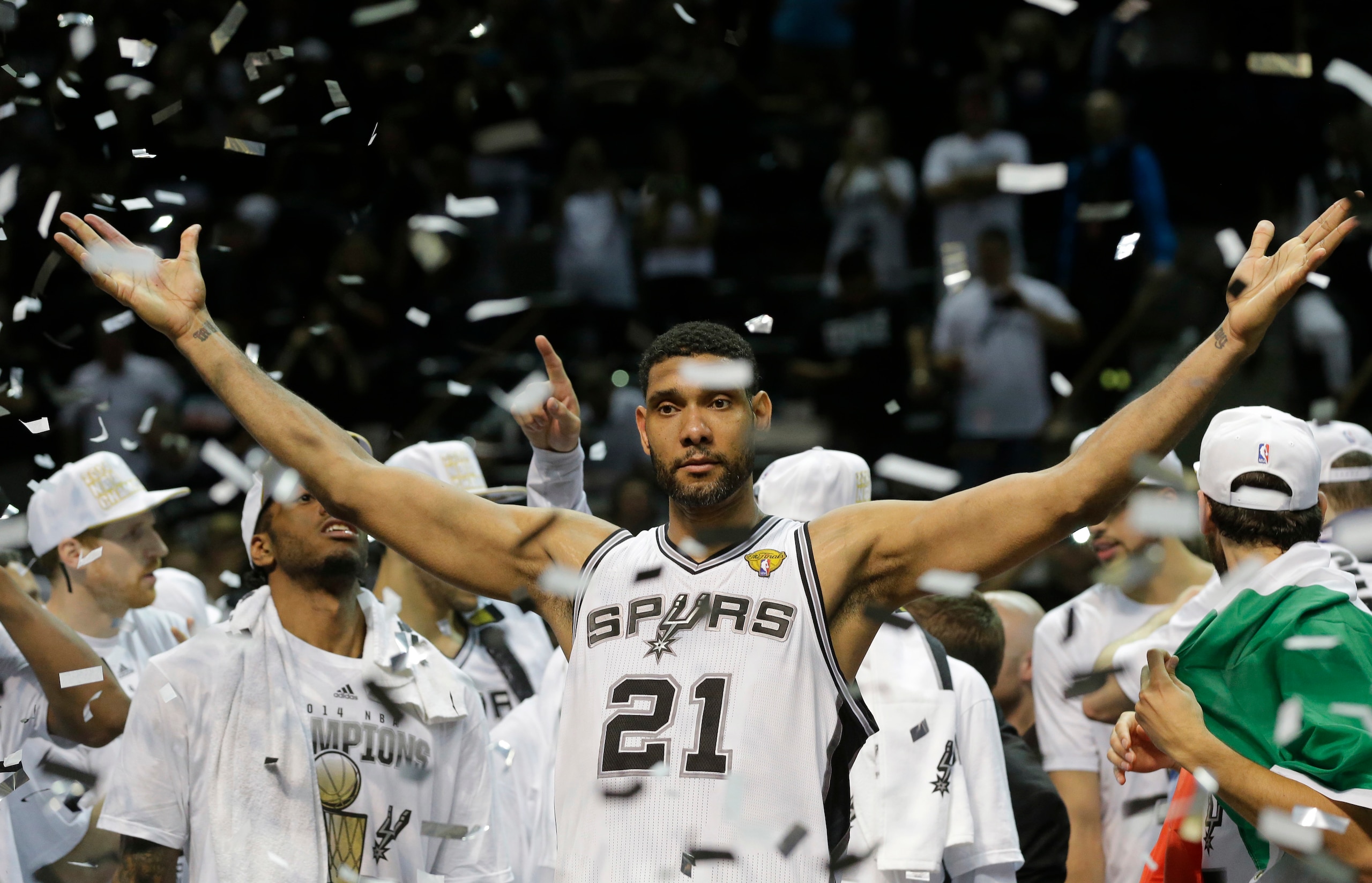
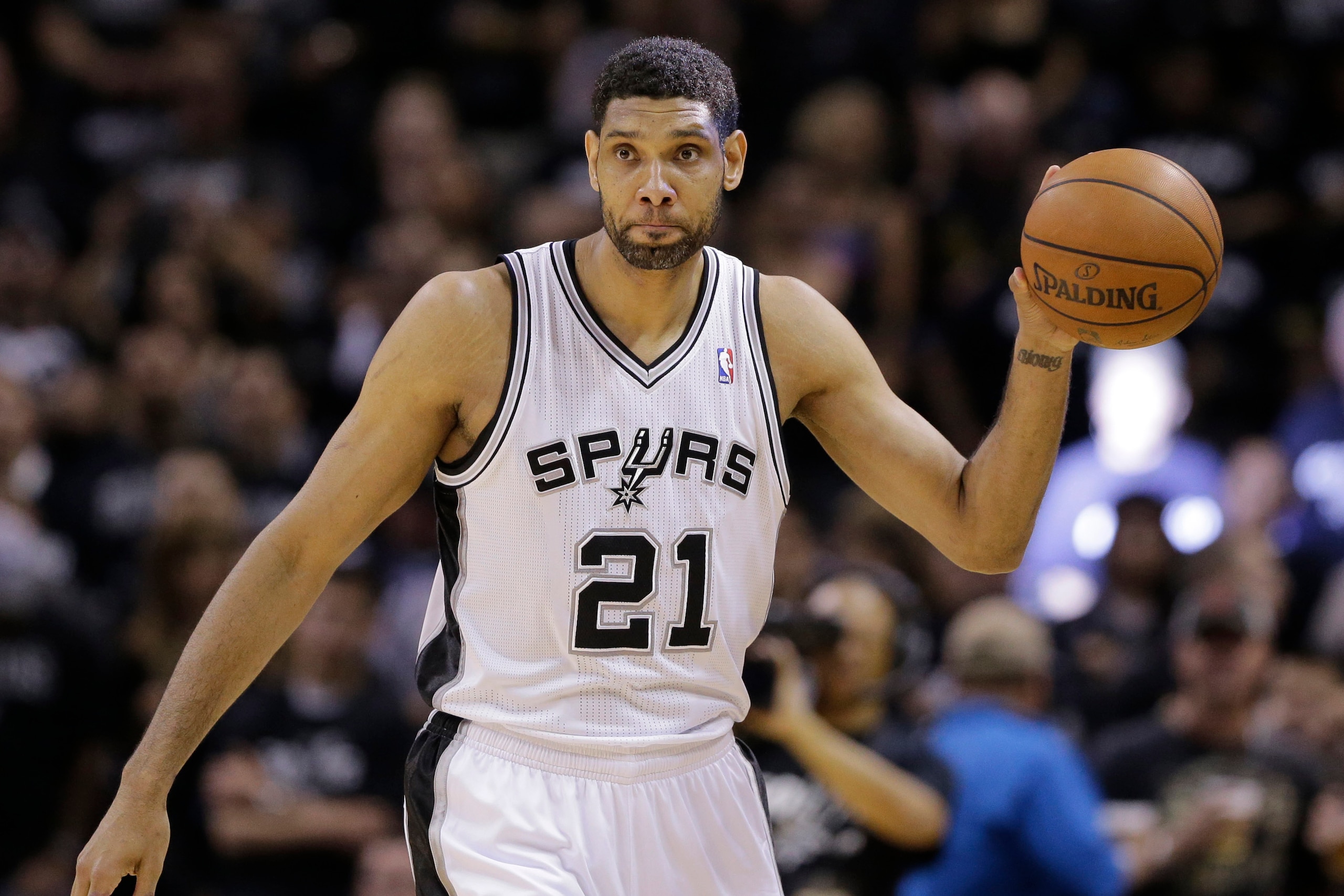
Whether you're focused on individual awards, team success, advanced stats or any other set of criteria, Tim Duncan has the top spot locked down.
In 19 seasons with the San Antonio Spurs, Duncan won Rookie of the Year, two MVPs, three Finals MVPs and made the All-NBA team 15 times, including 10 first-team nods. He's the all-time record-holder with 15 All-Defensive honors (yet inexplicably was never DPOY), and his 206.4 career win shares trail only John Stockton among one-team players.
He's the only one-team player in league history to hit for a specific career-success cycle: drafted first overall, win Rookie of the Year, win an MVP and win a Finals MVP. That's start-to-finish, top-to-bottom excellence no one else can match.
No one from the modern era produced wins more regularly than Duncan, whose Spurs teams hoarded five titles and made the playoffs every year of his career. He and head coach Gregg Popovich were the only constants during that remarkable run.
Timmy has an advantage of one kind or another over everyone else on the list: more rings and MVPs than Dirk Nowitzki and Stockton. More seasons than Larry Bird and Magic Johnson. Better advanced stats, more Finals MVPs and more consistent, hassle-free success than Kobe Bryant.
Sorry if this feels like a boring conclusion. But that's just how Duncan, the steadiest, most unassuming superstar we've ever seen, likes it.
Stats courtesy of NBA.com, Basketball Reference and Cleaning the Glass.

.jpg?w=2560 "Viral Dan Campbell Presser 💙")
.jpg?w=2560 "AD Trolls Bears WR on IG 😂")
.jpg?w=2560 "Cam Ward Says He's Not A Loser")
.jpg?w=2560 "Chargers Fall to 0-5 🤢")
.jpg?w=2560 "Report: Steelers WR to Miss 'Weeks'")