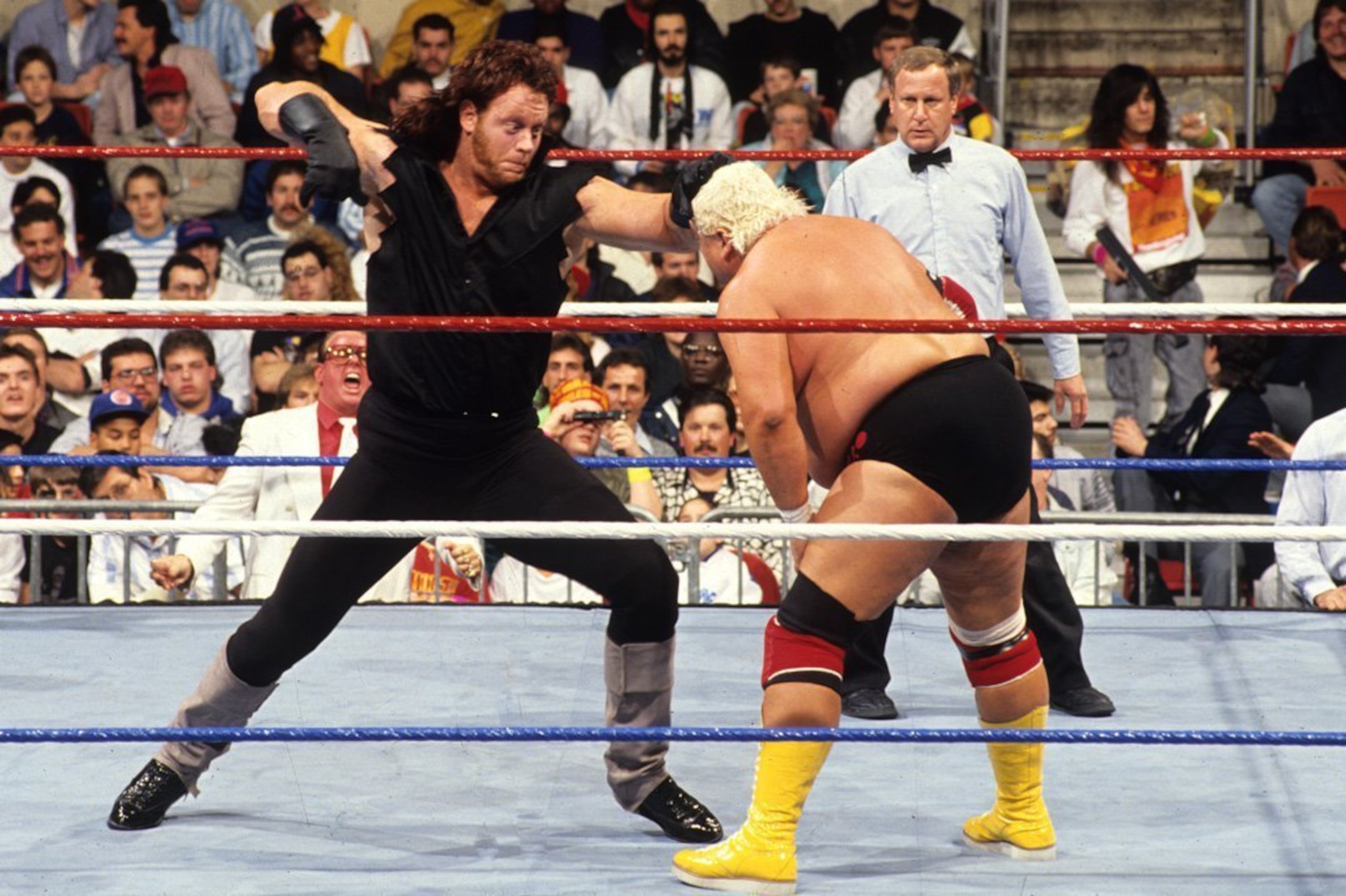

Power Ranking the Best WCW Wrestlers Vince McMahon Made into WWE Superstars
Wrestling history tells us that Vince McMahon withstood the early onslaught of Eric Bischoff and WCW to win the Monday Night War to put an end to Ted Turner's foray into the industry by using an array of talented individuals once cast off by the opposition.
Some were talented midcarders who had hit their ceilings; others were lucky to even be considered that, left to wallow in mediocrity in opening match slots.
The most successful ones seized opportunities in McMahon's company, embracing gimmicks and showcasing their skills in high-profile positions that were rarely presented elsewhere. Their open-mindedness, unquenchable thirst for greatness and willingness to take chances earned many of them recognition in the WWE Hall of Fame, and others have spots waiting for them when they are ready to hang up their boots.
These are just a few examples of McMahon taking WCW's scraps, recognizing their talent and making the most of them.
But 1st, the Ones He Didn't...
1 of 11To do a detailed rundown of the wrestlers McMahon turned into legitimate stars in WWE would be to tell a one-sided story of unparalleled genius. That would be unfair and inaccurate.
Be it his unwillingness to push certain stars, backstage politics or ignorance when it came to presenting them as main event attractions, there were a few stars who had it far better in WCW than they ever did in McMahon's traveling circus of sports entertainment.
"Ravishing" Rick Rude
In WWE, Rude was a fantastic heel with the potential to be a top-tier talent. His run as intercontinental champion allowed him to find his feet in the larger-than-life promotion, while matches with "Rowdy" Roddy Piper and The Ultimate Warrior proved he could hang with main eventers.
But he was never allowed to be one himself.
No matter how good he was or how many tests he passed, he was still relegated to midcard status. Frustrated, he left the company in 1990 and made his way to WCW, where he became a main event star and the heel around whom the entire upper card revolved around.
WCW understood his value, recognized his talent and made him a three-time WCW international heavyweight champion. It was a level McMahon never felt comfortable enough to push Rude to.
Big Van Vader
A cocktail of poor booking, Shawn Michaels' unwillingness to put him over and his own outburst in Kuwait doomed Vader to failure in WWE.
Sure, he challenged Michaels, Undertaker and Bret Hart for the WWE Championship and could have beaten any of them to win it at any time, but there was always a sense that McMahon and Co. were never sold on the idea of the big man being the face of the company.
After a blockbuster first six months, he faded into the background and, within two years, wrapped up his underwhelming run, leaving fans to ask what went wrong.
A former three-time WCW and IWGP heavyweight champion, as well as one of the best big men to ever lace a a pair of boots, he should have found similar success in WWE.
Diamond Dallas Page
To McMahon, Diamond Dallas Page was the perfect candidate for mystery stalker of The Undertaker's then-wife, Sara, and later a motivational speaker with perfect teeth.
In WCW, he was The People's Champion and unlikely world title victor. A hard worker who clawed and scratched his way to the top, he overcame a late start in the industry and the perceived nepotism of being close friends with Eric Bischoff to become one of the biggest stars of the Monday Night War.
For whatever reason, McMahon was never able to recognize what made Page a star, and the result was an embarrassingly ugly reign that Page had earned much better than.
Jeff Jarrett
In WWE, Jeff Jarrett was a good hand and in-ring competitor trusted to hold down the midcard. Backstage tension with Steve Austin prevented him from ever sniffing the main event, and his friendship with writer Vince Russo led to his departure in 1999.
With Russo behind him and a necessary need for fresh main event stars atop WCW, Jarrett achieved unprecedented success. He was the top heel in wrestling's No. 2 promotion and the competitor around whom entire episodes of Nitro and Thunder were built.
From October 1999 through the company's demise on March 26, 2001, Jarrett was a top star and main event talent, the likes of which he was never allowed to become during his time in McMahonland.
10. Rey Mysterio
2 of 11Rey Mysterio was known to a worldwide audience because of the opportunity WCW gave him as one of the cornerstones of the cruiserweight division.
The young luchador stole the show against the likes of Dean Malenko, Juventud Guerrera, Eddie Guerrero and Psychosis while introducing a new style to the largest viewing audience he had ever competed in front of. His in-ring style had a captivating charisma and made him one of the early breakout stars of the Monday Night War.
Unfortunately, WCW never knew how to capitalize on that.
Instead of pushing Mysterio as an underdog and making the most of his popularity, the company teased a push here or there, only to revert back to using him in the same spot it had since his arrival in the company in 1996.
There was a flirtation with a significant spot on the show when Russo arrived in 1999, but it ended up with the same result.
Fast forward to 2002 and Mysterio's arrival in WWE.
Right out of the gate, he was treated like a big deal, with video teasers airing ahead of his debut. From there, he was positioned as the biggest little man in the company, an inspirational underdog fans champed at the bit to get behind.
In 2006, he captured the world title in the most unlikely WrestleMania victory in years.
Mysterio's WWE run was full of ups and downs, but it was with McMahon's company that he firmly established himself as one of the greatest of all time and a genuine Hall of Famer.
9. Big Show (The Giant)
3 of 11WCW had a gold mine on its hands in the form of The Giant, but its failure to push him beyond the role of the latest massive heel for Hulk Hogan to topple pigeonholed him, and politics left him stranded as a midard star who should have been collecting world titles and touring the world as the company's greatest attraction.
It is no surprise that when WWE and McMahon came calling early in 1999, ready to back up the Brink's truck and unload a small fortune at his feet, Paul Wight was eager to accept.
Though his career in WWE has been full of inconsistent booking and enough heel turns to last 12 Superstars' careers, Wight became an international star with the company. He captured world titles, headlined major events and was the top draw at WrestleMania XXIV, when he battled undefeated boxer, Floyd Mayweather Jr., in the night's marquee match.
As The Big Show, he went on to become a household name, enjoying acting opportunities and stealing the show during The Rock's first stint as guest host of Saturday Night Live.
McMahon discovered Big Show's personality and, for better or worse, exploited it for the masses to enjoy. In the process, he solidified the giant's status as the best and most influential big man since Andre.

8. Eddie Guerrero
4 of 11Eddie Guerrero is one of the most beloved Superstars in WWE history.
A virtuoso performer who could blend unrivaled intensity with second-to-none comedic timing, he captivated fans around the globe en route to the most unlikely WWE Championship victory of all time at No Way Out in February 2004, when he defeated Brock Lesnar.
That victory, along with the unlimited number of matches and moments created by Latino Heat in WWE, never would have happened had he stayed in WCW.
Guerrero was every bit as good there as he was in WWE, stealing the show on a nightly basis against everyone from Alex Wright to Chris Jericho, but backstage politicking kept fresh faces down and his size (or lack thereof) was used against him when arguing for an opportunity.
WCW did not know what to do with Guerrero beyond a certain point or how to get the most out of him because it simply was not interested. He was not Hulk Hogan, the NWO, Lex Luger or Sting. He was a bit player, an excellent one, but there was an impenetrable glass ceiling he was never going to break through.
Thankfully for him, he took the first opportunity to escape, opened himself up and let his larger-than-life personality shine in WWE, where he became a Hall of Famer shortly after his death on November 13, 2005.
7. Chris Jericho
5 of 11Chris Jericho was ready to be a main event star by the time he started calling out Goldberg in the fall of 1998. It was in WCW that he had found himself as an entertaining heel with enough laugh-out-loud moments to win over even the most stoic fans.
His rivalry with Dean Malenko over the cruiserweight title solidified his status as one of the bright young stars in the industry, while his feud with Goldberg, which saw him wander around the arena in a moment right out of This is Spinal Tap, left fans wondering whether the company would pull the proverbial trigger on Jericho and give us all a new main event face.
It did not.
Goldberg had no interest in working with Jericho, and soon, all of the work he did to set up the feud was erased with one massive spear from the world champion. His opportunity dashed and creative frustration setting in, it is no surprise that Jericho jumped at the opportunity to sign with WWE.
Though his first few months in McMahonland were bumpy, to say the least, he was able to establish the Y2J character and engage the likes of Chyna, Kurt Angle and Chris Benoit in midcard rivalries that introduced him and his personality to the fans.
Within two years of his debut, Jericho defeated The Rock and "Stone Cold" Steve Austin on the same night to become the first WWE undisputed champion. In one night in WWE, he accomplished more than he did during his entire run in WCW, and a large part of that can be chalked up to McMahon understanding how to best utilize Jericho to get him perpetually over with audiences.
Jericho would go on to have six world title reigns, set the record for most intercontinental title reigns (nine) and main-event WrestleMania X-8. In 2019, the star power he attained in WWE allowed him to join upstart promotion All Elite Wrestling as its biggest attraction.
He became that company's first world champion.
All of which never would have happened had he stayed within the creative prison that was WCW.
6. Razor Ramon (The Diamond Studd)
6 of 11In WCW, The Diamond Studd was a glorified enhancement star managed by Diamond Dallas Page. He was going nowhere fast, and the lure of stardom in WWE led to his departure from the company in 1992.
Enter Razor Ramon, a charismatic heel oozing machismo who immediately leaped into the main event scene by way of his association with Ric Flair and Mr. Perfect. Ramon battled the likes of the latter and "Macho Man" Randy Savage early on before a babyface turn in 1993 led to his first Intercontinental Championship reign.
A legendary ladder match with Shawn Michaels and status as one of the greatest IC champions to ever lace a pair of boots followed.
Ramon would be one of the marquee stars for WWE for four years, competing against every major star the industry had to offer and enhancing his star to the point that Bischoff and WCW came calling once again.
In 1996, Ramon left WWE for the unlimited dollars of WCW, where he became the first Outsider to make an impact. His promo on the Memorial Day episode of Nitro jumpstarted the New World Order angle that would elevate WCW past WWE in the Monday Night War.
While he would become one of the faces of WCW's 83-week dominance in the ratings battle with McMahon, none of it would have been possible without Vince taking the scrap that was The Diamond Studd, fine-tuning it and turning it into a star Bischoff would even find desirable in the first place.
5. Diesel (Vinnie Vegas)
7 of 11Oz.
Vinnie Vegas.
Kevin Nash's introduction to a worldwide audience via his WCW run was anything but inspiring. The 7'0" former basketball player had the look and size to be a star but was so horribly mismanaged by the company's brain trust creatively that he was dead in the water by the time WWE and McMahon came calling in 1993 at the behest of Shawn Michaels.
Nash made the jump and was immediately paired with Michaels as Diesel, an imposing bodyguard who wasted no opportunity to interject himself into the Heartbreak Kid's matches. When Diesel went on a reign of dominance in the following year's Royal Rumble match, though, McMahon saw dollar signs and pushed him to the moon.
In the span of 11 months, Nash became a Triple Crown champion, winning the Intercontinental, Tag Team and WWE Championships to firmly establish himself as the face of the company's New Generation initiative. For one year, he towered over the company as its world champion, and while ratings and business were at all-time lows, there was no denying McMahon made Nash a star the likes of which WCW could never have imagined.
Enter Eric Bischoff.
Bischoff, much like he did Razor Ramon, offered Nash a guaranteed contract worth more money (and fewer dates) than McMahon could feasibly offer, and the big man accepted. Also like Ramon, it never would have happened had McMahon not have been able to realize Nash's potential and transform him from the cartoonish Vegas and the absurd Oz into a legitimate world champion in Diesel.
4. Mick Foley (Cactus Jack)
8 of 11Mick Foley is an interesting case because he had opportunities to headline pay-per-views and fight for world titles during his time in WCW. As Cactus Jack, he waged war with Sting in a memorable Falls Count Anywhere match and wrestled Big Van Vader in a series of heavyweight championship matches that left both men battered, brutalized and Foley missing an ear.
Issues with booking and distrust for the creative team, headed by Ric Flair, led Foley to seek an opportunity elsewhere. First, he went to ECW and captured the attention of the wrestling world with a series of anti-hardcore promos that remain some of the best interview spots in wrestling history.
Then, in 1996, he signed with WWE and debuted as Mankind. A deranged, psychotic competitor whose motives were not always immediately clear, he attacked The Undertaker on his first night and engaged in a rivalry that ranks as one of the best in the long and illustrious history of McMahon's company.
Six months into his run, he was headlining pay-per-views against Shawn Michaels for the WWE Championship. Within three years, he would win his first world title as the lovable underdog character.
Over the course of his WWE run, Foley portrayed four characters: Mankind, Cactus Jack, Dude Love and himself. Every one made an unbreakable connection with audiences, allowing him to remain a bona fire main event star and one of the most popular performers of the Attitude Era.
Not to mention a No. 1 bestselling author, Chef Boyardee commercial actor and crossover star.
He entered WWE's Hall of Fame in 2013 in Madison Square Garden, the same arena in which he once watched Jimmy Snuka dive off a steel cage on to Don Muraco, sparking his desire to become a professional wrestler.
It was a fitting moment for a star WCW inexplicably let get away and whom McMahon made into the most unlikely face of a franchise ever.
3. Triple H (Jean-Paul Levesque)
9 of 11Jean-Paul Levesque never had the opportunity to become a star in WCW because the man behind the character never intended to be a part of that company's roster for very long.
Seeing it as an opportunity to get exposure, he competed on WCW Saturday Night as the protege of Lord Steven Regal for the better part of a year before departing for WWE in 1995, recognizing that McMahon would know what to do with someone of his talent more than Bischoff or anyone in WCW.
Now dubbed Hunter Hearst Helmsley but still playing the aristocrat character, he became one of the more promising young stars in the company. Behind the scene, he became part of a The Kliq, a legendary backstage group of friends who politicked for each other and travelled together.
His career in WWE almost came to an end in May 1996, when he partook in the infamous Curtain Call, during which he, Razor Ramon, Diesel and Shawn Michaels embraced in front of the fans in Madison Square Garden, breaking kayfabe in a moment considered disrespectful by the old-timers who worked for McMahon.
For the better part of a year, Helmsley was jobbed out and beaten down, left to atone for the sins of the group. He did and, in the process, earned McMahon's respect. From there, he gradually made his way up the rankings.
He won the Intercontinental Championship, became Michaels' right-hand man in D-Generation X and in August 1999 finally captured the WWE Championship as McMahon prepared to push him to the moon. He became the first heel to leave WrestleMania with the gold in 2000, transformed into the greatest bad guy of his generation and was the character around whom entire shows were built.
Ignoring his relationship with Stephanie McMahon and his backstage political pull, there is no denying that Triple H worked hard for and earned his opportunity to become the face of WWE during the trying period that was the Ruthless Aggression Era.
Today, he is the executive vice president of global talent strategy and development, next in line to oversee the daily operations of WWE when McMahon steps away.
That is quite the trade-up from undercarder Levesque in WCW.
2. The Undertaker ('Mean' Mark Callous)
10 of 11"Mean" Mark Callous was a solid big man with quality wins over Brian Pillman and The Road Warriors and a fantastic manager in Paul Heyman, but he was going nowhere with his uninteresting and one-dimensional character.
With opportunities drying up in the unstable creative environment created by WCW, the surprisingly quick and agile heavyweight took his talents elsewhere, debuting at the 1990 Survivor Series as The Undertaker.
At a time when WWE had become gimmick-heavy, the idea of a wrestling mortician looked and felt like another addition to the scrap heap of bad ideas concocted by noted wrestling genius McMahon. The difference? Mark Calaway, the man behind the dark and eerie persona.
Whereas others never fully embraced their characters, he did. He became The Undertaker, adding the slow and stalking march to the ring, the facial expressions and body language that captivated the audience. It was clear early on that he understood McMahon's vision, accepted it and sought to make it his own.
The result was the greatest gimmick in WWE history.
Over the course of his 30 years with the company, Undertaker has captured the WWE Championship from the likes of Hulk Hogan, Sycho Sid, Steve Austin and Edge. Three of them are Hall of Famers, and the fourth should be.
He has headlined WrestleManias, delivered one of the greatest matches of all time against Shawn Michaels and worked with every name of any value to ever lace a pair of boots.
Undertaker is the guardian of WWE, the measuring stick against whom all performers of any kind of star are tested. The last great outlaw in an industry devoid of them, he is a throwback to a bygone era.
Had it not been for the top-ranked Superstar on this list, he would be the greatest WCW star to ever get away.
1. 'Stone Cold' Steve Austin ('Stunning' Steve Austin)
11 of 11"Stunning" Steve Austin was a damn good hand for WCW.
A solid technician with obvious charisma, he was trusted by those in power to hold down the midcard as either the United States or TV champion. He even formed a tag team with Brian Pillman from out of nowhere that the two of them turned into the critically acclaimed Hollywood Blondes duo.
That could have propelled Austin to stardom, but creative inconsistency led to its premature demise and Austin was left to wallow in the same midcard abyss he had called home earlier in his run with the promotion.
By 1995, Hulk Hogan had a stranglehold on the creative team and had brought with him the washed-up stars of yesteryear, essentially phasing out the likes of Austin, Dustin Rhodes and Marc Mero, all of whom had been pillars of WCW's attempts at a youth movement.
Austin found himself out of job in 1995, and after a short-yet-phenomenal run in Paul Heyman's ECW that showcased his ability to talk and voice his frustrations, he signed with WWE.
The Ringmaster gimmick was a dud, for sure, but his in-ring work caught the attention of Bret Hart, who requested the opportunity to work with Austin at Survivor Series 1996. That match, and the feud it spawned, launched Austin into the main event stratosphere.
As Stone Cold, he touted the gospel of Austin 3:16, which stated, "I just whooped your ass." He became a juggernaut for the company, causing merchandise to sell at an incredible rate and bringing a much-needed attitude to the product.
At WrestleMania 13, he and Hart executed a flawless double turn. And the rest, as they say, is history.
Austin captured the WWE title at the following year's Showcase of the Immortals and went on a run that altered the course of wrestling history forever. The biggest star of all time, he flipped tradition the bird as the franchise player of the Attitude Era.
He led WWE past WCW in the Monday Night War and ensured McMahon's sports-entertainment empire kept its head above water. He took wrestling to heights it had never before experienced and did so by being himself. He wore black boots and tights and was unapologetically confident.
His BMF walk, his head shaking and verbal assaults were as much apart of his act as anything else, and the fans ate it up.
A "good hand" in WCW became the most profitable star in wrestling history, and McMahon again proved he could take another promoter's scraps and make them into household names.
.jpg?w=2560 "AD Trolls Bears WR on IG 😂")
.jpg?w=2560 "Viral Dan Campbell Presser 💙")
.jpg?w=2560 "Report: Steelers WR to Miss 'Weeks'")
.jpg?w=2560 "Buzz: MHJ Hired Agents for Trade")
.jpg?w=2560 "Cam Ward Says He's Not A Loser")


.jpg?w=2560 "Chargers Fall to 0-5 🤢")