

The 2010s were packed with memorable NBA moments. When you look back, it's hard to fathom how they all happened in just one decade.
The LeBron James-led Heatles, Dirk Nowitzki's 2011 run for the ages, Linsanity, the San Antonio Spurs' revenge tour, the Golden State Warriors' half-decade dynasty, LeBron ending the Cleveland Cavaliers' championship drought, Kawhi Leonard and Kyle Lowry doing the same for the Toronto Raptors and more have all happened since 2010.
All of them are key moments NBA fans and analysts seem to gravitate toward. Oftentimes, though, a less-heralded domino fell and led to them.
This is an ode to the moments that led to the moments. In other words, we're looking at the moments that are otherwise underappreciated despite being crucial to the ones that garner more attention.
Sasha Vujacic Seals the 2010 Finals
1 of 10
When most people talk about the Los Angeles Lakers' 2010 Finals victory over the Boston Celtics, they rightfully focus on Kobe Bryant's will to win and ability to contribute despite an off shooting night.
In Game 7, Kobe went 6-of-24 from the field, but he grabbed 15 rebounds and dished a critical assist to Metta World Peace that put L.A. up 79-73 with just over a minute left in the fourth quarter. As World Peace said in the postgame press conference:
"And he passed me the ball. He never passes me the ball. And he passed me the ball! Kobe passed me the ball. And I shot a three. And Phil [Jackson] didn't want me to shoot the three. I heard him because he's the Zen Master, so he can speak to you without. ... He can speak to you, and he don't need a microphone. He just, you can hear him, in your head. 'Ron, don't shoot, don't shoot.' I said, 'Whatever. Pow! Three!'"
But again, that memorable moment happened with 1:01 left on the clock, and the Celtics hit two threes of their own after that. Ray Allen almost immediately answered World Peace's, then Rajon Rondo canned one with under 20 seconds to go.
The game ultimately came down to Sasha Vujacic. Yes, Sasha Vujacic.
With 11.7 seconds left, Allen fouled Vujacic with the Lakers up 81-79. If he'd missed both free throws, the Celtics would've had plenty of time to tie or take the lead. Even if he'd made one of two, another three from Boston would've sent the game to overtime.
But Vujacic warded off both potential scenarios by calmly sinking both freebies and icing the game. He played a total of 4:41 in that contest. He went 0-of-2 from the field but managed to sink his only two free throws without the benefit of the game getting him in rhythm and with the weight of a Finals Game 7 bearing down on him.
2011 Mavericks Effectively End the Kobe-and-Pau Lakers
2 of 10
Fresh off the Los Angeles Lakers' second consecutive title, a panel of 13 experts were asked by ESPN whether Kobe would notch his second three-peat. Eleven responded affirmatively.
"Yes," Dave McMenamin wrote. "Too deep. Too experienced. Too driven. Too well-coached. Too talented. Too long. Too much Mamba and Pau and Ron and the rest. Two titles in a row become three."
After a 57-25 regular season in which Lamar Odom won Sixth Man of the Year and a 4-2 series win over Chris Paul's New Orleans Hornets in the first round of the playoffs, those prognostications were looking decent. Then, the Lakers faced Dirk Nowitzki and the Dallas Mavericks.
ESPN convened another panel of experts. All 14 understandably picked the Lakers to win the series. L.A. entered the season with the second-best title odds. Dallas was seventh.
When the teams actually met, the Mavericks were a basketball buzzsaw, overwhelming the Lakers in a four-game sweep that ended with a 36-point beatdown. That game, Jason Terry and Peja Stojakovic combined to shoot an eye-popping 15-of-16 from three.
The rout caused a level frustration that led to what is perhaps the lasting image of the series: Lakers center Andrew Bynum blatantly elbowing J.J. Barea out of midair in the fourth quarter.
"That's one of the biggest bush-league things I've ever seen," play-by-play commentator Mike Tirico said. "That is terrible."
Bynum was suspended for the first four games of the next season, and that era of Lakers basketball was essentially over. They won another Pacific Division title in 2011-12, but the luster had worn off, and LeBron James' Miami Heat were ascending.
Generally, when we think back on the 2010-11 Mavericks, their triumph over Miami is the first thing that comes to mind. And that makes sense. But dismantling a team as good as the Kobe-and-Pau-era Lakers was a pretty clear sign this team was on the way to greatness, and that series deserves a little more attention.
Warriors Waive Jeremy Lin
3 of 10
Jeremy Lin appeared in 29 games for the 2010-11 Golden State Warriors, who finished that season at 36-46 under head coach Keith Smart.
He was second to Stephen Curry among Warriors in box plus/minus that season. Sure, it was in a limited sample, but any rookie (especially an undrafted rookie) being positive in that metric is rare.
Despite the promising signs, including 18.0 points, 5.8 rebounds, 4.4 assists and 2.1 steals per game in the G League that season, Lin didn't log a single minute with Golden State in 2011-12. In fact, the Warriors released him in December 2011.
Three days later, Lin signed with the Houston Rockets, who also opted not to play the guard. On Dec. 27, the New York Knicks swooped in. The rest is, as they say, Linsanity.
After playing sparingly for just over a month, Lin was suddenly thrust into a prominent role on Feb. 4, 2012. Over the next 10 games, he averaged 24.6 points, 9.2 assists, 4.1 rebounds and 2.4 steals in the run-and-gun style of head coach Mike D'Antoni.
Shortly after a 38-point performance from Lin in a win over the Lakers, Knicks superfan Spike Lee texted the Warriors' new head coach, Mark Jackson.
"I got a text message from Spike Lee this morning," Jackson said (h/t Yahoo Sports' Kelly Dwyer). "I had nothing to do with Jeremy Lin. I never saw him do a layup. So for the people … stop asking me. He never practiced for us so leave me out of it."
Whoever made the call to keep Lin out of the rotation in 2011-12 and eventually cut him probably deserves more from the Knicks than a text from Spike. Perhaps a bouquet, some chocolates or a thank-you card would do.
New York's NBA fans haven't had a ton to cheer about over the last 20 years, but Linsanity was a bright spot for the entire league. And the point guard at the center of it wouldn't have been able to capture the world's imagination from Madison Square Garden without the Warriors letting him go.



Gregg Popovich Takes Tim Duncan out with 19.4 Seconds Left
4 of 10
Tim Duncan is one of the 10 best players in NBA history (give or take a few).
And for the first five games and 47:40 of Game 6 of the 2013 NBA Finals, he was plus-29 against the Miami Heat. At that point in the series, San Antonio was minus-12 with Duncan off the floor.
After Kawhi Leonard missed a free throw with 19.4 seconds left on the clock and the Spurs up 94-92, head coach Gregg Popovich took Duncan out of the game for Boris Diaw.
Leonard hit the second free throw to put San Antonio up three, but Duncan remained on the bench. The ensuing possession is among the most famous in league history.
LeBron James missed a three, and the Duncan-less Spurs surrendered an offensive rebound to Chris Bosh. He, of course, kicked it out to the corner, where Ray Allen hit a contested three that sent the game to overtime. Miami went on to win that one before securing the series in Game 7.
Popovich later provided an explanation, per Tom Orsborn of the San Antonio Express-News:
"On the last possession, we were switching at the 3-point line to take away the three, and Boris Diaw has a little more speed than Tim Duncan, so it makes sense to have him out there reading at the 3-point line. Unfortunately, we had two guys (Diaw and guard Tony Parker) that went to LeBron and didn't switch with Bosh, and he went right to the hole. He's the guy who got the rebound, so it has nothing to do with Duncan."
It's a fair explanation from Popovich, but one has to think that a blown switch might be less likely with one of the highest-IQ defenders in league history on the floor. And Duncan is undoubtedly a better rebounder than Diaw.
It's every bit as reasonable to think a different outcome—particularly the one many expected in the moment—was possible had he been in the game.
"Jalen Rose and I watched NBA officials wheel the Larry O’Brien Trophy into the runway to our right," Bill Simmons wrote for Grantland. "It couldn’t have been farther than 15 feet from us. We watched security guards assume positions around the court, and we watched Heat employees hastily sticking up yellow rope around the courtside seats."
The league was getting ready to present the trophy to the Spurs. The game was supposed to be over. And, had Duncan been in the game, it might have been.
The Tim Duncan Guarantee
5 of 10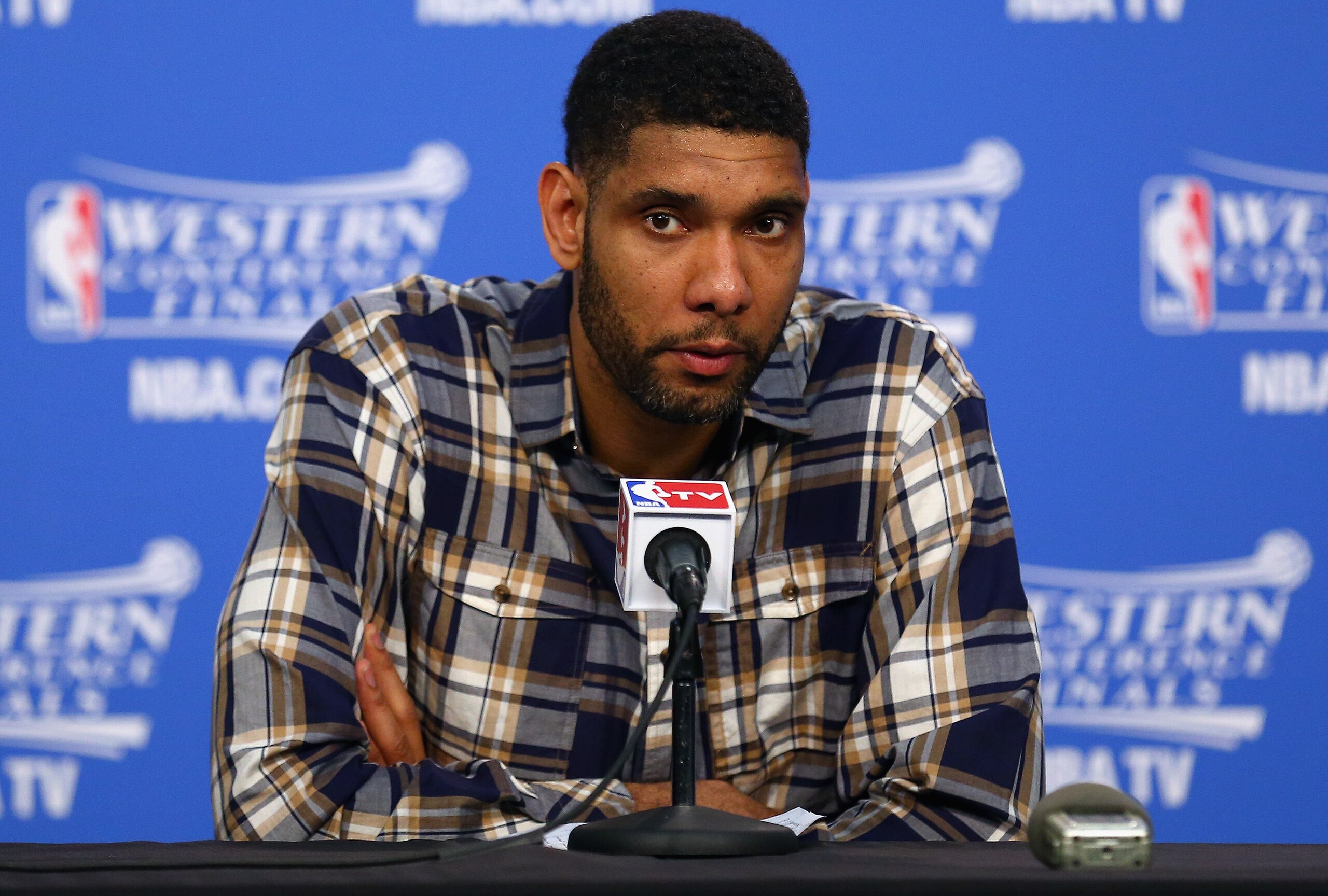
That "devastating loss" pushed Tim Duncan and the San Antonio Spurs to one of the league's all-time-great revenge tours. They went 62-20, good for the best record in the league.
After getting by a pesky, eighth-seeded Dallas Mavericks squad in seven games, they essentially cruised to the Finals, beating the Portland Trail Blazers in five games and the Oklahoma City Thunder in six.
Then, following the clincher against OKC, TNT's David Aldridge asked Duncan about the upcoming rematch with the Miami Heat. The typically stoic Duncan stepped outside his persona to guarantee a title.
"We've got four more to win," he said. "We'll do it this time."
Now, this isn't the kind of on-court or transactional moment that the rest of this list is packed with, but it was a moment that signified how determined and hungry this group was. Fueled by that desire to exact revenge, San Antonio played some of the best team basketball we've ever seen.
In 2013-14, the Spurs led the league in passes per game. In the Finals, they averaged 355.2 passes, compared to Miami's 255. All series, the ball flew around the floor with purpose, and it generally wound up in the right player's hands.
The unselfish play had the Heat's defensive rotations in shambles for what wound up being a short series. Over five games, San Antonio outscored Miami by 70 points, which amounted to the largest point differential in a single Finals.
The Heat were loaded with talent that year. LeBron James, Dwyane Wade and Chris Bosh captured the attention of the NBA world for the four years they were together. But the Spurs made Miami's Heatles run far shorter than originally anticipated with a performance that looked like the personification of "will to win."
2015 Warriors Doubters
6 of 10
After the Golden State Warriors won the title in 2015, Stephen Curry, Klay Thompson and the rest of that jump-shooting team should have disproved the "jump-shooting teams can't win in the playoffs" theory.
"Desire, hard work, and talent make a champion," Marcus Woo wrote for Slate in June 2015. "But you need luck, too—and the Warriors enjoyed lots of it this year, avoiding major injuries, facing depleted teams in the playoffs, and not having to play the Clippers or the Spurs—two of the few teams that could have given Warriors big problems."
Skip Bayless, then of ESPN, shared a similar sentiment: "I love Steph but GSt had a fortuitous run to title. Avoided OKC, Clips, Spurs and 4 straight injured starting PGs. Needs to validate next yr."
After responding, "Love you too Skip!" Curry did indeed validate 2014-15.
The next year, he posted the highest single-season offensive box plus/minus in NBA history. Of the 29 individual seasons in which a player has averaged at least 30 points per 75 possessions, 2015-16 Curry's 66.9 true shooting percentage is the highest (by far). It was an unfathomable 12.8 points above the league average.
Behind that unprecedented combination of volume and efficiency, Curry secured the only unanimous MVP in league history, and his Warriors set the record for wins in a season with 73.
Thompson averaged 22.1 points and shot 42.5 percent from three. Draymond Green went for a ridiculously well-rounded 14.0 points, 9.5 rebounds, 7.4 assists, 1.5 steals and 1.4 blocks per game.
As a whole, Golden State's offensive rating was 8.1 points better than the league average, giving it the third-best relative offensive rating in league history (behind only the 2003-04 Dallas Mavericks and the 2004-05 Phoenix Suns, both piloted by Steve Nash).
This was, undoubtedly, one of the best regular-season teams in NBA history. It may not have needed the bulletin-board material from before the season, but it certainly didn't hurt.
Kobe Bryant's April 2016
7 of 10
It's difficult to compile a list of Kobe's greatest moments. He won five titles, scored 81 points in a single game, legendarily stonefaced that Matt Barnes pump fake and drilled two free throws with a torn Achilles.
Whatever your favorite might be, it would be difficult to leave his 60-point finale out of the conversation. Lee Jenkins expanded on that performance for Sports Illustrated:
"The number was both preposterous and predictable. The Achilles tendon had been torn. The rotator cuff had been ravaged. Twenty years had abused his body. But they could not steal his soul. Bryant left the way he came, bald head and jutted jaw, craving the rock and hunting the hoop. No one paid $10,000 for a seat to watch him pass. They shelled out for the same reason they always have, to witness a showman who takes the shots others aren't bold enough to attempt or skilled enough to convert."
Over the years, there has been plenty of talk about Kobe's 2015-16 teammates doing everything they could to get him the ball. He took 50 shots while the rest of the team got 35. But what may have really fueled the outburst, beyond Kobe's intangible drive for excellence, was a little load management (before "load management" existed).
From the start of that season through April 3, Kobe averaged 28.4 minutes per game. Then, over the five outings immediately preceding the 60-pointer, he averaged 23.7 minutes. He played just 19 minutes in his second-to-last game.
It doesn't sound like a ton of relief, but for a player with the mileage and injury history of Kobe, that extra rest may have been just what he needed to log 42 minutes and hoist 50 shots against the Utah Jazz on April 13, 2016.
Several dates from his career carry significance. That may be the one that symbolizes Kobe best.
Draymond's Flagrant Foul Points in 2016
8 of 10
Like the 2014-15 Warriors, the 2015-16 Cleveland Cavaliers deserve the bulk of the credit for their championship. But it's difficult to have a conversation about either without at least acknowledging the theoretical asterisks.
Draymond's suspension following Game 4 of the 2016 Finals is a big one.
The Warriors, of course, were up 3-1 at that point. But with Green out for Game 5, Cleveland managed to flip the momentum and eventually win the series.
There's no way to know how it would've ended without the suspension (just like there's no way to know how 2015 would've played out with a healthy Kyrie Irving and Kevin Love). Green has few, if any, people to blame for this but himself, though.
Some fans may quibble over Green's intent on the kick to Steven Adams' groin, which resulted in a Flagrant 2. They might even wish the league had employed more of a "spirit of the law" approach to his swipe at LeBron James in the Finals and found some way to avoid the suspension.
But it's hard to explain away his first flagrant of that postseason run when he seemingly wrestled Michael Beasley to the ground on the final possession of a first-round loss.
Sure, you might argue that Beasley goaded Green or sold the contact a bit, but there was one second on the clock. The Rockets had the ball and were up by one. There was no good that could've come from that tie-up. All it did was start Green's count of flagrant foul points.
Had he not committed that flagrant, there's a chance he would've been available for Game 5. And that could've made a huge difference. Over the course of the series, Golden State was plus-23 with Green on the floor and minus-27 with him off.
2016 Warriors Held Scoreless for 4:39
9 of 10
There are plenty of memorable moments from Game 7 of the 2016 Finals. LeBron James' chase-down block of Andre Iguodala, Kyrie Irving's clutch sidestep three and Kevin Love's stellar defense on Stephen Curry are a few that come to mind.
But if we expand the definition of "moment" a bit, all three could be considered part of one.
With 4:39 left in the fourth quarter, Thompson scored a layup assisted by Draymond. The bucket pulled the teams into an 89-89 tie. Remarkably, the Warriors—the same team with the historically great offense detailed earlier—didn't score another point for the rest of the game.
Holding that team to zero points over nearly five minutes of a Game 7 has to be one of the greatest defensive stretches in league history.
Fear the Sword's Trevor Magnotti explained the overarching defensive philosophy that helped Cleveland win that series, and it applies to that 4:39, too: "By cutting off driving lanes, rotating aggressively, and maintaining smart perimeter defense on shooting threats, the Cavs kept Golden State from getting their easiest looks, which altered the series almost as much as LeBron's offensive surge."
The Cavs were locked in for that entire stretch. And while having one of the best basketball players of all time is the biggest reason they won it all, the desire that manifested in the form of defense is up there, too.
James Dolan Nixes the Kyle Lowry Trade
10 of 10
In December 2013, the New York Knicks and Toronto Raptors were close to striking a deal that might have drastically altered the fortunes of both organizations.
According to USA Today's Jeff Zillgitt, New York would've received Lowry in exchange for Metta World Peace, Iman Shumpert and a future first-round pick:
"But the Knicks killed the deal, at the request of Knicks owner James Dolan, according to people familiar with the situation. Dolan was smarting from a deal with then-Denver Nuggets general manager Masai Ujiri, who traded Carmelo Anthony to the Knicks for a handful of valuable assets. Dolan was worried Ujiri, now Toronto’s GM, was getting the best of the Knicks again."
From January 2014 to now, the Knicks have gone 175-353. Over the same stretch, the Raptors have gone 352-174 (only the Golden State Warriors had more wins) and won the 2018-19 championship.
From 2014-15 to now, Lowry is 13th in the entire league in wins over replacement player. And he's now Toronto's all-time leader in that metric.
The Knicks may owe the Golden State Warriors a thank you for Linsanity, but they might deserve one, too. Ujiri looked poised to rebuild the Raptors shortly after his arrival, and Dolan nixing the Lowry trade helped turn Toronto into one of the most successful and stable teams in the NBA.
Unless otherwise noted, stats courtesy of NBA.com, Basketball Reference, PBPStats.com or Cleaning the Glass.

.jpg?w=2560 "Raiders Could Start Mendoza")

.jpg?w=2560 "Rodgers Iced Out on Plane 💎")


.jpg?w=2560 "🚨 Week 8 AP Top 25 Poll")