

Perhaps it's bad form to rain on parades before they've had a chance to get going, particularly where exciting up-and-comers in Major League Baseball are concerned.
But, well, so be it.
Last week, we put on our skeptic hat and looked at 10 established MLB stars who may not live up to the hype in 2019. This week, we're going to turn our attention to 10 supposed breakout candidates—all of whom have MLB experience—who have much to prove before they can achieve stardom of their own.
We're not saying these guys aren't talented. We're more so using them as examples of how absurdly difficult it is to be a good baseball player. And to keep things fair, we've even second-guessed a few players from our own list of breakout candidates.
We'll start with the guy who has the least to prove and end with the player who has the most.
10. Harrison Bader, St. Louis Cardinals
1 of 10
Career MLB WAR: 3.9
The St. Louis Cardinals can be content knowing that Harrison Bader is one of the best defensive outfielders in the business. The 24-year-old finished 2018 with both 19 defensive runs saved and 19 outs above average.
A guy who's this good at a premium defensive position doesn't need to hit much to earn his keep. He merely needs to hit enough, and Bader did that to the tune of a .756 OPS and 12 home runs last season.
However, the right-handed swinger was rendered mortal by right-handed pitchers. They held him to a modest .695 OPS, in part because they struck him out in 31.1 percent of head-to-head matchups.
In general, Bader struck out (29.3 K%) a lot more often than he walked (7.3 BB%) last year. Such an offensive profile demands that the hitter at least be good at driving the ball. To this end, his 91.6 mph exit velocity on fly balls and line drives tied for 211th out of 332 qualifiers.
In short, Bader must prove he's not ticketed for life as a platoon hitter and/or defensive specialist.
9. Nick Pivetta, Philadelphia Phillies
2 of 10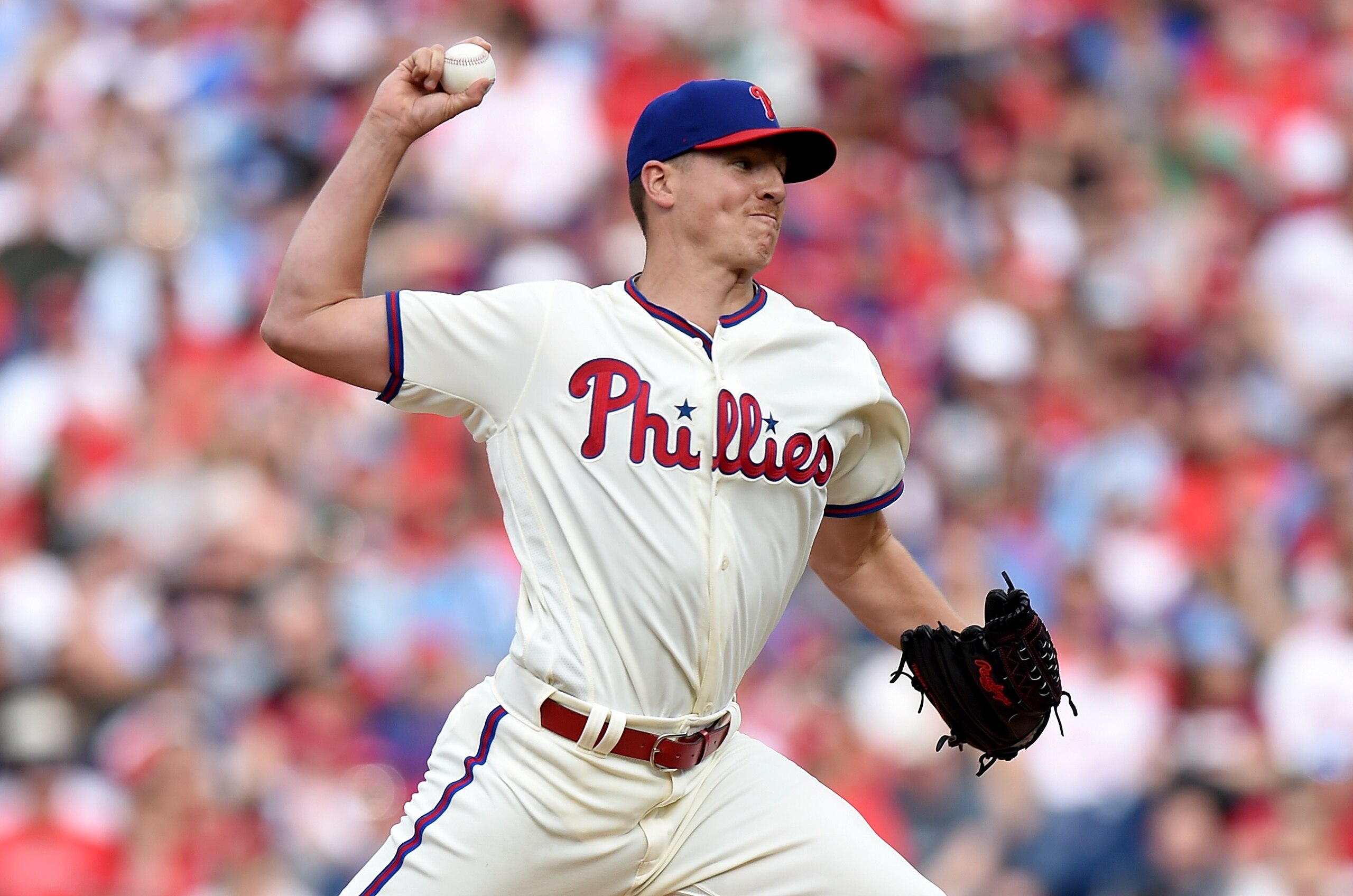
Career MLB WAR: 2.0
There's widespread support for Nick Pivetta as one of the biggest breakout candidates for the 2019 season, and it doesn't take strong spectacles to see why.
The 26-year-old teased a tantalizing strikeout talent when he broke through in 2017, and he promptly realized it in 2018. He punched out 10.3 batters per nine innings, which ranked 12th among qualified pitchers. He also walked only 2.8 batters per nine innings.
Why was Pivetta so difficult to hit? Start with his beautiful 12-to-6 curveball. Then check out his fastball, which sat at 94.8 mph with decent life through the hitting zone.
And yet the right-hander put up only a 4.77 ERA. That was partially the fault of a lousy Philadelphia Phillies defense that contributed to a .326 batting average on balls in play, but Pivetta can't blame his defenders for the 24 homers he allowed. Nor can he blame them on Citizens Bank Park, as there were few cheapies.
8. Rafael Devers, Boston Red Sox
3 of 10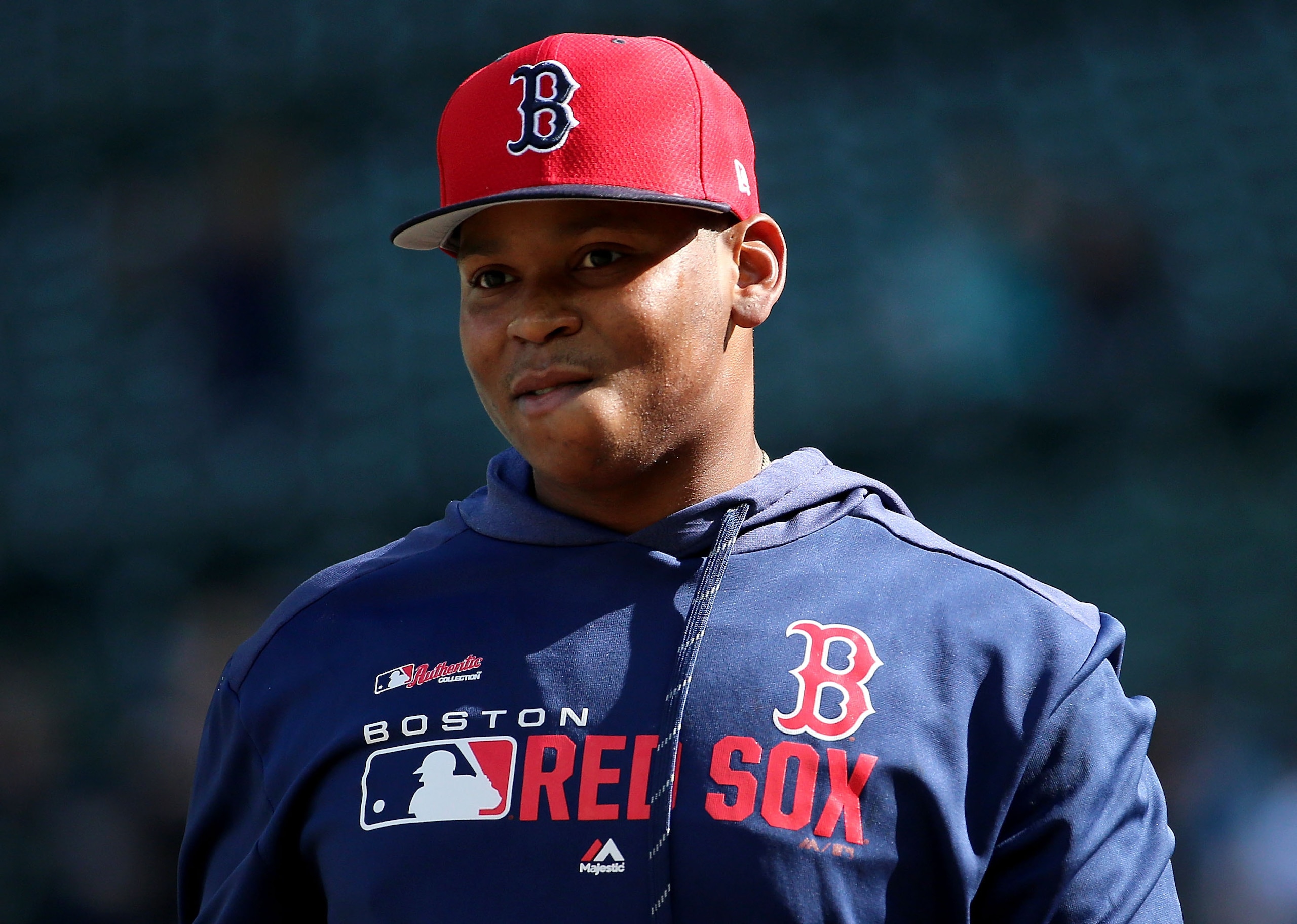
Career MLB WAR: 1.3
Rafael Devers has only been in the majors since 2017, yet it seems like he's already produced a career's worth of highlights for the Boston Red Sox.
His first MLB hit was a home run. He later homered off a 103 mph fastball from Aroldis Chapman. His postseason resume includes three home runs and a key go-ahead hit in Game 4 of the 2018 World Series.
Yet the Red Sox must hold their breath whenever the ball is hit to Devers at third base. His defensive ratings are poor, and it's not because he lacks the athleticism for difficult plays. He has more trouble with routine plays than any other third baseman.
To boot, the .298 on-base percentage he put up in 2018 is a microcosm of his offensive issues. It stemmed from a high out-of-zone swing rate and a low in-zone contact rate, which undercut his penchants for driving the ball—see his 95.3 mph exit velocity on fly balls and line drives—and using the whole field.
The bright sides are that Devers is still only 22 years old and very obviously talented. But for now, there is a gulf between his potential and his reality.

7. Shane Bieber, Cleveland Indians
4 of 10
Career MLB WAR: 1.0
We're big Beliebers around here. We have Shane Bieber pegged not only as a breakout candidate but also as a sleeper for the American League Cy Young Award.
The point is to look beyond the 4.55 ERA that Bieber posted in his first season with the Cleveland Indians in 2018. That's where you'll find impressive strikeout (9.3 K/9) and walk (1.8 BB/9) rates achieved through pinpoint control and a diverse pitch mix.
For 2019, the 23-year-old's next trick should be to even out his platoon split. Left-handed batters got to him for a .909 OPS last year. That won't happen if his new changeup does its job.
But like almost all other pitchers, Bieber will be working primarily off his fastball. And his is nothing special. Though it sat at 93.1 mph last season, its spin rate (2,266 RPM) was right at the league average (2,263 RPM). Batters hit his fastball harder (89.9 mph) than they did the average fastball (89.2 mph).
It's in part because of this that all the time Bieber spent in the strike zone last year was a double-edged sword. His .336 xwOBA—a Statcast metric based on quality of contact—within the zone was higher than the MLB norm of .327.
This doesn't mean Bieber can't improve on 2018, but it is a reason to question whether he truly has ace potential.
6. David Dahl, Colorado Rockies
5 of 10
Career MLB WAR: 1.7
The Colorado Rockies simply can't have Nolan Arenado, Trevor Story and Charlie Blackmon carry as much offensive weight as they did in 2018. Others must help out.
David Dahl is expected to do exactly that in 2019. He's had more than his fair share of injuries since the Rockies drafted him 10th overall in 2012, yet he's done nothing but hit when he has been healthy. His biggest break came last year, as he finished with an .859 OPS and 16 homers over 77 games.
The 25-year-old outfielder was especially comfortable in the season's final month, wherein he went off with a .985 OPS and nine homers. That hints at a solid ability to drive the ball, as the left-handed swinger averaged 93.0 mph on his fly balls and line drives.
Two reasons for concern, however, are Dahl's platoon and home/road splits from 2018. To account for Coors Field, we'll illuminate them using weighted runs created plus:
- RHP/LHP: 123/68
- Home/Road: 146/55
A 100 wRC+ is average, so Dahl was a well-below-average hitter outside his comfort zones against right-handed pitchers and at Coors Field. Between these and the injury bug, that makes three dragons he must slay before he can reach his potential.
5. Jesse Winker, Cincinnati Reds
6 of 10
Career MLB WAR: 0.4
He's no Joey Votto, but Jesse Winker is a Cincinnati Red who knows how to hit.
He was known as an advanced hitter as he was racking up a .398 OBP in the minors, and he's had little trouble translating his talents to the majors. He put up a .375 OBP in 2017 and then a .405 OBP in 2018 before he underwent season-ending surgery on his right shoulder.
However, the Reds must be careful about running the lefty swinger out there against lefty pitchers, who've eaten him alive relative to their right-handed counterparts:
- vs. RHP: .902 OPS
- vs. LHP: .595 OPS
Winker is also coming off an alarmingly large gap between his power at Great American Ball Park (.511 SLUG%) and at other ballparks (.354 SLUG%). The 95.5 mph he averaged on fly balls and line drives suggests this was a fluke, yet Winker did make life hard for himself by neglecting his pull side.
In the meantime, Winker's outfield defense is being cemented as a liability. He's been worth minus-18 defensive runs saved in only 825.2 major league innings.
More guys should have Winker's on-base talent, yet he himself needs to do more.
4. Amed Rosario, New York Mets
7 of 10
Career MLB WAR: 0.8
Amed Rosario was a consensus top-10 prospect when the New York Mets called him up in 2017, and he's coming into this season hot off a strong finish to 2018. He hit .303 with a .779 OPS over his last 47 games.
Poking holes in a guy with these credentials shouldn't be so easy.
The 23-year-old's most obvious flaw is his defense at shortstop, which resulted in minus-16 defensive runs saved in 2018. The physical tools for great defense are there, but, not unlike with Devers, the routine plays give Rosario problems.
To avoid a potential move to another, less glamorous position, Rosario has two options: He can either field his position better, or he can hit well enough to allow the Mets to live with bad shortstop defense.
One hitch in the latter path is that Rosario isn't particularly powerful, as he averaged a pedestrian 90.4 mph on his fly balls and line drives in 2018. He also had one of MLB's highest-out-of-zone swing rates, and he didn't show the bad-ball-hitting ability to justify it. His .232 xwOBA against pitches outside the strike zone was second only to Adam Jones for the worst in MLB.
And that hot finish to 2018? It was on the lucky side.
3. Willians Astudillo, Minnesota Twins
8 of 10
Career MLB WAR: 1.0
Willians Astudillo only has 31 major league games to his name, yet he's already the most interesting man in baseball.
He's a primary catcher who's also played every other position as a professional. He's also an offensive anachronism, as everything he does at the plate is geared toward putting the ball in play. To wit, his 103 MLB plate appearances have yielded three strikeouts and two walks.
So far, it's working. The 27-year-old hit .355 in 29 games with the Minnesota Twins last year, and he's 6-for-9 early in 2019. That's a .382 total batting average, which is on track [plants tongue firmly in cheek] to break Ty Cobb's all-time record.
But while Astudillo is a rare oddity, he's not exactly an offensive specimen. He was one of Minnesota's slowest baserunners in 2018, and the fly balls and line drives he's hit in the majors have averaged 87.8 mph.
Astudillo is something like an Ichiro Suzuki clone, minus the speed and defensive brilliance at a single position. He's only going to become a true star if his hits keep falling at the rate they've been falling. Never say never, but that may be too good to be true.
2. Tyler O'Neill, St. Louis Cardinals
9 of 10
Career MLB WAR: 1.4
The best word to describe Tyler O'Neill is "intimidating."
The 23-year-old looks like he's wandered off the set of a 1980s action movie. He's clubbed 127 homers in six career minor league seasons, as well as nine in 61 games in the majors last season. In so doing, he averaged a robust 97.4 mph on his fly balls and line drives.
Yet the Cardinals must be careful about putting too much hope in O'Neill because he strikes out a lot.
As in, "a lot" even relative to the average slugger. O'Neill has run a 26.4 K% at the Triple-A level, and he endured through a staggering 40.1 K% in his first taste of the majors last season. Among batters who took at least 100 plate appearances, only Drew Robinson and Brett Phillips did worse.
O'Neill didn't help himself by frequently swinging outside the strike zone, but an arguably bigger concern is how often he came up empty inside the strike zone. His 65.8 percent rate of in-zone contact was easily the worst among qualified hitters.
The easy comparison to make is Joey Gallo, but the Texas Rangers slugger at least had good zone discipline when he first came up. O'Neill has work to do to get on Gallo's level.
1. Tyler Glasnow, Tampa Bay Rays
10 of 10
Career MLB WAR: -1.1
By all rights, Tyler Glasnow should be unhittable.
He works off a fastball that sits in the mid-90s but plays more like a high-90s heater because of how close to home plate his long-limbed 6'8" frame allows him to release the ball. He also boasts a particularly nasty Uncle Charlie, and he put a slider in his back pocket last year.
And yet the 25-year-old has been worse than replacement-level since debuting with the Pittsburgh Pirates in 2016. He showed signs of life upon joining the Tampa Bay Rays last summer, but he still only mustered a 4.20 ERA in 11 starts.
The bright side is that one of Glasnow's long-standing bugaboos appears to be going away. He walked a lot of batters in Pittsburgh's organization, but he's walked a reasonable 20 in 60.2 innings as a Ray.
Glasnow's hittability, however, remains an issue. It's been a struggle for him to get hitters to expand the strike zone, and his fastball has been more hittable than it should be. It's been knocked around to the tune of a .363 xwOBA, compared to the MLB norm of .351.
Hence a hard-hit rate that keeps climbing and a home run rate that refuses to go below the MLB average. Sans improvements in those departments, stardom will remain frustratingly out of reach for Glasnow.
Stats courtesy of Baseball Reference, FanGraphs, Baseball Savant and Baseball Prospectus.
.jpg?w=2560 "Mahomes Told Teammate to Leave Meeting")
.jpg?w=2560 "🚨 Week 8 AP Top 25 Poll")
.jpg?w=2560 "Baker Gets Glove From Rays 🧤")
.jpg?w=2560 "NFL investigating Eagles")
.jpg?w=2560 "Steelers Roll Saints in Paris")
.jpg?w=2560 "Updates from EVERY NFL Game 🏈")
.jpg?w=2560 "5 Teams Eyeing Jonathan Taylor")