

Jarrett Culver, Ja Morant Are the Breakout Sophomores Shooting Up Draft Boards

The 2019 NBA draft class could be in line for a needed boost by a pair of breakout sophomores.
Over the last few weeks, Texas Tech's Jarrett Culver and Murray State's Ja Morant have become hot topics among scouts who've mostly been underwhelmed by the freshmen and overall talent pool.
Culver's 25 points at Madison Square Garden last Thursday against Duke drew significant attention, thanks to a prime-time stage as well as the particular shots and moves he executed.
TOP NEWS

Brown with an all-time summary of relationship with Tatum

Heat, Giannis were down by 20+ in each of their 3 losses

Power Ranking Every NBA Team's Starting Lineup 🔢
And with only two power-conference opponents on the Racers' schedule—the first being Alabama, against whom he scored 38 points—Morant put on a validating performance Saturday in a tight loss to then-No. 7 Auburn, finishing with 25 points, eight rebounds and seven assists.
"They both have pro games," said one scout who expected them to draw interest from lottery teams.
Culver's breakout
A role player as a freshman, Culver still popped last year with 6'5" size, a projectable jumper and encouraging sequences of perimeter defense. This season, he's turned flashes into efficient, No. 1 option production, now averaging 19.6 points on 55.8 percent shooting and 45.0 percent from three.
"I already had Culver in the lottery before the Duke game," said another scout.

His 30.3 percent usage rate is up from last season's 22.1 percent. A more threatening, well-rounded scorer and playmaker, Culver has capitalized on the extra touches, ball screens and looks.
Pick-and-roll ball-handling
Freshman: 9.8 percent of offense, 0.67 PPP, 32nd percentile
Sophomore: 20.8 percent of offense, 1.09 PPP, 91st percentile
Through 12 games, Culver has already generated 50 points out of pick-and-rolls after racking up 28 points in 37 games last season. He's timing his drives and finishing, and 15 of his 21 pick-and-roll passes have led to field goals.
Spot-up
Freshman: 31.8 percent of offense, 1.15 PPP, 88th percentile
Sophomore: 19.5 percent of offense, 1.21 PPP, 86th percentile
One of the nation's most efficient spot-up players a year ago, Culver continues to score off the catch with rhythm shooting, pull-ups and drives past closeouts. It's a strength of his game that hints at a higher floor, with teams likely to feel confident that at the least, he can stretch the defense and make shots or plays when facing closeouts.
Off screens
Freshman: 9.6 percent of offense, 1.10 PPP, 73rd percentile
Sophomore: 9.5 percent of offense, 1.43 PPP, 92nd percentile
The success he's had making shots after flaring or curling off screens is just another positive sign regarding his potential to fit into an already established NBA offense.
Isolation
Freshman: 10.3 percent of offense, 0.52 PPP, 12th percentile
Sophomore: 17.6 percent of offense, 1.21 PPP, 91st percentile
Despite lacking blow-by speed or a quick release on his jump shot, Culver has compensated in different ways, whether it's by using counter footwork off the dribble, improvisation in the paint or simply difficult shot-making while contested.
Still, isolation scoring may be the least convincing addition to his game, given his slow-motion delivery and lack of explosion. By June, scouts must determine the extent to which his lack of burst and strength will restrict him at the NBA level.
Continuing to bury dribble jumpers and score in volume against tougher Big 12 opponents will certainly help strengthen and solidify his case as a lottery pick.
Morant's breakout
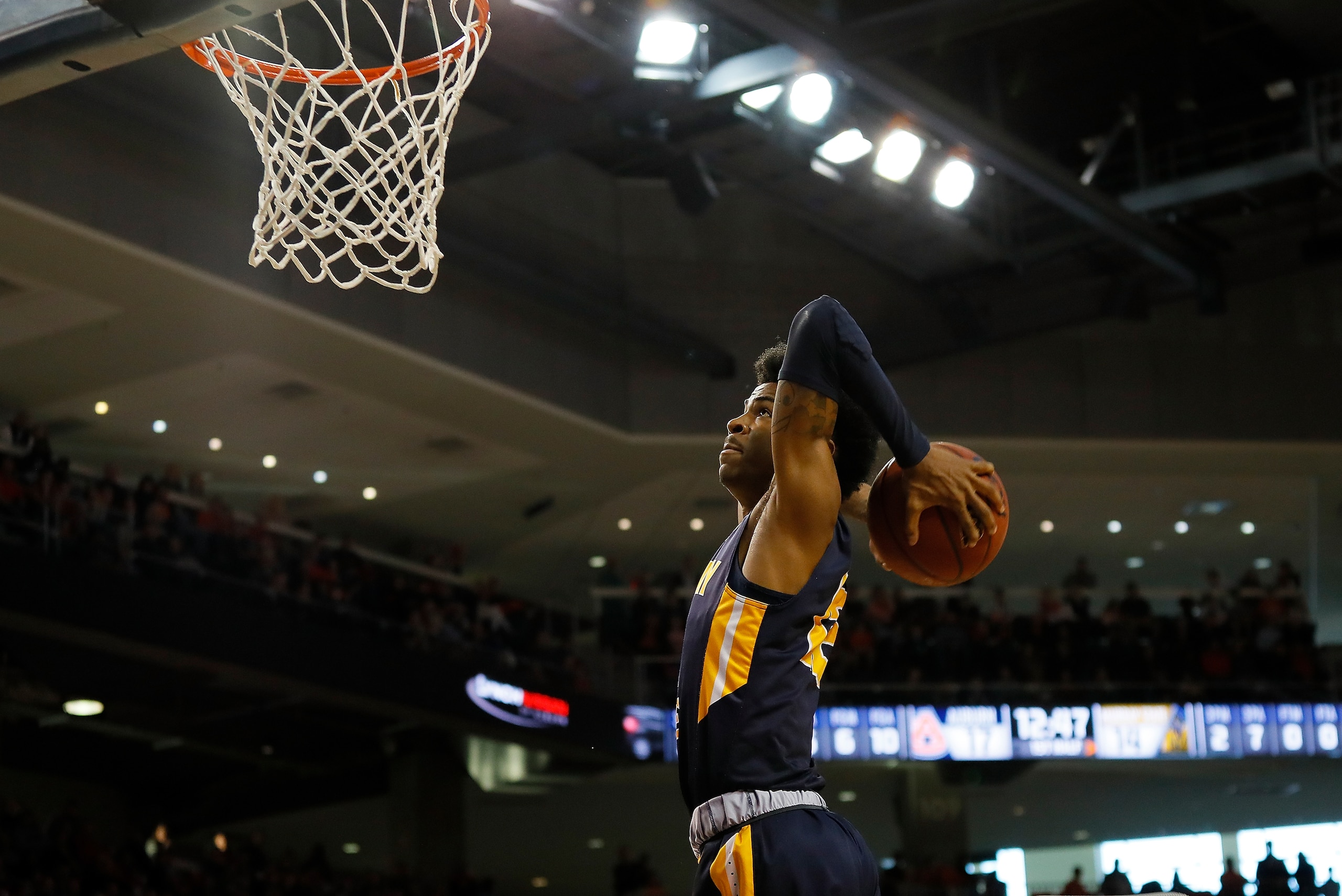
Meanwhile at Murray State, Morant's numbers are relatively inflated compared to Culver's due to a monster workload and a 33.1 percent usage rate. But they're still eye-catching: 23.0 points, 9.3 assists and 7.0 rebounds on 52.3 percent shooting.
No guard in over 25 years has even averaged at least 20.0 points, 8.0 assists and 5.0 rebounds. Along with spectacular production, the 6'3" point guard also possesses elite, positional athleticism that screams NBA potential.
Morant's identity will revolve around his knack for putting pressure on defenses with open-floor speed, half-court handles and explosion in the lane. But setup passing remains his signature skill.
Pick-and-roll passing
Freshman: 11.8 percent of offense, 1.13 PPP, 81st percentile
Sophomore: 17.6 percent of offense, 1.10 PPP, 70th percentile
A willing playmaker, Morant loves to whip the ball around with one-handed lasers, many from his left fingertips. He's sporting a nation-leading 56.1 assist percentage, significantly higher than TCU's Alex Robinson's 44.2 percent, which ranks No. 2.
Morant is an assist weapon off ball screens, able to free up rolling bigs or shooters by freezing the defense with hesitation dribbles and moving it with pass fakes before delivering the ball.
Transition
Freshman: 24.1 percent of offense, 1.10 PPP, 55th percentile
Sophomore: 24.5 percent of offense, 1.33 PPP, 85th percentile
Morant has become one of the nation's most exciting fastbreak players with the ball in his hands. He's already recorded more field goals handling it in transition (22) than he had all last season (21).
Spot-up
Freshman: 25.8 percent of offense, .99 PPP, 64th percentile
Sophomore: 11.4 percent of offense, 1.11 PPP, 77th percentile
He usually has the ball, but Murray State has had to find other ways of creating scoring chances for Morant. And that means having him give it up at the point and then get it back off the catch from the wing, where he has more space and better angles to slash.
He's also converted five of seven cuts, demonstrating elusiveness off the ball, as well as with it.
Far from a perfect prospect, Morant still comes with uncertainty and questions concerning his 4.9 turnovers per game, shaky jump shot and stretches of lazy defense.
Though often reckless offensively, and at times indifferent when it comes to retreating back or fighting through screens, NBA teams will be more willing to overlook his decision-making and suspect defensive effort given his high-usage role and tools to defend down the road.
His shooting will cause more hesitation. He's at 28.9 percent from three (30.7 percent last year) and 22.2 percent on half-court pull-ups.
Still, there are certain prospects who become too enticing based on the effectiveness of their athleticism and ball skills, plus the upside that kicks in if they eventually improve as a shooter. The Sacramento Kings will win the gamble they took on De'Aaron Fox, a 24.6 percent three-point shooter at Kentucky who's now at 41.2 percent as an NBA sophomore and averaging 18.1 points.
A lottery team searching for a point guard is bound to take a similar gamble on Morant, particularly given the amount of non-playoff rosters that could use a change or long-term upgrade at the position, including the Phoenix Suns, Cleveland Cavaliers, New York Knicks, Chicago Bulls, Orlando Magic, Minnesota Timberwolves and Utah Jazz.
Morant and Culver's stock will also both benefit from a projected draft field filled with question marks and no obvious depth outside of Duke's Zion Williamson and RJ Barrett.
Fellow Blue Devil Cam Reddish is shooting 37.0 percent from the field. North Carolina's Nassir Little has been held to 19.4 minutes per game, and Kansas' Quentin Grimes has fallen out of the discussion. Vanderbilt's Darius Garland and Missouri's Jontay Porter are done for the season with knee injuries, while Oregon's Bol Bol (foot) and USC's Kevin Porter Jr. (quad) continue to miss time as well.
Lottery teams will ultimately be hoping the starts for Culver and Morant represent legitimate breakthroughs. Their early consistency, along with the eye-test results, fuel optimism.
Both prospects have cracked the top 10 on Bleacher Report's final mock draft of 2018.
Stats courtesy of Synergy Sports and Basketball-Reference.com
_0.png?w=2560 "Unranked Teams Cause Chaos in Rankings 📊")
.png?w=2560 "Week 8 Winners & Losers 📊")
.jpg?w=2560 "Jonathan Taylor Landing Spots 📍")



