Roman Reigns Knows His Worth...Regardless of What the WWE Universe Thinks
In hindsight, the April 4, 2016, episode of WWE Monday Night Raw was a turning point.
The prior night, Roman Reigns toppled Triple H at WrestleMania 32; the Big Dog was now the WWE world heavyweight champion. And when he appeared at the top of the ramp on Raw, belt slung over his shoulder and smirk on his face, the Dallas audience lit into him with a chorus of boos.
Reigns probably expected this. The post-WrestleMania Raw audience is notorious, comprising superfans who travel halfway across the country to sit in the stands. These were Reigns' biggest critics, and they were intent on rejecting his babyface push, even if it disrupted the show—which it often did.
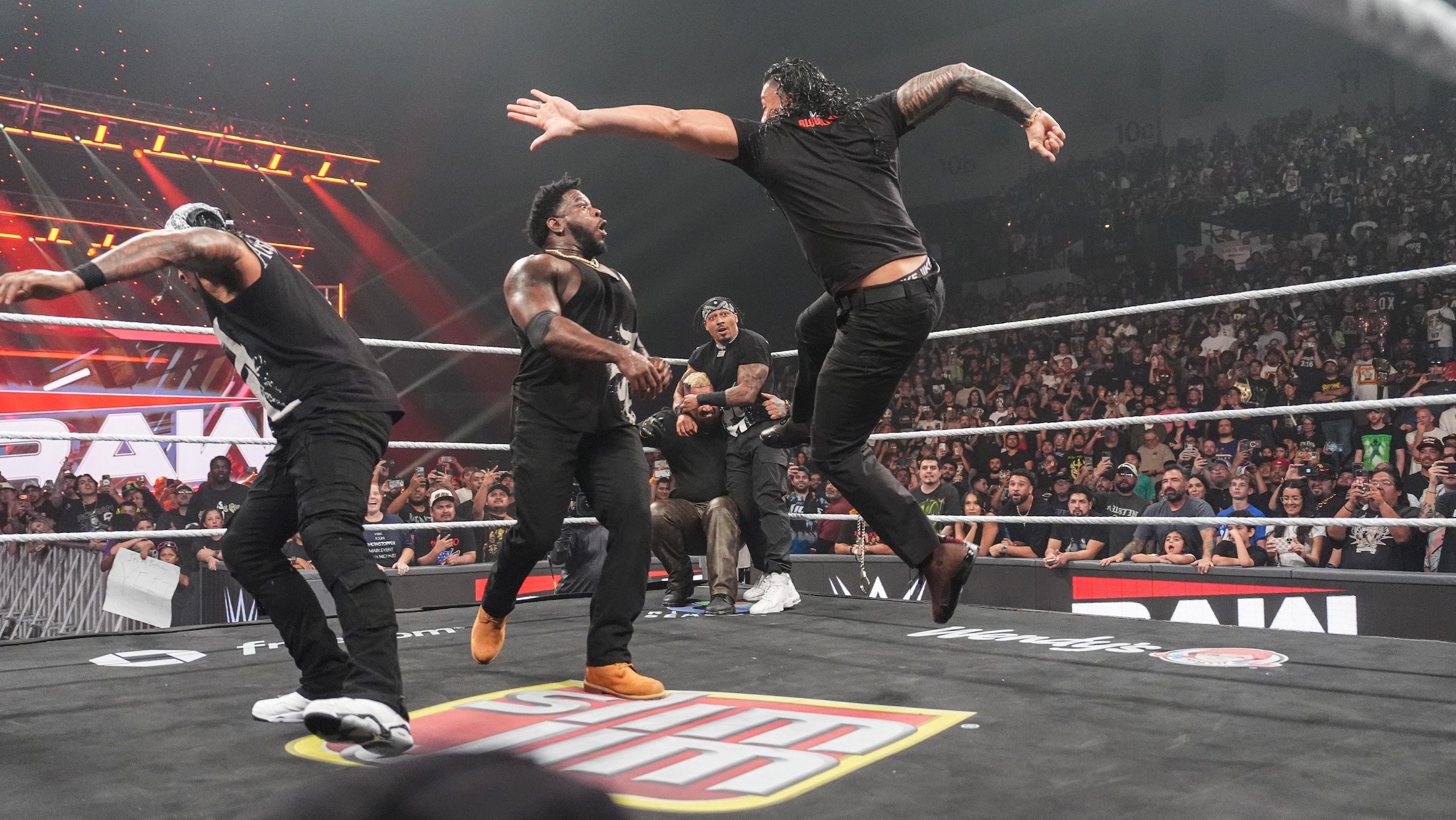
.jpg?w=2560)
In the middle of this in-ring segment, Reigns delivered a one-liner that seemed like both a concession and an act of defiance: "I'm not a good guy. I'm not a bad guy. I'm the guy."
No, WWE seemed to imply with this statement, we're not changing the story to please you. This is our top guy, and whether you love him or hate him, we're fine with it. He is whatever you want him to be.
Today, everyone is an expert regarding the wrestling business. Dedicated fans spend hours online discussing the "right" way to tell the story, rather than enjoying the story at face value.
After all, they forced WWE to change creative direction once before. In the lead-up to WrestleMania XXX, the fans rejected the Randy Orton vs. Batista main event so viciously that the company put Daniel Bryan in the main event to appease them. If they booed Reigns loudly enough, could they do it again?
WWE didn't get Reigns over as a babyface, but it wasn't for lack of trying. It sent him to the ring with The Rock. It highlighted his Anoa'i family heritage. It established him as a hardworking, honest family man, fighting the evil Authority. But the hardcore fans didn't care about any of that; they were intent on rejecting him not because of who his character was but because he was "chosen" by the powers that be.
This is the drawback of responding to audience criticism; do it once, and fans become emboldened, thinking they can book the show by proxy. And WWE, sensing that it had concocted a no-win scenario—the harder it pushed Reigns, the more smarks would hate him—threw up its hands.
In the years since, WWE has booked Reigns more ambiguously, openly acknowledging the "controversy" he brings to the table. At times, it even leverages the audience's distaste to give its storylines more bite. Three particular incidents stand out.
The first incident was at the 2017 Royal Rumble. Reigns entered at No. 30, which teased a potential win. The crowd members reacted negatively, but they were proportionally excited when Randy Orton was declared the winner instead. Without Reigns' involvement as a deliberate bait-and-switch, would Orton have received such a positive reaction from the hardcore fans? It's highly unlikely.
The second incident occurred after WrestleMania 33. Roman Reigns had beaten and apparently retired The Undertaker, which temporarily made him one of the most hated men in the company. WWE used that heat to fuel a feud with Braun Strowman, establishing Strowman as a morally ambiguous monster. His weekly, over-the-top beatdowns of Reigns propelled him to the top of the card, and the fans had no qualms about cheering Strowman on during these segments
In an interview with Bleacher Report on August 8, Reigns had nothing but good things to say about his feud with Strowman.
"It was a really cool experience," Reigns said. "Braun is such an elephant in the room. You can't take him anywhere without people just gawking at him and poking at him. He's just got that 'it' factor.
"He was so coachable," Reigns continued. "He was willing to listen, and he trusted where I'd been and what I'd been doing. And I think it's credit to him that he was able to learn so quickly and also that he was able to understand what an opportunity he had. And that's why that chemistry was so good. We could pick it up tomorrow, and we would still have that chemistry."
And the third incident was late last year, during Reigns' feud with John Cena. WWE went meta; Cena acted as a vent for the audience's ambivalence and, in a blistering promo, dismissed Reigns as a subpar "John Cena bootleg" and insulted Reigns' persistent attempts to get over.
"You blame me?" Cena asked in the most devastating line of the evening. "Fine. I blame you. I'm still here, because you can't do your job."
It elicited what has become a signature sound whenever American crowds react to Roman Reigns: an indistinct, mass noise of humanity that is neither cheering nor booing. Which, according to Reigns, is WWE's goal.
"I think [the reaction I get] is good where it's at," said Reigns in his Bleacher Report interview. "I mean, there are some Superstars who get a universally positive reaction. Someone like Daniel Bryan is a 100 percent babyface. And then there's guys like me. But there's loud and then there's really loud. And you really have to be in the arena every night to hear how loud [my reactions] get."
Absorbing this much negative attention, however, can't be healthy. In an interview with Bleacher Report, John Cena acknowledged that over the years, the fans' negative reactions have hurt his feelings. How has Reigns handled this emotional weight?
"It doesn't hurt," Reigns said. "I mean, it's not real. You kind of look at it from the perspective that these are people I've never seen before. On social media, it's just one person on one app saying something who I'll never see in real life. And if I did, the person would never say it to my face or interrupt my day.
"It's just one of those situations that comes with the role," Reigns continued. "Everyone has an opinion, and everyone has a phone. You kind of have to ignore it and stay within yourself. When I'm not on the road being Roman, I'm at home being Dad. So my time is very valuable."
Reigns' role as the company's top guy sends him all over the world, and he interacts with fans with all manner of opinion.
"I think WWE just wants a reaction," Reigns said. "We have a very passionate, diverse crowd, and we have a global product. And so it's very important for a person who's in my position to get a loud reaction. If you could follow me around with a camera 24/7, the reaction is different in every single town, every single city, every single country. It's something that I wish people could see."
WWE fans saw a hint of this at the Greatest Royal Rumble held in Jeddah, Saudi Arabia, where Reigns got a uniformly positive response. WWE, in its push to be recognized on a global stage, must have a champion that a global audience will respond to; it has to worry about the bigger picture more so than the idiosyncrasies of a single market or a fraction of that market. Reigns appeals to this silent majority; even if the fans on TV are saying one thing, the data are saying something else.
"At the end of the day, the statistics speak for themselves," Reigns said. "It's no secret the type of business we're doing, and with the quarterlies popping out here and there? I'm not one to look at that kind of stuff too much; I go to work and I work hard. But the numbers speak for themselves, and we're doing just fine."
The final question was about Brock Lesnar. Does he face any particular challenges preparing for Sunday's fight at SummerSlam? What must he do to deliver an entertaining match? Reigns' answer was unfailingly earnest.
“No, I wouldn’t say that working with Brock Lesnar presents any particular challenges," Reigns said. "He is a pro in the ring and the biggest name in sports combat right now. To be able to cross over and tell our story in a WWE ring at SummerSlam is exciting. You have [two men with] two incredibly physical styles who are fighting for the Universal Championship. [We're going to] entertain the fans and put smiles on faces worldwide.”
It became clear through his interview responses that Reigns is better at discussing and celebrating other people than discussing himself. He had wonderful, generous things to say about his opponents like Strowman, whereas he seemed to repeat himself and stumble when asked to self-reflect. There's something endearing about that. In many ways, it's a parallel to his ring work; his greatest strength is in selling, bumping and putting over other superstars.
Whenever asked to talk about himself, Reigns always said the "right" thing. Nothing he said was controversial. Nothing he said was offensive. None of his quotes would make headlines in the dirt sheets. But it didn't show his vulnerabilities either. It didn't break down that invisible wall that separates Reigns from the fans and prevents them from getting to know him more personally.
Some fans might see that as an old-fashioned, "strong and silent" masculinity and love him for it. Some fans might see that as cold and impersonal—especially in a digital era of oversharing—and hate him for it. But Reigns himself is doing what he feels is best. And that is what keeps him focused, grounded and level-headed, regardless of how the fans treat him at SummerSlam, or at the Raw after SummerSlam or beyond.
.jpg?w=2560 "Mahomes Told Teammate to Leave Meeting")
.jpg?w=2560 "5 Teams Eyeing Jonathan Taylor")



.jpg?w=2560 "NFL investigating Eagles")
.jpg?w=2560 "Jonathan Taylor Landing Spots 📍")