

View from Dakar: How Aliou Cisse's Senegal Captured the Spirit of the Nation
Senegal is seeking to become the only African team to reach the knockout phase at the World Cup, and the capital city of Dakar has been gripped by football fever in a manner not seen since the Lions of Teranga shook up the world at the 2002 tournament in Japan and South Korea.
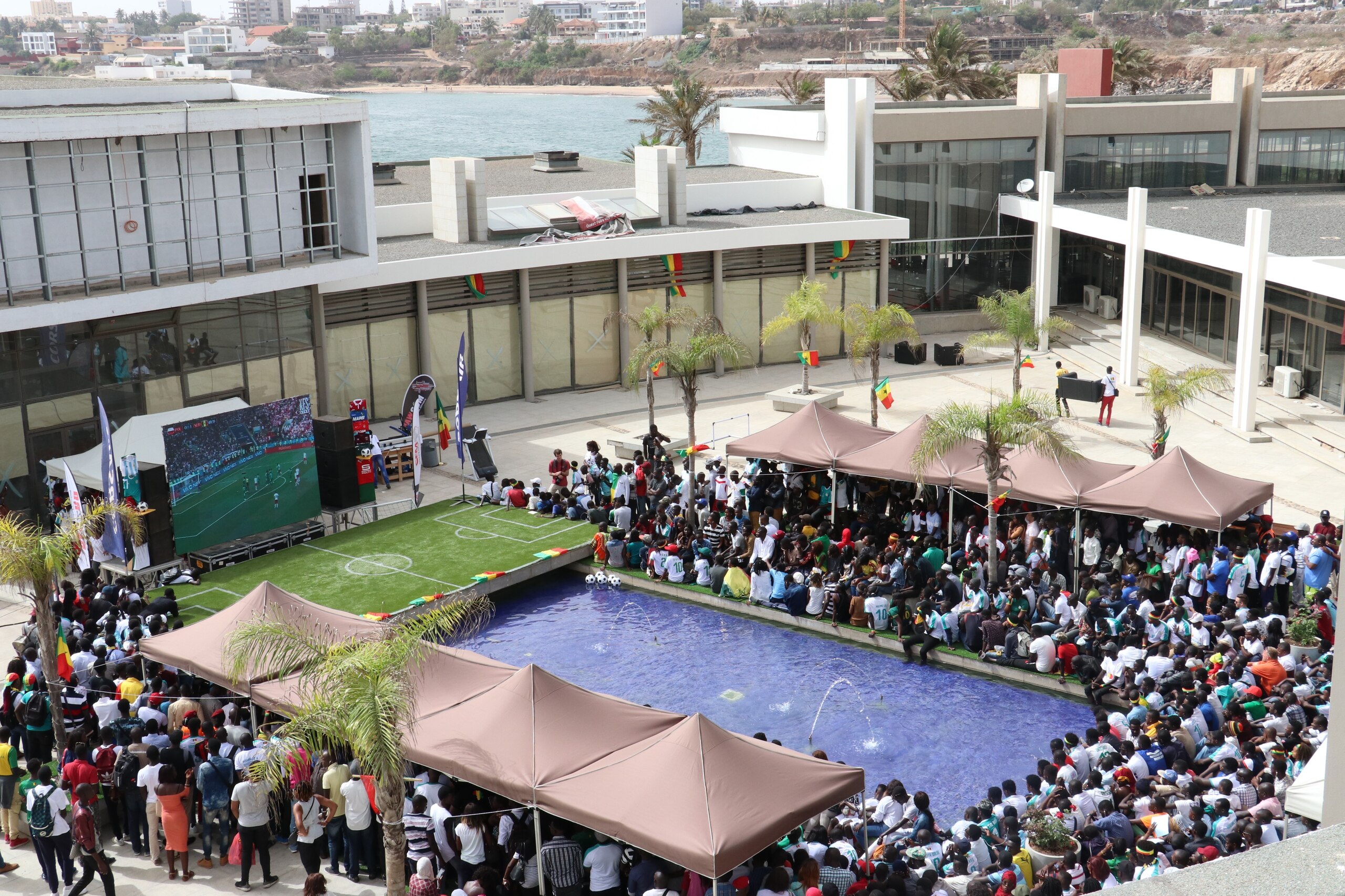
For Senegal's two games to date—the opening 2-1 win over Poland and subsequent 2-2 draw with Japan—supporters have piled into fan zones, such as the one set up by television channel RTS on Dakar's Place de l'Obelisque, a triangular wedge of open space in the middle of the capital overlooked by a giant obelisk erected to commemorate the country's independence from France in 1960.


Senegal's opening goal against Poland—a shot from Idrissa Gueye that deflected in off Thiago Cionek for an own goal—prompted an explosion of joy, with the celebrations that followed playing out against a backdrop of klaxons, vuvuzelas, fluttering Senegalese flags and honking cars.
There are fan zones dotted across the capital, at the Sea Plaza shopping mall, at Youssou N'Dour's Thiossane nightclub and in the suburban districts of Pikine and Guediawaye, while at Cheikh Anta Diop University, students squeeze into television rooms to watch Aliou Cisse's side play their games over 8,000 kilometres away in Russia.
"You see little flags on people's cars and houses. You see replica shirts everywhere in the streets," says Mor Bassine Niang, a journalist for the Senegalese sports newspaper Record. "They sell Lions shirts in every corner of the capital, from the Colobane Market, which is the biggest market in Dakar, to the pret-a-porter clothes shops. In some districts, the walls are painted in the national colours. When there's a match, nearly all the shops close so that people can follow it. People are enjoying the competition and they're all behind the team."
The names most commonly printed on the backs of fans' white replica shirts are those of Sadio Mane, Senegal's captain and talisman, Kalidou Koulibaly, the hulking centre-back, and M'Baye Niang, the skillful but skittish young forward whose career has taken him from the Caen youth academy to Torino via AC Milan, Montpellier, Genoa and Watford.
As a former French colony, Senegal inevitably draws upon players born to Senegalese parents in France, but while there are eight French-born players in Cisse's squad—and one, Keita Balde, who was born in Spain—most of his players were born on Senegalese soil.
"The majority of the players in this team were born here," Mor Bassine Niang says. "They grew up here and they earned their spurs in the different national youth teams. Players like Mame Biram Diouf, Kara Mbodji and Idrissa Gana Gueye, they're players who embody Senegalese culture. I could mention others. Just seeing these players, you know that they're good representatives of the Senegalese people."
Twelve of the players in Senegal's World Cup squad passed through Senegalese football academies such as Diambars, the youth training centre set up in May 2003 with the help of former France internationals Bernard Lama and Patrick Vieira.
Diambars (which means 'champions' in the local Wolof language) lies 88 kilometres south of Dakar in the coastal town of Saly. It is where Everton midfielder Gueye, Anderlecht centre-back Kara Mbodji, Caen full-back Adama Mbengue and Stoke midfielder Badou Ndiaye received their footballing education before fulfilling the dreams of every young African footballer by forging careers for themselves in Europe.
"It's a great comfort to know that the initiatives that we took have borne fruit," Saer Seck, president and co-founder of Diambars, tells Bleacher Report. "It's the same at Generation Foot [a Dakar academy], where they had Sadio Mane and Diafra Sakho and lots of other players. It gives me great joy and great pride to see these young players who joined us at the age of 12 playing key roles for Senegal at the World Cup."
The Senegal squad began their World Cup preparations by training at Diambars before heading to Russia, leaving the academy's current intake of 137 boys wide-eyed in their wake.
"It's a huge thing for them," Seck said. "After Idrissa Gana Gueye and Kara Mbodji go and talk to them, we show them pictures and videos of Gueye and Mbodji at their age. So they realise that, through hard work and sacrifice, they can realise the same dreams by playing for Senegal one day and going to the World Cup."
Aside from the exciting quality of their football, Senegal's players have also won new admirers in Russia with their coordinated musical warm-ups, while their fans have been praised for tidying up after themselves following matches.
Senegal's return to the global stage has inevitably rekindled memories of the 2002 World Cup, when a side featuring Salif Diao, Papa Bouba Diop and El Hadji Diouf sensationally ambushed defending world and European champions France in the opening game before going on to reach the quarter-finals.
The subsequent spread of Senegalese players across Europe's major leagues helped to establish the country as a leading light in African football, but despite all that talent, at international level, Senegal's successes have been limited. The 2002 World Cup was the first time they had ever reached the tournament, and their only appearance in an Africa Cup of Nations final occurred earlier that same year, when they lost on penalties to Cameroon.
With a population of just over 16 million people, Senegal is only the 24th most populous nation in Africa. Nigeria's population is 12 times bigger.
While Senegalese journalists are wary of making comparisons between the 2018 squad and the 2002 vintage, there is agreement that both groups are characterised by the same joie de vivre.
"They're passionate, they're patriotic and they love their country," says Aliou Goloko, a leading Senegalese sports journalist who is following Senegal in Russia. "Those players [in 2002] were dreaming about playing at their first World Cup, and it's the same situation here. The other similarity is the happiness and the zest for life that they're showing on the field with their singing and dancing. That's the real spirit of Senegal."
For Mor Bassine Niang, the singing and dancing are an encouraging sign that all is well behind the scenes, which has not always been the case with Senegal squads.
"It shows that the team are living well together," he says in a phone call from Dakar. "There have been Africa Cups of Nations when we've felt that there were differences within the squad, little groups here and there, but since Aliou Cisse arrived, you feel clearly that the squad is living well together, that the players are working together and that they want to give everything to defend the national colours."
The thread connecting Senegal's two World Cup teams is Cisse, the graceful, dreadlocked figure who captained his country in 2002 and led the team back to the tournament as coach in 2018.

Cisse, who spent four years in England as a player with Birmingham and Portsmouth, has known both the dizzying highs and the crushing lows of international football. At the 2002 Africa Cup of Nations in Mali, it was his squandered penalty—drilled at the legs of Cameroonian goalkeeper Alioum Boukar—that delivered the trophy to Cameroon.
A popular appointment in 2015 following the departure of Frenchman Alain Giresse, Cisse came in for strong criticism during Senegal's warm-up games when experiments with a new 3-5-2 formation yielded a string of distinctly underwhelming draws against Uzbekistan, Bosnia and Herzegovina and Luxembourg.
His stock has risen sharply since the World Cup began. His ice-cool goal celebrations during Senegal's win over Poland were a massive social media hit and his suave demeanour has turned him into an unlikely sex symbol.
More importantly, in addition to being the youngest coach at the tournament, the 42-year-old is also the only black coach—a fact that he has lamented.
"I represent a new generation that would like to have its place in African and world football," he said, per Jeremy Wilson of the Telegraph. "Indeed, I am the only black coach in this tournament. It's a painful reality that annoys me. I believe that football is universal. I believe that skin colour has little importance in the game."
Goloko says that Senegal's fans are "proud" of Cisse's status as a trailblazer, but adds with caution that his worth as a coach cannot be judged until the end of the tournament.
The fans are ready to dance again on Place de l'Obelisque and the car horns are ready to blare. Nobody is getting carried away just yet, especially not with Jose Pekerman's dangerous Colombia side barring the path to the last 16. But just as in 2002, Senegal are on the march.


.png?w=2560 "Week 8 Winners & Losers 📊")

.jpg?w=2560 "Malik Beasley Negotiating Plea Deal (AP)")
.jpg?w=2560 "Jonathan Taylor Landing Spots")