Bracketology 2018: Answering the Biggest Questions on the NCAA Tournament Field

Championship Week is in full swing, which means Selection Sunday (March 8) is just around the bend.
Who gets in? Who gets left out? Which mid-major is most dangerous? And how will the selection committee decide how to sort some of these teams?
This frantic time of bubbles bursting, inflating and back again has significantly more unknowns than certainties, but we'll do our best to answer the biggest questions about this inexact science of bracketology.

.jpg?w=2560 "Rams Raiders Football")

Our first question comes from @tim_gwatney13:
"Does ASU have any chance, at all to even make First Four? Obviously taking in account the games between now and when you write it."
First of all, allow me to point out just how badly I cursed the poor Sun Devils. In a bold predictions piece from early January, I said that Arizona State would earn the No. 1 overall seed.
There were other bold predictions in there that didn't even remotely come true, but, man, it takes a special kind of jinxing power to turn a potential No. 1 seed into the primary team that we'll be talking about on the bubble for the next few days.
So, does Arizona State have a chance at getting a bid? Absolutely. The Sun Devils won a road game against Kansas and a neutral-court game against Xavier—each of which is currently projected for a No. 1 seed. That's only about six percent of their total resume, but you can't find a team with two better wins. They also had solid neutral-court wins over Kansas State and St. John's, as well as Pac-12 victories (at home) over USC and UCLA.
The problem is they lost 11 of their final 19 games. And while Oklahoma had a similar horrendous record in the second half of the season, the Sooners almost exclusively lost to projected tournament teams. Arizona State, on the other hand, was swept by Oregon and Stanford, lost twice to Colorado and had less-than-ideal losses to Utah, Oregon State and Washington.
Based on current projections, that's nine losses to non-tournament teams, which is an awful lot.
I still had Arizona State in the field as of Thursday morning, but I also suspect that they'll be out by Saturday once all the other bubble teams have had their chance to improve their resumes.
Next up, a question from @mlquiram about the one bubble team that no one can stop asking about:
"How is the selection committee trained to deal with a team with a situation like Notre Dame?"
The short answer is that the committee isn't trained to deal with it.
Injuries happen all the time in this sport, and when a crucial player misses a game or two, the committee will often "discount" losses that occur without that player. The one big example is Wisconsin losing to Rutgers in 2015 in a game that Frank Kaminsky missed with a concussion. Those Badgers still got a No. 1 seed, even though the Scarlet Knights went 0-15 the rest of the season and turned that into a dreadful loss.
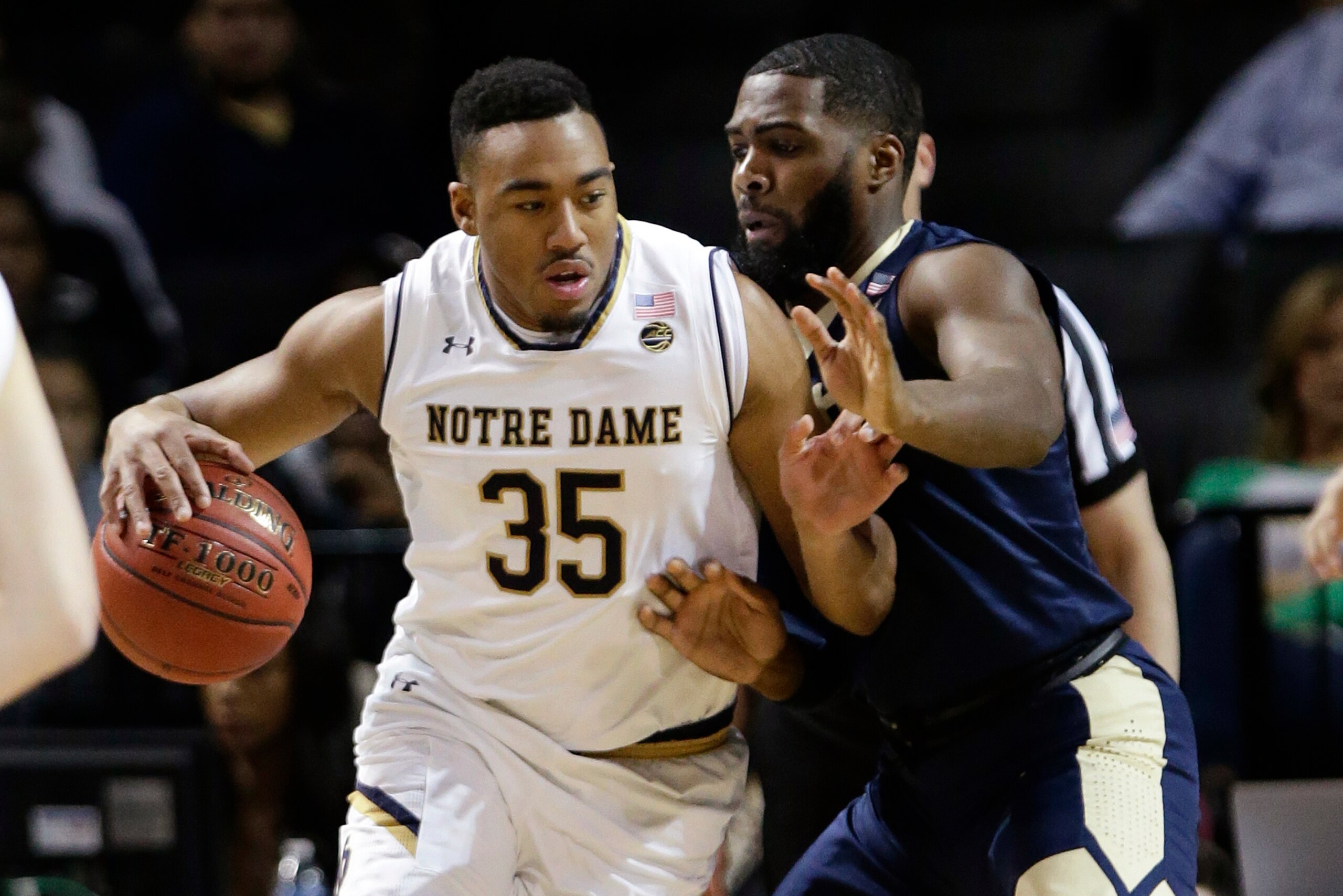
But I cannot recall a time when a preseason All-American missed two months of the season before returning to a team that suffered nine losses in his absence.
It would be one thing if Notre Dame was awesome with Colson in the lineup, struggled without him and then was great again once he returned.
That's not the case, though. Everyone seems to have forgotten that the Fighting Irish weren't that good with Colson. They had one impressive victory over Wichita State, but even that game required a frantic second-half comeback and one of the biggest bailout, last-second foul calls of the entire season. Notre Dame also lost games to Ball State and Indiana while at full strength.
Hell, Notre Dame wasn't even in the first five out of my New Year's projected bracket. At that time, the Irish were 11-3 with an RPI rank of 71. So, even if the committee did decide to completely disregard the 15 games played without Colson and solely judge this team on what it has been with him, we're still talking about a bubble team, at best.
That said, despite the loss to Duke in the ACC quarterfinal, the Fighting Irish are still in the conversation—even if it's only because we spent so much time talking about them and aren't quite ready to say goodbye for good.
Let's keep things rolling with a non-bubble question from @Baselne2Packlne:
"Will Michigan State end up as the 2/3/4 seed in UVA's bracket again? I'm seeing this decently often in bracketologies. But why wouldn't they be placed in the Midwest bracket over the South?"
I can't speak for the other bracketologists, but I currently have Michigan State as the third-best resume from the Big Ten, behind both Michigan and Purdue.
That's an important thing to note, because there is a bracketing principle that requires the top four teams in a conference go to different regions if they are No. 4 seeds or better. In a vacuum, Michigan State would obviously prefer to be in the Midwest (Omaha) Region. But so would Michigan and Purdue, and based on my seeding, they get dibs before Michigan State.
Moreover, because of the aforementioned bracketing principle, ACC teams Duke, North Carolina and Clemson would not be allowed to land in the same region as Virginia, which further limits the options on where we can place the Spartans.
Honestly, it's coincidental that Michigan State always seems to be projected for the same region as Virginia. After the results of the 2014 and 2015 tournaments, I fully appreciate Virginia fans not taking too kindly to that coincidence. But it'll all boil down to where the Spartans land on that final seed list. If the committee has them ahead of Michigan and Purdue, they'll be the ones in Omaha.
How about one more non-bubble question? This one is from @mmoats1997, who asked basically the exact same question last year:
"Who is the one mid-major no one wants to see in round one? Murray State?"
Murray State is one good choice. Jonathan Stark is a ridiculously talented lead guard who could put on a 2008 Stephen Curry show by scoring a million points in a couple of upsets. The senior has averaged 24.5 over his last 22 games and is impossible to completely shut down.
But the Racers aren't the one mid-major team I'd be worried about.
Neither is Loyola-Chicago, though that is an excellent shooting team loaded with veterans. The Ramblers proved how dangerous they can be with a road win over Florida back in December. And after a slow start in Missouri Valley Conference play, they cruised to 17 wins in their final 18 games.
South Dakota State is another team that will cause sleepless nights for the coaching staff of its first-round foe. The combo of Mike Daum and David Jenkins Jr. is one of the best in the country, mid-major or not. But the Jackrabbits play atrocious defense—barely in the top 150 in adjusted defensive efficiency—which keeps them from being the singular team you want to avoid.

The correct answer is Nevada, which spent time in the AP Top 25 this season.
Nevada was the obvious No. 1 choice until it lost starting point guard Lindsey Drew to a season-ending injury. The Wolf Pack haven't been quite the same since then, even though there's still a ton of talent in Jordan Caroline, Kendall Stephens and Caleb and Cody Martin. They still have Elite Eight potential.
Two more questions and that's a wrap. The penultimate pregunta comes from @walther924:
"How do you evaluate different conference tournament performances? Arizona State falls to Colorado in the first round but the buffs are decent. Marquette SHOULD beat DePaul but then they will more than likely lose to Nova. How do you evaluate those 2 teams then?"
One of the hardest parts of this whole bracketology process is not putting too much stock into what happens during Championship Week.
It's almost impossible to avoid recency bias, especially with the talking heads constantly bringing up the undefinable "eye test." But the truth of the matter is that these games in March count for just as much as the games in November.
The difference is this is the final piece (or pieces) of the puzzle, and at this point, we have a pretty good idea of what more each team needs to do to either get into the field or solidify its spot.
Mathematically, Arizona State's neutral-court loss to Colorado on Wednesday might as well have happened four months ago. It didn't count for more than any of Arizona State's other 30 games. It's just that the other 30 games had already occurred and set the stage for this do-or-die game.
As far as Marquette goes, it did exactly what was expected, beating DePaul before losing to Villanova. All told, the resume didn't change one bit for the Golden Eagles as a result of those two games.
Also, the selection committee begins the whole selecting-and-seeding process on the Tuesday before Selection Sunday. They are aware of the games taking place in the conference tournaments and spend a lot of time watching them on TV, but they already began discussions with their perceptions of what these teams are after the regular season.
A deep run or a brutal loss might send some shockwaves through the selection room, but if anything, most of these major-conference tournament games are probably less important to the overall resume than what happens during the regular season, even though these games get the most national attention.
Last, but not least, we have an important question from @morrisoncrying:
"What would have to happen for the committee to leave Saint Mary's out/what're the odds of that happening?"
From the eye-test perspective, it would be a crime if Saint Mary's doesn't receive an invitation to the Big Dance. The 28-5 Gaels have one of the most efficient offenses in the nation, ranking fourth in effective field-goal percentage. They also have a legitimate National Player of the Year candidate in Jock Landale. And they got a big road win over Gonzaga back in January.
The problem is Saint Mary's didn't do anything else. Its second-best win was a home game against New Mexico State. After that, it's the season sweep of BYU, which is kind of nullified by the loss to the Cougars in the WCC tournament.
And that's it. No other Quadrant 1 or Quadrant 2 wins for the Gaels, who deliberately put together a weak nonconference schedule for the umpteenth consecutive year.
That would probably be OK if they had taken care of business against Quadrants 3 and 4, but they suffered bad losses to Washington State and San Francisco. They also had a neutral-court loss to Georgia, which wasn't great at the time and hasn't aged well.

For Saint Mary's to get in, it needs to hope that major-conference teams on the bubble continue to shoot themselves in the foot and that the top mid-major teams win their conference tournaments.
Fair or not, the second part of that equation might be the most important. If it's just Saint Mary's that the committee is viewing as an at-large candidate, maybe they find a spot for the Gaels. But Middle Tennessee has already lost. If New Mexico State and/or Vermont falter in their conference tournaments, too, the committee may decide to just disregard all of them rather than choosing their favorites.
(I still contend this is what happened to Monmouth in 2016 when Saint Mary's, Valparaiso, San Diego State and Hofstra each lost in their conference tournaments and were all left out of the NCAA tournament.)
Long story short, a lot of things need to go right for Saint Mary's to get in at this point. The Gaels are right on the cut line for now, but each quality win by a bubble team and each bid thief will push them that much further away from the field.
Thanks for all the questions! If you missed out, there's always next year. And I'll still be on Twitter answering your questions through Selection Sunday and beyond.
Kerry Miller covers men's college basketball for Bleacher Report. You can follow him on Twitter, @kerrancejames.
.jpg?w=2560 "Steelers Saints Football")

.jpg?w=2560 "Packers Safety Slams Refs 🤬")
.jpg?w=2560 "🚨 Week 8 AP Top 25 Poll")