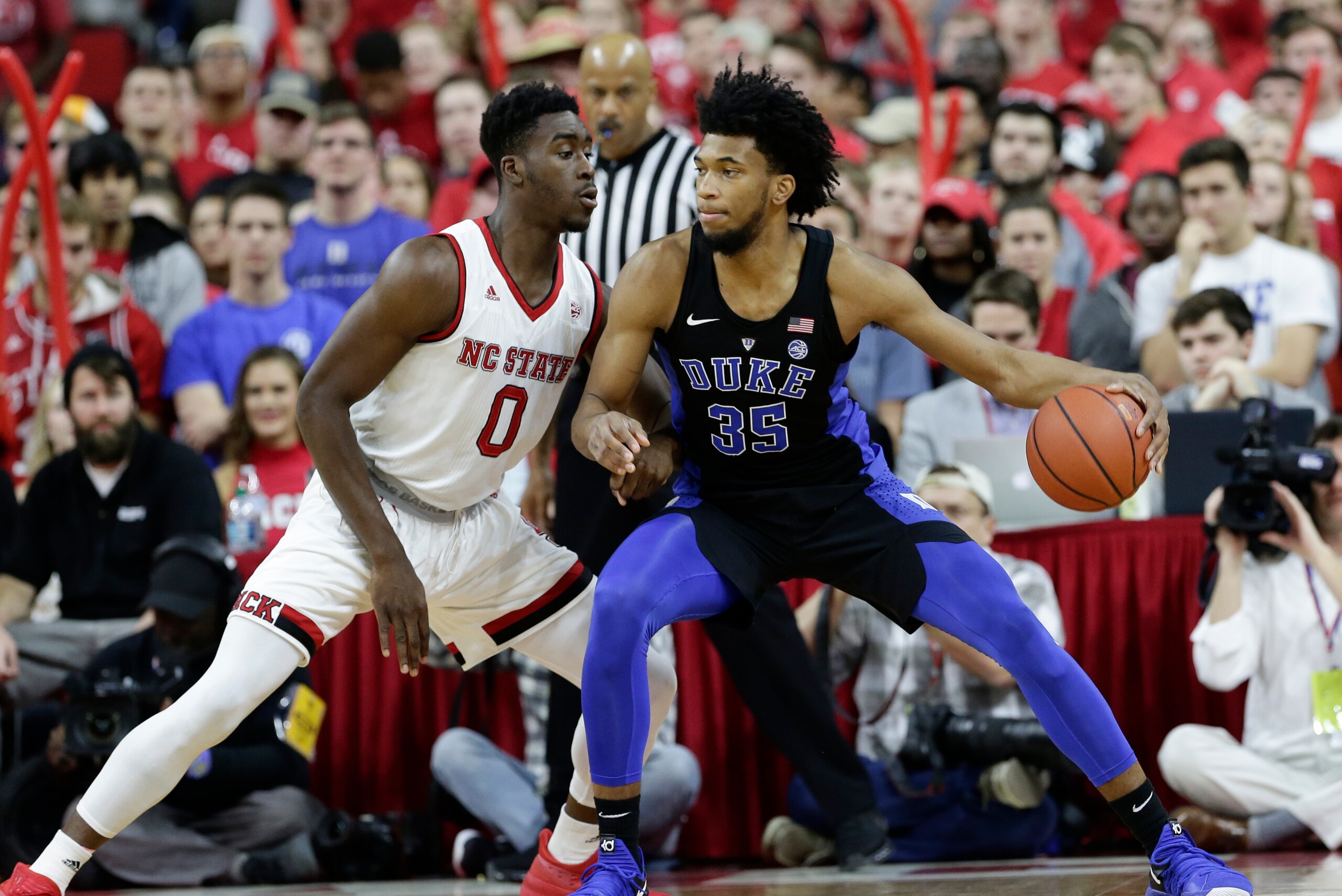


The NBA talent in college basketball is spread out nicely among the five major conference.
There is also Luka Doncic overseas and plenty of intriguing mid-major prospects. For now, we're just focusing on the top names from the ACC, Big 12, Big Ten, Pac-12 and SEC.
Which conference has the most future pros? It looks like the 2018 lottery could be heavily represented by the SEC.
Rankings were based on NBA potential. Draft projections account for a player's range if he chooses to declare in 2018.
ACC
1 of 5
5. Trevon Duval (Duke, PG, Freshman)
Projected draft range: Late first round
Shooting 26.9 percent from three and 61.0 percent at the free-throw line, Duval only scores 16.4 points per 40 minutes. But he'll still draw first-round looks for his ability to break down defenses with his quickness and handles.
The ACC's assist leader, he also ranks in the 98th percentile in pick-and-roll passing, per Synergy Sports. Cue up the Kris Dunn comparisons for their similar tools, attacking style and jump-shot trouble.
4. Bruce Brown Jr. (Miami, SG, Sophomore)
Projected draft range: Mid-to-late first round
The eye test on Brown is more convincing than the stats, which show he continues to have trouble with his jumper. But he also checks enough boxes to add value on days when he isn't making outside shots.
A 6'5" combo guard and two-way playmaker, Brown averages 4.1 assists, 6.9 rebounds and 1.3 steals. He grades out well as a pick-and-roll ball-handler by Synergy Sports, and he'll defend both guard positions.
Brown just needs to work on his shooting (21.7 percent jump shots) and creating (0-of-5 in isolation).
3. Lonnie Walker IV (Miami, SG, Freshman)
Projected draft range: Mid-to-late first round
Walker is starting to cook (15.7 points per game over his last three) after a slow start that may have been tied to an offseason knee injury. Long and athletic, he looks the part of a pro 2-guard. Despite some inconsistent shooting, his jump-shot mechanics and shot-making are more convincing than the early numbers.
Playing behind Brown and Ja'Quan Newton, Walker may want a second year at Miami to raise his stock, but his tools, athleticism and perimeter scoring potential should still be enough to draw 2018 first-round interest.
2. Wendell Carter Jr. (Duke, PF/C, Freshman)
Projected draft range: Lottery
Overshadowed in Duke's frontcourt by the ACC's top prospect, Carter has been a constant, making the plays his role calls for while flashing a skill set scouts can see translating.
Per 40 minutes, he's averaging 22.0 points, 14.3 rebounds and 3.1 blocks on 61.2 percent shooting and 11-of-23 from behind the arc. Carter shows advanced footwork in the post and a fluid jumper with range.
He doesn't jump out athletically, and there are some questions about his ability to guard NBA 4s around the perimeter. But his offense and nose for the ball appear real.
Al Horford continues to look like Carter's best pro-player comparison.
1. Marvin Bagley III (Duke, PF/C, Freshman)
Projected draft range: Top four
Even without noticeable polish, Bagley still averages 21.9 points. Opponents haven't had any answers for his quickness, athleticism and motor around the rim, where he's generating 1.509 points per possession (95th percentile). He's making teams pay in the post (1.0 PPP, 84th percentile) as well.
His cutting (1.581 PPP), transition game (1.292 PPP), roll-man numbers (1.474 PPP) and putback success (1.397 PPP) each grade out as excellent by Synergy Sports.
The question marks with Bagley focus on his defense and shooting, as he's making just 30.8 percent of his jump shots and 61.7 percent of his free throws.
Big 12
2 of 5
5. Devonte' Graham (Kansas, PG, Senior)
Projected draft range: Second round
Graham will get looks as a potential backup for his ball-handling and jumper. He's making at least 40 percent of his threes for the third time, and he's raised his assist percentage to 31.6 percent from 19.2 percent.
Though not big or athletic, Graham is quick and shifty enough, and he's developed into an excellent pick-and-roll ball-handler (1.111 PPP) and shooter off the dribble (42 percent.)
4. Lagerald Vick (Kansas, wing, Junior)
Projected draft range: Second round
Vick is building an intriguing case for himself, having nearly doubled his scoring output to 14.1 points per game. Making 42.3 percent of his threes, Vick does most of his work as a spot-up shooter and cutter (26.5 percent of offense), finding ways to generate offense without being used to create.
Sticking at the next level will require Vick to become a more consistent defender.
3. Jevon Carter (West Virginia, PG, Senior)
Projected draft range: Late first to second round
Carter has built his identity around defense, where he's strong and aggressive with quick feet and hands that have led to 3.4 steals per game, second in the country. He may have moved the draft-stock needle for himself after holding Trae Young to 8-of-22 shooting and eight turnovers during West Virginia's win over Oklahoma earlier in January.
Averaging 6.3 assists, shooting 39.8 percent on 5.4 three-point attempts per game, Carter has also taken his offense to a new level. Limited speed and athleticism are reasons to hesitate on the 22-year-old senior.
2. Mohamed Bamba (Texas, C, Freshman)
Projected draft range: Top 10
NBA teams will look at Bamba as a defensive solution. Leading the nation in blocks (4.4 per game), he also forces opponents to think and adjust throughout a shot clock just by patrolling the paint. Between his feet and 7'9" wingspan, Bamba offers enormous upside in rim protection, as well as a high-percentage finishing target and cleanup man on the offensive glass.
With a lean frame, he's struggled to score playing with his back to the basket (11-of-30). His jump-shot development (7-of-34 3PT, 59.3 percent FT) will also be worth monitoring.
1. Trae Young (Oklahoma, PG, Freshman)
Projected draft range: Top 10
Scouts are still deciding how Young stacks up with the other elite prospects, but it sounds like most agree his success isn't fluky. Still leading the country in scoring (30.5) and assists (9.7) midway through conference play, Oklahoma's lead guard taps into his quickness, handles and smarts to create offense and compensate for underwhelming size, length and explosiveness.
And with excellent vision and unlimited shooting range, he's capitalizing on his own creativity at a historic rate.
Young has been given a bright green light to average 20.6 shots and 5.3 turnovers per game. He'll have a major adjustment to make moving to the pros, both physically and role-wise. But his mix of quickness and ball skills has been too persuasive, even if his numbers are somewhat inflated.
Big Ten
3 of 5
5. Kevin Huerter (Maryland, wing, Sophomore)
Projected draft range: Second round
Huerter may be a year or two away from declaring, but when he does, there will be interest in his shooting. Making 47.0 percent of his 5.5 three-point attempts per game, the 6'7" sophomore wing has a sweet stroke and quick release with range off spot-ups and screens.
4. Justin Jackson (Maryland, SF/PF, Sophomore)
Projected draft range: Second round
A torn labrum doesn't erase Jackson's potential or previous NBA interest that existed. He wouldn't have been invited to the combine last year if teams weren't intrigued. Jackson stands out for his 6'7", 225-pound frame, 7'3" wingspan, shooting and hopeful defensive versatility.
3. Keita Bates-Diop (Ohio State, SF/PF, Junior)
Projected draft range: Mid-first round to second round
One of the country's breakout performers, Bates-Diop has bounced back from a leg injury to average 19.7 points and 8.9 rebounds. He's scoring from everywhere, making two threes per game and shooting 57.6 percent inside the arc.
Between his defensive tools, which he can use to guard multiple positions, and his newfound shot-making skills, Bates-Diop has emerged as a first-round name who continues to strengthen his stock and credibility.
2. Miles Bridges (Michigan State, SF/PF, Sophomore)
Projected draft range: Mid-first round
Bridges hasn't added or changed much to his game, though he's still averaging 16.9 points, creating highlights with his explosive leaping at the rim. He's also making at least two threes per game for the second straight year.
Bridges needs to work on his pull-up (26.8 percent) and runner (five makes total), but he has been effective when run off the three-point line, averaging 1.409 points per possession on drives to the basket out of spot-ups.
1. Jaren Jackson Jr. (Michigan State, PF/C, Freshman)
Projected draft range: Top 10
Scouts are high on Jackson's potential, which is fueled by a mix of physical tools, defensive versatility and shooting.
At 6'11", 242 pounds with a 7'4" wingspan, he makes 44.6 percent of his threes and leads the nation in defensive plus-minus, blocking 5.5 shots per 40 minutes. He's also 9-of-12 out of the post and difficult to challenge thanks to his strong frame and high release point.
Jackson isn't an advanced shot-creator. He's not overly fluid when attempting to face up and put the ball on the floor. But it's his fit in today's NBA that's remained such an appealing selling point. Almost every team in the lottery could use additional three-and-D up front.



Pac-12
4 of 5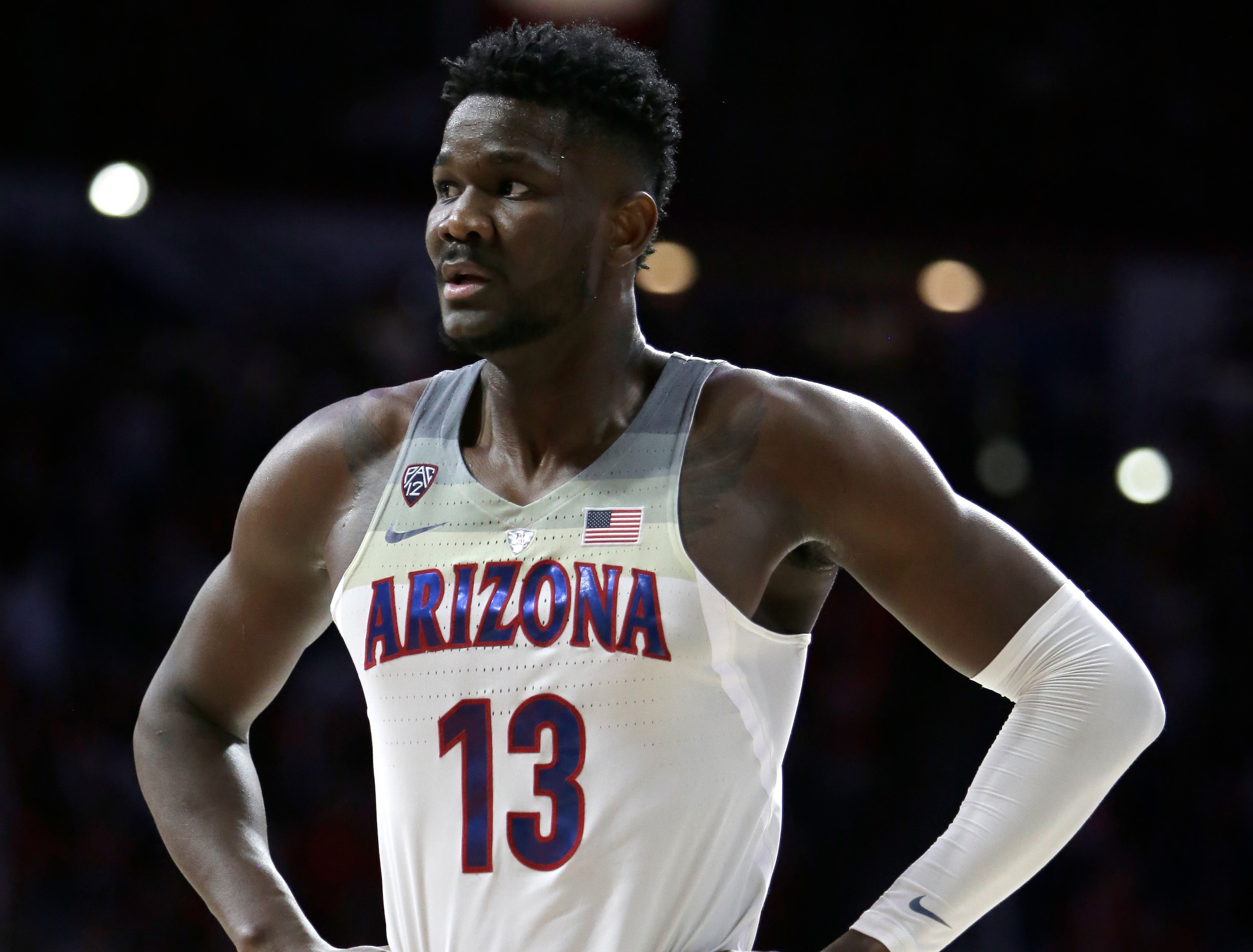
5. Chimezie Metu (USC, PF/C, Junior)
Projected draft range: Late first to second round
Making a consistent impact at both ends has been Metu's toughest challenge. Otherwise, at 6'11", 225 pounds, his tools, athleticism and scoring skill set point to NBA potential.
Metu averages 16.8 points, doing work as a post (.770 PPP) and isolation (.929 PPP) scorer, cutter (1.323 PPP) and roll man (1.306 PPP).
4. Aaron Holiday (UCLA, PG, Junior)
Projected draft range: Late first to second round
Size and athleticism work against Holiday, but he's averaging 18.8 points and 5.1 assists, shooting over 39 percent from three for the third straight season. He resembles Dallas Mavericks guard Yogi Ferrell, whose ball-handling and jumper have helped him stick.
Teams will view Holiday as a change-of-pace spark to bring off the bench.
3. De'Anthony Melton (USC, PG/SG, Sophomore)
Projected draft range: Late first to second round
USC is holding Melton out for the year based on possible ties to the FBI's pay-for-play investigation. He would still draw NBA interest if he chose to leave school.
Melton established himself as a prospect to watch after his freshman year, when he registered per-40 minutes numbers of 7.0 rebounds, 5.1 assists, 2.8 steals and 1.5 blocks.
A 6'4", two-way playmaker who plays and guards both backcourt positions, Melton has flashed the versatility that hints at NBA role-player potential.
2. Troy Brown (Oregon, wing, Freshman)
Projected draft range: First round
Even in a supporting role at Oregon, where his scoring goes on and off, Brown still jumps out under the NBA lens for his physical tools and versatility. Averaging 6.8 rebounds, 3.2 assists and 1.2 steals, he checks enough boxes to buy his jump-shot development extra time.
Brown could be viewed as a point-wing for his playmaking and passing. And he stands out as a savvy defender capable of guarding positions 1-3. Shooting could be the swing skill that determines how high his ceiling will go.
1. Deandre Ayton (Arizona, C, Freshman)
Projected draft range: Top three
Strong, long and athletic, Ayton separates himself with grown-man tools and a budding skill level. He's averaging 19.7 points on 62.9 percent shooting, generating 1.079 PPP in the post (90th percentile).
Ayton has an improved back-to-the-basket game and jumper; he has connected on 43.2 percent of his attempts inside the arc. Behind it, he's made eight threes, though he isn't ready to consistently convert.
Defense has been the primary concern with Ayton, who doesn't demonstrate the strongest instincts. But his lateral quickness and 7'5 ½" wingspan are reasons to remain optimistic and patient. He'll enter the draft as its most advanced big man, both physically and offensively.
SEC
5 of 5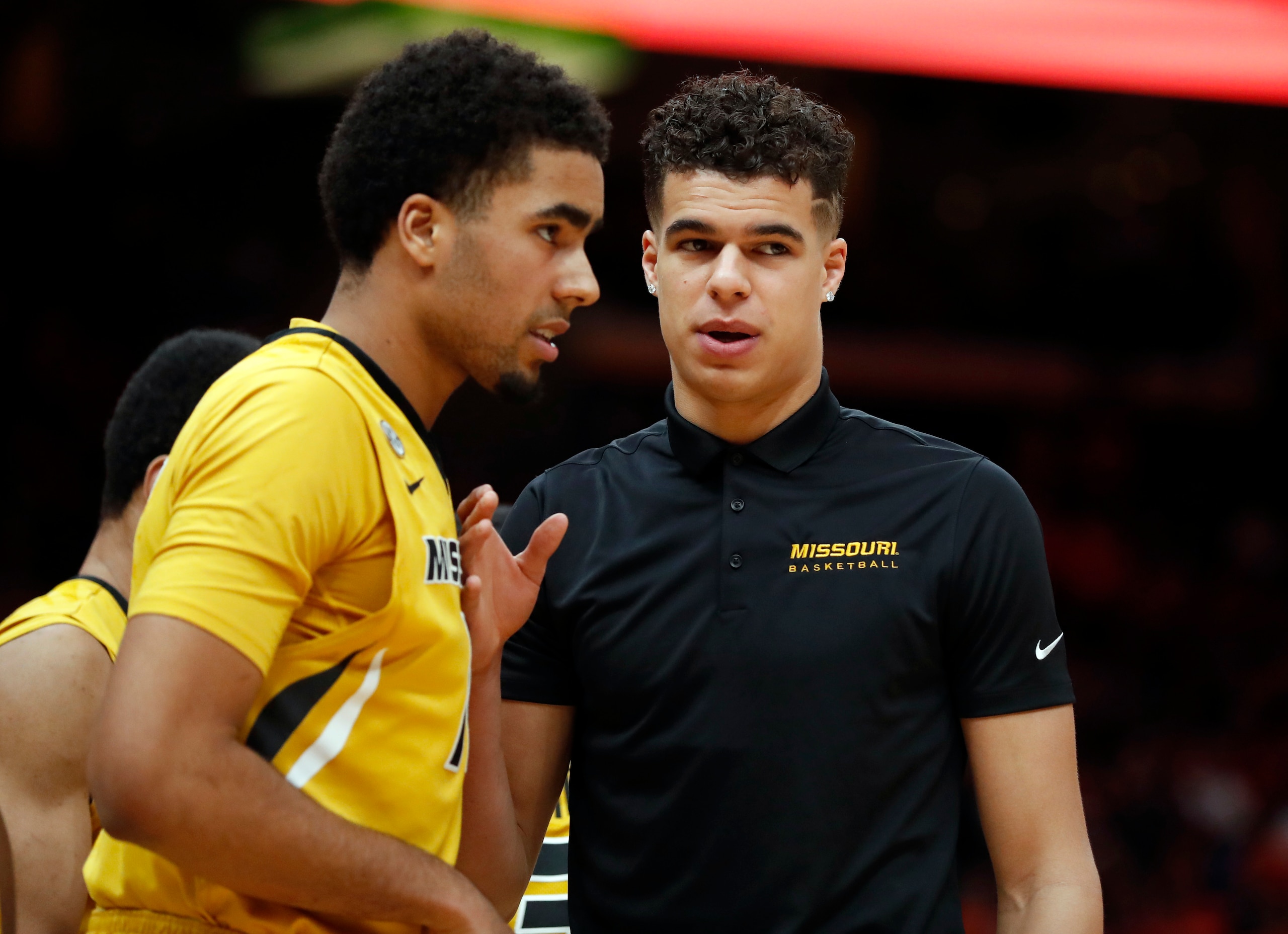
5. Robert Williams (Texas A&M, C, Sophomore)
Projected draft range: Lottery to late first round
Though Williams' skill level hasn't improved (9.6 points per game), he's still been a valuable weapon around the basket, where he ranks in the 95th percentile as a finisher (72.9 percent). His size, length and explosiveness suggest the easy baskets, rebounding (9.5 per game) and rim protection (2.4 blocks) will carry over.
4. Daniel Gafford (Arkansas, PF/C, Freshman)
Projected draft range: Lottery to late first round
Off the one-and-done radar to start the season, Gafford has suddenly become a name lottery teams will be scouting. Big (6'11", 234 lbs) and light on his feet, he leans on his tools, athleticism and motor to generate offense and block shots (3.6 per 40 minutes).
Though limited as a scorer and shooter, he's still averaging 21.9 points per 40 minutes, 1.292 points per possession as a roll man (84th percentile) and 1.75 PPP in transition (100th percentile).
3. Kevin Knox (Kentucky, SF/PF, Freshman)
Projected draft range: Lottery
The ups outweigh the occasional downs for Knox, who's 18 years old and 6'9" with perimeter scoring skills. Capable from three (25 makes) with a pull-up (44.8 percent) and runner (13-of-26) in the arsenal, he averages 14.3 points to lead Kentucky.
Just 2-of-11 out of isolation and shooting 29.8 percent from three, Knox needs to sharpen his ball skills and shooting, but he's shown enough promise for his age.
2. Collin Sexton (Alabama, PG/SG, Freshman)
Projected draft range: Lottery
Second in the SEC in scoring (19.3 PPG), Sexton has been at his best in the pick-and-roll game, averaging .991 points per possession (86th percentile). Quick and strong, he is tough to stop from turning the corner and getting to the basket. He's attempting 8.1 free throws per game, constantly putting pressure on defenses.
His shooting has started to cool, while his 3.4 assists to 2.8 turnovers aren't ideal. Sexton is undoubtedly a scoring point guard, but his playmaking and decision-making need work.
1. Michael Porter Jr. (Missouri, SF/PF, Freshman)
Projected draft range: Top six
Missing the season won't cost Porter much on draft night unless teams find issues with the medical reports on his back. Scouts have seen him for years, dating back to USA basketball in 2014.
At 6'10", Porter has distinguished himself with a mismatch mix of power forward size and perimeter skills. He's a scorer, special for his ability to face up, create, make tough shots and shoot threes over defenders.
Some scouts before the season picked him as the favorite to go No. 1. It won't happen, thanks to his injury and stiff competition, but Porter will remain top six on team boards through June, even without suiting up for Missouri.
Advanced stats courtesy of Synergy Sports.
.jpg?w=2560 "Raiders Could Start Mendoza")

.jpg?w=2560 "Rodgers Iced Out on Plane 💎")

.jpg?w=2560 "🚨 Week 8 AP Top 25 Poll")