Can Gabriel Jesus and Sergio Aguero Play Together for Manchester City?
In 21 Champions League and Premier League matches this season, Gabriel Jesus and Sergio Aguero have started together just six times for Manchester City.
Two of those six have seen them play as a two-man strike force; the other four have seen Jesus pushed out to the wing, allowing Aguero to take the sole central berth.
Although both have been incredibly productive—Aguero has 12 goals in all competitions, Jesus 10—they have largely done their work isolated from one another, trading time on the pitch and replacing one another in the rotation machine, or joining one another off the bench late in games. It is not, by any means, a "partnership."
TOP NEWS
Highlights and Viral Moments 🍿

Final Men's Ballon d'Or Rankings 📊

J-Dub Suffers Gruesome Injury
Throwing one on to join the other late in games has proved pretty successful for City manager Pep Guardiola.
Wednesday's loss to Shakhtar Donetsk saw Aguero come off the bench to convert a penalty Jesus had won; in November, Jesus twice came on late to provide telling assists—against West Ham United for Nicolas Otamendi's bundled equaliser, and against Huddersfield Town for Raheem Sterling's winner.

What's notable, though, is that in each of those Premier League games, Aguero was withdrawn just two minutes after City scored what would be their winning goal, leaving Jesus up top alone. It feels very much as though Guardiola is set in his decision that having both on can only be temporary.
Will they ever be able to work in tandem, as a starting strike pair, or are they destined to share game time and vie with one another for the nod in the biggest matches?
Never Before
As enticing as the idea of deploying Jesus and Aguero as a starting combination is, it doesn't mesh with Guardiola's tactical style at all; there is no precedent for him attempting to make it work.
Never in his managerial career has he utilised two strikers with frequency, opting for Lionel Messi at Barcelona, Robert Lewandowski at Bayern Munich and a rotation at City.
It's not that he didn't possess options at previous clubs. At Barcelona, he had Thierry Henry and David Villa but played them off the flank; at Bayern, he had Mario Mandzukic for a spell, and Thomas Muller was always there, capable and ready to step in.

Generally speaking, though, utilising two strikers reduces the number of midfielders you can play, and for Guardiola, numerical superiority and control of the ball in the centre is the foundation of his footballing philosophy.
The teams he has managed have been so powerful they would likely be able to overwhelm most others from a 4-4-2 shape, but he has no inclination to set out in that formation—it would only be seen as a last resort.
It has resulted in an extremely heavy churn of back-up or rotational strikers at clubs managed by Guardiola, as they simply don't get enough game time to stay happy or continue progressing. Since he began his managerial career in 2008, there has been at least one notable change in the forward corps in every summer transfer window he has presided over.
A Risky Trial
The opening day of the 2017-18 Premier League season saw City travel to Brighton & Hove Albion and start with Jesus and Aguero up front together. In order to accommodate it and retain a three-man, controlling midfield, Guardiola utilised a back three and wing-backs to form a 3-5-2 shape.
This was a calculated, partially political gamble. Dropping club legend Aguero for the opener could have backfired if the result hadn’t gone their way, but a show of faith in Jesus, whose early 2017 was wiped out by injury, was important, too.
He also had a similar issue in defence, with club captain Vincent Kompany fit and available but not necessarily his first choice.
He fielded them all.
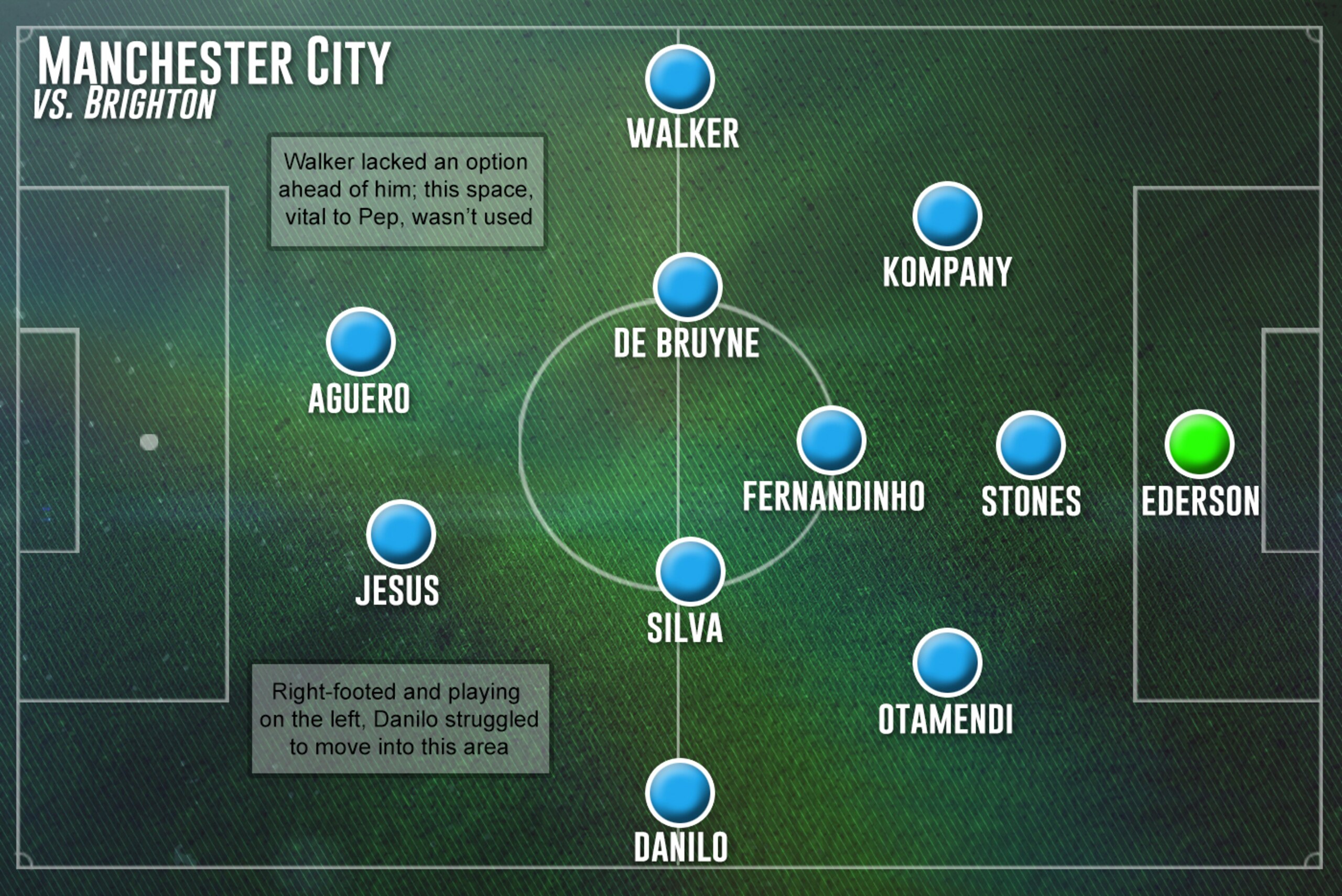
City won the game 2-0 but largely by virtue of having significantly better players than a newly promoted club, and the performance wasn't so fluent.
Danilo playing as a wrong-footed wing-back was a large share of the issue, and the ball too often ended up with Kyle Walker on the right flank with no option ahead of him.
The ball was recycled across the back three pointlessly and endlessly; 78 percent possession accrued, but just four shots on target mustered.
Revert to Type
Contrast the opening-day performance with the ones produced against Feyenoord (4-0), Watford (6-0), Stoke City (7-2) and Burnley (3-0) and more, and it looks like two different teams.
The key? Against Brighton, Guardiola compromised; against the others, he returned to what he knows best: fielding a 4-3-3 formation with the correct personnel to carry out his instructions.
City's attack is nicely varied, and the midfield boasts players capable of creating chances in lots of different ways, but it's notable just how often the team attempt to feed Leroy Sane (left wing) and Sterling (right wing) at the moment.
In particular, releasing the Germany international into space behind the full-back, or getting him to the byline in a position to cross low into the box, appears to be the No. 1 aim.

Cracking open defences from the edge and utilising players who can win one-on-one is essential for Guardiola, who now meets teams setting up with a low, defensive block on a weekly basis. There's too much of an onus on Kevin De Bruyne and David Silva—who are being closely marked—to unlock defences otherwise.
What Sane and Sterling do from those wing positions, wriggling through tight spaces and getting around defensive teams, isn't too dissimilar to what Pedro did for Barcelona under Guardiola, or what Kingsley Coman would do so well off the bench at Bayern.
Natural width, speed and decision-making kills, and the City boss knows it.
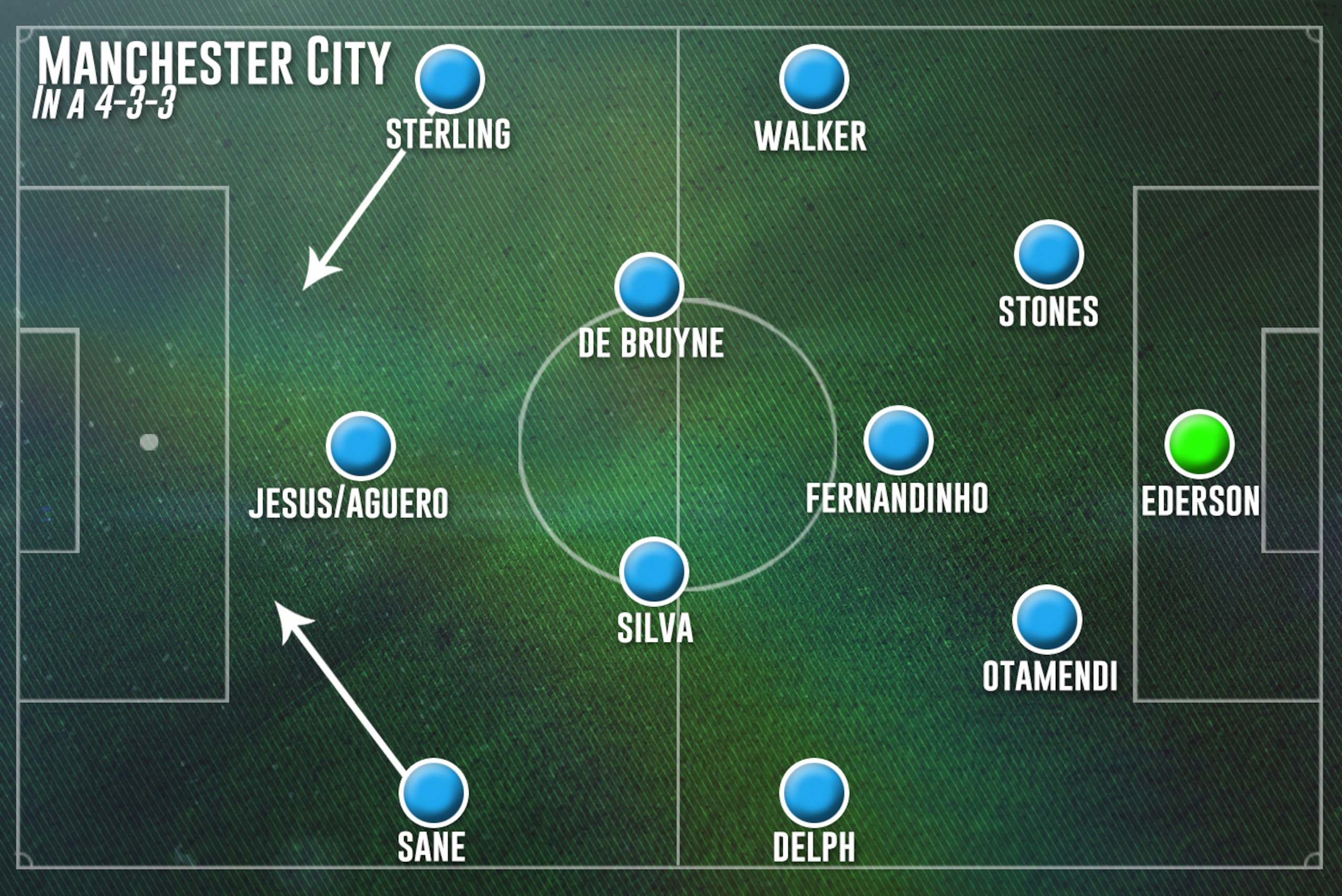
In order to operate with players in Sane and Sterling's roles, plus the three-man midfield and regular back four, there can only be one striker.
Guardiola tried to make it work another way—against Brighton, Sane and Sterling were on the bench, and the team started with no wingers—but he quickly gravitated back to what he believes in and what clearly works best.
How quickly he reverted to type is telling: If you exclude Wednesday's throwaway game against Shakhtar (where Phil Foden played left-wing-back and Tosin Adarabioyo joined Eliaquim Mangala and Fernandinho on the bench), we haven't seen the 3-5-2 formation since September.
Jesus Wide?
In four games this season, Jesus and Aguero have lined up together in a 4-3-3 formation. That's naturally meant the Brazil international has played wide, operating off the left against Feyenoord, Watford and Southampton while playing from the right against Shakhtar at home.
All four of those games have been wins, two by large margins, with Jesus either dovetailing with Aguero in the buildup to goals or driving inside from the left to create chances. He is capable of playing the role, no question.

The problem is, he is in direct competition for that spot with Sane, who has been incredible this term—eight goals and six assists in all competitions—and to a lesser extent Bernardo Silva, who cost £43 million-plus last summer and has barely dipped his toes in the Premier League pool.
Just like when they are thrown in together in need of a goal late in a game, Jesus wide of Aguero works, but it's another example of the two playing together only really being a last throw of the dice.
All statistics via WhoScored.com
.jpg?w=2560 "Rams Raiders Football")

.jpg?w=2560 "Rodgers Iced Out on Plane 💎")

.jpg?w=2560 "Packers Safety Slams Refs 🤬")

.jpg?w=2560 "🚨 Week 8 AP Top 25 Poll")