

Good thing we're not required to hold our breath after forecasting the NBA's next crop of breakout candidates.
Every so often, a player does something to invite loftier expectations. Sometimes, he outperforms rookie-year projections. Other times, he makes unanticipated strides as a sophomore. In certain instances, he simply entered the league to much ado, either because he was drafted with a high lottery pick or incited steal-of-the-night jibber-jabber.
More than a few of these household names in training live up to the towering bars set before them. But not everyone is so dependable—or lucky. Some never parlay their hype into sustainable practice.
This one's for those in danger of not meeting their estimated. These players have been billed as patented building blocks or future superstars. They've delivered stretches, sometimes entire seasons, that evoke ambitious projections but have yet to convert them into new norms.
All of them are young enough to flip the script. None of them are complete flops. They've just turned overwhelmingly positive trajectories into matters of uncertainty.
Honorable Mentions
1 of 6
Devin Booker, Phoenix Suns
Devin Booker made "The Leap" as a rookie, backed up his scoring mystique as a sophomore and is doing the same thing as a third-year alpha. How much better is he supposed to get?
No one is waiting for him to reinvent himself on defense. He occasionally makes good reads when harassing pick-and-rolls and has improved as a closeout defender under interim head coach Jay Triano. Playing beside a better, more seasoned supporting cast would heighten expectations, but he's not someone who should be expected to do anything other than hone his effort and anticipation when facing screens and handoffs. (He's made some strides there, too.)
Something also has to be said for his launching more shots and assuming more offensive responsibilities without torpedoing his efficiency. This would be the first season he registers a true shooting percentage in line with the league average, but he's never fallen too far below board.
And Booker's vision is on the come-up. He's averaging a career-best 5.8 assists per 100 possessions and more potential dimes than Kyrie Irving. The Phoenix Suns are scoring like a top-10 offense over their past 10 games with him on the court. They'll need more from him in the coming years—beginning with fewer contested pull-ups—but calling him an inefficient gunner is overkill. The Suns are waiting on him to iron out a few wrinkles, not repeat his rookie-season liftoff.
Elfrid Payton, Orlando Magic
Elfrid Payton only fails to get a main-attraction nod because we're privy to his cyclical act by now: lower the bar to start the season, detonate after the All-Star break, summon lingering belief and then crush that faith to begin the following year.
Rinse, lather, repeat.
Just look at Payton's career splits:
- Pre-All-Star Break: 10.4 points, 3.7 rebounds, 5.8 assists, 48.0 true shooting percentage, 99.0 offensive rating
- Post-All-Star Break: 11.4 points, 5.3 rebounds, 8.1 assists, 50.4 true shooting percentage, 108 offensive rating
The discrepancy in his performance is even more pronounced when looking at 2016-17 alone. He averaged 13.5 points, 7.0 rebounds and 8.4 assists with a 55.6 true shooting percentage after last year's All-Star break, during which time the Orlando Magic scored like a top-five offense when he was running the show.
Demanding anything more than seasonal seesawing from Payton just seems tacky at this stage. The Magic are exploring alternative means of playmaking with spacier lineups. The rest of us should give up on the idea of Payton cementing himself as an above-average floor general.
Dennis Schroder, Atlanta Hawks
Dennis Schroder has the individual numbers. He's averaging 19.7 points and 6.8 assists per game on a reasonable 45.1 percent shooting in his first season as the Atlanta Hawks' leading man.
Can he be the driving force of a quality offense? That much is unknown.
Atlanta is pumping in 104.7 possessions when he's the pilot—both underwhelming and impressive. That wouldn't be good enough for a top-12 finish, but Schroder isn't working with a lot of bucket-getting talent and the Hawks had a worse offensive rating with him at the helm last year, when Tim Hardaway Jr. and Paul Millsap were on the team.
It still isn't safe to say Schroder has turned the corner. He is a predictable decision-maker when attacking the basket and doesn't reach the foul line nearly enough for someone who leads the NBA in drives per game. He's shooting 40 percent on pull-up threes, but history suggests that'll implode.
Grinding out more trips to free-throw line, passing more on downhill attacks and maintaining league-average efficiency from deep for an entire season will go a long way toward validating Schroder as a franchise point guard. For now, his stock remains in limbo.
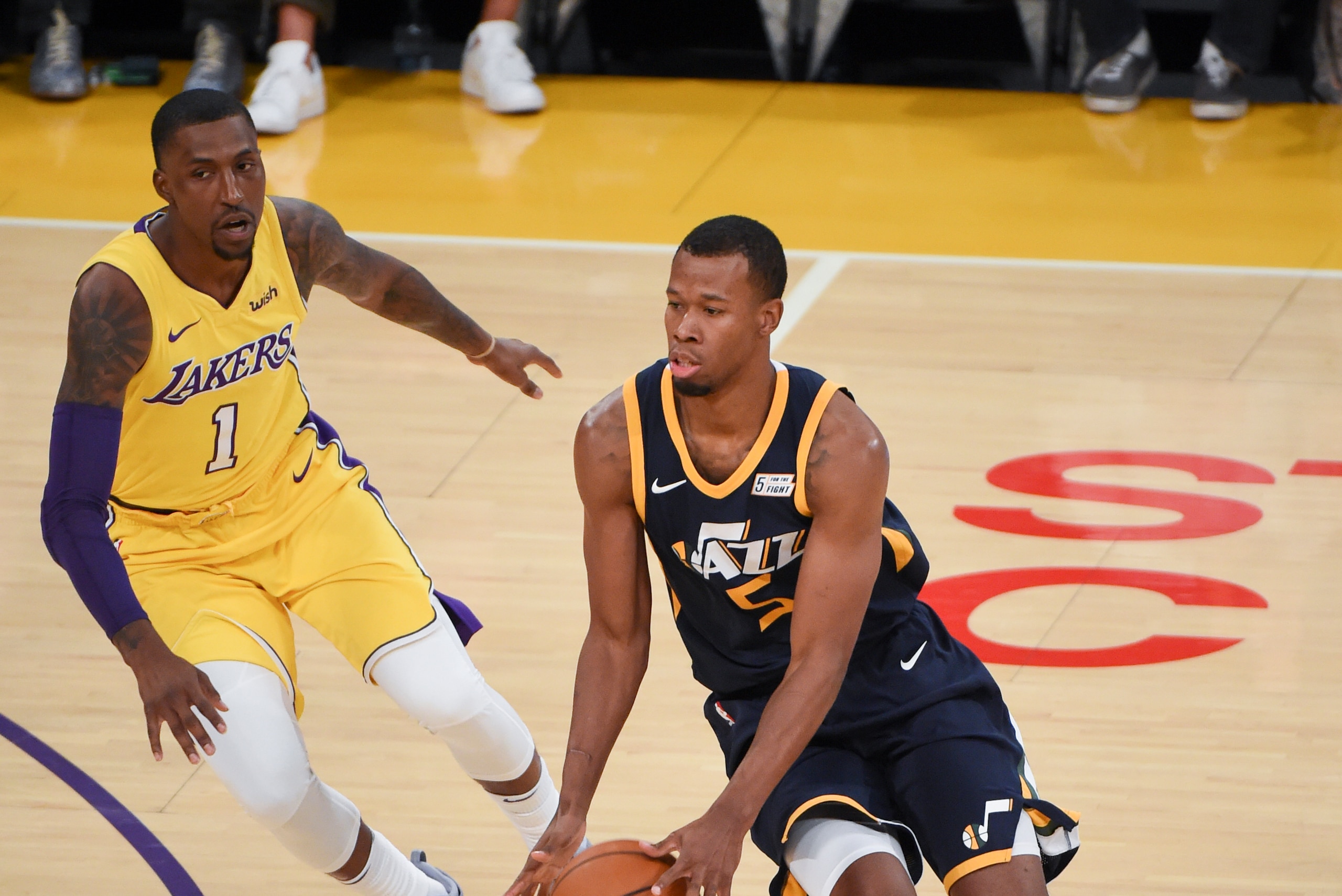
Kentavious Caldwell-Pope, Los Angeles Lakers
2 of 6
Age: 24
2017-18 Per-Game Stats: 12.9 points, 5.1 rebounds, 2.7 assists, 1.6 steals, 0.4 blocks, 42.5 percent shooting
Remember when Kentavious Caldwell-Pope was considered a max-contract formality ahead of last summer's foray into free agency? And remember how the Detroit Pistons cut bait with him after trading for Avery Bradley and hard-capping themselves...by signing Langston Galloway? And then remember how he needed to "settle" for a one-year, $17.8 million deal with the placeholder-sloshed Los Angeles Lakers.
Good times.
Spaceship loads of people misread the 2017 free-agency market. This writer sure did. Caldwell-Pope has never been worth a max contract in the literal sense, and few expected him to justify his expiring pay grade for the Lakers. But he looked like the Detroit Pistons' best player for a large chunk of last season, prior to his rotator cuff injury.
Reggie Jackson's absence allowed Caldwell-Pope to ferry more playmaking responsibilities. He saw additional time (early on) as a pick-and-roll initiator and averaged a career-high 3.9 assists per 100 possessions. His three-point clip dipped below the league mean by year's end, but his 35 percent conversion rate was a personal best, and he connected on more than 40 percent of his treys before encountering issues with his shoulder in January.
Signing with the Lakers never profiled as a cure-all for Caldwell-Pope's offensive inconsistencies. They have more perimeter mouths to feed, and Lonzo Ball gets priority reign when on the floor. That has gifted Caldwell-Pope with a simpler job description—and he's still existing in this weird offensive gray area.
The Lakers give him the green light to attack, and he's holding serve, if progressing, as a passer. He's deferring on 42 percent of his drives, up from 19.6 last season, and tallying more potential assists (5.8, compared to 5.1 in 2016-17) despite receiving fewer overall touches. Which, yay. But the tug-of-war over his scoring efficiency rages on.
A career-high 42.5 percent knockdown rate from the field isn't worth a humble brag when slightly more of his buckets are coming off assists. His improving shot profile (more threes, fewer long twos) hasn't equated to much better decision-making. No one on the Lakers attempts more pull-up jumpers, on which he's shooting under 32 percent, and he's putting down 21.4 percent of his looks out of the pick-and-roll—fourth-lowest mark among 105 players to finish at least 35 possessions as the ball-handler.
Pushing the pace hasn't helped Caldwell-Pope's topsy-turvy finishing in transition. More than 30 percent of his touches have come on the break, but he ranks in just the 46th percentile of efficiency. He settles for stop-and-pop threes, tries completing heavily contested layups and draws shooting fouls with less frequency than Robert Covington.
Caldwell-Pope's next jaunt into free agency next July is shaping up to be another fascinating ordeal. Teams can talk themselves into his feisty defense across all ball-dominant positions. They might even be sold on him as a tertiary setup man. But his long-awaited offensive leap, specifically as a scorer, remains in the "pending" queue—a potential red flag five years into his career.
Rodney Hood, Utah Jazz
3 of 6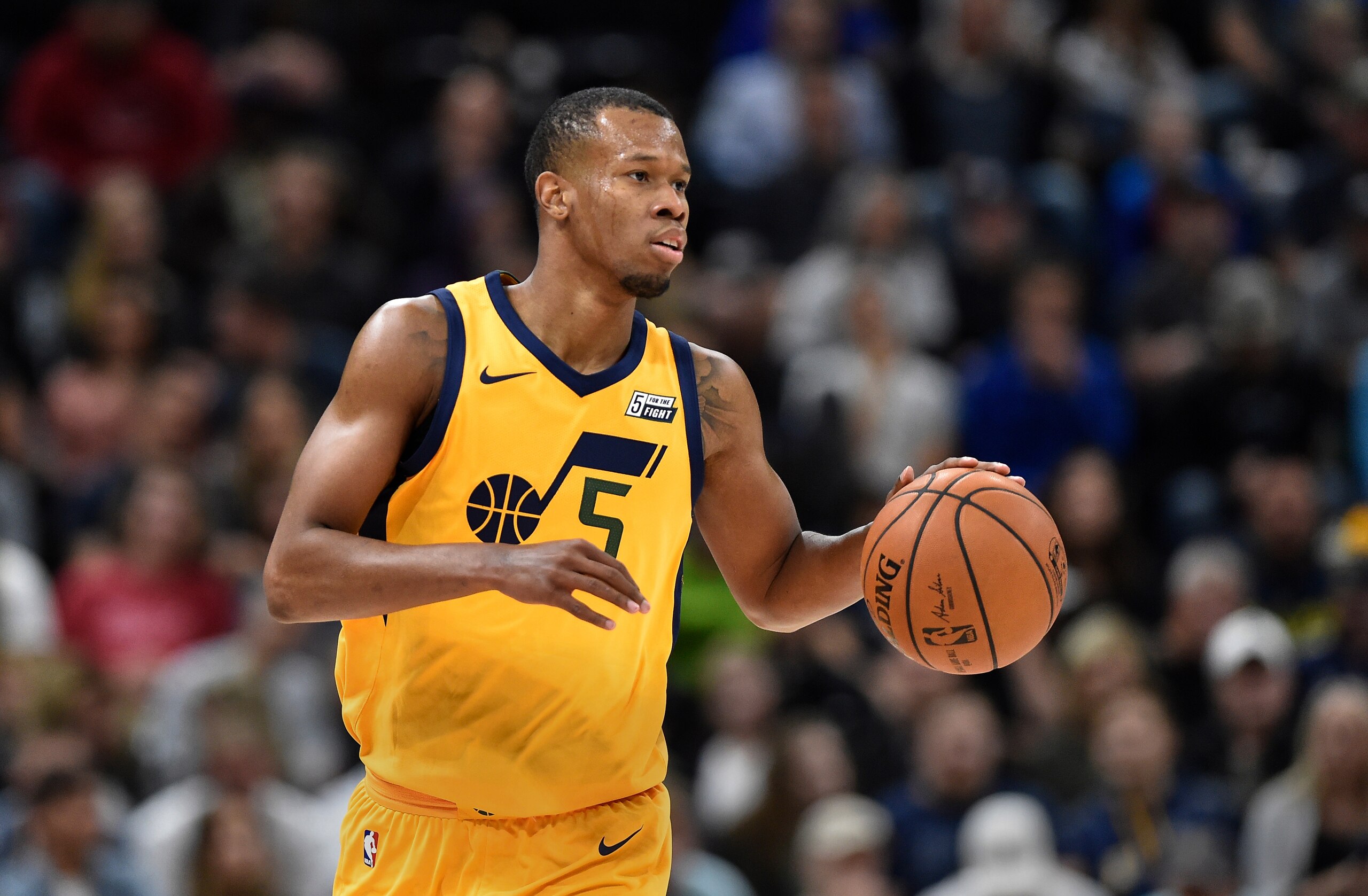
Age: 25
2017-18 Per-Game Stats: 17.7 points, 2.6 rebounds, 1.8 assists, 0.7 steals, 0.2 blocks, 41.9 percent shooting
Advanced Stats: 15.8 PER, -0.52 RPM, -19.34 TPA
Rodney Hood's ceiling is getting the ultimate test following departures from Gordon Hayward and George Hill. This season will, effectively, decide whether he has the zing and zip to be a featured offensive hub or winds up playing out his days as a second- or third-tier option.
Base this assessment solely off his most recent stretch, and the returns won't look too shabby. Hood is averaging 20.8 points and 2.0 assists on 46.6 percent shooting (46.2 percent from three) over his past eight appearances. The Utah Jazz continue to labor through stretches that reinforce the absence of an established pecking order, but they're piling on more than 115 points per 100 possessions with Hood in the game during this span—truly elite output.
Many of the lineups he headlines, though, have included stark defensive trade-offs. Hood himself hasn't been good on the less glamorous side relative to past years. He ranks 451st out of 456 players in defensive points saved, according to NBA Math. He's foul-happy when guarding pick-and-rolls and gets torched by spot-up shooters.
Utah will gladly stomach these concessions—especially now, with Rudy Gobert's absence largely stripping the team of its defensive identity. But Hood's hot streak is not necessarily sustainable; he's faced just one top-15 defense over these eight outings (Philadelphia 76ers). His 45.8 percent clip on pull-up threes isn't going to hold, and he doesn't have the one-on-one or crunch-time reps to buoy his recent uptick.
The Jazz have found some success with him as the triggerman on pick-and-rolls. He's shooting 45 percent when closing possessions as the ball-handler and isn't committing as many turnovers as Joe Ingles, Raul Neto or Ricky Rubio. But a definitive verdict cannot be rendered on his passing.
Hood is a serial settler. He doesn't reach the rim nearly enough to collapse defenses and still attempts a few too many low-efficiency twos. He is sixth on the team in potential assists despite being fourth in frontcourt touches. He doesn't cough up control when on the attack, but he's not dishing out meaningful passes either; Devin Booker posts a higher assist rate on his drives.
That Hood swishes more than 48 percent of his looks after using between two and six dribbles is a solid harbinger of his shot-making peak. But will that efficiency stick? He hit 38.6 of those same attempts last season.
More importantly: Will his full range of tricks coalesce into anything resembling a complete product? He mirrors an unfinished Khris Middleton right now—someone who flashes playmaking, on-ball scoring, off-ball sniping and defensive hustle, but rarely at the same time.



Norman Powell, Toronto Raptors
4 of 6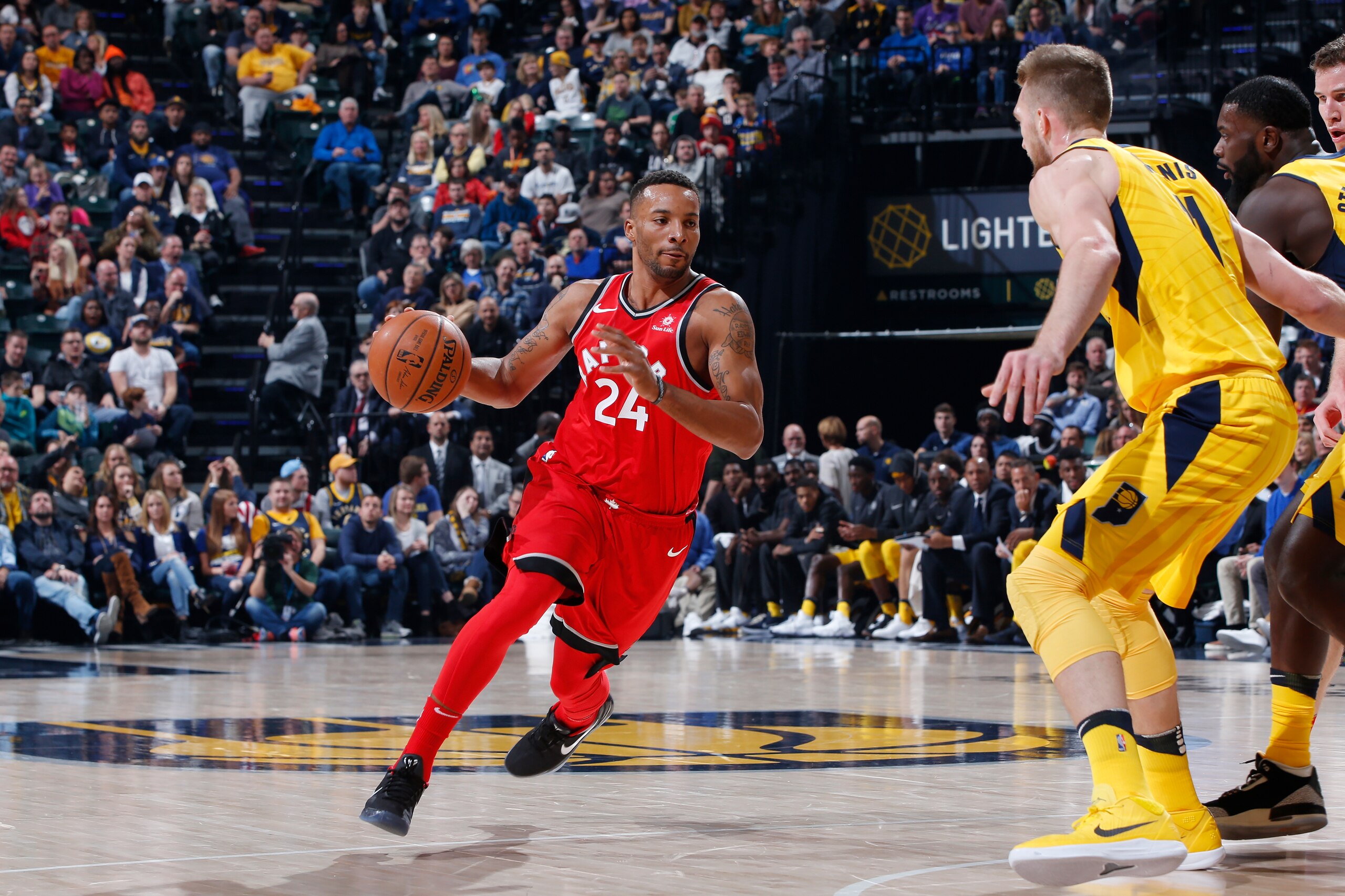
Age: 24
2017-18 Per-Game Stats: 9.5 points, 1.9 rebounds, 2.0 assists, 1.3 assists, 0.4 blocks, 43.8 percent shooting
Advanced Stats: 12.7 PER, -0.06 RPM, 3.55 TPA
Norman Powell is already a success story. Second-round picks don't typically emerge as key ingredients to a conference contender and broker four-year, $42 million extensions that generate universal nods of agreement before their 25th birthday.
Expecting too much box-score pizzazz out of Powell is also the wrong way to frame disappointment, however marginal. The Toronto Raptors aren't trying to turn him into a franchise face. They have DeMar DeRozan and Kyle Lowry to carry that burden.
Powell is who he's supposed to be in many respects: that defensive go-getter who strokes threes off the catch and looks to push the ball at every opportunity. But, at the same time, that shouldn't be all he is—particularly when he's not even the best version of that player and has curried lineup and/or big-picture favor over DeMarre Carroll, CJ Miles and Terrence Ross.
Milking Powell's spot-up touch works well for the Raptors. He's converting more than 43 percent of his standstill triples. Giving him the leeway to fire off the dribble isn't panning out as well. He's knocking down under 20 percent of his pull-up jumpers but sinking 54.1 percent of his shots on drives.
Fast-break buckets aren't coming as easily in his third year. Over 30 percent of his possessions originate on the run, where he's shooting 47.4 percent—by far and away a career-worst mark. His free-throw rate has plunged since last season and sits uncomfortably low for someone who has founded his value upon reaching the rim and getting out in transition.
Leveling off on offense wouldn't be the worst thing in the world. The Raptors have the surrounding firepower and, as of this year, analytics friendly shot selection to keep humming. But plateauing potential doesn't bode well for a team with limited long-term upside on the wings, and Powell's materializing defensive limitations don't put his trajectory at ease.
Slotting him as a de facto small forward isn't a viable option, at least not right now. Rookie OG Anunoby has retained his starter's role following Powell's return from a hip injury in large part because his 6'8" frame holds up versus bigger and more explosive wings. Toronto's most-used Anunoby lineup is outpacing opponents by 1.1 points per 100 possessions—not great Bob but better than the minus-4.3 it notches with Powell subbed in for Anunoby.
Further complicating matters: That differential has more to do with the Raptors' superior offensive performance. Their starting five gives up more points with Anunoby, and the defense improves overall when Powell is in the lineup. The $42 million man is also setting fire to his offensive struggles in the short time he's been back after his hip injury.
None of which inoculates Powell against this scrutiny. His time in Toronto has been peppered with promise and confusion. His rookie-year rise makes it seem like he's been around forever, but his career is still in its infancy. He has time to morph into the high-end three-and-D weapon the Raptors tabbed him to be. He's just not there yet.
Andrew Wiggins, Minnesota Timberwolves
5 of 6
Age: 22
2017-18 Per-Game Stats: 18.9 points, 4.1 rebounds, 1.8 assists, 1.4 steals, 0.6 blocks, 45.5 percent shooting
Advanced Stats: 14.9 PER, -0.44 RPM, -23.86 TPA
Everyone is waiting on Andrew Wiggins to be the spitting image of a superstar—including Minnesota Timberwolves owner Glen Taylor.
"To me, by making this offer, I'm speculating that his contribution to the team will be more in the future," he told the Associated Press before signing Wiggins to a max extension (via ESPN.com). "We've got to be better. He can't be paid just for what he's doing today. He's got to be better."
Spoiler alert: Wiggins has improved his defense a tad this year.
Caveat to the spoiler alert: He hasn't advanced his resume anywhere else.
Wiggins' scoring was always due to decline with the Timberwolves adding Jimmy Butler and Jeff Teague to the offensive pecking order. But head coach Tom Thibodeau hasn't noticeably tinkered with his role. Wiggins is free to drive and pull up as he sees fit, with a little more off-ball work sprinkled in for good measure.
He's traded in junky long twos for more threes and shooting north of 75 percent within three feet. His 31.7 percent accuracy from beyond the arc is troubling but not entirely unexpected or damning when Minnesota remains uninterested in shooting threebies and doesn't generate enough wide-open looks on the triples it hoists.
Still, diminished volume—and crunch-time flamethrowing—hasn't helped Wiggins boost his general efficiency. He's shooting an inexplicably career-worst 62.5 percent from the foul line, and his true shooting percentage ranks 33rd out of 35 players jacking at least 15 field-goal attempts per game. He's been an unmitigated non-factor on his trademark pull-ups; his combined efficiency on two-pointers and three-pointers places as the worst among 34 players averaging five stop-and-fire shots per game.
Minnesota does a nice job getting him reps as the primary ball-carrier. One if its six most-used lineups is a Wiggins-plus-bench unit that nukes opponents by 7.3 points per 100 possessions, and he runs more pick-and-rolls than anyone on the team except Teague. But he's a decision-making train wreck as the ball-handler; he cannot be counted on to fling the right pass out of double-teams or off the dribble.
ESPN.com's defensive real plus-minus still doesn't rank Wiggins as a top-350 defender to boot. The Timberwolves are better, statistically, when he's in the lineup, but his impact feels hollow—perhaps borne from the personnel around him. If nothing else, even after accounting for Minnesota's deeper hierarchy and new-to-each-other learning curve, he isn't meeting the offensive benchmark set by his max extension.
Justise Winslow, Miami Heat
6 of 6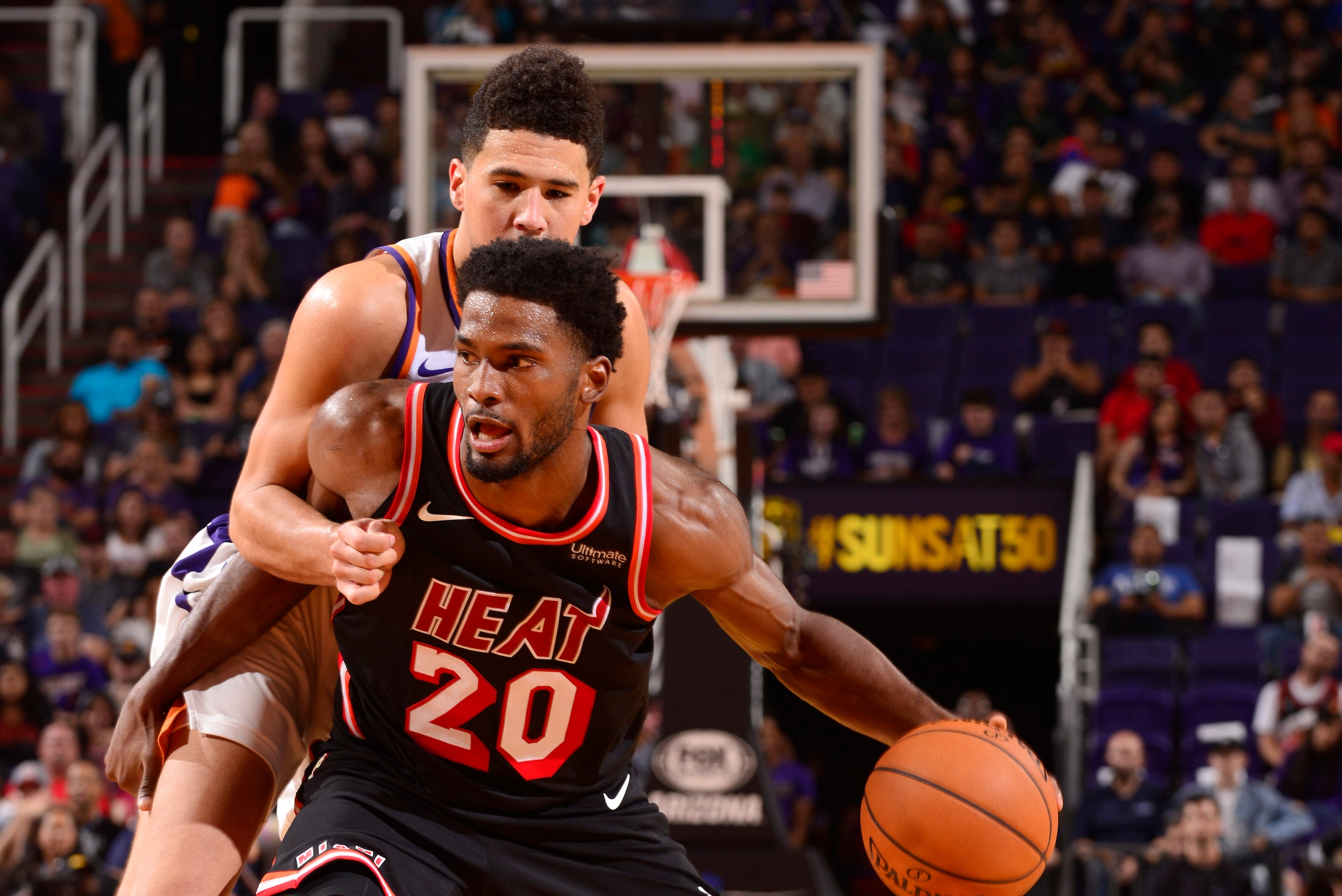
Age: 21
2017-18 Per-Game Stats: 6.7 points, 5.6 rebounds, 1.6 assists, 0.8 steals, 0.4 blocks, 44.2 percent shooting
Advanced Stats: 11.4 PER, -1.20 RPM, -4.47 TPA
Think of what Danny Ainge's front-office legacy would be if the Charlotte Hornets accepted his reported offer of six picks (four first-rounders) so he could draft Justise Winslow in 2015. Or maybe think about how many three-point contests Winslow would have under his belt after being subjected to head coach Brad Stevens' magic wand.
The 21-year-old is enjoying something of a hot(ish) streak at the moment. The Miami Heat are giving him more run at power forward, where his lack of shooting isn't as much of a standout detriment, and he's shooting 37.5 percent (3-of-8) beyond 24 feet over his last five cameos.
Miami is more liberally tossing him on bigs at the other end. He spent ample time guarding Karl-Anthony Towns during a Nov. 24 victory against the Timberwolves—a dual-purpose move that, in the macro, lets Hassan Whiteside chase around more immobile frontcourt assignments while helping the Heat keep Winslow on the floor for longer stretches. As the Sun-Sentinel's Ira Winderman wrote:
"The key to his success has been tapping into that versatility. I found it interesting that Justise said he was not told he would be defending Towns until just before Friday's tipoff, as if Erik Spoelstra did not want to tip his hand about the unique defensive asset he can deploy in such a versatile manner. If you attend Heat games, one of the most enjoyable diversions is watching Justise work on defense. His fronting of the post against Towns on Friday night was relentless. It is a defense motor that is perpetual."
Wonderful. Seriously. Except, Winslow's place with the Heat, and in the NBA, has never been tied to his defense. He is a suffocating gnat, someone able and willing to pester players up a position or two. But the Heat still have to plan around his underdeveloped offense. He isn't a viable threat from behind the rainbow, and his scorching-hot shooting around the basket is on the decline.
Baby steps' worth of progress is hard, verging on impossible, to unearth. The Heat give him sporadic work in the post, but he's not efficient when operating on the block. He is opportunistic while attacking the basket, but a turnover machine when moonlighting as a pick-and-roll maestro.
Sub-20 percent shooting on mid-range looks doesn't bode well for his future as a three-point marksman. Nor does his so-so display at the charity stripe (66.8 percent for his career). He isn't an exceptional finisher in transition or on drives to the hoop and doesn't even rank inside the 20th percentile of shooting-foul frequency at his position, according to Cleaning the Glass.
Teams will always have a spot for jacks of all defensive trades. But those players aren't cornerstone material when they don't move or actively dull the offensive needle. They're specialists. And while Winslow's injury-plagued 2016-17 crusade basically renders him a sophomore this year, he's done nothing to suggest he'll ever be a reliable offensive asset.
Unless otherwise cited, all stats are courtesy of NBA.com, ESPN.com or Basketball Reference and current leading into games on Nov. 27.
Dan Favale covers the NBA for Bleacher Report. Follow him on Twitter (@danfavale) and listen to his Hardwood Knocks podcast co-hosted by B/R's Andrew Bailey.

.jpg?w=2560 "Mahomes Told Teammate to Leave Meeting")
.jpg?w=2560 "🚨 Week 8 AP Top 25 Poll")

.jpg?w=2560 "Baker Gets Glove From Rays 🧤")
.jpg?w=2560 "NFL investigating Eagles")

.jpg?w=2560 "Steelers Roll Saints in Paris")
.jpg?w=2560 "Updates from EVERY NFL Game 🏈")
.jpg?w=2560 "5 Teams Eyeing Jonathan Taylor")