

What Has Gone Wrong for Antonio Conte and Chelsea This Season?
In a perverse way, a football manager is perhaps more fallible when having their strengths critiqued than their weaknesses. Few in the game would describe it as an industry overflowing in the milk-of-human-kindness stakes, yet on occasion a rare degree of clemency is afforded when shining a torch on foibles.
A Pep Guardiola team with a susceptible defence elicits a roll of the eyes; a Jose Mourinho side with a lacklustre attack is met with a heavy sigh. For all the noise, it's rarely more than that. Press the mute button on the television or radio and the wheels keep on turning just the same. Parents would only be called in if Manchester City ceased to be the prettiest kid in the class or Manchester United the smartest.
.jpg?w=2560 "Cardinals Giants Football")

.jpg?w=2560 "Jets Dolphins Football")
All managers could fill a reservoir with hubris each and every time they are challenged on such perceived long-standing failings. Yet a crisis is born at a football club only when its team's identity becomes eroded to the point of confusion. And these identities are born from a manager's strengths, not their weaknesses. That's what got them the job in the first place.
Antonio Conte is nobody's fool. No one need tell him that what made Chelsea great last season is absent. The Italian's genius—and if ever a managerial feat should be weighted with such a moniker it must surely be one that took a team from 10th to champions, via a remarkable 43-point positive swing—was to make everything look simple. However, simple is never that simple.
Chelsea last term was a side built in the image of its manager. They were Conte's doppelganger to the point his mother probably couldn't tell them apart. Rare has a team from back to front looked so well versed in what their respective roles are. His teams are brilliantly drilled. That has always been his raison d'etre.
Tuesday will have killed him. At times against Roma, it was as though Chelsea's players had been replaced with 11 supporters picked at random, post a couple of pre-match beers. Conte lamented a lack of fight; more worrying was a lack of hope. A goal down after 39 seconds, it never got any better for Chelsea.
The last time Chelsea lost 3-0, they won their next 13 league matches and ended last season as champions. A more foreboding precedent for Conte is how Roberto Di Matteo lost his job the last time Chelsea lost so heavily in Europe, against Juventus in November 2012, just months after winning the Champions League. Conte will remember it well, he was Juventus manager at the time.
Regardless of whether Tuesday's result will prove a catalyst for a positive run or alternatively confirmation of a slump, Sunday's fixture against Manchester United at Stamford Bridge has the distinct feel of being season shaping. In terms of things he could probably do without just at the minute, the return of Jose Mourinho and Nemanja Matic is up there with syphilis.
Chelsea should never have been as bad as what went on before him during Mourinho's annus horribilis of 2015; equally, Conte had no right to make them anything like as good as they were last term. All things considered, he's still way ahead of the curve.
Last season, nothing would have got between Chelsea's back three without being cut out. Against Roma, a tourist bus taking a detour from the Colosseum could have ploughed straight through the centre of the pitch unimpeded.
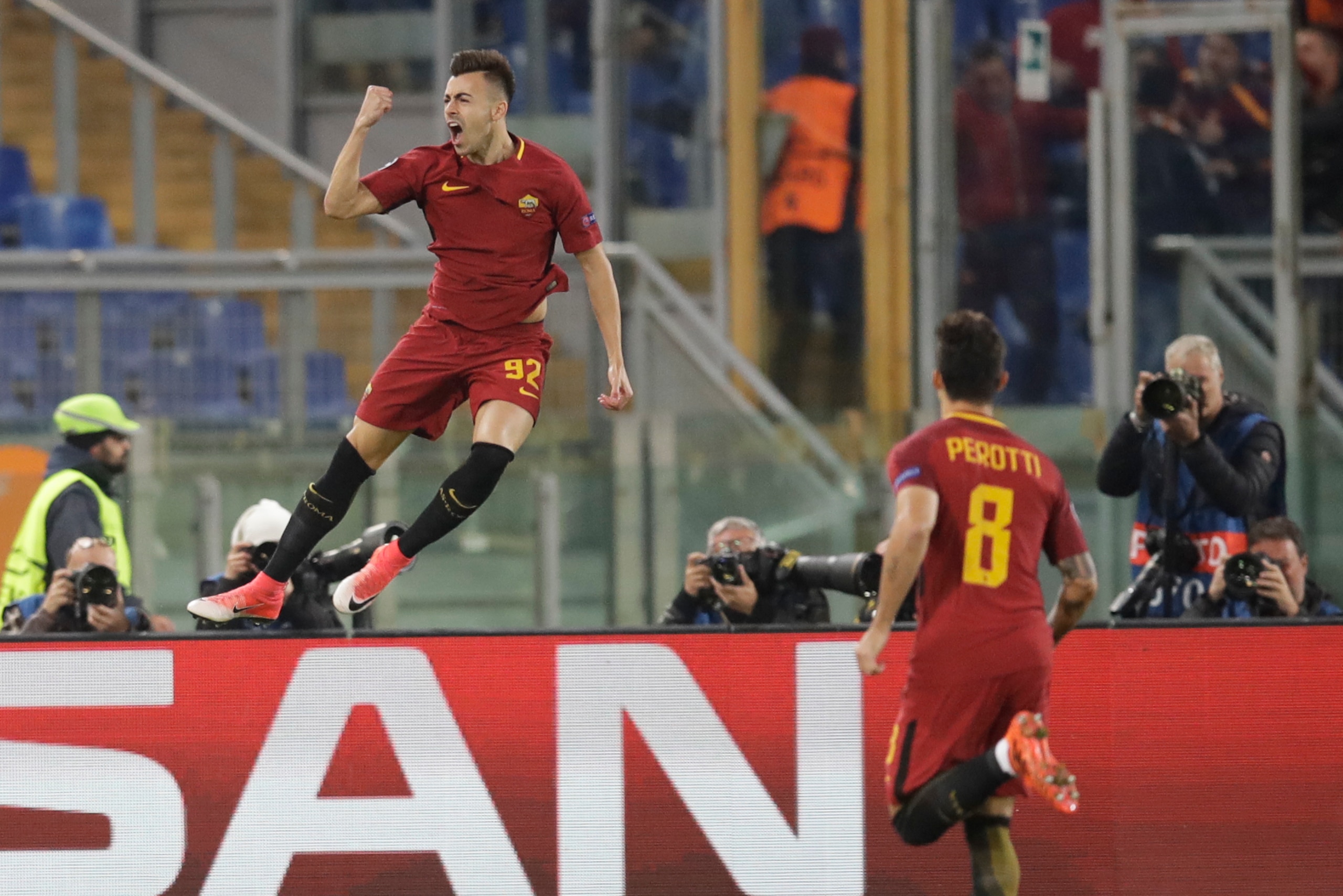
"And if you look to the right, Chelsea's players are doing a re-enactment of one of Buster Keaton's most famous scenes," the tour guide might have pointed out on watching three Chelsea defenders chase after Edin Dzeko while allowing Diego Perotti to career through on goal to the left of him completely unmarked. The champions of England became an instantaneous funny gif across the world.
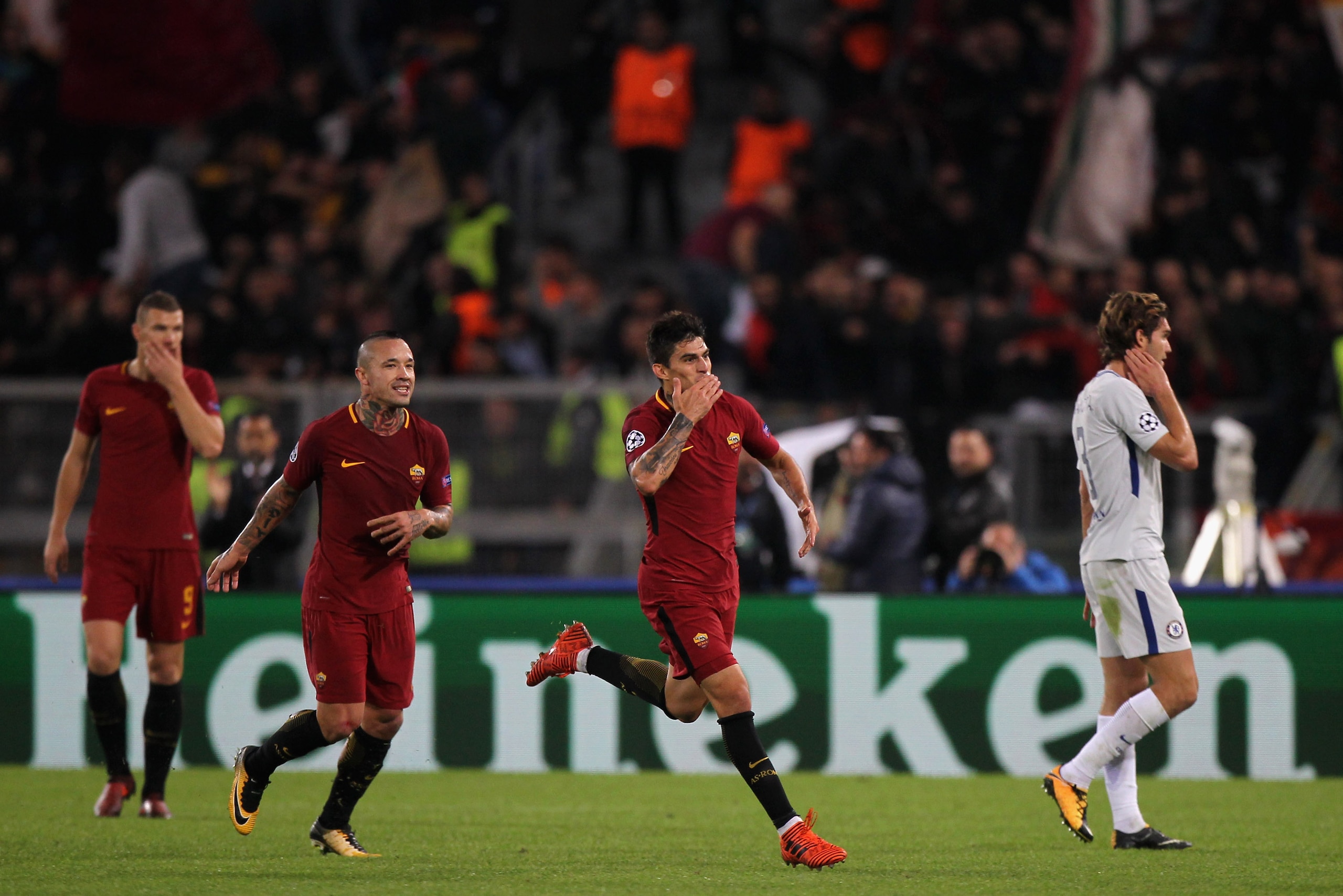
Even withstanding the fact Chelsea still look good to qualify for the knockout stages of the UEFA Champions League, have key players returning from injury and are only three points worse off than at the same stage last season domestically, there remains an inescapable sense something is amiss in the capital.
On his first return to Italy as a manager, Conte alternated between looking embarrassed and enraged. In three seasons at Juventus, in taking them from seventh to a hat-trick of Serie A titles, he coerced a defence into conceding just 67 goals in 114 league matches. Juventus' goals-against column averaged out at 22.3 per season under Conte. To date, Chelsea have conceded 10 goals in as many Premier League matches.
Returning to his homeland with Chelsea must have felt like Michelangelo dropping by the Sistine Chapel feeling unsure as to whether his latest works, crayon on paper, would match up.
Were it not for a mixture of Roma's profligacy and some smart goalkeeping from Thibaut Courtois, a 3-0 defeat sorrier than any in Conte's reign to date could have ended up a scoreline that may have had Roman Abramovich's hand hovering over the big red button in his underground lair.
Post-match, Conte spared no one. He implored his players to give more.
"The second half was ugly in every way. We must realise that we've got to earn our daily bread, we've got to chop up the turf if we are to progress and fight for something, otherwise it's a waste of effort," he lamented, per Football Italia.
"In the second half, Roma proved they were hungrier, more determined and had more desire to battle, so they deserved to win."
Though Conte's criticism fell some way short of when Mourinho accused his players of "betraying" him in the aftermath of what proved the final match of his second spell at Chelsea, against Leicester City in December 2015, the echo is getting clearer and louder. These are base, fundamental qualities Conte is bringing into question: hunger, commitment, determination.
Andrea Pirlo said in his autobiography I Think Therefore I Play (via former Arsenal forward Alan Smith for The Telegraph): "When Conte speaks, his words assault you. They crash the doors of your mind."
With Conte's players looking as shellshocked as he is, having their fallibility so publicly denounced could go one of two ways. While there has been the odd muttering of discord, it would be a surprise were it palpable.
The reasons Chelsea look in danger of experiencing a second-season syndrome that has afflicted so many clubs after a title win in recent campaigns are manifold. Insufficient investment in new players, injuries, suspensions, extra matches, discontentment over training schedules and player departures have all been cited as bones of contention.
Conte loves to coach. He might be a disciplinarian, but he's an educator, too. Last term he could work with his players every day at Cobham. With each passing weekend it became apparent whatever Conte was doing on the training ground was working. What looked intuitive on the pitch had clearly been expertly coached off it. This season, in having to juggle domestic duties with European ones, it's a case of fitting in sessions around rest days and matches. Tough, yet hardly unique to Chelsea.
The coach finds himself in a quintessential catch-22 situation. For his sides to work, they need to be full of life, yet at the same time his players must know one another's games inside out.
Rotation aids the former and impedes the latter. It is little surprise those that come in often don't understand the system as well as those they replace. Is it better to have a jaded player that implicitly knows his job or one full of energy that's a little green?
There is an argument Conte must look closer to home than his players when earmarking what has gone wrong with his defence. In the space of a couple of months, it has gone from being telepathic to turgid. Gary Cahill and David Luiz picking up suspensions has not helped, but Conte's current predilection to rotate his three central defenders with seemingly no more rhyme or reason than a punter hoping for three of a kind on a fruit machine is curious to the point of being plain odd.
In 17 matches so far this season, he has gone with nine different permutations at the back. Only once has he picked the same back three successively, which even taking into account Chelsea's substantially heavier workload seems nonsensical. It is 13 games and counting since he picked the same team two games running.
Having kept a first clean sheet in seven matches against Bournemouth last weekend, the option on Tuesday was there to stick with the same back three. Antonio Rudiger, Azpilicueta and Luiz were all fit. Instead, in order to accommodate Cahill, Conte moved Azpilicueta out wide at the expenses of wingback Davide Zappacosta. Shifting Cahill to the right of the three and using the right-footed Rudiger on the left all smacked a bit of Guardiola, the student years. Something is awry when Conte can't stop tinkering.
The sight of Cahill being replaced on 55 minutes against Roma despite being Chelsea's best defender on the night told the sorry story of how Conte's latest experiment had unfolded. Perhaps it shouldn't have come as too much of a surprise, given the same three had been an unmitigated disaster against Watford as far back as the game before last.
Sunday was clearly in Conte's thinking when he substituted Cahill with the game seemingly already dead at 2-0. As an aside, Pedro as a wingback hardly screams defensive solidity, either, with the Spaniard exposed by Perotti for Roma's third goal.
"If you are a great team you must have stability. You must have consistency. At this moment we are struggling a lot to find this type of balance," said Conte, per The Guardian's Dominic Fifield, sounding a bit like a fan ringing up a phone-in to lament a manager's indecision.
A good defence is like a good menu. It needs to be kept tight. It's better to have a few great dishes that work together than a myriad of choices that all taste like freezer. Ingredients need to be subtly balanced together with due care and consideration. Conte knows defences thrive on stability, which is what makes his current selections all the more perplexing.
The success he enjoyed with both Juventus and the Italy national side was in no small part down to having one of the best back lines in the history of the modern game. He built it. It was no different at Chelsea last season.
On that fateful day last year on September 24, when he switched to a 3-4-3 at Arsenal after his side went in at half-time 3-0 down, Conte had his lightbulb moment that shone right until the end of the season. The thing with light bulbs is you don't have to change them until they go out.
From the Arsenal game onward, in the 30 Premier League matches Cahill, Luiz and Azpilicueta subsequently played together in a back three (to be totally accurate it was actually 29-and-a-half, as Azpilicueta started at wing-back against Manchester City before moving to centre-half at half-time), Chelsea took 77 points from the 90 available.
The first time they didn't, in mid-May with the title already won, they shipped three at home to Watford. It was a prescient warning that has gone unheeded. Just four times this season have Cahill, Luiz and Azpilicueta lined-up as a three. The latter has been the only real constant, with just 15 minutes of playing time missed across the Premier League and Champions League.
At the point of winning the title last season, Chelsea had started just 16 outfield players. The team picked itself and rolled off the tongue. That number for the present campaign stands at 17. Conte would point to the fact Tiemoue Bakayoko, Alvaro Morata, Eden Hazard, Danny Drinkwater, N'Golo Kante and Luiz have all been injured or carried knocks at some point.
In front of an ever-changing back three, Chelsea's midfield is hardly any less chaotic.
The four-week absence of Kante with a hamstring injury has encompassed six missed matches. Over this period 11 goals have been conceded, with just one clean sheet kept. Unsurprisingly, the club is desperate for him to pronounce himself fit for Sunday's game.
Kante seems reticent to rush himself back if he's not completely ready, despite his team-mates lining up to give him a massage if it would help. The Frenchman has less been missed than mourned.
The sight of a midfield two comprising Cesc Fabregas and Bakayoko being overrun on Tuesday night is a familiar one. Bakayoko has only really impressed when partnered with Kante. Fabregas in a middle three or against weaker opposition remains a resplendent sight, but when tracking back he looks to be going backwards at such a rate of knots the fear is less whether he will catch his man as end up back in his mother's womb. Fabregas at 30 should not have played his 16th game of the season before the Halloween decorations have been boxed up for another year.
"It means Tiemoure Bakayoko and Cesc Fabregas have played a lot of games in midfield and obviously that goes into their legs," was Courtois' gentle way of asking if now might be the right time to start looking around care homes, per Metro.
Matic is still receiving therapy for that traumatic middle season at Chelsea (2015/16) that sandwiched two title wins. In partnering Fabregas at the moment the Spaniard's legs first began to operate a yard or two behind his mind, the Serb looked like he was dragging a corpse around the pitch with him.
It hardly needs re-emphasising how Matic got his mojo back last season when alongside Kante, and he is now playing arguably the best football of his career in Manchester. Mourinho mentions it about as often as "other" managers moan about injuries.
What can be deduced from the plethora of clearly briefed stories that have surfaced this week detailing how Chelsea's hierarchy are comfortable with the sale of Matic, on the grounds it is all part of a long-term plan, is that they are seriously nervous about the prospect of him playing a part in a Manchester United win on Sunday that could see Chelsea end the weekend as many as 12 points off the pace. In fairness, it sounds as though Matic was of the mindset to leave. Just why he wanted out of the champions so desperately has seemingly been left off the memo.
That a manager can feel short-changed in terms of the depth of his squad while 24 players are out on-loan at other clubs must surely be a problem unique to Chelsea. Tammy Abraham and Ruben Loftus-Cheek being handed first England call-ups this week, after impressing for Swansea City and Crystal Palace, will have given pause for thought for both the players and Conte.
If pressed, Conte is unlikely to toe the party line on Matic given over the summer he described losing the midfielder as a "great loss." Mourinho's favourite foot soldier started 65 of 76 Premier League matches in Chelsea's title campaigns of 2014/15 and 2016/17, respectively.
Matic and Kante are two of the best sub-editors in the business. They ensure everything makes sense and flows. To varying degrees, they did the same job entrusted to Conte when he was a player. They are sometimes seen as the brawn of a team, but they are more the brains. Without them, Chelsea have looked disjointed to the point of being dysfunctional at times.
Conte had envisaged introducing the eminently talented but clearly still raw Bakayoko in the manner Guardiola has Bernardo Silva at Manchester City. Whereas Silva has dazzled in cameos, his former Monaco team-mate Bakayoko has been charged with carrying a defending champions' midfield. That it has proved beyond him shocks no one, probably least of all Conte. He was supposed to be back-up for Matic, not his replacement.
The idea Conte on occasion picks his teams to purvey a message to his board is a mischievous one, with the Italian on the opening day forced to deny his starting XI against Burnley was a less than subtle nod to what he was still missing player wise. His most consistent complaint since arriving in England has always been about recruitment.
Alvaro Morata looks a sensible long-term replacement for Diego Costa, even if in terms of personality he is as diametrically opposed to his compatriot as possible. Conte no doubt thinks that's a good thing.
That Morata lacks the presence to bully opponents in the manner of Costa, and at times Chelsea can look a little one-dimensional without him, is tempered by the younger man's more than reasonable goal return—even if they have dried up a little of late.
Regardless, Chelsea need a more viable alternative than Michy Batshuayi if Conte continues to trust the Belgian with all the confidence one might feel handing a shopping list to a dog.
It is thought Conte is also disappointed with the club's failure to sufficiently add cover at wing-back and centre-half, despite signing one of each over the summer. There are familiar murmurings of Conte growing increasingly exasperated at having to filter his thoughts to Abramovich via board member Marina Granovskaia and technical director Michael Emenalo. The usual suspects, it seems, continue to buffer Chelsea managers from the Keyser Soze figure at the top.
Should Chelsea play on Sunday in the manner they did in midweek, Conte may yet get his meeting with the main man sooner than he envisaged, or hoped.
.jpg?w=2560 "Titans Ravens Football")


.jpg?w=2560 "NFL investigating 2 referees for separate viral exchanges")
