MIAMI — The double doors open to the Miami Heat's second-floor practice facility inside AmericanAirlines Arena, and Hassan Whiteside is in two places at once.
The 7-footer sits steps inside the entrance, perched atop the chair reserved for post-practice media chats. He looks a little antsy, failing—or maybe not trying—to hide the fact he'd rather be on the floor with his teammates or elsewhere entertaining his legion of social-media followers.
But if you look out on the court, he's over there, too. At least, you'll see his face flashing a $98 million smile, a black No. 21 Heat jersey and two impossibly long limbs stretched toward the ceiling.
TOP NEWS

Offseason Grades for Every Team 🧑🏫
Final Record Predictions for Every NBA Team 🔮
New NBA Power Rankings on 2026-27 Opening Night
Only the on-court Whiteside is an impostor. It's actually a mannequin, a training tool helping two roster hopefuls fine-tune their runners and floaters over big-league length. The facial photo and Heat threads are ostensibly fun aftermarket add-ons, yet they feel symbolic.
It's almost Miami's way of signaling it has something different in the big fella. As the Association gets smaller and more perimeter-oriented, the Heat have hitched their present and future to a restricted-area wrecking ball.
🔥 Top Videos from Around B/R 🔥
"What he does is really unique," Heat coach Erik Spoelstra said. "He's a dominant defensive player that makes your entire team defense better, and he's as impactful as any center in the league offensively."
That's not the commonly held scouting report on Whiteside, a 28-year-old with zero All-Star or All-NBA selections and previous red flags for immaturity, chasing stats and giving inconsistent effort. But it's what Miami needs him to be after it invested nearly a half-billion dollars into this starless nucleus.
The Heat's ceiling seems to sit around the fourth or fifth seed in the Eastern Conference. They have a lot of good players in a league where only great ones can change fortunes. No one is closer to that level than Whiteside, which makes his inconsistency all the more frustrating.
But his reputation might lag behind reality. If Whiteside were still that player, he says, he wouldn't be collecting max money from a franchise hyperfocused on culture, conditioning and discipline.
"I play for one of the organizations that's not going to let you slack, not let you just do what you want," Whiteside told Bleacher Report. "For me to start and play significant minutes, that should say I'm doing something right for the team."

Miami has proved the ideal environment to support Whiteside's growth.
Spoelstra, a longtime purveyor of positionless basketball, has reworked his game plan around the interior enforcer. And Pat Riley—whose big-man resume includes overseeing Kareem Abdul-Jabbar, Patrick Ewing, Alonzo Mourning and Shaquille O'Neal—has dropped words of wisdom along the way, like how Abdul-Jabbar used yoga to get better balance on his skyhook.
There are far more Riley nuggets for Whiteside to extract, but even he finds himself in awe of the godfather.
"It's like an aura around Pat Riley," Whiteside said. "He says more people on the team should talk to him; he's not the principal."
The Heat's roster has served Whiteside well during each stage of his development. When he was still finding his way, he could use Dwyane Wade, Chris Bosh and Luol Deng as guides. Now that Whiteside is ready to shine on his own, the team has been torn down and rebuilt around him.
The defense funnels everything toward his preternatural 7'7" wingspan. The offense either involves him as a lob finisher or leverages him as a lob threat to collapse the defense.
It's not a design most modern teams follow. But if you ask his teammates how it can work, they'll chuckle at the solution's simplicity.
"Throw him the ball," Josh Richardson told Bleacher Report. "Just get him the ball, and he'll do the rest."
Whiteside has long been flooding box scores. He's the only player to be a major-stat category leader each of the last two seasons (rebounds last season, blocks the year before). In 2016-17, he joined Dwight Howard as the only players in the last 20 years to average at least 17 points, 14 rebounds and two blocks.
But the significance of Whiteside's stats heightened the second half of last season. Spoelstra says that's when Whiteside better grasped what it means to "impact winning." His screens were harder and more consistent. His motor rarely sputtered. He wasn't just tallying blocks and boards; he was elevating the defense around him.
"It had nothing to do with [stats]," Spoelstra said. "Learning how to make winning plays, learning how to make his teammates better and caring more about the guys in the locker room than himself."
Whiteside became a full-fledged defensive anchor. He was a top-10 rim protector (47.5 percent shooting against, eighth among qualified players) and an elite glass-cleaner in traffic (5.8 contested boards per game, second). After the All-Star break, his floor presence netted Miami an extra 3.0 points per 100 possessions.
The oft-perceived problem child was a fully functional leader.
"The biggest change I've seen is his attitude and the way he approaches the game and his teammates," said Richardson, who arrived in 2015, one year after Whiteside did. "He's matured a lot since I first got here."

Whiteside's improved on-court focus is coupled with more of a laid-back approach away from it.
The old Hassan wouldn't have laughed off his Twitter rift with Joel Embiid. And remember when Whiteside seemed obsessed with his NBA 2K rating? He's barely sweating his real-life rankings anymore.
"I don't get mad about it much," Whiteside said. "I just don't understand it. Like sometimes, you can average more points and rebounds than a guy and they still say that guy is better than you. I just don't get it."
Whiteside's place in the big-man hierarchy remains open for debate. He can be too upright when defending pick-and-rolls and too methodical when trying to score in the post. He's apparently allergic to passing (in 218 NBA games, he's had three assists twice and two just 21 times), and his 61.2 career free-throw percentage doesn't indicate his range can expand.
But his physical gifts are freakish even by NBA standards. And his impact is both obvious and increasing.
Still, B/R's Dan Favale slotted Whiteside ninth among centers. He was only a couple of ticks ahead on the rankings compiled by HoopsHype (sixth) and Sporting News (seventh). General managers voted for eight different players as the Association's top center in NBA.com's annual survey, and Whiteside wasn't one.
That has to be more frustrating than he lets on. (For better or worse, he's more filtered when there are microphones present now.) But when you ask about rankings, the most fervent response isn't from Whiteside.
"I don't care what anybody else says. Hassan is one of the best centers in this league," Spoelstra said. "Fact. Period."
That's a revealing quote, even if it's a tad biased. Spoelstra has used the media to challenge his center before and isn't afraid of calling him out. So, the skipper's willingness to make such a charged statement over something as trivial as subjective rankings highlights the big man's maturation.
Whiteside has put himself closer to the spotlight by not trying to force his way into it.
"People were like, 'Oh, what are you gonna lead the league in this year?'" Whiteside said. "I was like, 'Man, it really depends on what our team needs. If our team needs a rebound, I'm gonna rebound more. If they need shot-blocking, I'm gonna be shot-blocking more.'"
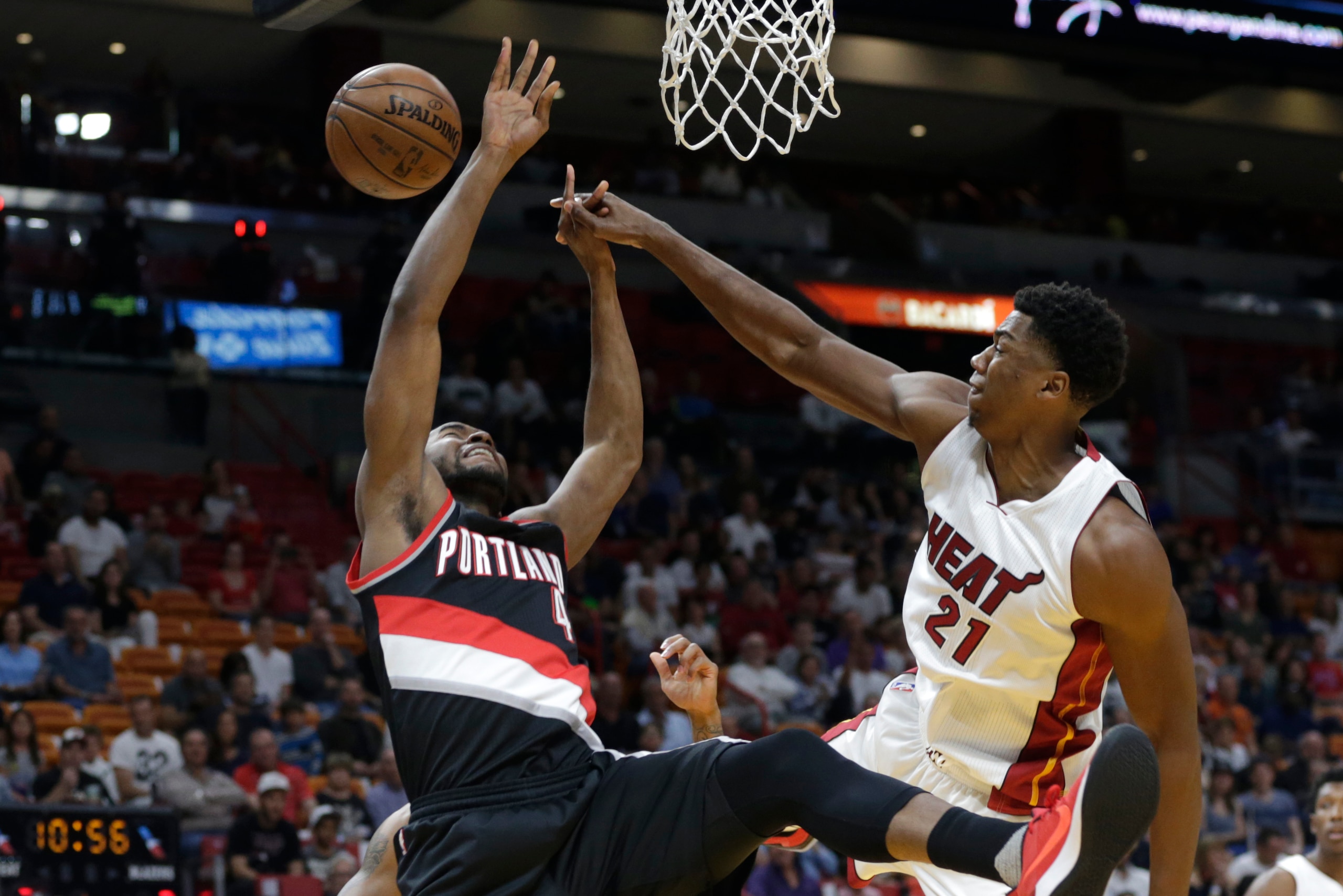
Whiteside is making the changes people have wanted to see.
So, what does that make him? You mean besides an elite social-media personality? (His must-follow list is short, by the way: CJ McCollum on Twitter, DJ Khaled on Snapchat). It makes him an encouraging work in progress who's farther along than you probably realize.
His rim protection and rim running are critical contemporary components. He isn't given enough credit for his ability to hang with perimeter players during quick defensive switches. And while he doesn't want "to be one of them bigs who falls in love with the three-point shot," he has a semi-green light to fire open jumpers.
"When it's in the context of the offense and the flow and it's the right shot, he's proven that he has good touch," Spoelstra said.
Whiteside's All-Star path has never been clearer.
The offseason exodus out of the East opened multiple spots for the world's greatest pickup game, and Whiteside's numbers will rival those of any would-be first-timer.
The leadership question is trickier. For all the strides Whiteside has made, the players and coaching staff did not select him as one of three co-captains (Udonis Haslem, Goran Dragic and James Johnson). Since Whiteside is paid more than any of them and longer tenured than Dragic and Johnson, the omission is hard to overlook.
But that just means this story is still being scripted. While an All-Star selection would (and should) be celebrated, it wouldn't move Miami forward on its own. For that, Whiteside must grab the leadership reins and become the nightly force that helps the Heat leverage their unique talent in elite fashion.
The odds of this occurring are slim, but Whiteside has overcome longer ones before.
All quotes obtained firsthand. Unless otherwise indicated, stats from Basketball Reference or NBA.com.
Zach Buckley covers the NBA for Bleacher Report. Follow him on Twitter: @ZachBuckleyNBA.
.jpg?w=2560)
.jpg?w=2560 "Purdy Becomes Highest-Rated QB EVER 🤩")
.jpg?w=2560 "Grading WWE Raw 🔠")