
What's to Blame for Pittsburgh Steelers' Lackluster Start in 2017?
Through six games, the Pittsburgh Steelers are 4-2, leading the AFC North. They most recently clawed their way to a 19-13 road victory at Arrowhead Stadium over the Kansas City Chiefs, then the league's last undefeated team.
But it hasn't been a smooth ride for the Steelers. Even in games they won, they showed signs of inconsistency and struggled. Here are six reasons why they haven't been as good on the field as their win-loss record would suggest.
Scoring Woes
1 of 6
The Steelers offense has yet to reach the 30 points-per-game average it has been seeking for years now, per Mark Kaboly for the Pittsburgh Tribune-Review.
In 2017, reaching that mark has been more difficult than it should be. Even with the Steelers' top offensive players—quarterback Ben Roethlisberger, receivers Antonio Brown and Martavis Bryant and running back Le'Veon Bell—all healthy, available and on the field at the same time, the team is averaging a 22nd-ranked 19.7 points per game, down from 24.4 a year ago.
It's not as though Pittsburgh's scoring opportunities have dwindled. In fact, the Steelers are averaging 3.3 red-zone appearances per game this season, up from 3.1 in 2016. They are just doing less with these opportunities, scoring touchdowns on only 50 percent of their red-zone appearances, down from 54.24 percent a season ago. That falls to a mere 28.57 percent at home.
Thus, the Steelers have yet to score more than 26 points in a single game, and Chris Boswell's 11 made field goals (in 13 attempts) match their 11 touchdowns.
Pittsburgh just isn't as efficient on offense as it used to be. The scoring opportunities are there, but the Steelers haven't been able to take advantage often enough to meet their potential.
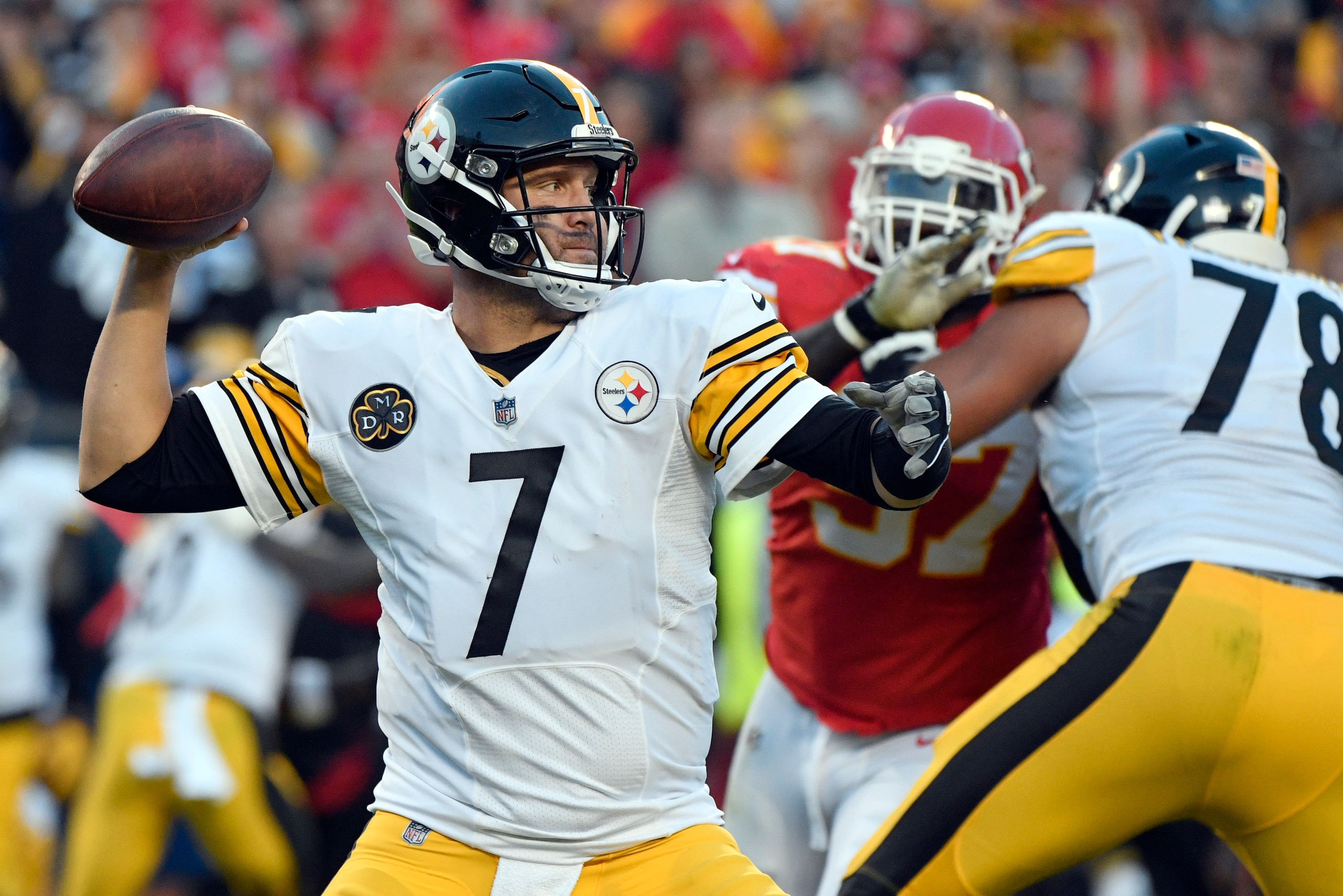
Ben Roethlisberger
2 of 6
One reason for the Steelers' struggles in the red zone this year is the performance of Ben Roethlisberger. Even though the quarterback has had a full complement of receiving weapons at his disposal—compared to last year, when Martavis Bryant was suspended and he had players such as Cobi Hamilton (who has since moved on)—he's had a rough start to this season.
Roethlisberger's passer rating of 78.2 is drastically lower than his 95.4 in 2016. His yards per passing attempt have dropped from 7.5 to 6.9, as has his touchdown percentage, which sits at 3.2. It's down from 5.7 in 2016.
He has thrown only seven touchdowns to eight interceptions, including five picks (two returned for touchdown) against the Jacksonville Jaguars in a Week 5 home loss at Heinz Field. Also, despite Pittsburgh's win over the Chiefs, he threw another in Week 6. On third downs, his passes are converting only 32.3 percent of the time.
Still, there is reason to believe that Roethlisberger's struggles are not his fault alone. FiveThirtyEight's Michael Salfino pointed out the 35-year-old has been only a slightly less accurate passer this season compared to 2014 through 2016. He also noted the quarterback was slightly more accurate on deep attempts of 10 or more yards in the air.
Indeed, Roethlisberger's turnover problem in concert with other offensive issues have made the 14-year veteran another issue the Steelers have had to overcome in 2017.
Silent Passing Game
3 of 6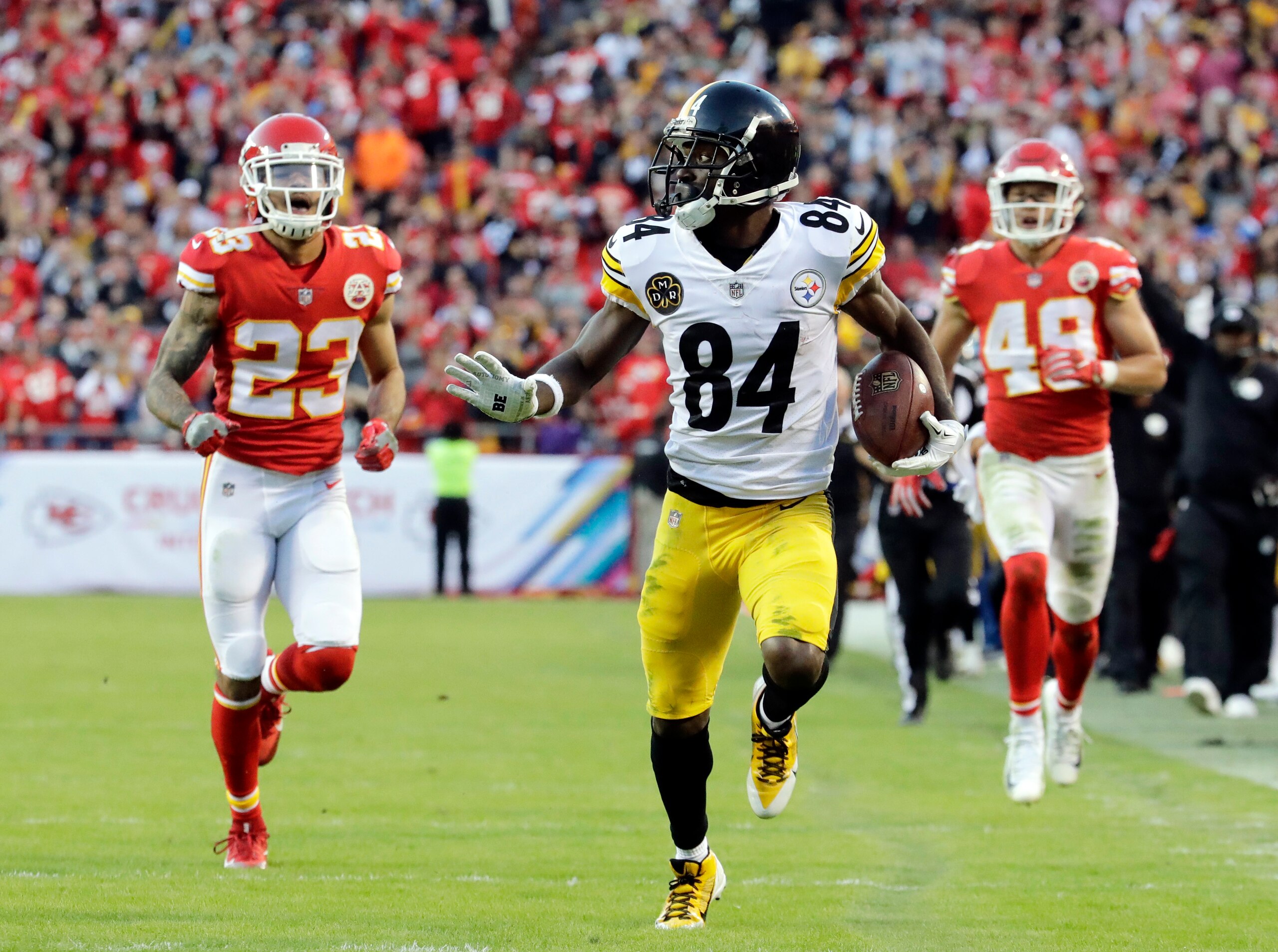
Roethlisberger has had the services of receiver Martavis Bryant, rookie JuJu Smith-Schuster, pass-catching running back Le'Veon Bell and, when called upon, slot receiver Eli Rogers, but he's chosen mainly to focus on one target in the passing game: Antonio Brown.
While this has proved productive in terms of yards gained this year, it belies another issue: Even though Brown's stock remains high, everyone else around him seems to be on the decline.
Brown has caught 48 passes on 74 targets for 700 yards this year; Roethlisberger has attempted 220 passes, with 137 completions yielding 1,521 yards. To put that in perspective, the rest of Roethlisberger's passing targets—seven in all—have 89 catches for 821 yards. Further, of Roethlisbeger's 71 first downs earned via passing, 30 of those have belonged to Brown.
Brown is averaging 116.7 receiving yards per game. The next-highest average belongs to Bryant, at just 38.5, and he has only sniffed 100 receiving yards in a game this year once. Even Bell isn't the force he was in the passing game a season ago. With 30 receptions for 156 yards, he's averaging 26 receiving yards per game, down from 51.3 in 2016.
Roethlisberger doesn't seem to have as much trust in his non-Brown receiving options this year. This has resulted in his forcing the ball to Brown, making the Steelers passing game more predictable to defend.
Big Ben completed 17 passes for 252 yards against the Chiefs, and eight receptions and 155 yards belonged to Brown. While it didn't matter in Week 6, thanks to the scrubbing power of a checkmark in the win column, it's a continuing issue. Essentially, the passing offense is limiting itself.

Passing Defense vs. Run Defense
4 of 6
It's a tale of two defenses in Pittsburgh this season, and this inconsistency has directly led to its two losses. This is also something that could prove troublesome as the year progresses and the opponents become more difficult to handle.
Right now, the Steelers defense ranks second in passing yards allowed at 921. The four passing touchdowns it has allowed is tied for second. Its 20 sacks of opposing quarterbacks is tied for the second-most in the league. It has forced eight turnovers on the year, five of them interceptions. On the whole, the Steelers defense ranks sixth in points allowed.
Yet, for as good as Pittsburgh's passing defense has looked this year, its ability to stop the run has been equally disappointing. In both of the team's losses, it gave up over 200 yards to opponents' running games. Its six rushing touchdowns allowed ranks 30th in the league, and opposing backs are averaging 4.7 yards per carry against them. Only five teams are faring worse.
Pittsburgh held its opponents to under 100 rushing yards in four contests this year—including an impressive 28 yards on 15 carries for the Chiefs on Sunday—but the amount of running isn't the issue. Instead, it's what opponents are achieving. They have been keeping themselves in the games and extending drives the Steelers should be able to choke off.
While Pittsburgh's ability to stop the pass deserves praise, as long as it is tempered by a run defense that continues to perform inconsistently, the defense as a whole won't be a dominant unit.
Offensive Line
5 of 6
A season ago, Football Outsiders ranked the Steelers offensive line as third in the league in run blocking and fourth in pass protection. Injuries were kept to a minimum, and as a result, Roethlisberger was sacked only 17 times through 14 regular-season games. The Steelers' running game averaged 4.3 yards per attempt.
As such, Pro Football Focus predicted in June that, as long as nothing changed, Pittsburgh would have the league's third-best offensive line for the 2017 season.
Instead, the unit has taken a step back. Through the first five weeks, Football Outsiders ranks the Steelers line sixth in pass protection but just 21st in run blocking.
Injuries are somewhat to blame, though. Right tackle Marcus Gilbert has missed time with a hamstring injury, which he reaggravated against the Chiefs, forcing Chris Hubbard into duty. Also, starting guard Ramon Foster was sidelined in Week 6 with a back injury.
Another problem has been left tackle Alejandro Villanueva, who was one of the best at his position in 2016 but in 2017 has given up 4.5 sacks, as many as he did for all of last season, according to the Washington Post.
Roethlisberger has already been sacked 10 times this campaign. And the running game led by Le'Veon Bell has produced in fits and starts: Only thrice have the Steelers surpassed 100 yards rushing (and twice for Bell) compared to nine times in the 2016 regular season.
An NFL offense is only as good as its offensive line. And while the Steelers have other issues that have negatively affected their offensive production this season, the regression—and increased number of injuries—on the line ranks among them.
Third Downs
6 of 6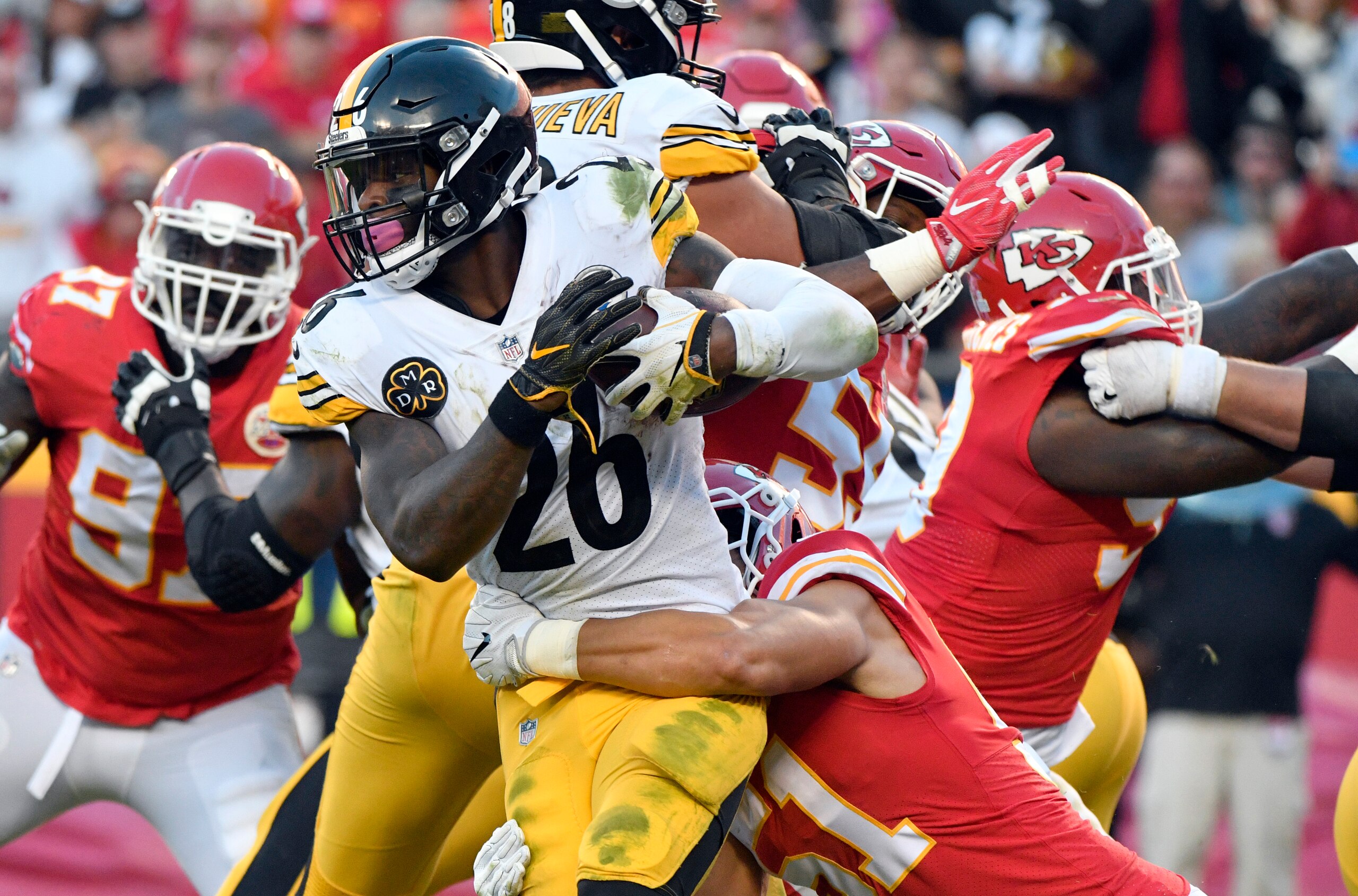
An initial glance doesn't show that Pittsburgh's offense is struggling in any appreciable way to convert third downs, at least compared to 2016. So far this year, the Steelers have converted 38.5 percent of their third-down attempts. That is lower than last season's mark of 41.1 percent, though not by much. However, when delving deeper, it becomes apparent that the Steelers' third-down offense is in bad shape.
The problem is the distance the Steelers need to gain on third downs in order to convert compared to the yardage they are getting in these situations. In 2016, the Steelers averaged 7.04 yards to go on third downs and earned 9.84 yards on those plays. Third-down rushes averaged 5.3 yards, and third-down passes traveled 7.4 yards per attempt.
This year, however, the Steelers need an average of 7.4 yards on third downs but are only gaining 6.9 yards on average. Their third-down rushes have averaged only three yards apiece, and their third-down pass attempts have traveled just 5.3 yards. While the to-gain number has risen, the yards earned on third downs have dipped significantly.
This regression alone is not a major problem. However, when placed in context with the Steelers' other offensive struggles—scoring in the red zone, the inconsistent running game, the way non-Brown receivers seem to be declining, Roethlisberger's numerous interceptions—it becomes a major piece of the puzzle.
Though the Steelers have had their problems on defense through their first six games, the offense has been the most disappointing. In order to solve most of what else ails that side of the ball, Pittsburgh has to start with moving the chains. Nothing else will appreciably improve until it has fewer yards to gain on third downs and can convert them with greater regularity.
.jpg?w=2560 "Rams Eagles Football")

.jpg?w=2560 "Grading WWE Raw 🔠")


.jpg?w=2560 "Injury-stricken Seahawks signing veteran RB")
