
Ranking 2017 Draft Picks Who'll Reach MLB Fastest
Like all things associated with baseball, analyzing MLB's amateur draft requires patience.
Fans get whisked away in scouting reports promising a bright future. Of course, it's human nature to desire progress as soon as possible. The overwhelming majority of baseball prospects, however, require years of development before graduating from the minors, a day which never comes for most.
Realistically speaking, even a fast-tracked prospect won't arrive until late next season. No 2016 selection has played in an MLB game, and 2015 headliners Dansby Swanson, Alex Bregman and Andrew Benintendi showed up last summer.
High school stars Hunter Greene and MacKenzie Gore may define this class a decade from now, but it's unreasonable to expect either teenager in the big leagues before 2020. This list exclusively features college picks, some of whom certainly don't carry the upside of younger, unpolished talents.
Being the first doesn't necessarily mean they will be the best. Yet, they're poised to hasten their timetable because they're well-equipped to contribute now and for many years ahead.
7. Brent Rooker, 1B/OF, Mississippi State (Drafted by Minnesota Twins)
1 of 7
After hitting like Babe Ruth during his junior year at Mississippi State, Brent Rooker shouldn't wait long to climb up the Minnesota Twins' ladder.
Although he batted .387/.495/.810 with 23 home runs, few scouts view the 22-year-old first baseman as a top-flight prospect. Of course, college stats do not ensure major league stardom. Plenty of Triple-A mashers have never figured out the highest level, but a 1.305 OPS anywhere above a youth rec league where the coaches still pitch remains impressive.
Minnesota, currently playing the 34-year-old Joe Mauer at first, snagged Rooker with pick No. 35, and they already agreed to a contract.
Per the Pioneer Press' Mike Berardino, Rooker is focused on honing his defensive utility.
"I'm going to try to find a home defensively," he said. "I'm going to do everything I can to become as good of an outfielder as I can so I can impact a game both offensively and defensively."
His bat and age could persuade an organization which often speeds tops prospects to the big leagues to hasten his road to The Show. Many other prospects from this draft class wield a higher ceiling, but Rooker should soon receive his opportunity to sink or swim against superior competition.
6. Jake Burger, 3B, Missouri State (Drafted by Chicago White Sox)
2 of 7Jake Burger devoured baseball from the moment he arrived on Missouri State's campus.
In three seasons, the third baseman batted .339/.420/.620. He didn't discover his power until his sophomore year, but he made up for lost time by belting 43 home runs over two seasons.
The successful slugger found a home with the Chicago White Sox, who typically gravitate toward polished college prospects in the first round. All guys with potential to make the majors immediately, Zack Burdi, Carson Fulmer and Zack Collins have not performed well enough to expedite their minor league stays. This is also, however, the same organization which called up Chris Sale months after drafting him in 2010.
He's not the smoothest player, but the 6'2", 220-pound Burger makes walloping contact. Although he's capable of holding his own at the hot corner, his bat could also play at first.
The retooling White Sox look far better off than most observers would have guessed before Opening Day, but they will likely trade Todd Frazier or watch him sign elsewhere this winter.
Two years from now, Burger could play for a burgeoning contender alongside Collins, Fulmer, Burdi, Yoan Moncada, Lucas Giolito and Michael Kopech.
5. Brendan McKay, 1B/LHP, Louisville (Drafted by Tampa Bay Rays)
3 of 7
Brendan McKay can hit. Brendan McKay can pitch. After selecting him with the No. 4 pick, the Tampa Bay Rays are open to letting him do both.
"At this point, our plan is to continue to let him explore that," Rays senior vice president of baseball operations Erik Neander said, per MLB.com's Bill Chastain. "He's probably the first guy, as long as we can remember, that has qualified on both sides of the ball to do this. We're excited to get him in here and explore it further."
He'll soon be ready to contribute in either facet. As the Louisville Cardinals entered Omaha for the College World Series, he sported a .343/.464/.657 slash line. He also recently set the program record with 385 career strikeouts on the mound.
A frugal franchise like Tampa Bay typically doesn't rush prospects to the major. Then again, Yahoo Sports' Jeff Passan reported that McKay may receive a record signing bonus, so the Rays appear to appreciate the special talent they snagged.
The Dick Howser Trophy recipient, awarded to college baseball's best player, is polished enough for the Rays to begin their two-way experiment. If they diverge from those plans, he could quickly justify a promotion as a smooth-swinging first baseman or test the waters as a gas-throwing reliever as soon as next year.

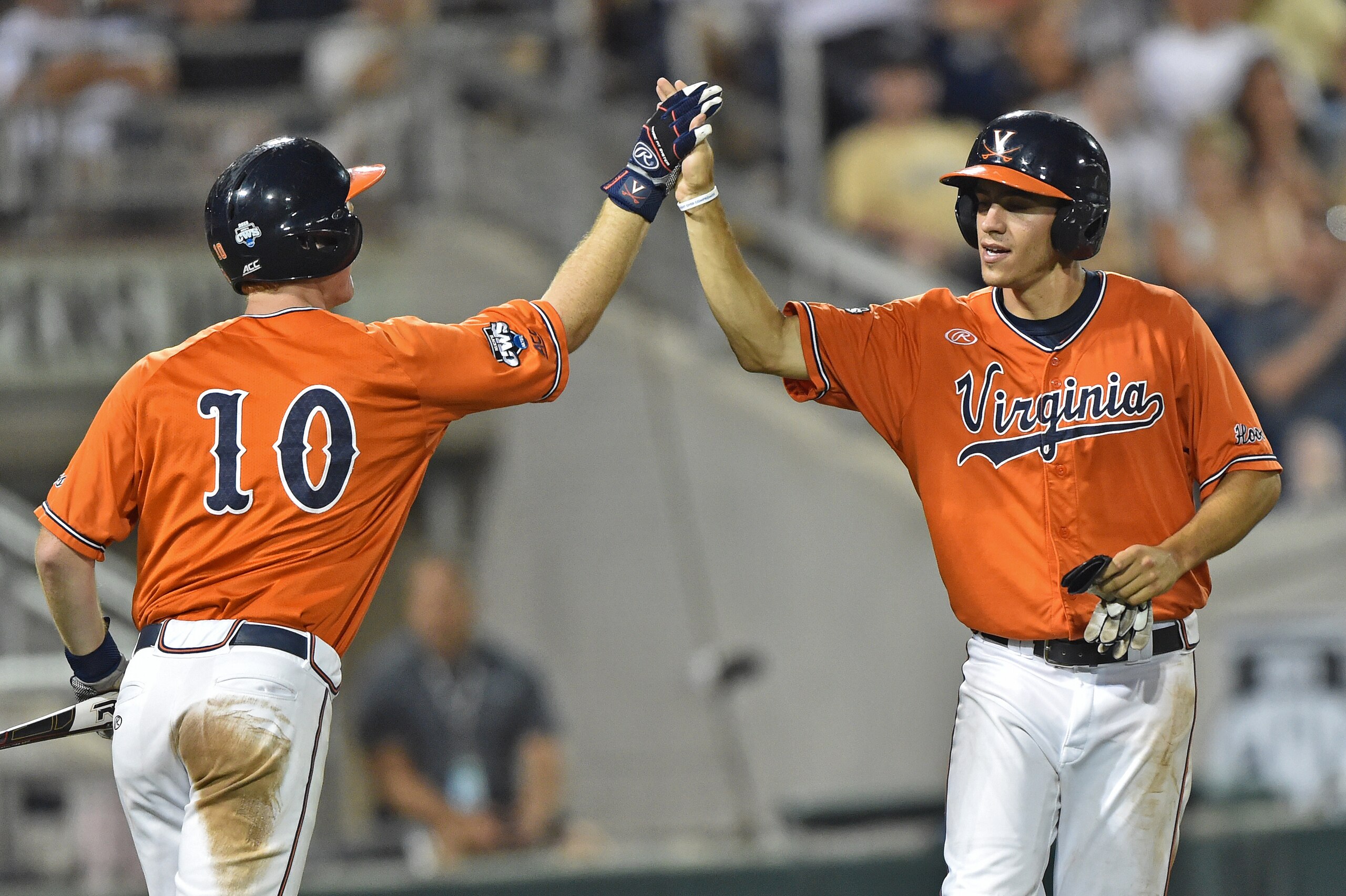
4. Pavin Smith, 1B, Virginia (Drafted by Arizona Diamondbacks)
4 of 7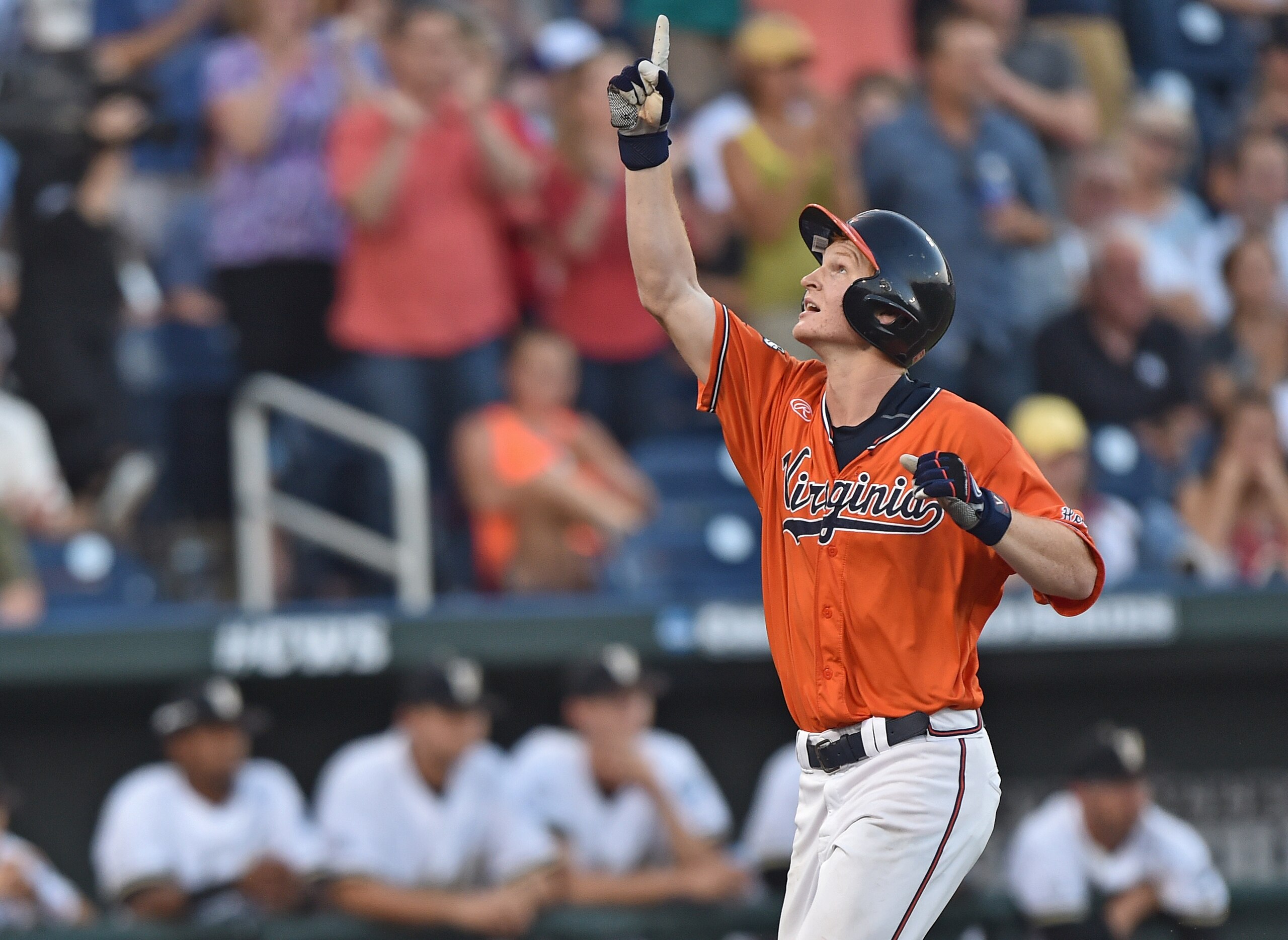
Pavin Smith probably won't punish the league upon his arrival, but he also doesn't need much minor league seasoning.
The exceptionally polished first baseman drew 38 walks with a microscopic 12 strikeouts during his junior year at Virginia. Not even a slap-hitting speedster incurs a strikeout percentage as dainty as 4.4 in the majors; only six qualified MLB hitters boast a rate below 10 percent.
Smith didn't make empty contact either. The lefty smacked 13 home runs with a .570 slugging percentage. He's unlikely to display such stellar pop as a professional, but the 21-year-old is capable of producing gap power while steadily reaching base.
Minor League Ball's John Sickels, who compared Smith to John Olerud and Eric Hosmer, said he "won't need long in the minors." He didn't find much to criticize in his "weaknesses" section, instead inserting that "few players offer the combination of safety and upside possessed by Smith."
He might have topped this list if not for getting drafted by the Arizona Diamondbacks, who already have a pretty good first baseman in Paul Goldschmidt. Yet a lot can happen during a year or two. If not used as trade bait, Smith could push his way to big league reps as a corner outfielder.
3. Adam Haseley, OF, Virginia (Drafted by Philadelphia Phillies)
5 of 7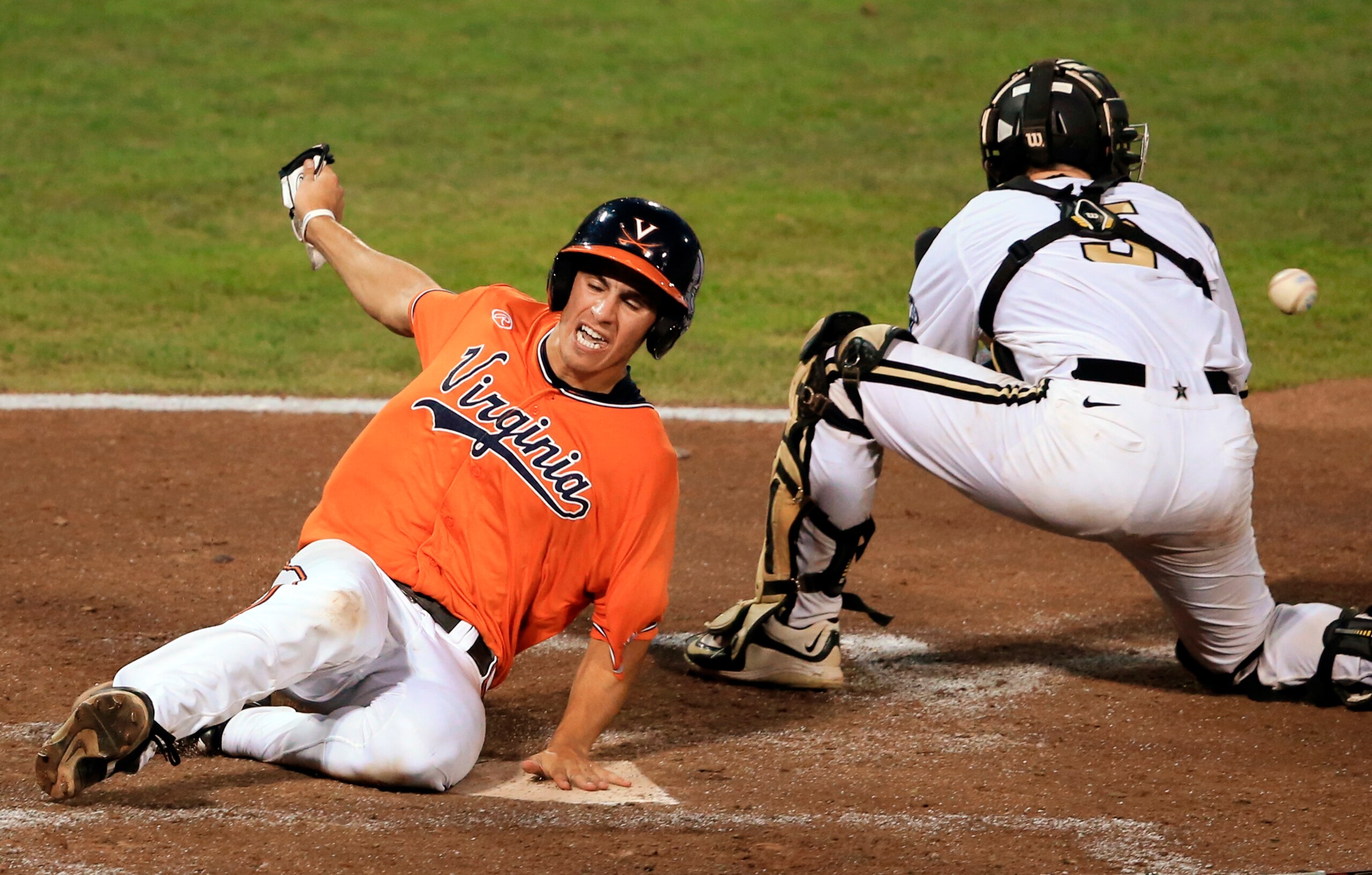
Smith remarkably might not be Virginia's first position player from this year's class to reach the majors. The Philadelphia Phillies picked his Cavaliers teammate, Adam Haseley, with the following pick, and he has a clearer path to the grand stage.
Hasely also rarely whiffed as junior, accruing just 21 strikeouts in 270 plate appearances. Having previously showcased scarce power, the left-handed outfielder batted .390/.491/.659 with 14 home runs and 10 stolen bases.
Even if Smith is ready to strike first, Haseley landed on the Phillies, who need all the help they can get. If they're committed to Odubel Herrera in center, the athletic 21-year-old could contribute as a plus defender in left or right field.
Philadelphia has not drafted a first-round college position who reached the majors since Pat Burrell in 1998. Yet its last college first-rounder, Aaron Nola, debuted on July 21, 2015, after getting taken the previous year.
If his offensive gains carry over into the minors, Haseley will quickly snag a starting role.
2. J.B. Bukauskas, RHP, North Carolina (Drafted by Houston Astros)
6 of 7After years of trusting their less publicized process, the Houston Astros are running away with the American League West behind an explosive young nucleus. They might not waste any time adding J.B. Bukauskas to the fold.
The 5'11" righty overpowered opponents at North Carolina, where he accumulated 227 combined strikeouts in 172 sophomore and junior innings. Yet because of his small frame and high-effort delivery, some scouts believe his future belongs in the bullpen, where MLB.com said he'd flaunt "closer upside."
Even if that's not his long-term landing spot, MLB.com's Jonathan Mayo suggested a scenario where Bukauskas debuts in Houston's bullpen this summer as Sale did with the White Sox:
"There's no indication that the Astros will do this with the North Carolina right-hander, but Bukauskas is the kind of arm who could contribute in a hurry if they put him in the bullpen. That's not to say he can't start long-term, but if Houston wanted to shorten him up for his first summer, his fastball-slider (especially that slider) combination could help its big league bullpen before the season is over."
That's an aggressive strategy, especially since the Astros are flush with relievers but light on starters. If not this year, they could follow the blueprint next season.
Command issues—he yielded 14 wild pitches this season—will delay his path to the rotation, but a contender won't store his explosive arm in the minors for long.
1. Kyle Wright, RHP, Vanderbilt (Drafted by Atlanta Braves)
7 of 7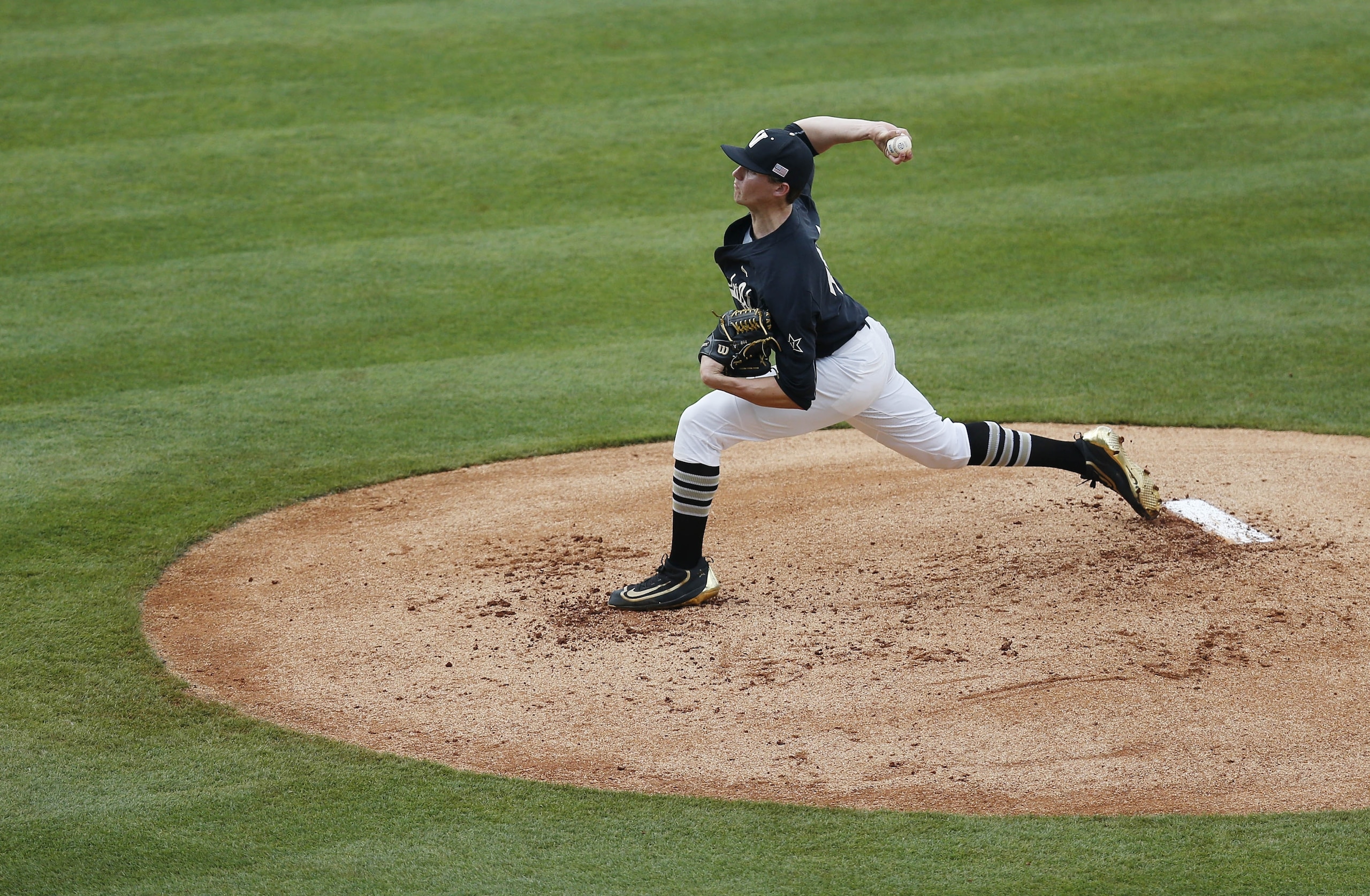
Perceived as the safest top-pick candidate, Kyle Wright reached an agreement with the Atlanta Braves on Friday. Per MLB.com's Mark Bowman, he will receive a $7 million signing bonus which exceeds Kris Bryant's $6.7 million for the highest bonus since MLB implemented the slotting system in 2012.
After notching a 3.41 ERA, 121 strikeouts and 31 walks in 103.1 innings for Vanderbilt, the 6'4", 220-pound righty will begin his express path to the majors.
Called the "best college starter in the draft class" by ESPN Insider Keith Law, Wright consistently throws in the lower-mid 90's with an advanced feel of all his breaking pitches. The 21-year-old has ample room for growth on a solid floor.
The Braves have prioritized pitching during their rebuild, but Wright should beat 19-year-olds Kolby Allard, Mike Soroka and Ian Anderson to the majors. Since veterans R.A. Dickey and Bartolo Colon are merely placeholders, rotation spots will soon open if Matt Wisler and/or Aaron Blair don't prove they belong.
A mid-to-late 2018 arrival isn't far-fetched. Seven years ago, the Braves called up Mike Minor—another first-round pick from Vanderbilt—a year after selecting him in the top 10. Wright may take a similar voyage to Atlanta.
Note: All college stats courtesy of The Baseball Cube.




.jpg?w=2560 "Raiders Could Start Mendoza")
.jpg?w=2560 "Rodgers Iced Out on Plane 💎")


.jpg?w=2560 "🚨 Week 8 AP Top 25 Poll")

