

Celebrating the Joy of Brazilian Full-Backs Ahead of the Champions League Final
Part of the anticipation for a Champions League final is dictated in the semi-finals, often by a player who takes control of a tie and suggests that he could perhaps bend the competition's climax to his will too. Sometimes it proves to be the case and sometimes it doesn't, as a quick recall of—to pick three random examples—Pavel Nedved in 2003, Lionel Messi in 2011 or Robert Lewandowski in 2013 tells us.
The player who made this year's last four wasn't a forward or an attacking midfielder. He wouldn't be considered as one of the standouts in his team on the basis of the season as a whole. For many, the now-34-year-old was even considered a spent force when he swapped La Liga for Serie A last summer, but then again, Dani Alves has always had a particular line in defying convention.


Before Juventus, and even before Barcelona, Alves was more than just a right-back. In Sevilla's glorious 2006-07 season, when Juande Ramos' team won a hat-trick of cups and were in contention for La Liga itself almost to the end, he was their key piece as (ostensibly) a defender. Alves' superstition was to have a haircut before every big match but, as the Guardian's Sid Lowe noted at the time, Sevilla had so many that he had to have multiple different hairstyles at once.
The haphazard hair was reflective of Alves' play; part defender, part attacking full-back, part chief playmaker and a little bit of everything else. As he took up the thread that Cafu, his senior counterpart who inspired youngsters around the globe to actually want to be a full-back, was just getting ready to put down, he was continuing a long and noble tradition of cultured and expressive Brazilian full-back play.
Moves towards full-backs as full-time attacking conduits began as far back as the 1940s, according to the BBC's Brazilian and South American football authority Tim Vickery in The Blizzard. Struggling to deal with speedy, clever forwards with the W-M system's three-man defence, a further defender was thrown in the mix, with two full-backs pushed wider.
"(They) began to see," wrote Vickery, "that they had space in front of them along the touchline into which they could push. This has been the basic template for Brazilian football ever since." As football began to break out further into the mass media, one of the position's greatest exponents came to the fore at a perfect moment, as part of an almost perfect team.
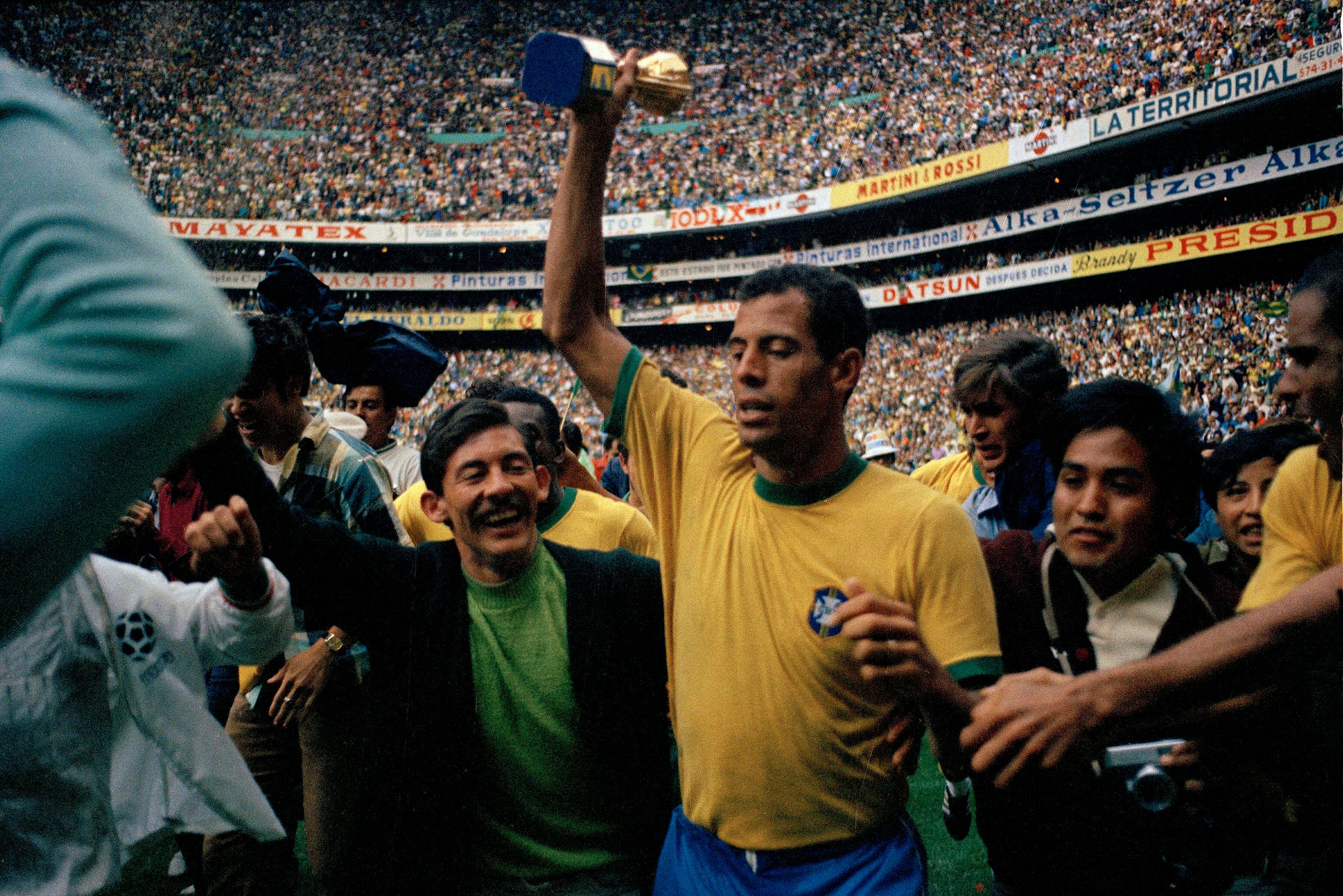
Carlos Alberto, Brazil's right-back in the 1970 World Cup and whose strike in the final against Italy is widely considered the greatest team goal in the competition by the greatest team to grace the stage, changed things. He was a rigorous defender but also acutely gifted on the ball, and thus ideal for supplementing his team's attacking efforts effectively.
He was also quick and athletic. As time goes by and the sepia-tinged memories of that 1970 team attaining football nirvana are further gilded, one of the key truths of their power is often airbrushed—that from a physical perspective, Brazil were ahead of the curve.
Mario Zagallo's team, unfettered by the bursting-at-the-seams fixture calendars of today, had put in 21 days of altitude training to ready themselves for the tournament in Mexico. "Our physical preparation was excellent," he told Vickery. "We won most of our games in the second half."
This higher plane of conditioning was most important for the full-backs who, in a system that requires them to attack, will get through more running than any other players on the pitch. Alves' compatriots and companions in Champions League excellence, his Juve team-mate Alex Sandro and particularly Real Madrid's Marcelo, are modern-day examples of Brazilian full-backs who can run their opponents into the ground.
The leader in that sphere of Brazilian full-back athleticism is popularly deemed to be Roberto Carlos, and both he and Cafu redefined the roles again. Both were celebrated for their attacking endeavours, but they were both specialist defenders. In a 2005 interview with Four Four Two, the former revealed that Roy Hodgson's desire to turn him into a forward player, rather than leave him at full-back, prompted his decision to leave Inter in 1996.
It was a wise choice. Both Cafu and Roberto Carlos thrived on that space that Vickery described, metres of space to run into, to gain momentum and to assess the possibilities in front of them. While Roberto Carlos' power is rightfully celebrated, Cafu, incidentally, regularly plays in exhibition games and—at the age of 46—typically tends to look like the fittest player on the park.
The attacking part of the full-back's job had become such a key part of it that players were often re-coached from other positions to adapt, fitting an extra attacking player into the team. Marinho Chagas, who played for Brazil in the 1974 World Cup, is one less celebrated example and shined during the tournament.
Chagas also underlined the risks inherent in trying to make novices into specialists, especially when bearing in mind the defensive side of the job at the highest level. That was clear in the match which ended Brazil's hopes in 1974. Johan Neeskens' opener in Dortmund, scored five minutes into the second half, was the product of a Johan Cruyff cross from the left, with the Netherlands No. 14 having time and space behind the advancing Chagas to pick his spot with the delivery.
Thirty-six years later, the Netherlands again powered past Brazil in the second half of a crucial World Cup match—on this occasion, the quarter-final in Port Elizabeth, which Dunga's team had led at half-time—and their attacking left-back was even more cruelly exploited.
Michel Bastos had spent much of 2009-10 playing on the right side of attack as his new team, Olympique Lyonnais, reached the Champions League semi-finals. Pressed into service in a position he had not played consistently, certainly not since arriving at Lille in 2006, his lack of finesse in the role was exposed time and again by Arjen Robben, who he fouled repeatedly.

Bastos was lucky to pick up just the one yellow card by the time he brought down Robben again for the free-kick from which Wesley Sneijder fashioned the Dutch equaliser. None of this was really his fault. He had the air of a man trying to catch a golf ball in woollen mittens, fighting desperately to save a situation which he didn't have the tools to deal with.
That is not about to happen to Marcelo, Alves or Alex Sandro in Cardiff. Alves deserves to be lauded to the skies for his displays against Monaco—and this, as he showed in 2015 when Barcelona triumphed, is his moment in the season to peak—but Marcelo could yet emerge as a central figure. He has had a wonderful season, and he too was outstanding against Bayern Munich and Atletico Madrid.
Marcelo has taken the application of full-back play onto a different level again, bursting inside to run through tired opponents, as he did to set up Cristiano Ronaldo's hat-trick goal in the second leg with Bayern, and as he had in scoring himself against Atleti in the 2014 final in Lisbon.
He could have been doing that in tandem with Danilo, but the right-back—who, when he worked with Alex Sandro at Porto, was the more coveted of the pair—has faded from view as the previous incumbent, Dani Carvajal, has gone from strength to strength. Danilo's desire to underlap, rather than overlap, was borne of his grounding as a midfielder. With Marcelo, it appears to be more a matter of instinct.
Given the demands placed on full-backs in Brazilian football for the best part of 80 years, it is little wonder that the instinct is there. Whatever happens next, Saturday night will present another opportunity to celebrate the fact that Brazilian full-backs changed the football world.
.jpg?w=2560 "Cardinals Giants Football")

.jpg?w=2560 "Tyreek Deal May Come Soon")

.jpg?w=2560 "Mahomes' Wife Trolls Kubiak 💀")