

There's No Slowing Down Kansas: Elite Speed Has KU Looking Like Title Favorites
The fastest team on hardwood took shape in late September when Kansas coach Bill Self made a decision that may end up bagging him a second national title.
Self, who built his career on a high-low offense spearheaded by his big men, started to consider playing 6’8” freshman wing Josh Jackson at power forward. At first, he thought he’d play him there maybe 10 minutes a game.
The Jayhawks had rarely ever gone to a small lineup under Self—they did so in just one game for four possessions all of last season—and with the decision, he would essentially have to rewrite his playbook.

.jpg?w=2560)

“It was real weird when we first started doing it,” junior guard Devonte’ Graham said. “Our spacing and stuff was real bad. We had three guards on the same side of the court, and we really didn’t have a flow.”
Six months later and on the heels of KU’s third Final Four under Self—third-seeded Oregon is the one last hurdle in the way—the head coach has created the closest version college basketball has to the Golden State Warriors.
Kansas is the first team since Connecticut in 1995 to score 90-plus in each of its first three tourney games. The Jayhawks have won by 38 (UC Davis), 20 (Michigan State) and 32 (Purdue), the third-highest margin of victory through three rounds in the last 10 seasons. When only considering the second and third rounds, KU’s winning margin is tied for the best of the last decade with that of 2015 Kentucky and 2008 North Carolina.
| 1. Connecticut (2009) | 31.3 | Lost in Final Four |
| 2. North Carolina (2008) | 30.3 | Lost in Final Four |
| 3. Kansas (2017) | 30.0 | ??? |
| 4. Florida (2012) | 26.7 | Lost in Elite Eight |
| 5. North Carolina (2009) | 26.0 | Champion |
KU’s domination is not surprising considering the talent. Frank Mason III is the favorite for National Player of the Year; Jackson is widely considered a top-three pick, and KU has at least three other future pros in Graham, Svi Mykhailiuk and Lagerald Vick along with one of the most intelligent bigs in the country in Landen Lucas.
But it is out of character for this group, which won the Big 12 by four games but did so just squeaking by in close games. KU’s in-conference efficiency margin was the smallest of any No. 1 seed since 2002 when Ken Pomeroy started tracking such numbers.
| Kansas (2016-17) | 112.6 | 104.9 | +7.7 |
| Villanova (2005-06) | 110.2 | 101.9 | +8.3 |
| Oregon (2015-16) | 113.3 | 103.3 | +10.0 |
| North Carolina (2015-16) | 112.7 | 100.5 | +12.2 |
| Oklahoma (2002-03) | 106.9 | 94.6 | +12.3 |
| Virginia (2015-16) | 111.3 | 98.8 | +12.5 |
| Kansas (2015-16) | 112.8 | 100.3 | +12.5 |
| Duke (2004-05) | 112.7 | 99.8 | +12.9 |
This is how those teams performed through the first three rounds of the tournament:
| Kansas (2016-17) | 134.0 | 92.1 | 41.9 | ??? |
| Villanova (2005-06) | 105.8 | 96.3 | 9.5 | Lost in Elite Eight |
| Oregon (2015-16) | 118.0 | 89.8 | 28.2 | Lost in Elite Eight |
| North Carolina (2015-16) | 127.5 | 103.8 | 23.7 | Lost in National Championship |
| Oklahoma (2002-03) | 114.8 | 94.5 | 20.3 | Lost in Elite Eight |
| Virginia (2015-16) | 125.4 | 95.9 | 29.5 | Lost in Elite Eight |
| Kansas (2015-16) | 120.7 | 95.3 | 25.4 | Lost in Elite Eight |
| Duke (2004-05) | 102.6 | 87.6 | 15.0 | Lost in Sweet 16 |
Logically, something is off here, but there are two explanations. One, the Big 12 was the strongest conference of the last 13 years, according to the numbers at KenPom.com, and that's mostly because of the depth of the league. That led to a lot of close games league-wide.
The more likely reason behind KU’s change is simply its mindset. The Jayhawks coasted through many games on cruise control and were talented enough to turn it on at the last minute.
“I’ve come to know the guys well enough—it’s kind of like the weather here,” Self said. “If you don’t like it, stick around and it’ll change in a couple minutes.”
That was most famously on display against West Virginia on Feb. 13 at Allen Fieldhouse when Kansas trailed by 14 points with less than three minutes left in regulation and eventually won in overtime.
“During the regular season, those spurts were maybe to get us back into a game because we were asleep for 30 minutes of it,” Lucas said. “It was different. Now, it’s OK, they’re giving us their best shot, we’re keeping it close, and then their best shot just eventually isn’t enough and starts wearing off. Then our guards take over.”
Self has also found his comfort zone as a play-caller with his four-out, one-in offense. He didn’t exactly start from scratch, as much of what KU is running stems from its ball-screen action, which Self has been utilizing for years.
KU’s coaches created a ball-screen motion offense during the 2004-05 season when star post player Wayne Simien was injured and KU had to rely more on its guards. The 2008 title team leaned heavily on pick-and-rolls because the strength of that team was also the guards.
But this roster and approach are something entirely different. Self has never had two playmakers in the backcourt as talented off the dribble as Mason and Graham, and then he’s never had a player like Jackson.
“Josh is smart enough to play anywhere,” KU assistant coach Kurtis Townsend said. “He’s like a queen on a chessboard that you can move anywhere.”
Those three, along with Mykhailiuk and Vick, are so talented off the bounce that Self has given this team more freedom than just about any he’s ever coached.
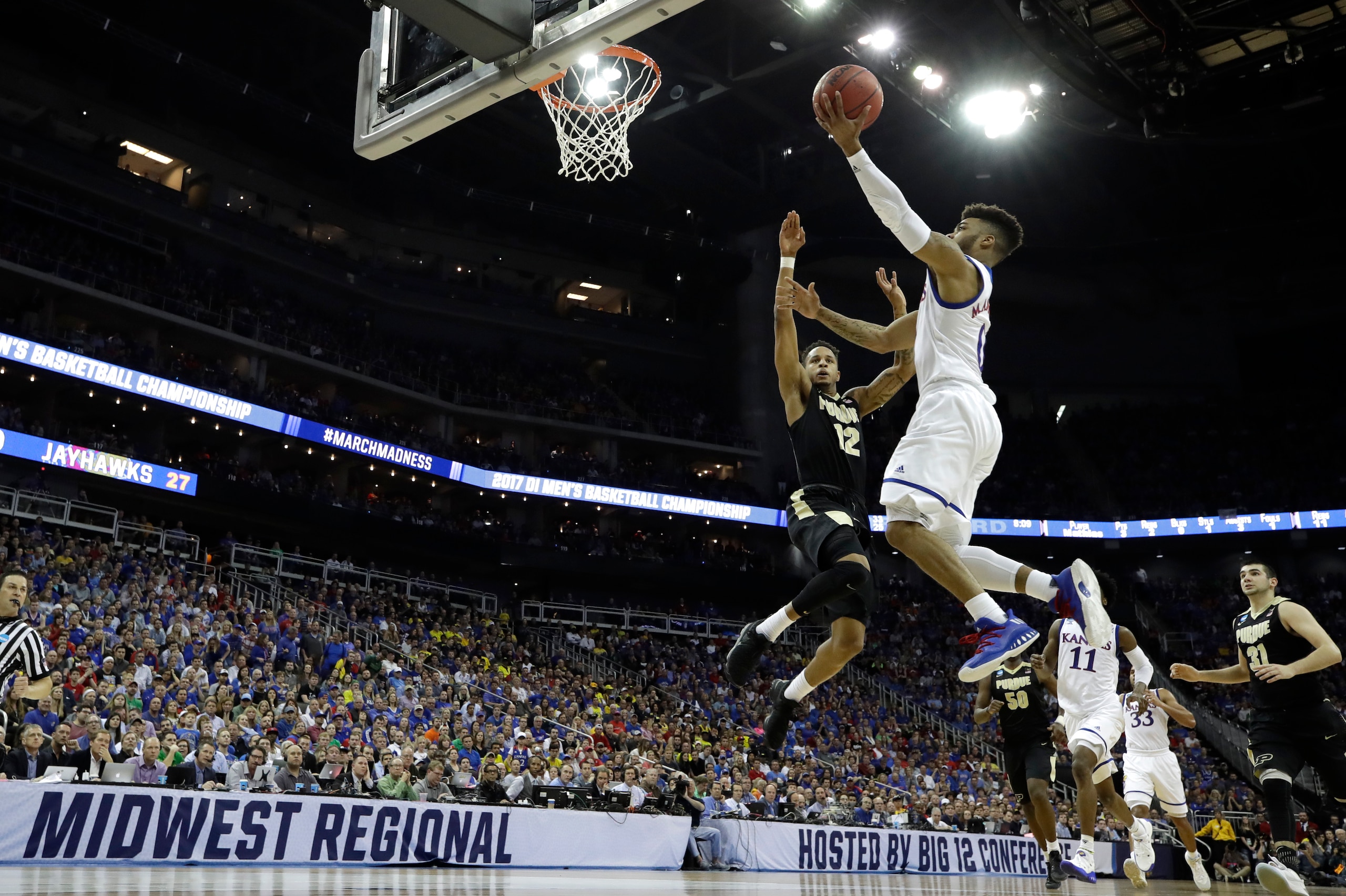
The Jayhawks have the green light to run at any opportunity and are shooting more threes than any team Self has coached at KU.
It doesn’t take a live-ball turnover to create a fast break either. Sometimes all it takes is getting Mason the ball and watching as each Jayhawk outruns his man down the floor, putting the defense in immediate recovery mode.
“They’re probably the best transition team that we’ve faced all year,” Oregon assistant Tony Stubblefield said, high praise considering the Ducks have played Lonzo Ball and UCLA twice this season.
Mason and Graham are so comfortable in this offense that they’ll suggest subtle changes to the coaching staff. In Thursday’s Sweet 16 game, Graham told his big men at halftime to start setting ball screens closer to half court instead of the three-point line, so Mason and Graham would essentially have a long runway to speed past the Boilermakers.
With around three minutes left on the clock, Self finally put up a stop sign when Graham was on the break. When Graham backed the ball out, Self smiled, called “five up,” a play in which the center sets a high ball screen for either Mason or Graham and lets Mason or Graham make a play.
"Once they got there towards the end, there was nothing you could really do about it," Purdue forward Vincent Edwards said. "Now they’re isoing and feeding off the crowd, making fadeaway and step-back threes. It’s tough, man."
The Jayhawks heard questions from the outside all week about whether they could handle’s Purdue’s mammoth frontline of Caleb Swanigan and Isaac Haas.
And, at one point early in the year, there were even questions inside their own locker room about small ball.
“At first, I honestly thought we would struggle all year rebounding the ball, but Landen inside is a monster, and Josh is as athletic as anybody in the country,” Graham said. “And we’ve got two hard-rocking point guards like me and Frank—we think we can pick on anybody.”
In KU’s locker room leading up to the Purdue matchup, the message was clear. “We kept emphasizing speed beats size 90 percent of the time,” Townsend said.
The Jayhawks used that team speed to frustrate the Purdue bigs. Jackson had four steals, using his quickness to get around Swanigan and not allow him to ever make contact to establish position.
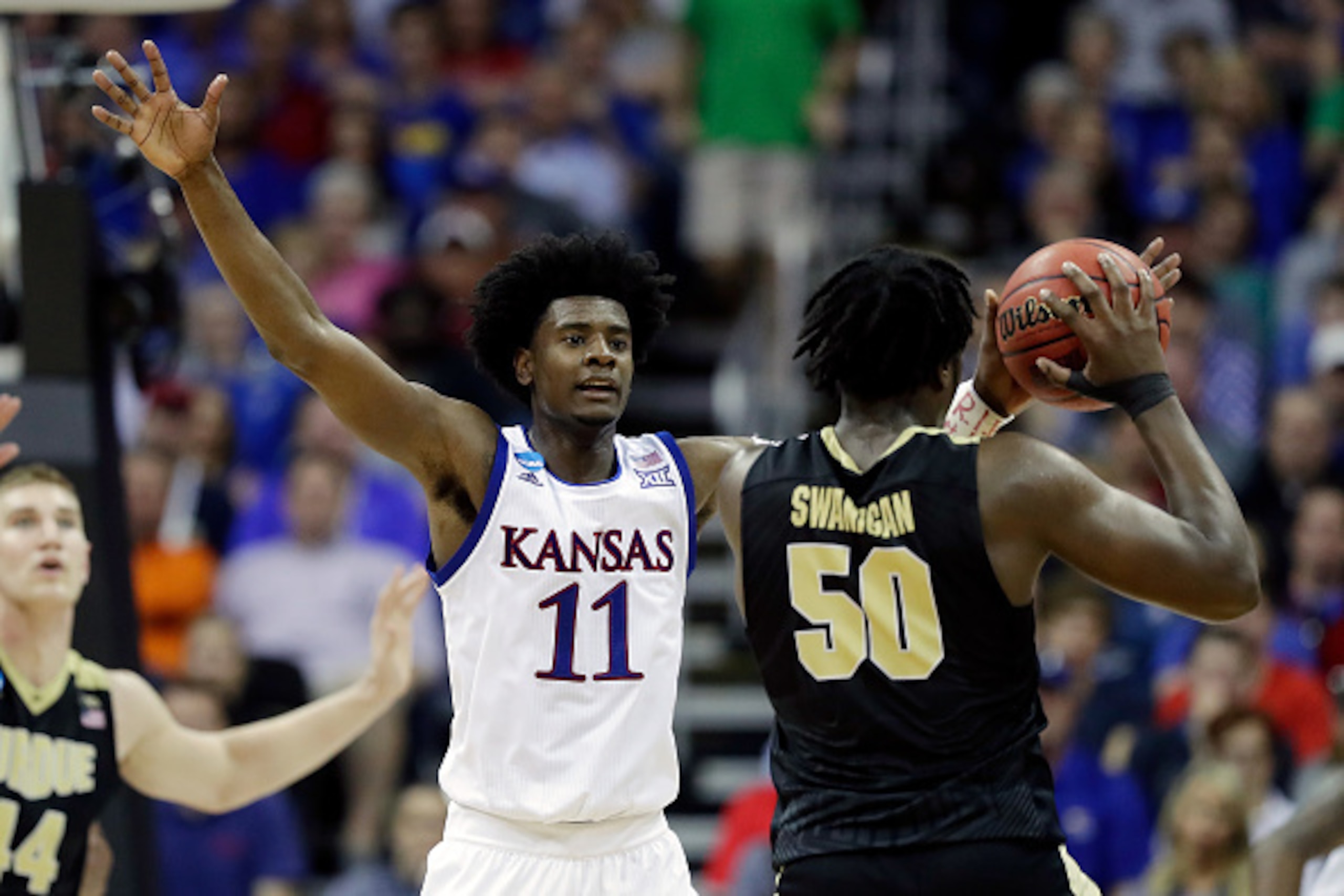
Lucas made sure Self knew he could guard Swanigan one-on-one and didn’t need any help.
Swanigan still got his (18 points), but nine of those points came on three-pointers, and he also had six turnovers and only seven rebounds.
KU out-rebounded the giant Boilermakers by seven, and it was Purdue's third-worst offensive game in terms of efficiency all season, per KenPom.com.
“I think the question was: Could they handle us?” backup center Dwight Coleby said. Y’all keep asking that question, can we handle them? Could they handle us and our speed and quickness?”
For the third straight game, the answer was clearly no.
But what awaits Saturday is one of the most athletic rosters left in the bracket in Oregon, a team that got past Michigan in large part because of its own quickness advantage.
The Ducks have their own version of a small-ball 4 in Pac-12 Player of the Year Dillon Brooks, and arguably the fastest center in college basketball and best rim protector left in the tournament in Jordan Bell.
Last year in this round, Villanova flummoxed Kansas with switching defenses and by not allowing the star of that KU team, Perry Ellis, to get the ball in his scoring spots.
The roster this year is much the same outside of Jackson replacing Ellis. But defenses have to cover more space and account for more speed.
While the Ducks are quick, “I don’t think man for man, at each position, they’re as fast as our guys,” Townsend said.
That makes the game plan simple every night for the Jayhawks.
Drop the snowball at the top of the hill and let it roll.
C.J. Moore covers college basketball and football for Bleacher Report. You can follow him on Twitter: @CJMooreBR.
.jpg?w=2560 "Viral Rams Coach Vid 🖕")


.jpg?w=2560 "Injury-stricken Seahawks signing veteran RB")
