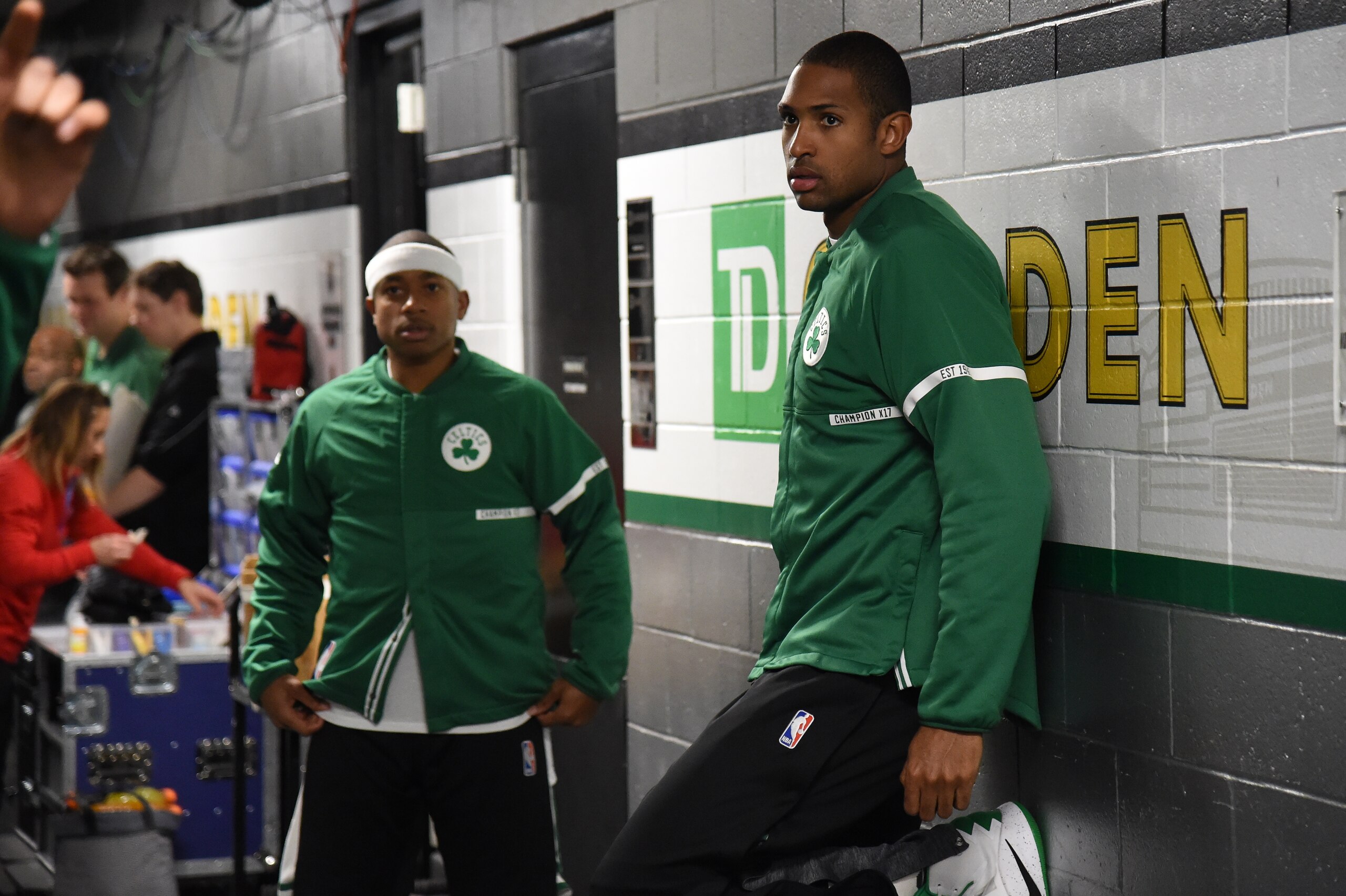

Midseason Grades for Each Boston Celtics Player
The Boston Celtics are living up to the lofty expectations pegged on them by fans, writers and sportsbooks in Las Vegas before the start of the 2016-17 season. They are 26-15 through 41 games, which puts them on pace to finish with a 52-30 record.
Several players (Isaiah Thomas, Jae Crowder, Avery Bradley) are in the midst of their best individual seasons, but it took until the past month for the Celtics to rise above the pack and join the Eastern Conference elite. With 13 wins in their last 16 games, they have put themselves in contention to chase down the Toronto Raptors for the No. 2 seed.
However, head coach Brad Stevens is not satisfied with where his squad stands despite its recent surge.
"I think we have to get a lot better," Stevens said Tuesday. "We've played a lot of close games. I think we did the math on it yesterday, 34 of the 41 (games have had margins of) 10 points are less, which is anybody's ballgame. And so we've been fortunate to win quite a few of those. We've lost a couple that you'd like to have back, but all being told, with the injuries and everything that we went through early, we've at least put ourselves in a position to keep competing. But there's a long way to go."
How have the individuals done in this collective process? Since roles differ across the roster, we will grade on a sliding scale: A star like Thomas faces different expectations than a bench player like James Young, so both will be judged accordingly. Players are listed in order of importance.
Deep Reserves
1 of 7
No. 15: Demetrius Jackson, PG
A logjam in the Celtics' backcourt has led Demetrius Jackson to spend the majority of his rookie campaign with the Maine Red Claws, Boston's NBA Development League affiliate. The 6'1" guard out of Notre Dame has not appeared in an NBA game since Dec. 2 but has shown a well-rounded skill set (17.9 PPG, 4.8 RPG, 5.3 APG) during 16 appearances with Maine.
Grade: Incomplete
No. 14: Jordan Mickey, PF
Jordan Mickey did not see the floor for 16 straight games over the last two months before frontcourt injuries cleared a path to his first career start on Jan. 11 against the Washington Wizards. He played 14 minutes in the win but has returned to the bench with Amir Johnson back healthy. After such a lackluster start to the season, the power forward is nothing more than emergency depth when Brad Stevens has his full complement of players, as shown by Mickey's team-worst plus-minus.
Grade: D
No. 13: James Young, SG/SF
James Young's best opportunity for playing time came and went early in the season when Jae Crowder went down with an ankle injury during November. The 21-year-old forward failed to fill that void on the wing, shooting below the 30 percent mark from three-point range for the third consecutive year.
With Gerald Green and Terry Rozier both ahead of him on the depth chart, it's unclear if Young will even get another shot at consistent minutes once he returns from a sprained ankle injury suffered in late December.
Grade: D
No. 12: Tyler Zeller, C
A sinus infection has forced the 7-footer to the sidelines since Dec. 30, but Tyler Zeller was already on the outskirts of the big-man rotation during the closing days of December. The center had played in only four of Boston's last eight games before experiencing the illness, with Stevens opting for lineups with bigs who can stretch the floor off the bench (Kelly Olynyk, Jonas Jerebko).
Zeller remains one of the top rebounders (8.7 rebounds per 36 minutes) on the roster, but he's become more of a situational option against bigger frontcourts.
Grade: C-
No. 11: Gerald Green, SG/SF
After a dismal start to the season, Gerald Green has experienced a useful resurgence following a breakout performance (eight points in 12 minutes, 3-of-6 from three) on Christmas Day against the New York Knicks. The 30-year-old has been red-hot from three-point range (44.4 percent) since then.
However, his defensive limitations have still kept his minutes down overall. The Celtics are allowing 112.9 points per 100 possessions with Green on the floor—the worst mark on the team among players in Stevens' usual rotation.
Grade: C
Bench Rotation
2 of 7
No. 10: Jaylen Brown, SF
The Celtics have kept a tight leash on the No. 3 overall pick, as he's averaging 13.7 minutes per game, 25th overall among rookies. The early returns have been promising, however, as Jaylen Brown is holding his own when you compare his numbers to other 2016 lottery picks.
“There’s ups and downs," Brown said last week. "You gotta stay consistent and things like that. And just being on a good team like this and playing…it’s even tougher. So I just gotta try to get better every day and be as consistent as possible.”
Grade: C+
No. 9: Terry Rozier, PG/SG
Like Tyler Zeller, Terry Rozier has slid further down the depth chart as the season has progressed. He's played in just six of 11 games since Christmas Day, as the Celtics have opted for more size in the backcourt with Marcus Smart and Gerald Green. Despite the switch, Rozier has shown plenty of promise with his defensive energy and athleticism in limited minutes.
"When we decided to go with Smart as the backup one to post," Stevens said, "it was more of a decision on Smart than it was on Rozier. He's done a really good job. When guys have been available or unavailable, you feel comfortable putting him in."
Grade: C+
No. 8: Jonas Jerebko, PF
Jonas Jerebko has been the most consistent big man in Stevens' bench rotation for the first half of the season, and a lot of that is due to his shot discipline. The 6'10" Swede takes only 8.1 field-goal attempts per 36 minutes, the lowest mark on the team outside of James Young. Jerebko's picky selection has paid off, though, as he's putting together another above-average season from three-point range (37.8 percent).
Grade: B
No. 7: Kelly Olynyk, PF/C
Kelly Olynyk experienced a disappointing start to the regular season as he attempted to find his groove following offseason shoulder surgery. The 7-footer posted career lows in points per game, field-goal percentage and three-point percentage during the first two months of the year. However, he's turned the corner in the last few weeks, shooting 56.1 percent from the field in January while the Celtics have won six of seven.
“I think he’s gotten into a good rhythm," Al Horford said of Olynyk's improved play. "I don’t know if people realize, but he had offseason surgery, and even though he’s playing and everything, a lot of the time you don’t feel quite like yourself right away."
Grade: B-
No. 6: Amir Johnson, PF/C
Amir Johnson has strengthened his hold on the starting center spot despite a decline in minutes. The 6'8" big man is averaging just 20.4 minutes per game—his lowest total in seven years—but the 10-year veteran continues to play his best basketball on the defensive end and has been a stabilizing presence for what's been a disappointing defensive season for Boston. The Celtics improve their defensive rating by 1.3 points per 100 possessions when he's on the court.
Grade: C+
5. Marcus Smart, PG/SG
3 of 7
Coach Stevens has made one more important discovery during the first half of Marcus Smart's third season: The 22-year-old is at his best offensively when he can create for others.
Stevens has handed him primary ball-handling duties off the bench over Terry Rozier in the past month, and the Oklahoma State product has responded with career bests in assists per game (4.4) and assist rate (20.4 percent).
Smart's development as an effective point guard has not completely covered up his offensive deficiencies, however. Through 38 games, he's made only minor improvements from last year in both field-goal percentage (36.5) and three-point shooting (30.1). To compound those problems, the third-year guard has exhibited questionable shot selection from beyond the arc, shooting nearly 47 percent from the corners and just 27 percent on above-the-break threes.
Smart's prowess on the defensive end balances out those struggles; he can guard up to three positions, which makes him a popular choice to close out games. His on-court impact (net rating of plus-2.9) has made Stevens a big fan.
"I know what he does to help you win," Stevens said. "Like, he cannot score a point, he can miss eight shots, not make any, and he can still have a positive impact on winning."
Grade: B

4. Avery Bradley, SG
4 of 7
His backcourt mate Isaiah Thomas may get most of the headlines, but Avery Bradley is quietly putting together a solid case for All-Star consideration during his seventh season.
The 26-year-old has made major strides in nearly every statistical category (17.7 PPG, 6.9 RPG, 2.4 APG, 47.5% FG, 40.9% 3PT), which puts him on pace for career bests at the campaign's midpoint.
The 6'3" shooting guard has earned the most acclaim for his work on the glass, as he leads the team in rebounds per game. That total would put his name in the franchise record books as the first Celtic guard to lead the team in that category.
That kind of production, combined with his first-team All-NBA defense selection, makes Celtics general manager Danny Ainge believe Bradley should be considered among the Eastern Conference elite guards.
"I think that Avery is a very underrated player," Ainge told 98.5 the Sports Hub in Boston (h/t CBS Boston) last month in a radio interview.
"I think he’s an All-Star-caliber player, for sure, and should be considered and mentioned among all the guys. Unfortunately, All-Star teams tend to be picked by points per game much more than what players shoot against you and defensive numbers and just watching how great of a defender he is. Because defense is so important in winning."
Grade: A-
3. Jae Crowder, SF
5 of 7
Kevin Durant, Stephen Curry, Kyle Korver, Kyrie Irving. These are just a few of the sharpshooters that Jae Crowder is besting in three-point shooting accuracy during the 2016-17 season.
The 26-year-old is ninth in NBA three-point percentage (42.6), a nearly nine percent improvement over his career mark (34 percent). That incredible turnaround has helped Boston turn into one of the most potent teams in the league from beyond the arc, ranking top-three in both three-point field goals made (third) and attempts (second) per game.
The small forward is also one of Boston's best shooters from inside the arc (56 percent), giving him a team-best 63.7 true shooting percentage.
“I’m just in a good rhythm shooting the ball right now,” Crowder said this week. “How I know that is that every time I take a shot I feel like it’s going in. That’s when I feel like my work that I’m putting in is paying off a little bit.”
Crowder's defense has taken a step back, unfortunately, largely thanks to a lingering ankle injury, as ESPN's real defensive plus-minus puts him No. 16 among all small forwards. That's a sharp drop from his No. 6 spot last season. However, his offensive gains, combined with his bargain salary ($7 million annually through the 2019-20 season) continue to make the wing one of the league's best values at his position.
Grade: A-
2. Al Horford, PF/C
6 of 7
Al Horford does not put up the stats of the prototypical max-salary player, but he demonstrates his value in nearly every facet of the game. The 6'10" big man is not only third on the Celtics in points per game (15.4), but he also ranks among the team leaders in rebounds (second), assists (second) and blocks (first) as well.
"I think he’s a mismatch every single game," Avery Bradley said earlier this season. "He can score every single time he gets the ball or he makes the right play."
Horford's versatile skill set has helped the Celtics become one of the NBA's seven best offenses throughout the first half of the season. Opposing bigs are forced to respect his outside shooting and passing ability, which opens up the floor for teammates. He's posted a team-best 112.9 offensive rating when on the floor, five points above the Celtics' season mark.
Despite the offensive gains, the four-time All-Star has not helped Boston as much defensively as most expected. Defensive rebounding (30th in NBA) continues to be a problem for the undersized front line, and Horford remains a liability in that area by grabbing a career-low 17.9 percent of all available defensive boards. It's hard to expect improvement in that area either, what with Horford's athleticism declining at age 30.
You can overlook the rebounding woes when you consider the Celtics are 21-10 with him in the lineup. That mark makes Horford worth his hefty $26.5 million salary thus far.
Grade: B+
1. Isaiah Thomas, PG
7 of 7
Isaiah Thomas has spent the first half of the 2016-17 season putting together a convincing case that he shouldn't just be an All-Star for the second straight season—he should potentially be a starter for the Eastern Conference.
The 5'9" point guard ranks fourth in NBA points per game (28.4), but his most impressive work has come during crunch time. Thomas is averaging 10.1 points in the fourth quarter, the highest mark in the league. According to The Ringer's Kevin O'Connor, it's also the best fourth-quarter scoring average for a player in at least 20 years, making the 27-year-old one of the NBA's most feared opponents during late-game situations.
Thomas has not only been a high-volume scorer, he's also been efficient with his shot selection. Given his career highs in both field-goal percentage (45.9) and three-point percentage (38.9), defenses have been forced to guard him tightly in all areas of the floor.
"Isaiah spent a lot of time on [shooting] this summer and getting the ball quickly off the ball into his shot," Brad Stevens said Monday.
"And you know if you look around the league, some of the hardest guys to guard are those guys who can get it in a millisecond off the ground into that smooth release and make shots, which is really hard to do from that distance. But he’s put in a lot of time and effort to become better at that.”
Thomas remains a liability on the defensive end, as Boston's defensive rating is 11 points better without the undersized guard on the floor. However, the offensive burden that Thomas carries makes those issues an afterthought during a stretch when the guard has led his team to 13 wins over the past 16 games.
"He's a special, special player obviously," said teammate Kelly Olynyk. "I don't know if there's another person in the world right now doing what he's doing. It's unfathomable."
Grade: A
All statistics and contract information courtesy of Basketball-Reference.com and NBA.com unless otherwise noted and are current as of Jan. 17. All quotes were obtained firsthand unless otherwise noted.

.jpg?w=2560 "49ers LB Suspended for Headbutt")
.jpg?w=2560 "Buzz: MHJ Hired Agents for Trade")
.jpg?w=2560 "AD Trolls Bears WR on IG 😂")
.jpg?w=2560 "Report: Steelers WR to Miss 'Weeks'")