

The Reasons Behind Robert Lewandowski's Bayern Munich Dip
Strikers should not be measured on goals alone is the modern-day maxim. The man providing your most significant threat to opponents is supposed to be so much more than an out-and-out goalscorer.
Perhaps Robert Lewandowski would like—at least right now—for his goals tally to be the only thing that matters.
The Poland international's return after 12 Bundesliga games is a relatively healthy seven goals. However, after five goals in his first three games, he has scored just twice in the following nine league outings.
TOP NEWS
Billboard Trolls Man City 👀

New NFL contenders starting to emerge after Week 4
.jpg?w=2560 "Cardinals Giants Football")
NFL investigating 2 referees for separate viral exchanges
At the same stage last season, he had 14, including the outrageous five in nine minutes against VfL Wolfsburg. That was a freak performance, but there is still a major difference in the Bayern Munich man's output that is worrying, if not baffling.
Much—if not almost everything—comes down to the 4-3-3 formation in which he is being played.
Lewandowski became the first foreign-born player to reach 30 Bundesliga goals last season, winning the Torjagerkanone as the league's leading scorer in the process, as he thrived in the 4-1-4-1/4-2-3-1 formations preferred by then-coach Pep Guardiola. So why did Carlo Ancelotti change things when he arrived in Munich in the summer?
"This team is already very good. The way they control the game suits me," the Italian told L'Equipe (in French) earlier this season. "I would just like them to play more vertically. I would like to see the full-backs cross more. Guardiola preferred to see wingers in the style of Robben or Ribery, Coman or Douglas Costa in that role. I want to use those sorts of players to cross but to also be on the end of them. I want more people in the box."
So far, though, it has not been the case. With the emphasis on the full-backs, notably David Alaba and Philipp Lahm, to get forward and the wide players to get in front of goal, Bayern have looked far less of an attacking force than they did last season, and consequently so has Lewandowski.
The Bayern forward gets few goals from outside the box—two of 30 last term in the Bundesliga, and none of seven league strikes this season, per Squawka—and so he can only be as good as his service. And at the moment, it is not good.

Take the wide positions. In the recent 2-1 win over Leverkusen, Bayern sent 16 balls into the box; in the same fixture last season, which they won 3-0, they delivered 13. In last weekend's match, they completed just one from open play, and two corners reached a Bayern head, including Mats Hummels' for the match-winner.
In the same fixture a year ago, Bayern's accuracy was no better, but the position from which the crosses were delivered—much closer to the byline—was. That's a nightmare for defenders, who generally have to attempt to clear when facing their own goal, and manna from the flanks for a striker of Lewandowski's predatory instincts.
Under Guardiola, Lewandowski had help through the middle, notably in the form of Thomas Muller. Muller, who is yet to score in the Bundesliga in 10 games this season, notched 20 goals himself in 2015/16, but it is his seven assists that are most interesting. Four of them were for Lewandowski goals, while he also won a penalty that his strike partner converted.
Under Ancelotti, Muller has been exiled out wide on the right and is further up the pitch, making it more difficult for him to both get in front of goal and tee Lewandowski up for goalscoring chances.
Muller was not the only one to provide creativity through the middle last season. Thiago Alcantara and Mario Gotze also did so, while Arturo Vidal burst forward, giving defenders other things to think about than Lewandowski.
Ironically, in seeking to flood the penalty area with more players, Ancelotti seems to have done exactly the opposite. All too often, Lewandowski appears isolated, particularly when more instinctively defensive players, such as Lahm and Joshua Kimmich, feature in the three-man midfield.
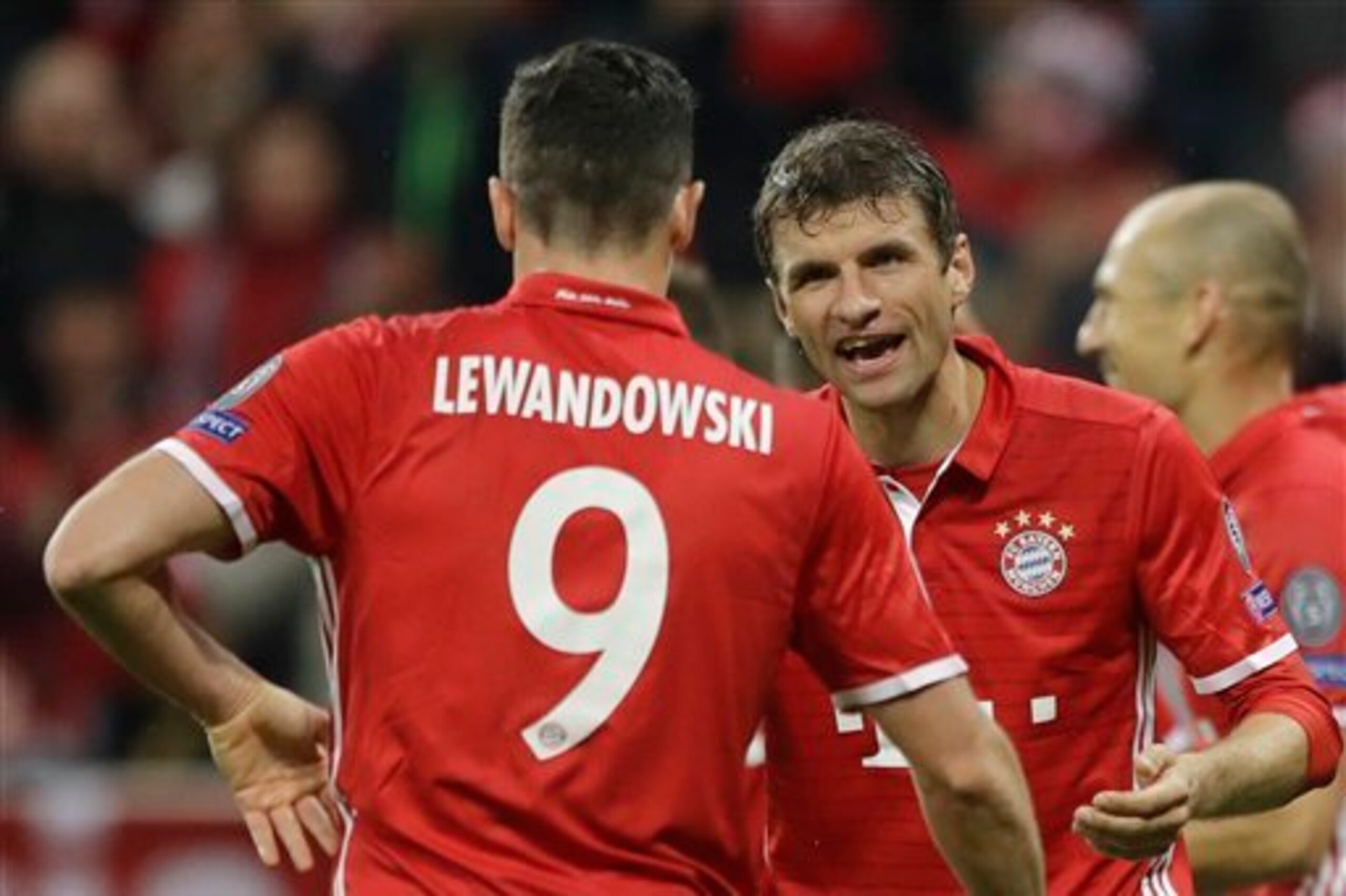
"One of his finest qualities has always been when he's with his back to goal, shielding the ball," his former boss at Dortmund, Jurgen Klopp, said, per UEFA.com's Piotr Kozminski and Philip Rober.
But for the moment, that is almost exclusively his role, and with midfielders reluctant to come forward—either because of their natural game or because they are aware the side is open to counter-attacks if they do—Lewandowski's ability to hold up the ball is all but wasted.
There is also the fact that Lewandowski is—like many great players before him—suffering a dip in form. After an exhausting 2015/16 that was significantly extended by Euro 2016, he has looked a little jaded. His stats suggest the same.
When he holds the ball up, his use of it is not as good as last season, with his pass-completion rate down. The 3 per cent difference between 2015/16 and this season in the Bundesliga, according to WhoScored.com, does not look particularly worrisome, but the dramatic drop in the Champions League from 83 per cent to just over 71 per cent—in a competition in which the slightest mistake is exposed—tells its own story.
It is the same tale when he gets a sight of goal. Only 18 of his 50 shots this season have been on target, per ESPN FC, some 36 per cent. Last season, nearly one shot in two had a chance of finding the net. It seems Lewandowski is only human, after all.
It is worth remembering his "goal drought" is only a relative one. It is only by his own stratospheric standards—54 goals in 75 Bundesliga games—that he is struggling. Only three players in the German top flight have found the net more times than him this season.
"I would not swap Robert Lewandowski for anyone," Ancelotti told L'Equipe (in French). The Italian might, however, have to compromise on his tactical preferences to get the best out of his irreplaceable Polish striker.

.jpg?w=2560 "Hill Injury Update Football")
.jpg?w=2560 "OBJ Calls Out Giants After Release")
.jpg?w=2560 "Tyreek makes another cryptic post amid Chiefs rumors")


.jpg?w=2560 "Greenlaw Talks Payton Exchange")
