

Importance of Lallana, Wijnaldum to Liverpool Clear as Can, Sturridge Toil v Utd
Liverpool's first evening kick-off since the expansion of Anfield this summer failed to deliver a famous night under the stadium's lights, with Jose Mourinho's Manchester United putting in a typically Mourinho performance to take away a 0-0 draw.
Jurgen Klopp's side have struggled against teams who park the bus, and Mourinho once again produced stifling, spoiling tactics to claim a point and show that while United sacked Louis van Gaal for being too negative, Mourinho is still the master bus parker.
United's performance was one that Sunderland boss David Moyes or West Bromwich Albion manager Tony Pulis would have been proud of. Mourinho deployed a 4-4-1-1 formation with Paul Pogba behind Zlatan Ibrahimovic in attack. At times, though, United's two wingers sat in and it was six in defence for the visitors.

.jpg?w=2560)

Liverpool, therefore, struggled for their typical high-energy, high-pressing game, unable to break down United's deep defence, especially with tactical fouls to break up play being the order of the first half from the visitors.
United's setup wasn't the only reason for Liverpool's failure to produce their usual attacking football, though, with the loss of midfielders Adam Lallana and Georginio Wijnaldum also proving key.
Lallana was fit enough for the bench, having had over a fortnight since the Reds' last outing away to Swansea City, and his introduction for the last half an hour improved Liverpool's attacking verve from deep.
Replacing the injured duo in midfield were Emre Can and Philippe Coutinho, with Daniel Sturridge taking up the No. 9 role and Coutinho dropping deeper into the midfield three—as had happened at Swansea after Lallana's early injury.
On paper, having two players of the quality of Coutinho and Can available should not mean a weakened team, but the problem was the style of play of these two compared to the two they replaced.
Ultimately, losing two of the three midfielders to have started every league game together was always going to upset Liverpool's rhythm, and that was how it played out.
Klopp opted to keep captain Jordan Henderson at the base of the midfield triangle, rather than moving him into one of the box-to-box roles and deploying Can in the holding role. While Henderson again did well—often having to mop up after misplaced passes from those ahead of him—Can looked lost in his role.

Post-match, Mourinho attempted to claim Liverpool were negative in their approach by using Can and Henderson together, but it was clearly still a midfield three from Klopp's side, with Can operating in the role Wijnaldum had been.
Last season, Can and Henderson lined up alongside each other in a 4-2-3-1, but here it was a different role for Can, who was starting his first league game of the season. He struggled at times and lacked the energy and drive of Wijnaldum or Lallana.
There was more than one occasion in the first half that saw Klopp reprimand his compatriot, with one in particular seeing Klopp and assistant Zeljko Buvac jump from their seats after Can bizarrely opted to play the ball backwards with yards of space ahead of him in midfield.
Such instances slowed Liverpool's play down further and provided a stark contrast to the darting, direct runs Liverpool's midfielders have been accustomed to making this season.
Klopp's change to 4-3-3 this season and using two typically attacking midfielders in the box-to-box roles took many by surprise, but the use of two players able to make lung-busting runs from deep has been key to Liverpool's early-season form.
Take Lallana's goal at Arsenal on the opening weekend as the case in point, where Wijnaldum and Lallana combined inside the box, both having made runs from midfield to get into the box beyond the forward, Roberto Firmino, and combine to finish.
Such third-man running was missing against Man Utd without the duo, with the first such run from midfield arriving after Lallana had replaced Sturridge on 60 minutes.
While Can improved in the second half, his style of play is different to that of Lallana or Wijnaldum, and with Henderson looking nailed-on for the holding role in midfield, the German will need to adapt his game if he is to compete for one of the box-to-box roles in midfield going forward.
Of course, Can managed to bundle into the box and force an excellent save from David De Gea and it is this drive from midfield that is needed more in the different role to his usual holding one. Can will be hoping for further opportunity to find his feet before Wijnaldum returns.
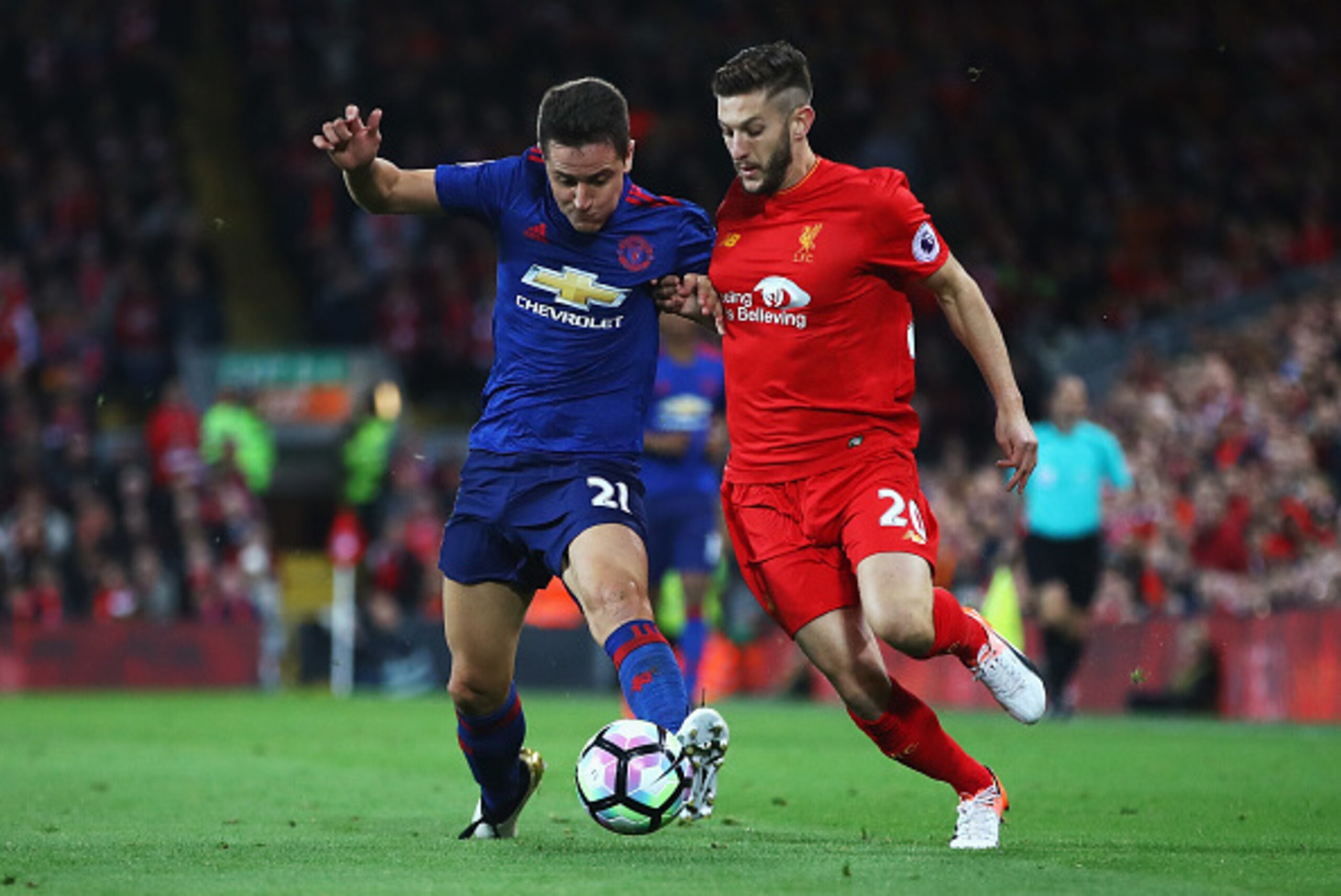
On the other side of the midfield triangle, Coutinho did little wrong, but in a similar way to Can, he isn't the type of player to make the run beyond the forwards. When deployed on the left of the front three, it's the Brazilian who drops into the space that Lallana then exploits by running ahead of him. Coutinho isn't going to make such runs, and again this created a lack of drive from deep, making it easier for United to sit deep and leave play in front of them.
It was no surprise, then, when Liverpool looked better following Lallana's introduction, with Coutinho back in his more natural and better-suited role, and drive from midfield being added.
That Lallana's introduction and therefore Liverpool's brighter play arrived after Sturridge's departure could be coincidence or could be due to a better understanding between those who remained on the pitch. Something isn't clicking for Sturridge just yet.
Post-match, Klopp told reporters that Lallana had trained for two days before the game and could even have started, so that surely means he will return to the XI on Saturday when Pulis' West Bromwich Albion arrive to attempt, you would assume, similar stifling tactics.
Who makes way for Lallana—Can or Sturridge—will be interesting, with neither impressing and both looking off the pace at times.
The manager defended Sturridge post-match, saying: "This was a really difficult game for a striker, the way we played today was not easy to enjoy for a striker."
Klopp instead focussed on his side's lack of control and poor passing play, especially in the first half, when United were happy to make the game "hectic" and constantly break up play with petty fouls.
Liverpool must learn to cope with such opposition if they are to continue their early-season form, with this being only their third home game of the campaign—and not every side will arrive at Anfield to be as open as Leicester City and Hull City were previously.
Indeed, West Brom on Saturday could see similar tactics from Pulis' side, so the hope must be that Klopp's team can learn from this and find solutions to unlocking six-man defences—with Klopp urging more patience from his players in such situations.
Ultimately, Liverpool shouldn't be too downbeat by the result and perhaps instead the frustration at not beating such an expensively assembled but negatively set-up team, should reflect more on the opposition's ambitions.
.jpg?w=2560 "Falcons Saints Football")
.jpg?w=2560 "Rams Eagles Football")
.jpg?w=2560 "Injury-stricken Seahawks signing veteran RB")


.jpg?w=2560 "2 NFL Officials Suspended")
