

Is Bayern Munich's Niklas Dorsch the Next Toni Kroos or the Next Schweinsteiger?
It’s arguable there is no more stable outfield position in Bayern Munich’s team right now than central midfield. The sheer class of the personnel, and the depth of numbers possessed in that area, make it both a comfort and a headache for Carlo Ancelotti when picking his team.
In Xabi Alonso and Thiago Alcantara, you have two pass masters; in Javi Martinez and Arturo Vidal, there are two all-action, stern tacklers; and in Joshua Kimmich and Renato Sanches, the future of German and Portuguese football respectively might just be present.
However, that hasn’t stopped fans hoping for a glimpse of youth prodigy Niklas Dorsch, who whetted fans' appetites with a few cameo appearances during the International Champions Cup. He contested in the UEFA Youth League last season but has been confined to Bayern II duties this season, with Ancelotti running the rule over him close by.

.jpg?w=2560)

He was one of several youngsters given the chance to shine during the summer, playing the second half against Inter Milan (alongside German-American Timothy Tillman), and also appeared in what was essentially a pre-pre-season friendly against Pep Guardiola’s Manchester City in July.
This was the first time the fans had seen him since impressing during the 2015-16 winter break. A disappointing 2-1 loss to Karlsruher SC ahead of the Ruckrunde was only made bearable by Dorsch’s promising showing—one that Jerome Boateng eloquently labelled “good,” per the Bavarian Football Works.
So the players like him, the manager seems to, and the fans are desperate for more. Is Dorsch all he’s cracked up to be, and is he deserving of labels such as the "next Toni Kroos" and "next Bastian Schweinsteiger?"
Summer Hiccups
Sadly, Dorsch did not display his best attributes during his brief glimpses of action with the first team over the summer; Ancelotti will have walked away knowing the 18-year-old had far more to offer.
The game against City was chaotic in midfield to say the least, with Guardiola’s new charges attempting to implement his pressing philosophy and force errors from Bayern. Dorsch fell prey to this a few times, with some of his passing a little loose for comfort, but at least the aggression that underlines his game was still there.

His next performance, against Inter, was a strange one as he played from right-back. It’s clearly not his position—covering depth, tracking runners and operating within the tight confines of the touchline is not his game—and there were clear positives and negatives to take from the experience.
He consistently looked to cut inside, showing outright reluctance to go down the line and test the outside of the full-back. His passing was good, and he always offered for the ball, frequently encouraging right-sided buildup play.
There was one moment where he tore back to dispossess a runner on his flank and then calmly started an attack, but it was anomalous; for the most part, his defensive disorganisation was clear.
The Kroos Label
Wind back a little further in his career, though, and the reason why he was once labelled the “next Kroos” is clear. On a slightly more familiar stage, he can truly shine in midfield.
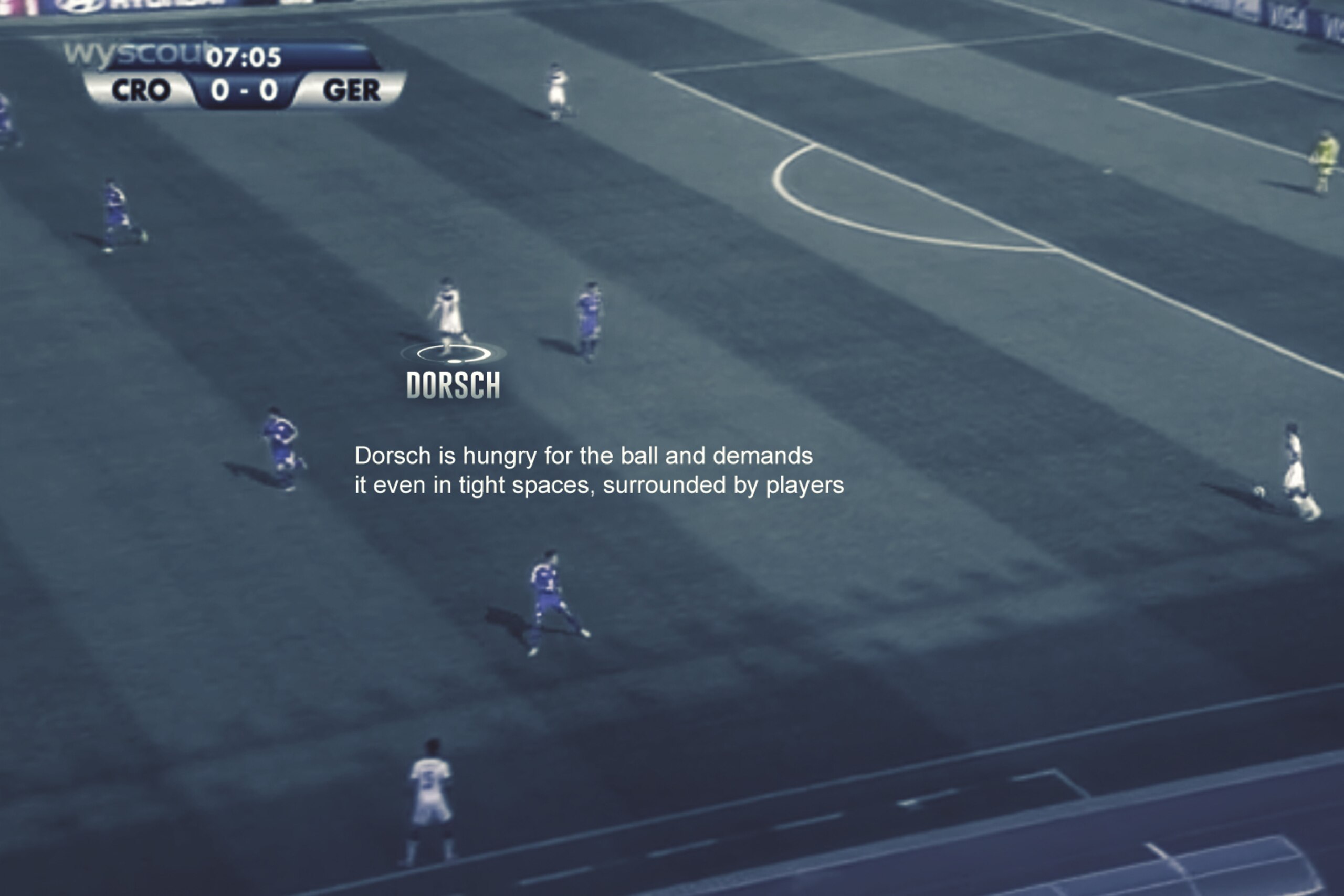
There have been multiple excellent performances from Dorsch over the last year, with the 2015 FIFA Under-17 World Cup housing the most accessible ones outside of Munich. There he played a leader’s role for Germany and showcased some remarkable footballing acumen and skills.
Former Bayer Leverkusen midfielder Stefan Reinartz has recently introduced the concept of “packing”—explained here by Raphael Honigstein for ESPN FC—and Kroos was crowned the king of it during Euro 2016.
By passing forward and penetrating lines of players, you can “pack” groups of players. It’s a measure of how many opponents you can essentially bypass or take out of the game with a stroke of the ball.

Dorsch’s first instinct is to pass forward; he packs a lot of players when he plays. Be it at the heart of a Germany youth midfield or stuck at right-back in a pre-season friendly, he will try to break lines and foster the beginning of attacks wherever possible. Unlike many midfield “mediators,” he will almost always look up first; he’s never happy to pass sideways or backwards.
This is an extremely attractive trait—both to managers and fans. It’s something Sergio Busquets doesn’t get enough credit for, and something Kroos has only recently become truly appreciated for. Dorsch has the same forward-thinking passing brain—though, of course, it’s the trait rather than the level of accomplishment that’s comparable.
For both Bayern and Germany, he has shown the ability to create clear-cut chances despite being 40-50 yards from goal. His long-range passing is superb—be it lofted aerial switches or scything, defence-splitting passes—and he creates more chances than most do from his deep-lying position.
Aggression
One attribute that can always transcend the position you play in is aggression, and fairly often, native midfielders can succeed in unfamiliar roles because of it.
Alessandro Florenzi is an example of this; despite playing best as a No. 8 upon breaking into the AS Roma senior side, he’s found a new home at right-back, and it’s been possible because of work rate and aggression.

This is not to recommend Dorsch as a future Bundesliga right-back, but it was encouraging to see the aggressive streak in his game rise to the fore when he asked new questions in pre-season.
It suggests it’s a natural part of his game—one that will never dim—and explains why some prefer to label him the “next Schweinsteiger” rather than the “next Kroos.”
His tendency to break out from a defensive block and pursue the ball means he’s most at home as a No. 8 rather than a No. 6, and when given license to hunt for tackles, he’ll take full advantage. His low-to-the-ground frame means he can cover short areas fast, nipping in to meet the ball-player quicker than expected.
Whether he’d have the positional discipline to curb these tendencies should he be played as a No. 6 is tough to say, but there’s also a question of whether you’d really want to limit him.
Playing in a midfield pivot alongside a more disciplined player—like Kroos does with Sami Khedira for the seniors—could allow him to break lines with passes and storm out to intercept, therefore unlocking both of his best qualities.
.jpg?w=2560 "Falcons Saints Football")
.jpg?w=2560 "Rams Eagles Football")
.jpg?w=2560 "Injury-stricken Seahawks signing veteran RB")


.jpg?w=2560 "2 NFL Officials Suspended")
