Will Anybody Watch the Stanford-Washington Friday Night Showdown?
Not only did college football analyst Todd Blackledge get a heads-up from one of his bosses, but his opinion was sought as well.
What would you think about Stanford vs. Washington on a Friday night?
"I'm all about doing the games," he said. "If we get a chance to do a great matchup and a great game, I'm all in favor of it."


_0.png?w=2560)
Little did Blackledge know it would help lead to his working one of the most important games of the 2016 college football season—albeit one that not enough people in the rest of the country are talking about, at least not yet.
The Cardinal are ranked seventh; the Huskies are No. 10. Although the Pac-12 showdown comes at an early part of the season, it has the feel of being more than an elimination game.
Although the conference isn't known for staying true to form, these two teams already stand out in the North Division, with every other team already having at least two losses (although not all of them have opened league play yet).
A win for Stanford would be a big step toward trying to win its fourth Pac-12 title in five years, with no ranked teams on the rest of its schedule. Washington hopes to validate the hype that goes with its ranking and claims of being a rejuvenated program.
That also means the game could have huge playoff implications, especially since the Pac-12 only has one other ranked team, Utah at No. 18. With the ACC and Big Ten looking strong and Alabama at No. 1, the Pac-12, Big 12 and Houston in the American Athletic might end up competing for one spot.
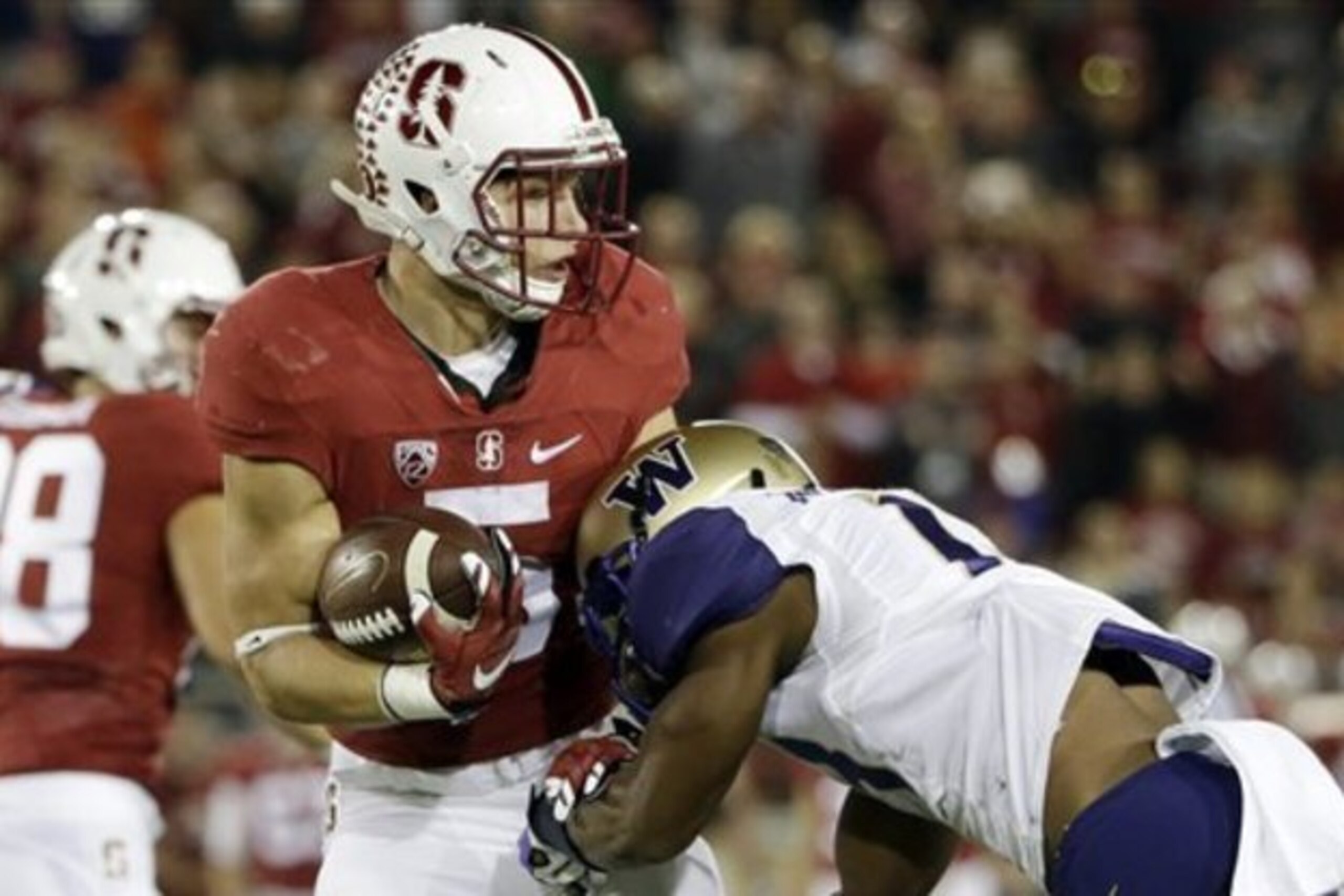
It might also be Stanford running back Christian McCaffrey's best opportunity to impress Heisman Trophy voters. His 436 rushing yards are 15th in the nation, but his average of 211.67 all-purpose yards rank second only by San Diego State's Donnel Pumphrey (222.0).
Last year, McCaffrey had 300 all-purpose yards against the Huskies (109 rushing, 112 receiving and 79 on kick returns). This year's Washington team ranks 26th in the nation in total defense, No. 57 against the run and No. 15 in scoring defense.
So there's a lot at stake, and not just for the teams and players. Regardless of the outcome, industry experts will have a close eye on what kind of ratings ESPN draws.
For a lot of people, Friday nights are for going out to dinner or catching the latest movie. It's a chance for high school football to take center stage, and at some colleges it's homecoming.
Nicknamed the "death slot" because both the ratings and ad revenue dip, Fridays are generally not considered a good night for TV or college football. It goes against tradition and routine, and specific to this game, rush-hour traffic in Seattle could be especially problematic with a 6 p.m. local kickoff.
It's one of the reasons why Washington generally tries to avoid schedule irregularities, as Husky Stadium has hosted only one game on a non-holiday weekday since 1945 (UCLA in 2010). Another is geography as the state is located in a corner of the country, which means it occasionally has to travel more.
For example, last week Washington played Saturday night at Arizona, more than 1,200 miles away (1,500 driving). Due to the desert heat, the Wildcats prefer to play after sunset in September, and sure enough the game went into overtime before the Huskies won 35-28. Washington coach Chris Petersen said his team didn't get back home until 5 a.m.
"It's a quick turnaround and here we go," Petersen said during his on-campus press conference Monday. "Any time you don't play on Saturday, it is a pain. It definitely takes you out of your rhythm, your routine and all those types of things for sure."
Incidentally, Stanford was in Los Angeles last Saturday, knocking off its third straight name opponent, UCLA, 22-13, after having already defeated Kansas State, 26-13, on a Friday night and Southern California, 27-10. But it has other issues to deal with due to the shortened week, including both starting cornerbacks, Alijah Holder and Quenton Meeks, being out with injuries.
To understand how this all came about, one needs to go back to the Pac-12 TV deal that was agreed to in 2011. Both Fox and ESPN have the rights to 22 of the conference's football games each season, including four each that are specifically slated for Thursday or Friday nights.
"There was no sort of perfect science to that," Nick Dawson, who oversees college football programming across the ESPN networks, said about that part of the scheduling.
"At that point we have a draft process between us and Fox. We happened to have first pick in that sort of midweek game draft process this particular year. We took the Stanford at Washington game at No. 1 for our network."
But no one knew it would work out this well, with both teams undefeated.
| No. | 2013 (rating) | 2014 (rating) |
| 1 | Birmingham, Ala. (9.2) | Birmingham, Ala. (9.2) |
| 2 | Greenville, S.C. (4.9) | New Orleans (4.2) |
| 3 | Knoxville, Tenn. (4.4) | Knoxville, Tenn. (4.1) |
| 4 | New Orleans (4.3) | Greenville, S.C. (4.1) |
| 5 | Nashville (3.3) | Memphis (3.8) |
| 6 | Memphis (3.3) | Atlanta (3.8) |
| 7 | Columbus (3.3) | Jacksonville (3.5) |
| 8 | Jacksonville (3.3) | Oklahoma City (3.4) |
| 9 | Louisville (3.2) | Tulsa (3.1) |
| 10 | Atlanta (3.2) | Nashville (2.9) |
So the challenge for ESPN is to draw national attention for what would usually be considered a regional game, at an unconventional time. According to Sports Media Watch, last Friday's TCU vs. SMU game on ESPN drew a 0.9 rating, or 1.357 million viewers, and the late game of USC vs. Utah on Fox Sports 1 landed a 0.7 rating, 1.042 million.
In comparison, the top game each Saturday has drawn at least 5 million viewers.
ESPN's hope is to score something along those lines, especially if it can attract viewers in its core college football markets, even though they're nowhere near Seattle or San Francisco. They're all in the South.
"The thing about ESPN is they want to win the night," said John Ourand, who covers television and media for Street & Smith's Sports Business Daily.
It seems likely that it will, especially since there's little competition broadcast-wise. There's no presidential debate, no NFL game to worry about, and Major League Baseball's playoffs don't get underway until the following week. It even avoids the World Cup of Hockey finals.
ESPN2 is offering the only other college football game that night, Toledo at BYU, as a nightcap. As an appetizer, an anchor and reporter will broadcast live from the stadium for the evening version of SportsCenter.
"We're actually pretty optimistic about what we can do from a ratings perspective," Dawson said.
Since 1990, ESPN's best ratings for a college football game on a regular Friday night was 4.194 million viewers for Boise State at Michigan State on Aug. 31, 2012.
However, except for the day after Thanksgiving, when long-established rivalry games are sometimes played, this game is believed to be its first Friday night game in which both teams came in ranked in the Top 10.
It's a unique situation and opportunity for everyone involved.
"It's pretty exciting," Blackledge said.
Quotes were obtained firsthand unless otherwise noted.
Christopher Walsh is a lead SEC college football writer. Follow Christopher on Twitter @WritingWalsh.

.jpg?w=2560 "NFL investigating 2 referees for separate viral exchanges")
.jpg?w=2560 "Report: Chiefs Contact Hill's Agent")
.jpg?w=2560 "OBJ Calls Out Giants After Release")
.jpg?w=2560 "Tyreek makes another cryptic post amid Chiefs rumors")

.jpg?w=2560 "Greenlaw Talks Payton Exchange")