Manchester United Boss Jose Mourinho's Key Decisions Ahead of 2016-17 Season
Paul Pogba's arrival has sent expectations around Manchester United skyrocketing, so how can manager Jose Mourinho ensure that his team are as successful as possible in the 2016/17 Premier League season?
Football management is all about decisions. There are choices to make at every level, from the biggest macro-calls about the direction of the club to the minute, out-of-sight micro-decisions about travel, coaching, diet and tactics. Successful managers are made by getting more of these right than wrong.

He does not have to get everything right, but let's take a look at some of the most pressing decisions facing Mourinho—the ones that will likely define his, and United's, season.
Tactics
The big tactical question is a simple matter of formation.
Does he play a 4-2-3-1 with a central midfield spine made up of what he would describe as a No. 6, a No. 8 and a No. 10, or does he play a 4-3-3 with a No. 6 and two No. 8s?
For the purposes of this discussion, No. 6 represents the holding midfielder and No. 8 represents the more box-to-box, attack-minded version. This is a little confusing at United in terms of actual shirt numbers—the No. 6 is a No. 8 and the No. 8 is a No. 10.
Of course, no one seems to quite know what the No. 10 is, but we will come on to that.
There should really be no debate here. There are not too many downsides to choosing 4-3-3. Mourinho has ample attackers to pick from in all the necessary positions in either formation, but the balance of United's available midfielders screams 4-3-3.
He could play Michael Carrick or Morgan Schneiderlin—or even occasionally Pogba—at No. 6 and Pogba, Ander Herrera or Schneiderlin as the two No. 8s.
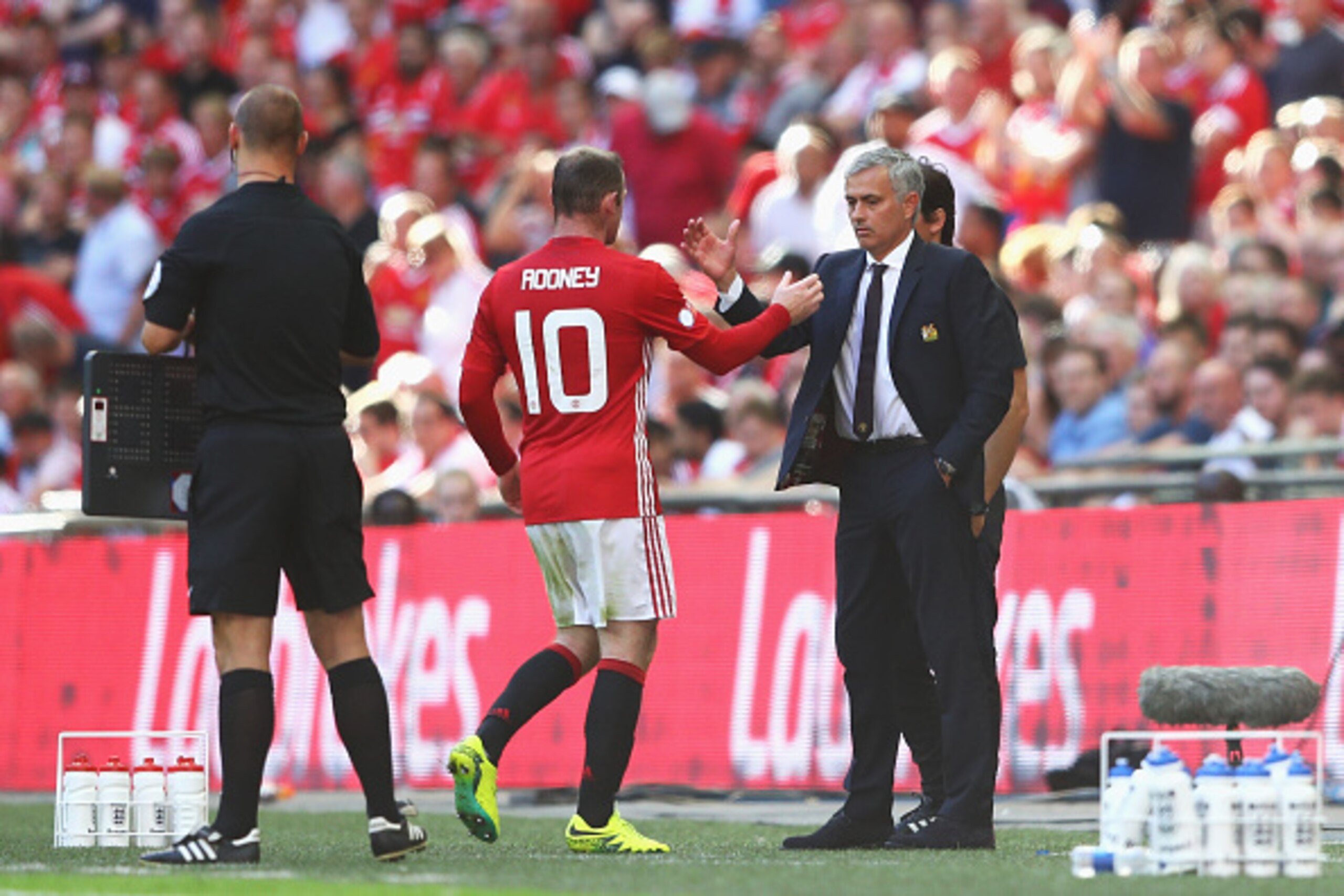
What is much more likely to happen, though, is that he will play two of the above in a 4-2-3-1 to accommodate Wayne Rooney into the side at No. 10.
Assuming that is the case, he needs to decide the primary partner for Pogba. Obviously there can be some variation for specific opposition, or to adapt to the vagaries of form and fitness, but some kind of first-choice partnership will need to be built.
This is especially true given Pogba's capacity to be effective in the final third, meaning he needs to build an understanding with a partner who will give him the freedom to properly express himself. Add to that Rooney and Zlatan Ibrahimovic's shared tendency to drop deep, and it becomes abundantly clear why some stability of personnel is needed.
Footballers need to be able to predict their team-mates' movements, and with movement as unpredictable as that which is on offer in the current squad, regular playing time together will be crucial.
Will Mourinho opt for the experience of Carrick, the energy of Schneiderlin or the attacking prowess of Herrera? There are pros and cons to each choice, and none seems obvious, hence the advantages of 4-3-3.
This is one of the manager's most important choices.
Personnel
So, the Rooney question, then. This most divisive topic must surely be reaching its endgame.
In the simplest possible terms, in Rooney's last three league seasons he has scored 17, 12 and eight goals. Some of that decline can be explained by a shift in position, but not all of it. After all, last year was supposed to be the campaign in which he led the line and fired in 20 goals.
Instead, it became abundantly clear he could not do that as he laboured and struggled, all bobbling first touches and Hollywood balls out to the right wing. He hit a purple patch in January, did OK in midfield against teams who left him alone and that was about it.
It may be a little reductive, but it is not too wide of the mark to say that playing Rooney at No. 10 compromises most of United's most talented players.
It compromises Pogba by giving him more defensive responsibilities in a midfield two. It compromises Ibrahimovic because the two men will so often be naturally drawn to similar areas of the pitch.
It compromises Henrikh Mkhitaryan, whose natural inclination when playing wide on the right will be to drift inside to those same spaces. It compromises Juan Mata by taking up the one spot on the pitch in which he could excel.
Anthony Martial is less likely to receive the kind of artful through balls from Rooney that he would from Mkhitaryan or Mata. The former Everton man has never been that kind of No. 10. In his younger days he brought so much to the table that it did not matter.
But now, the pace has gone, the personal magic is only intermittent and his overall contribution does not make up for what his inclusion does to the rest of the team.
Perhaps the club captain will prove his doubters wrong. Perhaps his chaotic and ineffective performance in the Community Shield was a factor of pre-season fitness levels, but the evidence is becoming overwhelming.
This is Mourinho's single biggest decision.
There are other personnel decisions, too. Pre-season has more than hinted that Antonio Valencia will be the starting right-back, but there are others who will compete for that role.

Pre-season also looked like bad news for Memphis Depay's place in the pecking order. When Marcus Rashford came on for Martial at Wembley on Sunday, it was hard not to wince for the not-even-on-the-bench Dutchman.
Ibrahimovic's arrival means one fewer central place for Rashford or Martial to slot into, and seeing the England international look his usual assured and effective self coming in off the left wing cannot have been easy for the former PSV Eindhoven man.
The Dutchman can ill afford another season on the sidelines in terms of his development, and Mourinho has to decide whether to do something pro-active about that or not.
Elsewhere in the squad, he has clearly already decided that Bastian Schweinsteiger is not in his plans, but players like Mata and Daley Blind present intriguing choices.
Then there are younger, or at least less experienced players he will have to shepherd through the season. His treatment of them will be under the microscope of rigorous public attention. Rashford and Timothy Fosu-Mensah are the most obvious, but the older but not-much-more experienced Jesse Lingard is another.
He showed again at Wembley that he has something special to offer on occasion, and it is easy to imagine Mourinho valuing his work rate. But his inclusion meant no room in the side for Mkhitaryan in the Community Shield, and it would be a massive shame if that continued into the season proper.
It is clear there are a lot of challenges facing the new manager in the personnel department.
How much trouble does he want to cause?
The Mourinho siege-mentality machine has been creaking into action. Before the Pogba signing, he complained of other managers discussing the deal.
Per Sky Sports' Dev Trehan, he said: "I only speak about us. I heard already two of my colleagues from other clubs speaking about us. I do not like that. It is not ethical."
Once Pogba had arrived, he told MUTV (h/t TalkSport):
"I know the discussion, I understand that, sometimes in football, things happen and the club breaks the record, but this is only possible at clubs like Man United.
When I heard some of the comments and heard some of the managers criticising that, I don't think they ever have this problem because, to have this problem, you need to be at one of the top clubs in the world. So at Man United it can happen.
"
Within reason this can be entertaining and effective, but Mourinho will have to decide how much energy he wants to spend on personal feuds with his "colleagues" in a league now packed with managerial heavyweights. There is a thin line between building a siege mentality and getting drawn into unnecessary distractions.
Management is not about getting every decision right. It is about getting enough right that the ones you get wrong do not matter so much.
If Mourinho makes the right calls on these big decisions, everything is set up for United to enjoy a really successful season.



.jpg?w=2560 "Latest Peyton-Colts Rumors")