

LAS VEGAS — In the honest-to-goodness NBA, the stars shine brightest during the playoffs. In the version put forth at Las Vegas Summer League, the postseason is as good a time as any to sit top talent.
At least, that's how things unfolded Wednesday—and not at all to the detriment of the teams proceeding sans studs.
The Philadelphia 76ers had no trouble advancing to the next round without Ben Simmons, this year's No. 1 overall pick. It helped that they were up against the D-League Select squad, but Philly's 108-71 stomping at the Thomas & Mack Center was no less effective or efficient.
TOP NEWS

Heat, Giannis were down by 20+ in each of their 3 losses
.jpg?w=2560 "NBA Gambling Charges")
Malik Beasley Negotiating Plea Deal (AP)

Yaxel: Luka Not MJ 🗣️
The Sixers, who had been 0-3 in Sin City, shot 53.9 percent from the field and 43.9 percent from three, with five players in double figures. Among those was Timothe Luwawu-Cabarrot, the 2016 draft's 24th pick, who finished with 15 points on 6-of-12 shooting.
Across the way at Cox Pavilion, the Minnesota Timberwolves dispatched the San Antonio Spurs, 80-71. Both teams took the floor without their top performers—Kris Dunn for the T-Wolves, reigning Summer League MVP Kyle Anderson for the Spurs. Dunn hasn't played since suffering a concussion Sunday.
Not that the Wolves needed to see any more from the No. 5 pick out of Providence. Through two games, he averaged 24 points on 54.3 percent shooting. In his stead, Xavier Silas chipped in 10 points and two assists while Tyus Jones (15 points, nine assists) handled the bulk of the on-ball duties. Adreian Payne, a 2014 first-rounder, led all scorers with 20 points.
The most shocking starless swing of the day, though, belonged to the Utah Jazz.
On Tuesday, the Jazz dropped a double-overtime thriller to the Portland Trail Blazers, 92-89, despite squeezing 30 points and nine rebounds out of second-year stud Trey Lyles. On Wednesday, with Lyles (likely) excused from the rest of summer league, Utah took Portland apart, 86-71.
"Everybody kind of looks for Trey when he's out there," Jazz summer league coach Johnnie Bryant said afterward. "There's a little more movement [without Lyles]. There's a little more cutting. And guys know they've got to step up and take their shot."
Tibor Pleiss, the Utah's highly touted center from Germany, dropped a game-high 20 points to go along with eight rebounds. Joel Bolomboy, a 2016 second-rounder out of Weber State, added 14 points and nine boards. Aaron Craft and Spencer Butterfield chipped in 11 points apiece.
Whether any of the star absentees—Simmons, Dunn, Anderson and Lyles—see any more action this summer seems doubtful. At this point, their teams don't have much incentive to trot them out in more exhibitions and every reason to give other guys more run.
If any of the big names do garner further floor time in Sin City, it'll be icing on the cake for the fans who pack the stands.
Bricks for Buddy
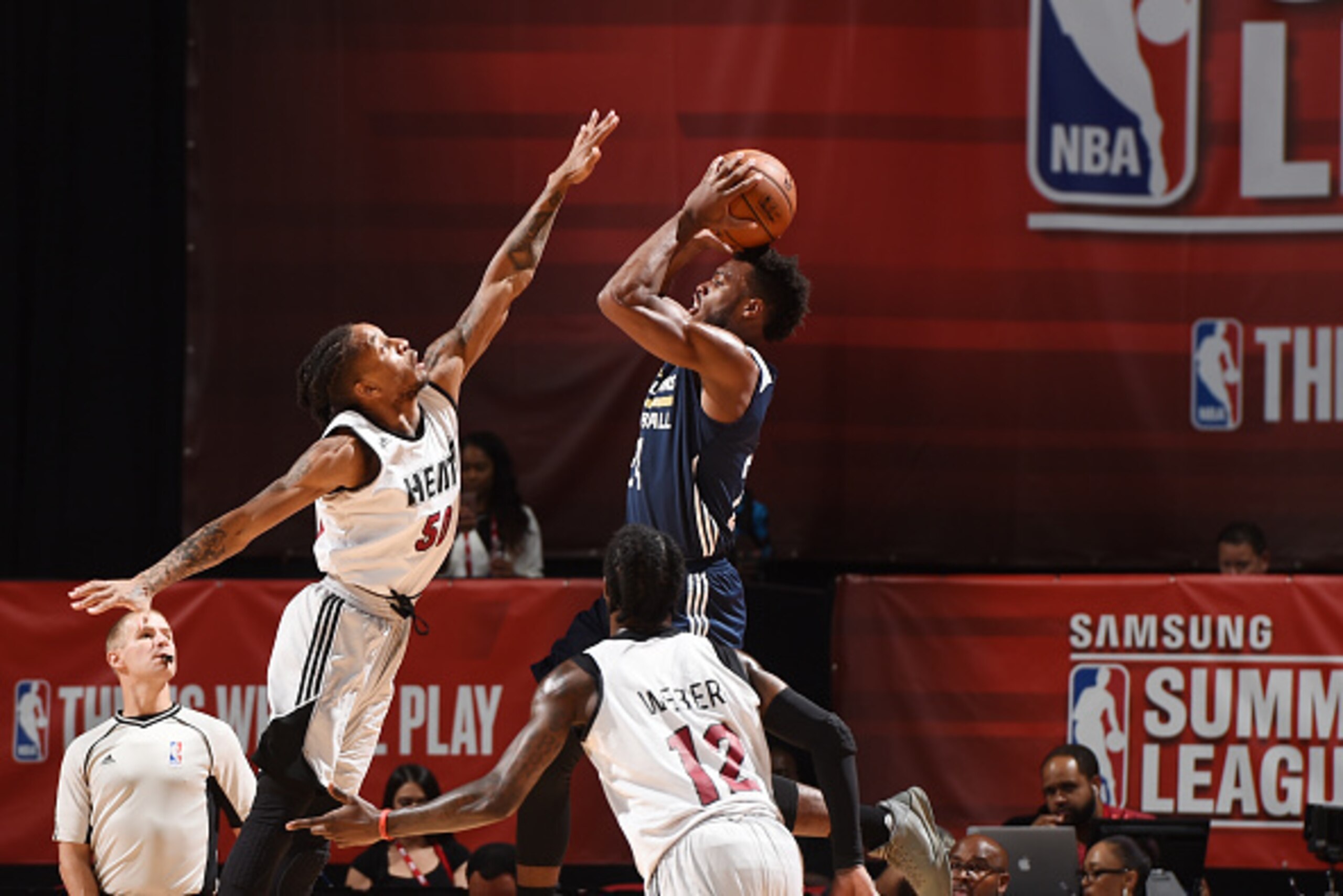
One by one, Buddy Hield's shots kept clanking off the iron at the Thomas & Mack Center. One by one, Hield kept shooting them, hoping to find an end to his cold streak during the New Orleans Pelicans' 81-77 defeat to the Miami Heat.
"Let the offense work for you," Pelicans coach Robert Pack told his star rookie. "If you have to make the right play, you get in there. They're collapsing the defense on you. You just have to make the right play. That's just as good."
Hield did plenty of that. The No. 6 pick out of Oklahoma dished five assists after averaging three helpers per game through his first three.
"Everybody's guarding me so tight, so I've got to make plays for my teammates," Hield said afterward. "Everybody around me can score the ball."
Cheick Diallo, Alex Olah and David Lighty did what they could on that front, with double-figure scoring efforts for each. Hield chipped in a team-high 16 of his own but didn't score from the field until halfway through the third quarter and didn't scratch from deep until the 4:05 mark of the fourth.
He finished shooting 5-of-17 from the field (1-of-7 from three) with four turnovers but insisted he wasn't worried about his subpar performance.
"Oh, this is the first time this has happened to me in a long, long time," Hield said, "probably a year and a half."
Back then, Hield was well on his way to becoming a deity in Norman, Oklahoma. Now, he's trying to find his way—and his jumper—in Las Vegas. Through his first four games as a pro, Hield has hit 33.8 percent of his shots from the floor, including an abysmal 24.4 percent from three.
That might be more of a concern if he were headed to New Orleans as the star he was in college. With the Pelicans, he'll be the one playing the part of complementary scorer for one of the game's great young talents.
"When I get to training camp, guys like Anthony Davis will open the floor more for me," Hield said.
Until then, Hield's chief task will be learning how not to press, how to take what the defense gives him.
"It's just a learning curve, you know," he said. "The best in the world, they went through tough times like this. Just got to grow from these growing pains."
Brown, Rozier Big Again for Boston
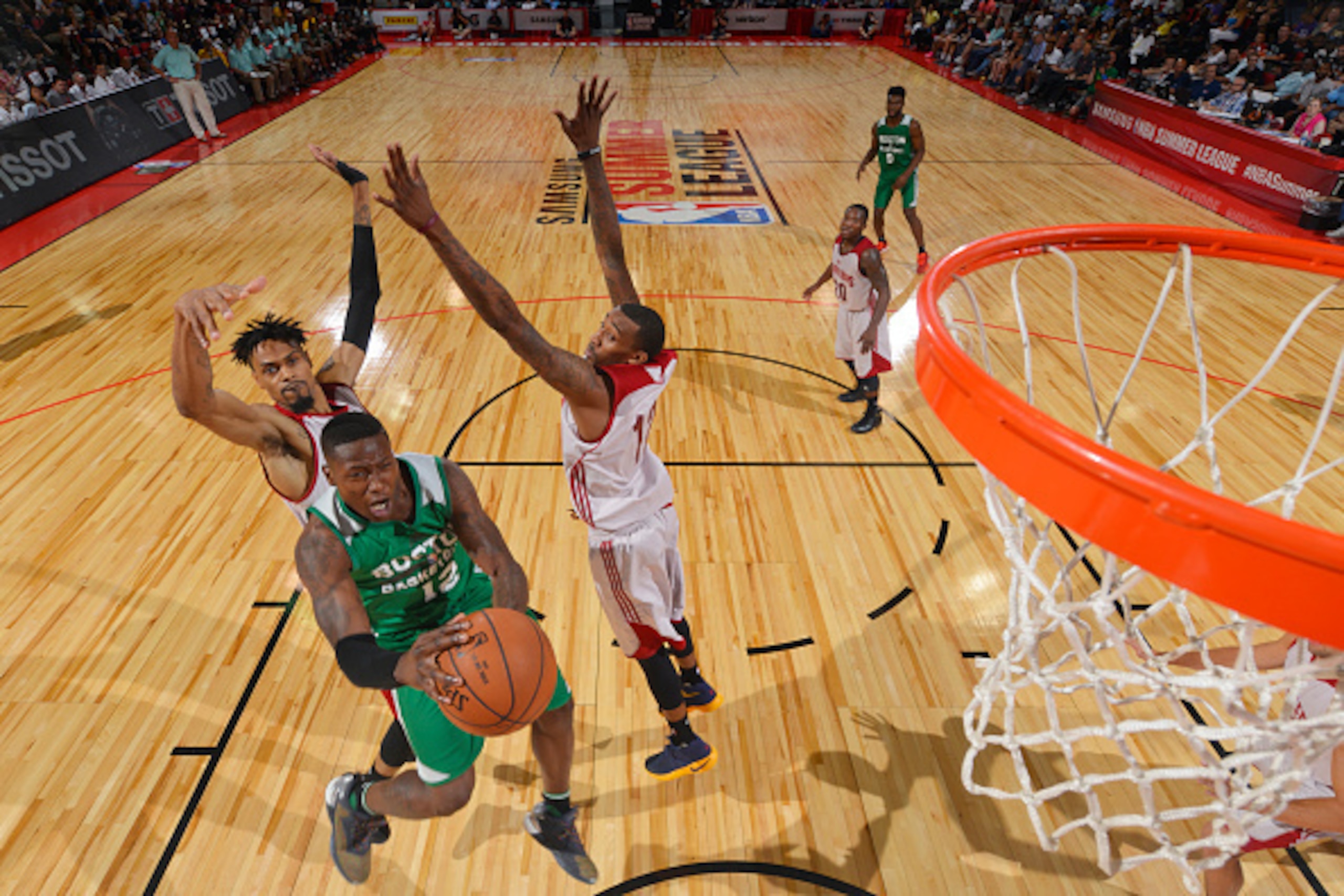
Say what you will about Danny Ainge's track record in the draft—and it isn't a pretty one—but his top picks from each of the last two years, Terry Rozier and Jaylen Brown, are starting to show out in summer league.
Brown followed up his 20-point, 10-rebound effort from Tuesday with 25 points and nine boards during the Boston Celtics' 98-94 loss to the Cleveland Cavaliers on Wednesday. Rozier, coming off a 26-point showing against the Dallas Mavericks, dropped 24 more on the Cavs.
Both players were aggressive from the get-go, combining for 17 free throws on 20 trips to the stripe. Brown, in particular, continued to show off his sky-high hops with yet another vicious finish.
The loss leaves the C's with one more game Friday before they head home for the summer. For Brown and Rozier, it'll be one more chance to strut their stuff—and make Trader Danny look a little bit better in the process.
Behind the Scenes: Sports Science in the NBA
Hours before any balls began bouncing in Las Vegas, a smattering of students, media and other sports professionals gathered in the bowels of the Thomas & Mack Center to learn about the present and future of sports science technology.
ESPN's Mark Jones introduced a slew of speakers, beginning with a duo from Fatigue Science. The Vancouver, Canada-based company works with over 50 professional sports teams around the world, including the Toronto Raptors, to help players optimize their sleep patterns—and avoid the ill effects of so-called "sleep debt."
Fatigue Science's special wristband and software combine to measure sleep patterns and allow clubs to better understand who needs more rest and how best to afford players adequate sleep amid hectic travel schedules.
Next up was Catapult, represented by North American president Brian Kopp. The Australian outfit has gained a strong foothold in the NBA during recent years, partnering with 17 teams—including the Golden State Warriors, San Antonio Spurs and Dallas Mavericks—to track player exertion and exhaustion using a tracking device of its own.
The league's collective bargaining agreement doesn't currently allow players to use wearables in actual games, so the data thus far is largely limited to practices and shootarounds. That could change, with another round of talks between the owners and players likely in 2017.
Up third was Alex McKechnie, the Raptors' director of sports science. McKechnie, who previously worked with the Los Angeles Lakers, described the ins and outs of trying to apply these technologies and the data they derive to the realities of playing in the NBA.
"The game is played on the hardwood," McKechnie said, "not on analytics."
As McKechnie explained, what's most important is that a team's management empower its coaches to put players in position to succeed and provide them with the proper support. It seems simple and fundamental, but in an industry often ruled by egos and competing interests, it can be all too easy for even the most valuable lessons of sports science to get lost in the shuffle.
To conclude the session, Chris Grancio, the general manager of Adidas Basketball, briefly explained what goes into making a modern basketball shoe. Among the most eye-opening nuggets: that all Adidas signees are required to undergo physical evaluations at P3 in Santa Barbara, and that it takes 18 months (if not longer) to design a signature shoe.
All quotes were obtained firsthand.



.png?w=2560 "Week 8 Winners & Losers 📊")
.jpg?w=2560 "Jonathan Taylor Landing Spots")
.jpg?w=2560 "Aikman Blasts Cowboys WR 🫣")