

How Can Germany Best Replace Key Absentees in Euro 2016 Semi-Final vs. France?
Germany paid a hefty price for their dramatic Euro 2016 quarter-final win over Italy on Saturday. The world champions finally beat their bogey team in a competitive match for the first time but lost key players in the process.
Head coach Joachim Low will have to make numerous changes to his lineup for the clash with host nation France in Marseille's Stade Velodrome on Thursday. "The Italy match and the 120 minutes left their traces," the 56-year-old said in a press conference on Monday, per Stephan Uersfeld of ESPN FC.
Outside of the spot between the sticks, where Manuel Neuer remains perhaps the world champions' biggest trump card, every position group is missing a starter. France will be a big test for Germany's depth, which Low hasn't really had to tap into so far.


"#Löw: "There will be personnel changes, but I have faith in all of my players." #JederFuerJeden #EURO2016 #GERFRA
— Germany (@DFB_Team_EN) July 4, 2016"
Here, Bleacher Report takes a look at the absentees and how they could best be replaced.
System
Before Low can decide on the players to start the match, however, he needs to settle on a system.
Against Italy, he changed from Germany's usual 4-2-3-1 to a 3-4-2-1 alignment that added cover for the Azzurri's dangerous counter-attacks and facilitated the buildup phase with Toni Kroos marked tightly in midfield, giving more of the responsibilities in possession to centre-backs Mats Hummels and Jerome Boateng.
The World Cup holders have picked up extensive experience in a system with three at the back in the last two years and it worked rather well against Antonio Conte's men, who didn't produce much danger from open play throughout the 120 minutes.
France, of course, are a much different side and, with everyone on board, Low would likely change back to the system his side played for the first four matches at the Euros.
Seeing as Germany will be without some experienced and battle-tested players, however, it seems reasonable to expect Low to stick with a slightly more cautious approach that includes three centre-backs providing cover for his creative attacking force.
Defence
Centre-back Mats Hummels picked up his second booking of the tournament and will miss the match with a suspension.
The rule that has come under a lot of criticism is especially harsh on the 27-year-old, seeing as his first booking against Slovakia was a terrible decision, and his second caution in the dying moments of regulation in the quarter-final was for a 50-50 challenge.
""I'm so glad the yellow card suspension rule exists because why would we wanna see the best players play in the semifinal?" Said no one ever
— Kayla Knapp (@KaylaKnappFOX) July 2, 2016"
It comes at an inopportune time for Low, seeing as the quarter-final was Hummels' best performance for the national team since the 2014 World Cup, where, among other strong performances, the Bayern Munich defender scored the winner against France in the quarter-finals.
Germany do have good options to replace the 27-year-old, though. Depending on the system, both Shkodran Mustafi and Benedikt Howedes could play in central defence. Should Low go with a four-man back line, the smart money is on Schalke 04 captain Howedes to take Hummels' spot.
The 28-year-old struggled in the two first matches of Euro 2016, playing out of position at right-back, where his lack of technical skills and quickness showed up numerous times, both in his pedestrian contributions going forward and defensively, most notably against Ukraine's Yevhen Konoplyanka.
The World Cup winner did, however, play well against Italy at right-centre-back, a role more suited to his characteristics. Against the physical Graziano Pelle, Howedes more than held his own, earning a high compliment from his head coach:
Mustafi had replaced Hummels against Ukraine and played decently, scoring the team's first goal of the Euros from a Kroos free-kick, but he hasn't seen the field since. If Germany go with a three-man back line, the 24-year-old's likely matchup would be Antoine Griezmann.
Midfield
Sami Khedira has been ruled out with a muscle injury that had already forced him off the field after a quarter of an hour against Italy. "We will do all we can that he can play in an eventual final" Low said, per Uersfeld.
Team captain Bastian Schweinsteiger replaced the Juventus man in the quarter-final, but he is a doubt for Thursday with a knee problem. It's a race against time for the 31-year-old, whose fitness—or lack thereof—was a big talking point ahead of the tournament.
Low has assured the media that his captain would only play if he was fully fit, per Uersfeld: "Players with minor injuries will definitely not play. That's clear. I hope that he gets fit in time, because Bastian can give our team a lot. But I will definitely not play someone of whom I am not convinced that he can go 90 or 120 minutes. I've done that in the past, and I won't make the same twice."
With the starter and his natural replacement presumably out of the picture against France, two of the four outfield players who have yet to see feature are the most logical candidates to play in the semi-final: Emre Can and Julian Weigl.
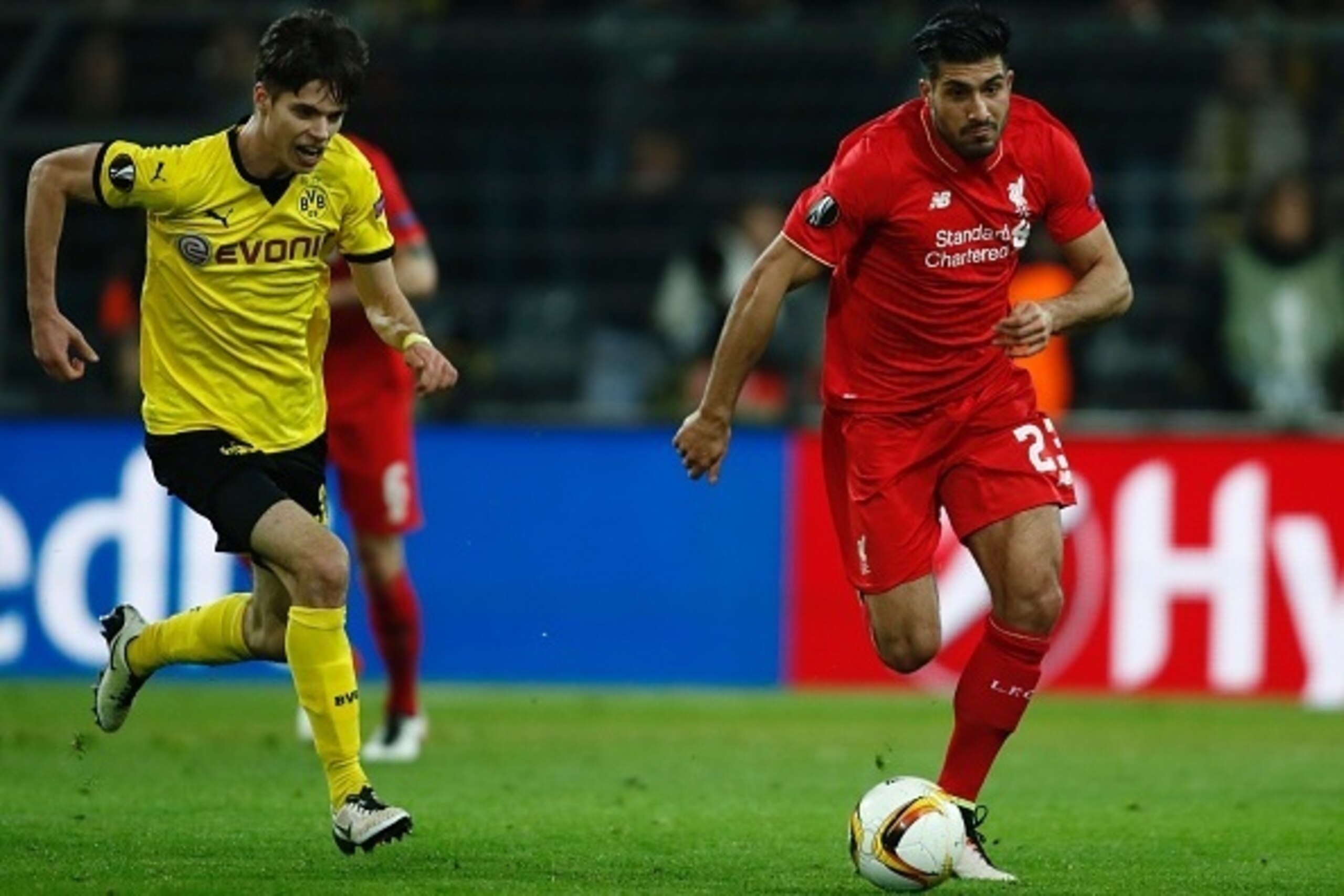
The versatile Liverpool man would be the closest thing to a direct replacement for Khedira as a willing runner and powerful, physical midfielder. Debuting in September, the 22-year-old has picked up six caps but has yet to play in a central role for Germany, having so far mostly played at full-back, where he looked anything but convincing.
Borussia Dortmund's Weigl is the more strategic player, a better passer and would thus also help out in the buildup phase. The major concern about him is his lack of experience at the international level, with the 20-year-old only debuting in the penultimate warm-up match ahead of the Euros against Slovakia.
No stage has proved too big for one of the shooting stars of the last Bundesliga season, however, as he displayed a remarkable consistency in his performances for Thomas Tuchel's side, as well as a maturity beyond his years in his style of play. What he lacks in physicality, Weigl makes up for in intelligence in terms of his positioning on the field and his decision-making.
Low has already ruled out pulling Joshua Kimmich away from his duties as a makeshift right-back and inserting him into his more natural position in central midfield, per Deutsche Welle, so the decision should come down to Can and Weigl.
This writer's best guess is that Weigl will get the start, with Can a better option for an appearance as an energiser off the bench.
Attack
On a personal level, Mario Gomez's injury is the most tragic development. The striker's renaissance at international level had been one of the best stories to follow until it was cut short with a hamstring injury.
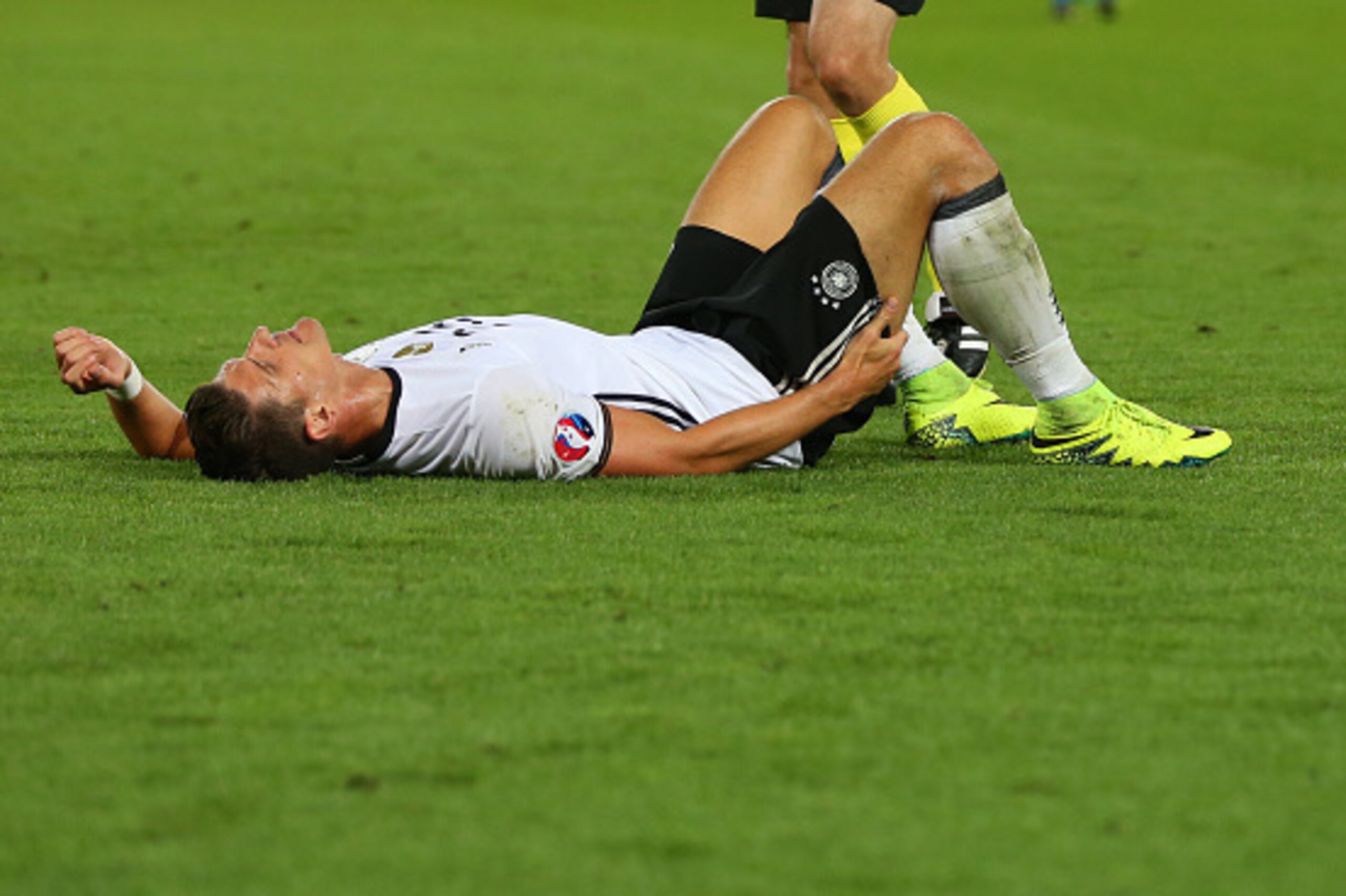
The 30-year-old has been ruled out for the rest of the tournament, with Low offering his sympathies, per the German football association's official website: "Our thoughts are with Mario. He’s done well in the tournament and has helped us in a number of ways. We now need to rethink our tactics a bit and try to cope without him."
Gomez had only started from the final match in the group stage against Northern Ireland, but he was a key component in a Germany attack that finally clicked in that match. To that point, Mario Gotze had started and looked out of his depth leading the line, so it seems unlikely Low will go back to him.
Rather, Gomez's absence could push Thomas Muller into a central attacking role.
His goalscoring drought may still be ongoing and his poor attempt in the penalty shootout against Italy certainly didn't add confidence in front of goal, but the 26-year-old is still useful to his side, as Raphael Honigstein of ESPN FC explained: "His often unpredictable runs and unexpected ideas are an integral part of Low's setup and a necessary injection of anarchy into a passing game that could otherwise become a little too pretty."
If not Muller, then Julian Draxler could get a shot atop the formation. He fell victim to Low's tactical plans against Italy after his man-of-the-match performance against Slovakia in the round of 16, but he replaced Gomez when he had to leave the pitch after 72 minutes.
A quicker and more physical player than Gotze, the Wolfsburg man and Muller could take turns at centre-forward and play off each other, spearheading an unpredictable attacking force that could give France fits.
Lars Pollmann is a Featured Columnist who also writes for YellowWallPod.com. You can follow him on Twitter.

.jpg?w=2560 "NBA Gambling Charges")

.png?w=2560 "Week 8 Winners & Losers 📊")

.jpg?w=2560 "Aikman Blasts Cowboys WR 🫣")
.jpg?w=2560 "Jonathan Taylor Landing Spots")