Sloppy Spain Build Their Own Euro 2016 Mountain as They Swap Paths with Croatia

The net bulged and those behind it erupted in euphoria. In front of them, Spain's David De Gea sat on the turf in shock, his arm pointing despairingly at a team-mate, his head quickly dropping.
On his back was No. 13, which seemed fitting: 13 seconds had just changed the entire tournament.
At the other end to begin the sequence, Sergio Busquets had played in Aritz Aduriz on the edge of the Croatia penalty area. Immediately the Athletic Club Bilbao man had let go of a shot, but flying in from the left, Darijo Srna blocked it.
TOP NEWS

Final Men's Ballon d'Or Rankings 📊
World Football Moments 🍿
_0.png?w=2560 "CFB Top 25")
Unranked Teams Cause Chaos in Rankings 📊
And then it happened.
Marko Pjaca picked up the loose ball and flashed a direct pass to Nikola Kalinic. Driving at Gerard Pique and Sergio Ramos, the striker then fed the outstanding Ivan Perisic, who took one touch before riffling his shot past De Gea.
There it was: the bulge, the goal. Croatia 2-1 Spain. Thirteen seconds had changed everything.
If the games and days that had preceded this one at Euro 2016 had felt a little flat and routine, this was anything but.
Group D had always looked significant in the context of the draw, and as Perisic lined up his shot the stakes were immense. Awaiting the winner was the most gentle run to the final; awaiting the loser was Italy, and then possibly Germany and France after that.
Already, AS had called it the "route of the death," but given the way they'd looked coming in, Spain had seemed almost certain to avoid it. But no. Perisic and Croatia have pushed them down that path, and Spain helped them do it.
As La Roja exited the pitch at the Stade de Bordeaux on Tuesday, a feeling of complacency was as striking as the knowledge of the ramifications this result had for the rest of the tournament.
Inside seven minutes, Vicente del Bosque's men had gone ahead after a crisp team move was finished off by Cesc Fabregas and Alvaro Morata, and at that moment it felt as though something of a non-event would unfold: Spain were five points clear at the top of the group; Croatia were without Luka Modric and Mario Mandzukic; the game had that feel about it. But then Spain got sloppy.
Minutes later, a stray pass from Ramos allowed the Croatians to break, with Kalinic drawing a save from De Gea. In the sequence that directly followed, the Manchester United No. 1 was slow to move the ball on after receiving it from Pique as Spain attempted to play out from the back, allowing Ivan Rakitic to win possession and chip the goalkeeper. His shot hit the crossbar and the post.
On the surface, the rest of the half unfolded in a familiar manner, Spain dominating possession and their opponent waiting for them, but this was different to previous encounters. Del Bosque's players were casual and played as though they weren't mindful of the stakes, while Croatia attacked with venom and purpose.
Their equaliser through Kalinic was deserved, and then the second half was similar. Uncharacteristically, Spain lacked control through the middle despite their possession, reflected by the fact Del Bosque removed Nolito for Bruno Soriano after an hour.
But Croatia kept coming and Perisic's winner had been coming, too. Spain never quite looked like themselves. How? Why?
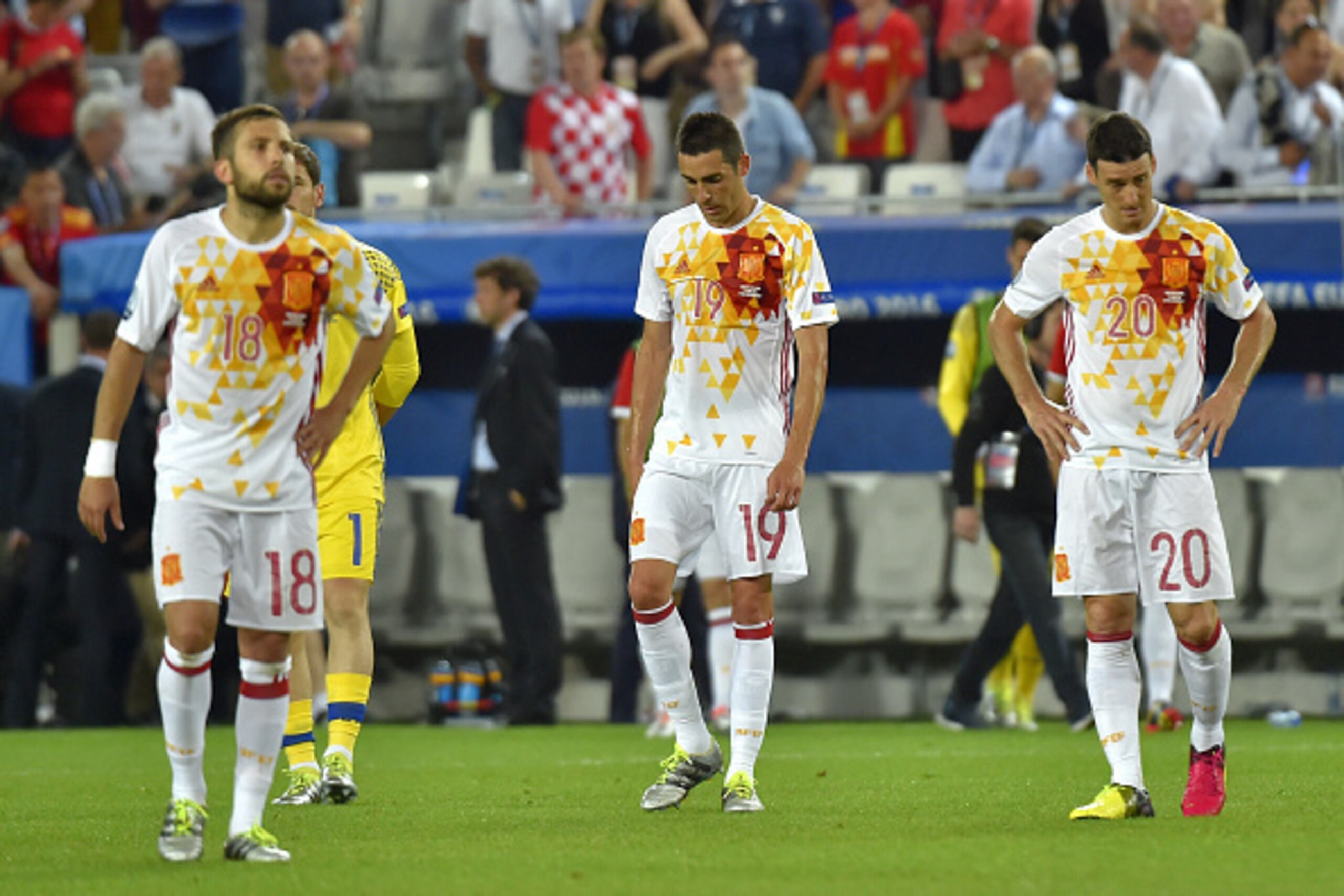
"I've no need to tell you that it's worrying to have lost this match," said Del Bosque at the post-match press conference. "We had the game in the palm of our hand."
They did, and that seemed part of the problem.
For Spain, it was as though there wasn't enough pressure in the situation after they'd gone ahead. Whereas against the Czech Republic and Turkey there'd been an urgency to them, here there was a we've-got-this disposition that didn't fit the circumstances.
Up front, Morata quickly faded out of the game after his opener. In midfield, Andres Iniesta lacked the spark he'd shown in previous outings, while at the back, the shakiness that defined La Roja's experience at the 2014 FIFA World Cup in Brazil returned. It didn't help that Ramos missed a penalty, either.
Watching on, surprised rivals will have felt relieved that vulnerabilities remain for the tournament favourites, yet maybe those rivals shouldn't be all that surprised.
Throughout the last 12 months, a number of those comprising this Spanish squad have been part of teams that have shown a curious habit for switching on and off, their excellence often conditioned by the environment. For Iniesta, Pique, Busquets and Jordi Alba, the season just completed at Barcelona was one in which the Catalans' excellence arrived at pivotal junctures but often slipped when it appeared little was on the line. The trips to Levante, Las Palmas and Malaga were neat examples.
At Real Madrid, Ramos endured a largely subpar season until his side's late surge to the Champions League crown. As he's often done, the club captain went to another level as the difficulty rose, but he required that stimulus first.
Of those five aforementioned players, four are the leaders of this incarnation of La Roja, and on Tuesday it was as though that tendency to let up just fractionally was transported on to the international stage.
They'd shown it prior to the tournament in a remarkably similar shock loss to Georgia, and at a goal up against a weakened Croatia—with everything seemingly going their way, having already qualified—it returned once more. And the damage it caused was immense.
"We shouldn't be allowing ourselves to suffer a lapse in concentration," added Del Bosque, despite his insistence that his team hadn't performed badly.
"It was a strange match," Ramos told the media, his message similar. "We dominated at the beginning, created chances, went ahead and then we let them back into it."
But Spain didn't only let Croatia back into it; they let the whole tournament back into it. At 1-0 up, the holders were staring at a gentle run to the Euro 2016 final, and right there many will have felt the tournament's finale was likely going to be a case of La Roja and one other.
But now Spain have Italy. Get past them, and it's possibly Germany next. Progress, and it's perhaps France after that.
On the other side of the draw, outsiders are suddenly daring to dream. For Spain: "To the dark side," said AS on its front page.

.png?w=2560)
.jpg?w=2560 "Jonathan Taylor Landing Spots 📍")