

Joshua Kimmich, Mario Gomez Revitalise Germany's Attack in Northern Ireland Win
There are two ways to look at Germany's 1-0 win over Northern Ireland and, more importantly, the much-improved performance of the world champions at the Parc des Princes in Paris on Tuesday.
On the one hand, they only beat Northern Ireland. The Green and White Army fought bravely, but ultimately they were so limited that Germany's Toni Kroos alone completed more passes than the entire Northern Irish team, per Opta's Bart Frouws (via Michiel Jongsma on Twitter).
Anything other than a commanding performance would have been a major disappointment and a serious blow to their Euro 2016 title credentials. The ultra-defensive opponents were never going to pose much of a threat and Germany's dominance over them was not as much an expectation as it was considered a fait accompli before the match.
TOP NEWS

New NFL contenders starting to emerge after Week 4
.jpg?w=2560 "Cardinals Giants Football")
NFL investigating 2 referees for separate viral exchanges

Deion Playbook Found at Hotel
Indeed, it was one of the most lopsided games fans will see in a major international tournament, the scoreline notwithstanding:
There's some merit to taking on this point of view. In the grand scheme of things, Northern Ireland can't be a measuring stick for the World Cup holders, who will have to beat the winner of Spain against Italy in the quarter-finals to make the final four, as they have managed in each of the four previous tournaments under Joachim Low's leadership.
However, one can also take up a more optimistic stance: Germany's improvement transcended the weakness of their opponents on Tuesday. Two personnel changes revitalised the German attack that had looked so laboured for much of the first two matches against Ukraine and Poland.
It wasn't just Joshua Kimmich and Mario Gomez's impact—the two replaced Benedikt Howedes at right-back and Julian Draxler, respectively, in the starting XI with Mario Gotze moving to the left wing in the Wolfsburg man's place—it was more about what their introduction meant for the two biggest offensive stars, Mesut Ozil and Thomas Muller.
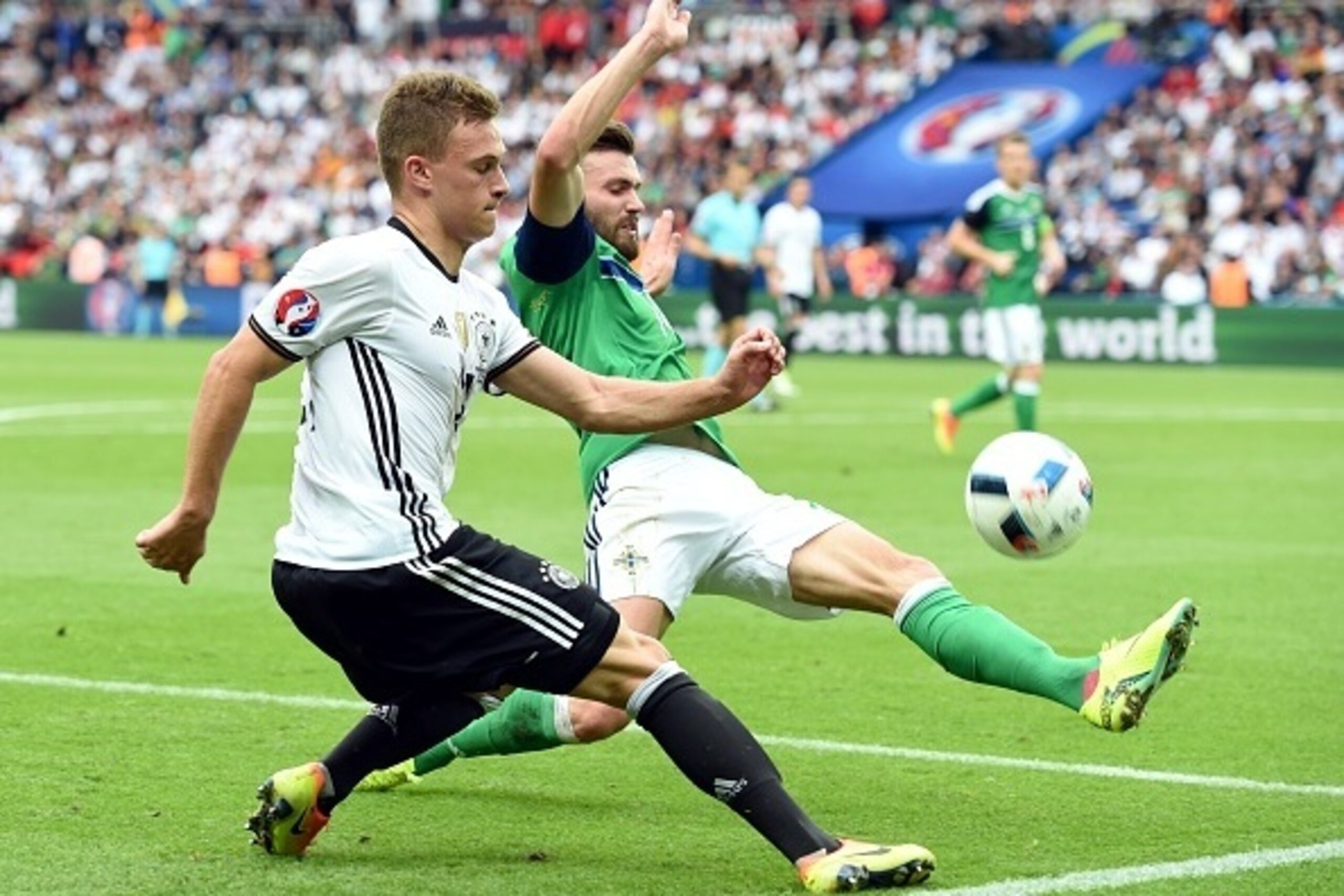
Bayern Munich's versatile 21-year-old was especially impressive, as he offered everything Howedes couldn't in the first two matches. Kimmich provided vertical runs that stretched the Northern Irish defence and whipped in a number of dangerous crosses and cutback passes thanks to his impeccable technique—his most natural position is in central midfield, after all.
With him providing an outlet deep into the opposition half, Germany's play wasn't focused as much on the left wing, which allowed for more fluidity and more pace in the combinations around the penalty box.
Ozil and Muller profited greatly from Germany's improved attacking structure.
This writer had described the Arsenal playmaker as the key to success in this match, and the 27-year-old delivered with an incredible performance, as these numbers indicate:
"Ozil found space and time on the ball by constantly moving between the Northern Ireland lines, then always looked to attack the back four with a little run or a vertical pass," Raphael Honigstein wrote for ESPN FC.
Honigstein added:
"Ozil played with kind of appetite and authority that separates supreme players from those who are merely supremely talented. The 27-year-old had a point to prove after underwhelming showings in the opening two games, and he did so at the Parc des Princes even though, to accommodate the marauding Muller, he spent a lot of time in an inside-right position rather than his preferred central role.
"
Muller got out of a veritable slump in form with a performance that had everything except for a goal. It wasn't for a lack of trying, though. Per WhoScored.com, the 26-year-old fired away six shots, but it wasn't to be for the Bayern star.
In the first 34 minutes alone, he failed to beat Michael McGovern in a one-on-one after a fabulous move through Kimmich and Ozil, pulled a shot just wide of the target, hit the post with a powerful header and fired a shot off the crossbar.
If anyone deserved a break, it was Muller, and he got it in the form of an assist for Gomez after half an hour. The striker had played Muller on in the box, but he recognised he didn't have an angle to shoot and smartly stepped on the ball, laying it off for Gomez, who put it in the net via a deflection.
With Kimmich interpreting his role at right-back with the due offensive touch against this level of competition, Muller was free to move into a more central role and play off Gomez, and the goal wasn't the only example of the two linking up well.
The Fiorentina forward, who spent last season on loan at Besiktas, displayed some classic No. 9 play, shielding the ball well against physical defenders, laying it off for midfielders making runs into the area and firing away five times himself.
There are few better stories surrounding the German team than Gomez's, seeing as his international career seemed to be over, with the 30-year-old sparingly called up between Euro 2012 and November 2015.
His winner against Northern Ireland is something of a late catharsis for Gomez, whose perseverance in earning a return to the national team can't be lauded enough.
With all the talk about Germany not bringing a formidable striker to France, the former Stuttgart and Bayern player gave the best answer in his first appearance in the starting XI.
That his goal remained the only one of the evening was not only down to McGovern's heroics and Muller's struggles to get over the hump in European Championship, though.
There was a distinct break in their play after hour or so, with only one more big chance for the team in the final half-hour. Andre Schurrle replaced Gotze in the 56th minute, and it was immediately notable that Germany were less fluid in their movement and combinations became few and far between in comparison to the first half.
Gotze was arguably even more wasteful with his chances than Muller and came off immediately after a big miss, but he was a big part of the improved performance, showing he's more comfortable in a midfield role than having to lead the line.
Schurrle, on the other hand, was an odd fit for this opponent, seeing as he needs space to make runs, with close control and ingenuity not among his stronger qualities.
It's unfair, however, to pin it all on the Wolfsburg attacker. Germany on the whole took the foot off the gas and became more sloppy in their passing, looking less incisive going forward, possibly because "Northern Ireland kept on defending as if the match was still scoreless, never committing men forward in sufficient numbers and never pushing for an equaliser with real urgency," as Honigstein put it.
"We simply need to be more purposeful and consistent. We played well but it should have been a more emphatic result," Low said after the match, per the German football association's official website.
It seemed like complaining about first-world problems after a largely impressive performance, but the 56-year-old is experienced enough to know that the tournament only really starts with the round-of-16 match—most likely against Slovakia—on Sunday, and that Germany still have to improve if they want to survive the tortuous run to the final their half of the bracket provides.
For instance, the team left a lot of spaces in transition, knowing Northern Ireland were too busy defending, but better opponents could exploit Germany's attacking mindset.
For now, however, Low can enjoy this victory. Even though it only came against Northern Ireland, his changes worked to perfection. With a revitalised attack, Germany can look forward to the knockout stages.
Lars Pollmann is a Featured Columnist who also writes for YellowWallPod.com. You can follow him on Twitter.
.jpg?w=2560 "Hill Injury Update Football")
.jpg?w=2560 "Titans Giants Football")
.jpg?w=2560 "Tyreek makes another cryptic post amid Chiefs rumors")


.jpg?w=2560 "Greenlaw Talks Payton Exchange")
