

State of Spain: Purring La Roja Ideally Placed to Defend Crown at Euro 2016
The cover of Marca said it all: "That is how champions play."
It was the morning after the most dazzling display of Euro 2016 to date, a proper fiesta of football, and a familiar realisation was setting in: They're the favourites. Yeah, them. Again.
The night before, after a week of largely unconvincing performances from Europe's heavyweights, Spain had sparkled at the Stade de Nice, emphatically dispatching Turkey 3-0 with the most uplifting grace and mastery.
TOP NEWS

Soccer Stock Check 📈📉

New NFL contenders starting to emerge after Week 4
.jpg?w=2560 "Cardinals Giants Football")
NFL investigating 2 referees for separate viral exchanges
Suddenly, Spain have that look about them once more. On Sunday, Marca added that people are falling in love with Spain all over again, and it certainly feels that way: Andres Iniesta is enchanting them, there's a vibrancy now accompanying the technical proficiency, the joy is back.
For some time, that look and that feeling of supremacy had been fading, and a certain storm had been gathering around La Roja. But outlooks alter rapidly in football. Significant changes can occur from little moments, and that's the case here.
Gerard Pique's late winner against the Czech Republic in Spain's opener was his side's release. It was only a single strike and they were only three points, but the emotional shift since has been immense. That goal fended away growing negativity, giving Vicente del Bosque's men a platform and chance to simply get on with it.
Against Turkey, the results were clear.
As such, La Roja appear renewed, the vintage sensations having returned. The bookmakers now have them as favourites, which is logical: Spain's outlook is very, very good.
Potentially Gentle Path
As Spain sauntered their way past Turkey in Nice, France, on Friday, the significance of it went beyond the nature of the performance: It was a massive step in a long tournament.
Earlier in the day, Croatia's throwing-away of a 2-0 lead to draw 2-2 with the Czechs had meant that La Roja's victory took them two points clear at the top of Group D and only one point away from securing it—a position that carries an immense reward.
At the time of writing, Italy have already secured top spot in Group E, while France and Germany lead Group A and Group C, respectively, and are favourites to progress as such.
The winners of those groups will all be placed on the other side of the draw to the winner of Group D, which means a point or better for Spain against a Croatia outfit likely to be without Luka Modric through injury (per Reuters, h/t Sky Sports) would likely present La Roja with a path to the final that would avoid France, Germany and Italy.
This is a good example of the way draws significantly impact tournament football.
If Spain do go on and top their group, they'll meet the third-placed side from Group B, E or F in the round of 16. In such circumstances, possible opponents would include Wales, Slovakia, Sweden, Republic of Ireland, Iceland, Portugal and Austria.
Progress, and Spain would meet the runner-up from Group A or C in the quarter-finals. Right now, the sides occupying those positions are Switzerland and Poland.
Progress from there, and a semi-final opponent of a similar ilk would be very possible, with a not-entirely-functional Belgium side perhaps standing as the most difficult team Spain could face en route to the final.
Adjustments, Versatility
Subtle adjustments against Turkey on Friday gave Spain an ominous look, the most notable ones centring around Alvaro Morata, Cesc Fabregas and Del Bosque's use of his substitutes.
Earlier in the week against the Czechs, Morata had looked lively but had spent too much time roaming from his starting position. At Juventus, he's often been at his best when doing just that, presenting to his midfield before turning to run at defences, but for Spain, those instincts were problematic in their Euro 2016 opener.
In Toulouse, Morata's desire to come and "play" with his midfield team-mates often left La Roja with little penalty-area presence or pressure against the defensive line, which allowed the Czech back four to push up and limit space:
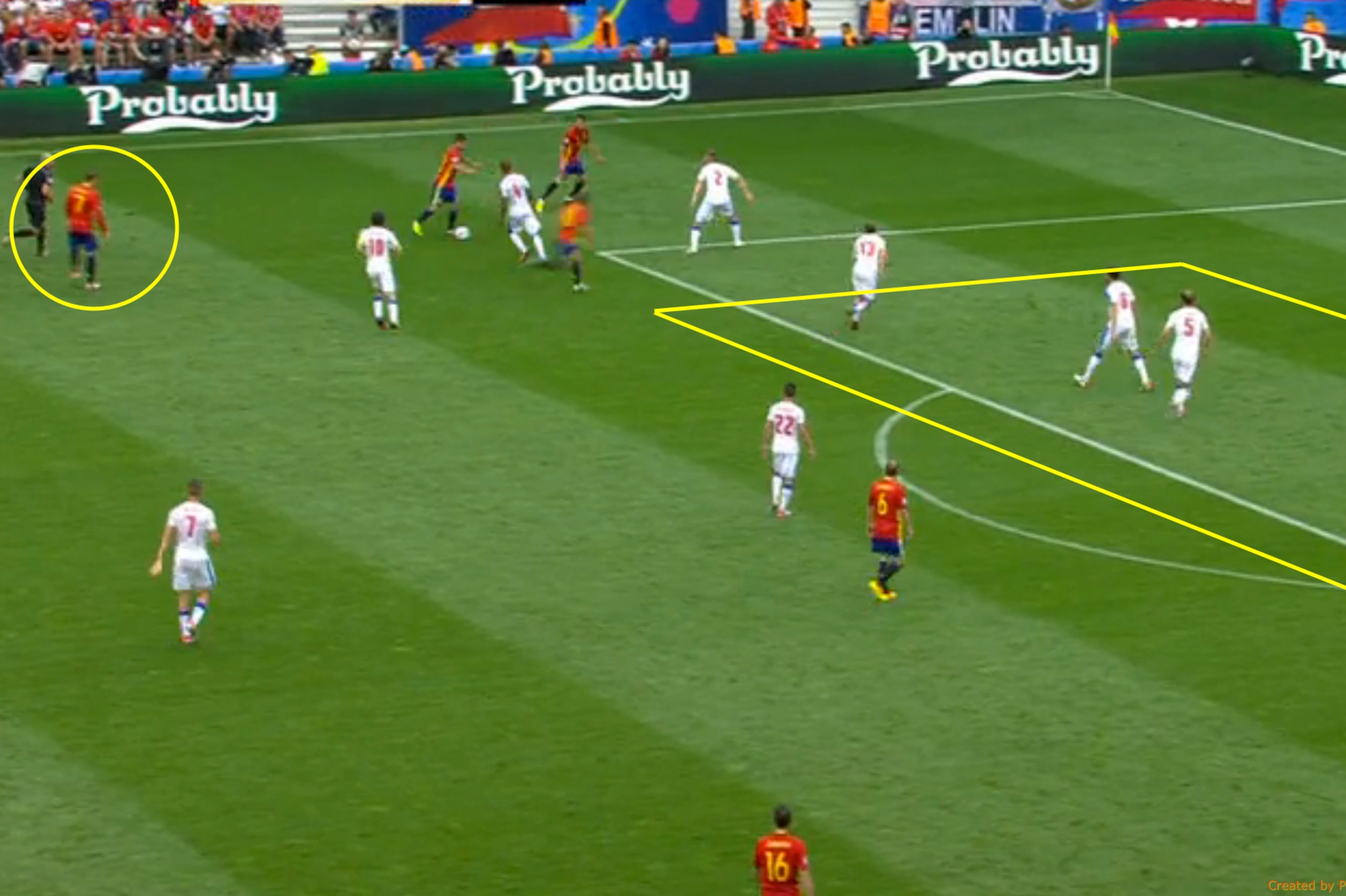
Against Turkey, though, the Real Madrid product was far more focused with his movements: He occupied the centre-backs, pushed hard up against the defensive line and his threat of getting in behind pinned Spain's opponents deep, opening space in front of the Turkey defence.
That was evident even before the 23-year-old opened the scoring.
When Juanfran broke down the right flank in the 32nd minute, Morata's charging run into the six-yard box drew three defenders with him, opening a huge space in the middle of the box for Juanfran to play a pull-back to the trailing Nolito.

It was the same minutes later when his unstoppable header put Spain ahead.
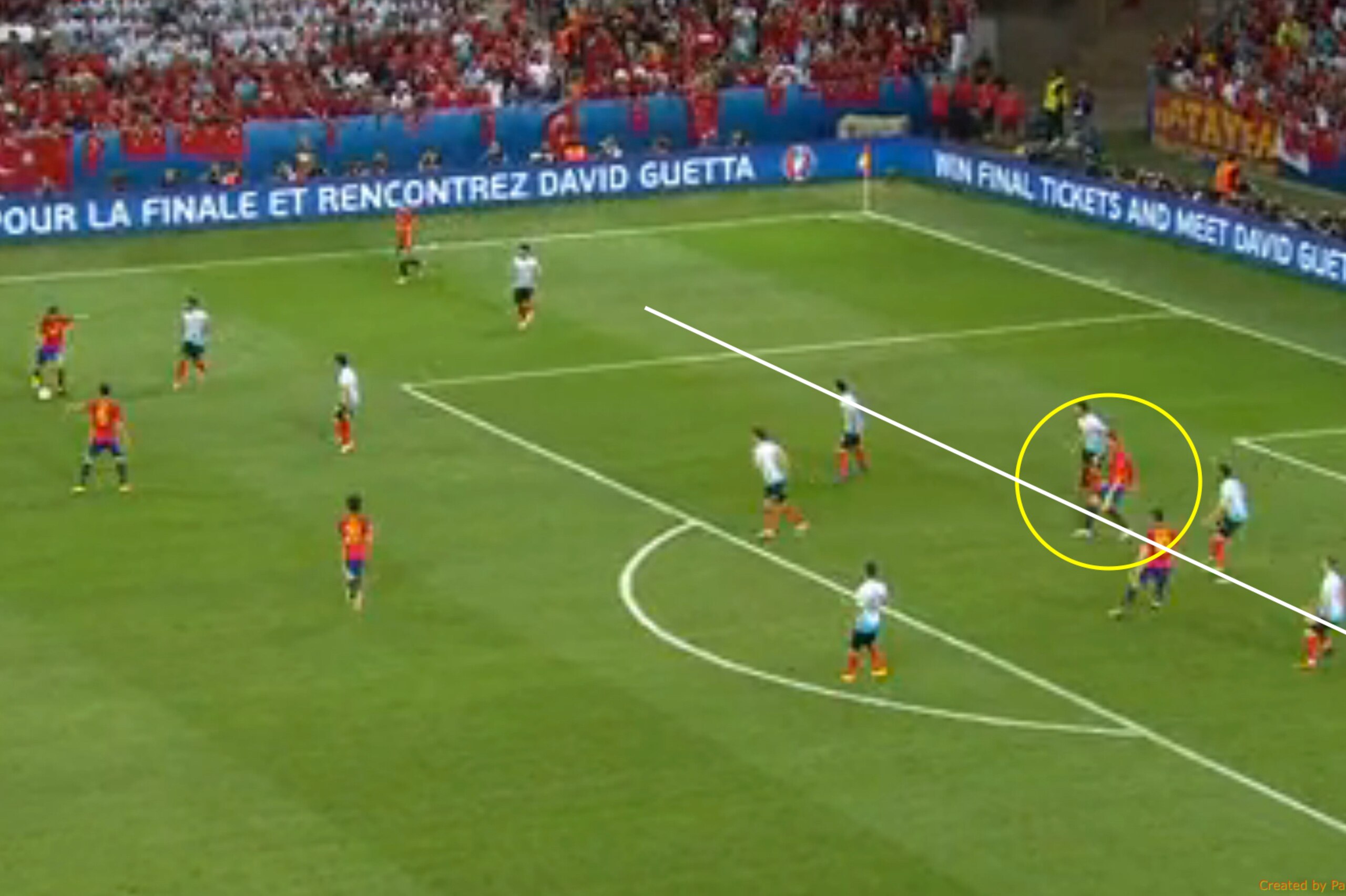
By constantly pushing the defensive line back, Morata gave Nolito the opportunity to deliver a cross deep into the box with the Turkey back four stuck only a few yards from their goalkeeper, Volkan Babacan.
Whereas the Czechs had been able to push up with Morata often moving into midfield, Turkey couldn't get out and were therefore late in playing for offside.
It sounds simple, of course, but sometimes football is simple. Spain don't need a roaming, ball-playing centre-forward. They need an opportunistic striker making darting runs in the box to pull defenders around and bury chances. On Friday, that's what Morata was, which will leave Del Bosque encouraged and rivals concerned.
It was also notable at the Stade de Nice that Spain got a far more assertive performance from Fabregas.
According to Squawka Football, the Chelsea midfielder had been a prime culprit in meaningless possession in La Roja's tournament opener, playing passively and passing either sideways or backward.
But against Turkey, he looked more like the Fabregas we've grown accustomed to, pushing the ball forward with sharp, direct passing (as illustrated by FourFourTwo's Stats Zone) and also making himself a runner into the box from midfield to unbalance the Turkey defence.
In the second half, Del Bosque then pushed Fabregas (and later Koke) into a wider role when replacing David Silva with Bruno Soriano. With the introduction of another holding midfielder, La Roja's shape shifted toward something more like a 4-1-4-1, adding defensive strength and snuffing out any possibility of a Turkish rally:

Euro 2016's King
Selcuk Inan fell over in disbelief. The rest of us smiled for hours in disbelief.
Play had just resumed after half-time on Friday when Iniesta received a pass from Jordi Alba just behind the half-way line. Immediately, Inan went to press him. Behind him, two more Turkey players lurked. As corners go, it was a tight one.
Or so it seemed.
With his first touch, Iniesta cushioned a bouncing pass. With his second, a flick of his boot lifted the ball over the head of the closing Inan, who "clattered past him like a dog chasing a tennis ball that his owner didn't throw," wrote ESPN FC's Iain Macintosh.
It was a moment of astonishing skill, awareness and ingenuity in the middle of a performance for the ages, one that came on the back of an equally impressive display against the Czechs. This is Iniesta on a new plane of existence. In 10, 20 or 30 years' time, you'll still be talking about Iniesta at Euro 2016.
He's that good. That joyful. That inspiring.
On form and influence, he's also the best player at this tournament.
And it's not even close.

.jpg?w=2560 "Hill Injury Update Football")
.jpg?w=2560 "OBJ Calls Out Giants 😳")
.jpg?w=2560 "Tyreek makes another cryptic post amid Chiefs rumors")



