

Spain's Steady Euro 2016 Start Can Be Accelerated by Subtle Alterations
The whistle blew, the three points were theirs and thoughts everywhere were the same: We've seen that one before.
On Monday, Spain opened their Euro 2016 campaign in Toulouse, France, with an absolutely-dominant-everywhere-but-the-scoreboard 1-0 victory over the Czech Republic. In tune with their recent history, it was the most familiar of contests and the most familiar of scorelines.
Throughout, Vicente del Bosque's men enjoyed the majority of possession and dominated the shot count. Their defensive responsibilities also bordered on non-existent, and yet, as has often been the case for La Roja, their triumph was secured by the narrowest margin there is.
TOP NEWS

New NFL contenders starting to emerge after Week 4
.jpg?w=2560 "Cardinals Giants Football")
NFL investigating 2 referees for separate viral exchanges
Deion Playbook Found at Hotel
That won't bother Spain. Monday's win was one that needed to be secured regardless of how given the wider picture that has surrounded them. They will also point to their glory years and rightly say there's nothing wrong with narrow victories: In 2010, four consecutive 1-0 wins took them to a World Cup title in South Africa.
There are some basic truths that are relevant here, too.
When your dominance in general play nullifies the opposition's threat to such an extreme extent, you only need to score once. That dominance also takes a physical and mental toll on the opponent, making that single goal more likely as the game progresses.
"We've played plenty of similar matches and we just need to keep pushing our opponents until they slip," Andres Iniesta told Mediaset (h/t Marca) after Monday's victory. "This is the way to go, we've been very successful with these tactics."
Subtly, or perhaps not so, Del Bosque in the post-match press conference also reminded that "our style hasn't been too bad in recent years."
There are questions that linger, though: Does Spain's now-faded sense of supremacy change things? Does this outfit have the players in key areas to execute the way previous Spanish teams have? Won't more be necessary against sides stronger than the limited Czechs?
Spain can be pleased with their steady start, but alterations are needed to accelerate their campaign in France and build momentum. Here, we take a look at two such alterations that look necessary after La Roja's opening game at the tournament.
Limit Morata's Roaming
Operating as a striker for Spain isn't at all straightforward. Since the peaks of David Villa and Fernando Torres, many have been trialled in the position, and few have thrived.
Now, it's Alvaro Morata's turn.
On Monday against the Czechs, the Juventus forward provided some small glimpses into his potential for La Roja despite his lack of familiarity with this system.
He drew strong saves from Petr Cech twice in the first half—the first came after he'd nipped in front of his opponent to reach David Silva's cross, and the second arrived after he'd played hard up against the defensive line and had been put through on goal by Iniesta.
Other moments and half-chances arrived, too, and when Spain looked most dangerous, there was a common theme: Morata wasn't roaming and was instead attacking the box.
The issue for Spain, however, is that roaming is something Morata likes to do. At Juventus, the 23-year-old has been at his best when running at defences, his instincts taking him toward his midfield to link with team-mates before turning and dribbling at opponents.
But those instincts proved problematic for Spain at times against the Czechs, as his desire to come out and "play" often left his team with no penalty-area presence:
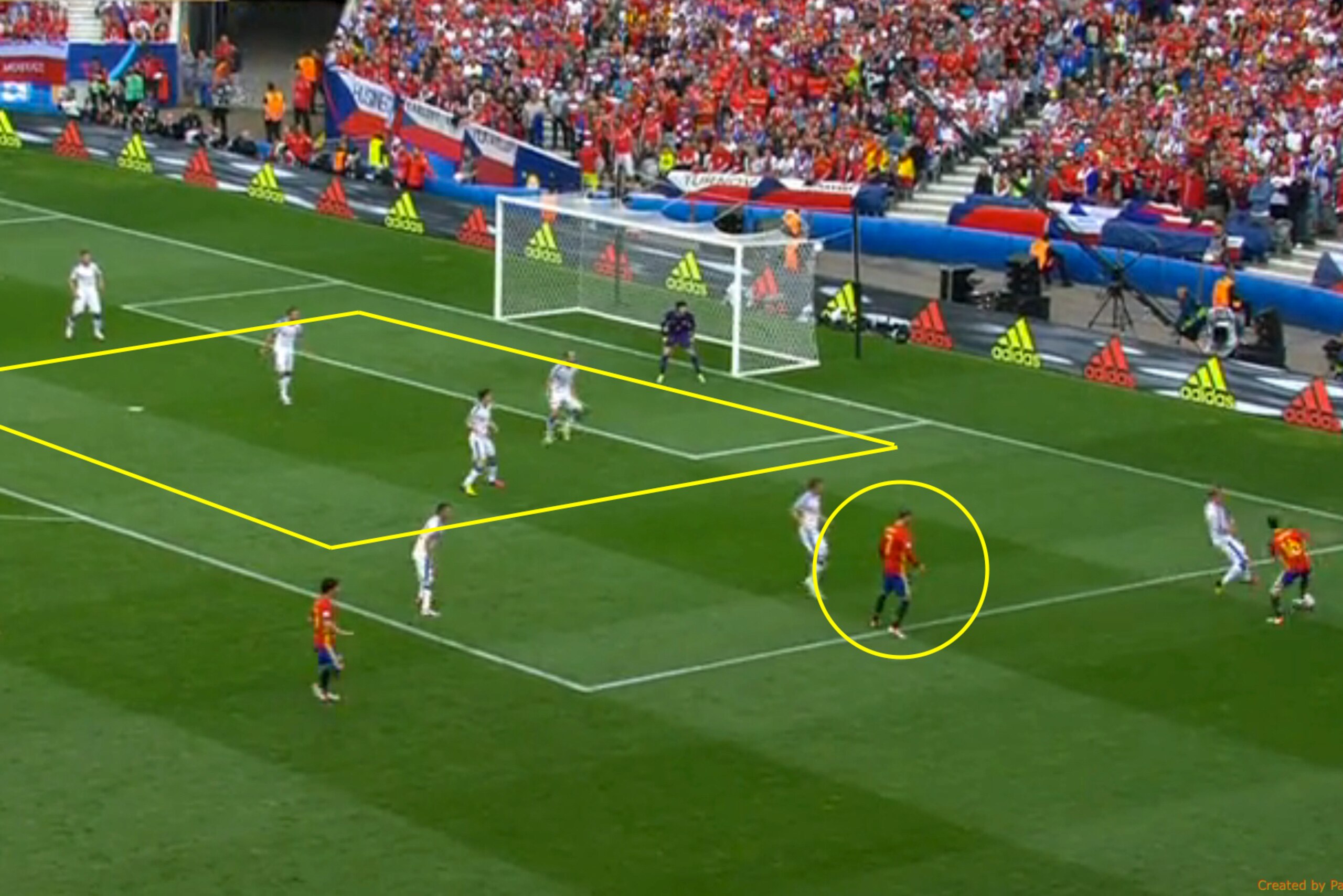

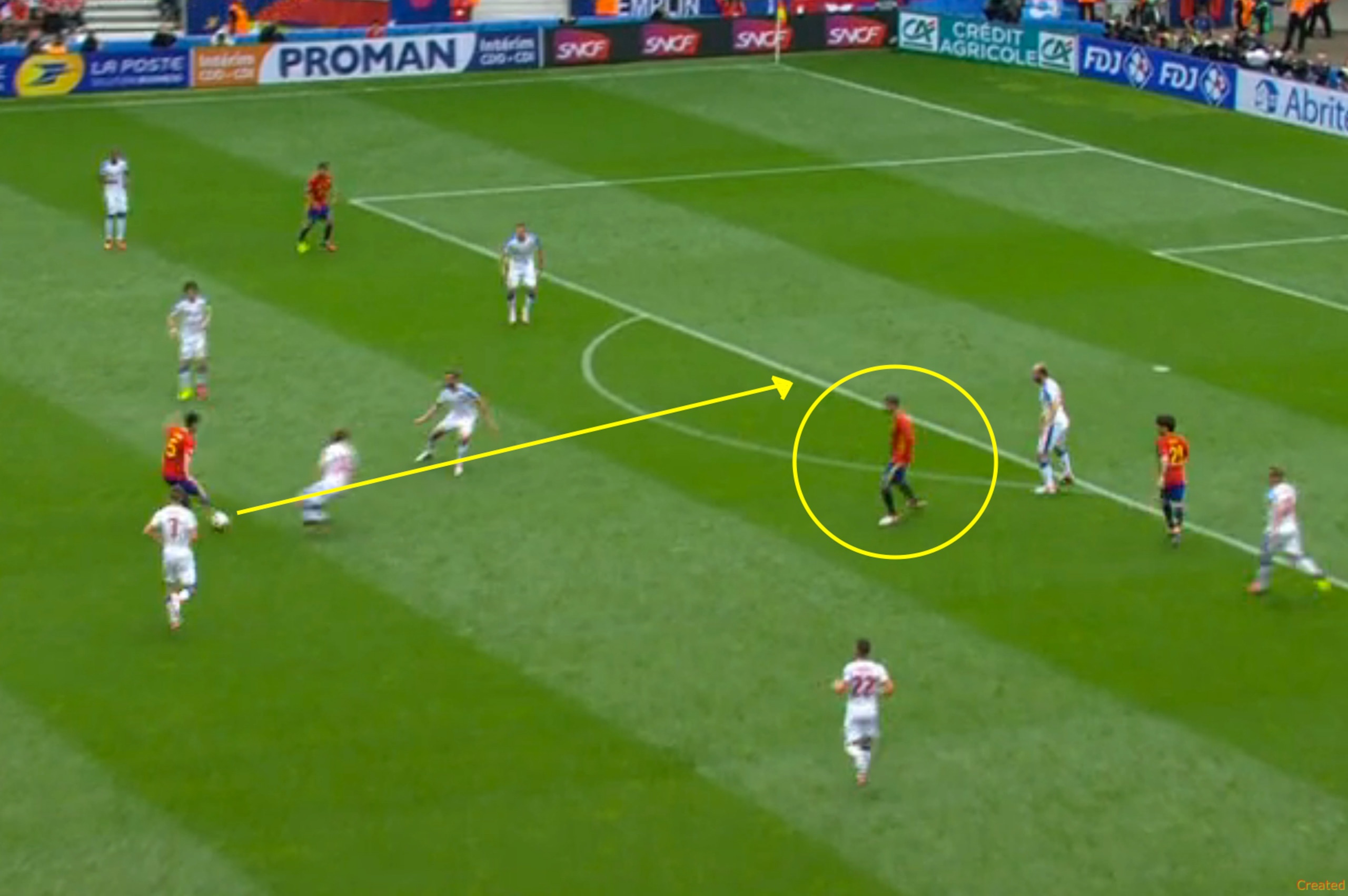
For Morata, those freeze frames perhaps reflect his limited clarity for his role in this Spanish outfit, and that's understandable. Not only is he inexperienced within Spain's setup, a striker in Del Bosque's system must also balance a goalscoring mindset with the requirement to create space for runners and drag defensive lines out of shape.
Both Villa and Torres were excellent at doing that, and such an understanding will come for Morata. But right now, he could be better served by adopting a more singular focus: play hard up against the defensive line, occupy the centre-backs and attack the box.
Against the Czech Republic, both of his first-half chances came when doing exactly that, and doing so also opens up options for his team-mates.
When he went roaming on Monday, the Czech defence was able to push out comfortably and blunt Spain, but when Morata pressured the defensive line and forced it deeper, Silva and Juanfran on the right were able to attack the spaces that opened up:

As Spain move forward in Euro 2016, they are going to need goals from Morata if they are to win the tournament given their lack of firepower across the XI.
On Monday, the striker showed in glimpses that he's capable of providing them—if he limits his roaming and stays closer to goal.
More Aggression from Fabregas or an Alternative
The criticism often levelled at Spain is that much of their possession in midfield lacks purpose, and though those involved will argue every pass has intent behind it, Cesc Fabregas' performance against the Czech Republic illustrated why such criticism is never far away.
Operating on the right of a midfield three, Fabregas spent 70 minutes in a passive existence on Monday before being substituted for Thiago Alcantara. Too often his passes went sideways and backward; he rarely looked for his striker in Morata; he didn't make the runs into the box from midfield that Spain's system demands when its ball-playing wingers wheel around onto their preferred foot and turn inside.
For the remainder of Euro 2016, Spain need a more aggressive Fabregas—the version we've often seen, who's always looking to cut opponents open and who has goals on his mind; who's instinctive with his passing and who can be a dangerous midfield runner.
Spain need that Fabregas. Or they need an alternative, and Del Bosque isn't short of options.
In Koke, the manager has a more rugged and direct midfielder whose greater defensive work ethic could be important against stronger sides. He also has Thiago, the option he used against the Czechs.
And the altered dynamic Thiago's late introduction brought about on Monday was notable.
Whereas Fabregas had maintained possession for La Roja without really threatening, the Bayern Munich midfielder consistently looked to attack the box. In possession, he drove at defenders, but just as importantly, he repeatedly made himself an off-the-ball runner and penetrated the penalty area when Silva turned inside.

Immediately after his introduction, one such run opened room for Silva to pick out the onrushing Jordi Alba, who missed a good chance to score. Not long later, Thiago himself missed the chance to hit a first-time strike after receiving the ball from Nolito while attacking the same space.
Spain either need to see that aggressive mindset from Fabregas or turn to another option.
.jpg?w=2560 "Hill Injury Update Football")
.jpg?w=2560 "Titans Giants Football")
.jpg?w=2560 "Tyreek makes another cryptic post amid Chiefs rumors")


.jpg?w=2560 "Greenlaw Talks Payton Exchange")
