

Ramiro Funes Mori: From Kamikaze to Cornerstone of the Argentina Defence
Argentina have not exactly been firing on all cylinders so far in the Copa America, but there have been few scares in what has traditionally been the team's Achilles' heel. The defence has stood up to all the tournament has thrown at it so far, and Ramiro Funes Mori has been a big factor in its stability.
The Everton defender has enjoyed a meteoric rise through the football ranks in the last few years. Just three years ago, he was considered no more than a useful second-string full-back for River Plate and also had to bounce back from a serious knee injury that kept him out of the game almost six months.
TOP NEWS

Final Men's Ballon d'Or Rankings 📊
_0.png?w=2560 "CFB Top 25")
Unranked Teams Cause Chaos in Rankings 📊

Brown with an all-time summary of relationship with Tatum
But if there is one thing Funes Mori does not lack, it is character. The young prospect bounced back and grabbed onto his favoured position at centre-back, and he wrote his name into River folklore with a last-minute headed winner to upset Boca Juniors in the Bombonera.
The Copa Libertadores and a lucrative move to Merseyside followed, and in the last six months, he has emerged as Argentina coach Gerardo Martino's first choice, as Nicolas Otamendi is the more mobile colleague in the middle.
Questions over the 25-year-old, however, still remain. His talent is doubtless, but he has yet to shed the reputation of being a loose cannon, liable to explode and leave his team exposed. Funes Mori's introductory year in the Premier League did not shed those concerns: Some excellent performances for Everton were peppered with moments of catastrophic inattention, as well as his fair share of cards.
The Copa America, then, represents a big test for the talented but erratic player. With the likes Ezequiel Garay and Mateo Musacchio left out, he and Otamendi were left as the only front-line defenders charged with keeping out the cream of South America's striking elite. So far, he has proved rather adept.
In the opening clash, both Argentina and Chile's defence endured a torrid time in taking the ball out from the back. Each team looked to pressure high up the field, and the result was a breakdown in communications with the midfield.
Happily for the Albiceleste, Sergio Romero was there to save the team when Alexis Sanchez was left gloriously open to net the first, while at the other end Angel Di Maria and Ever Banega would both convert their chances.
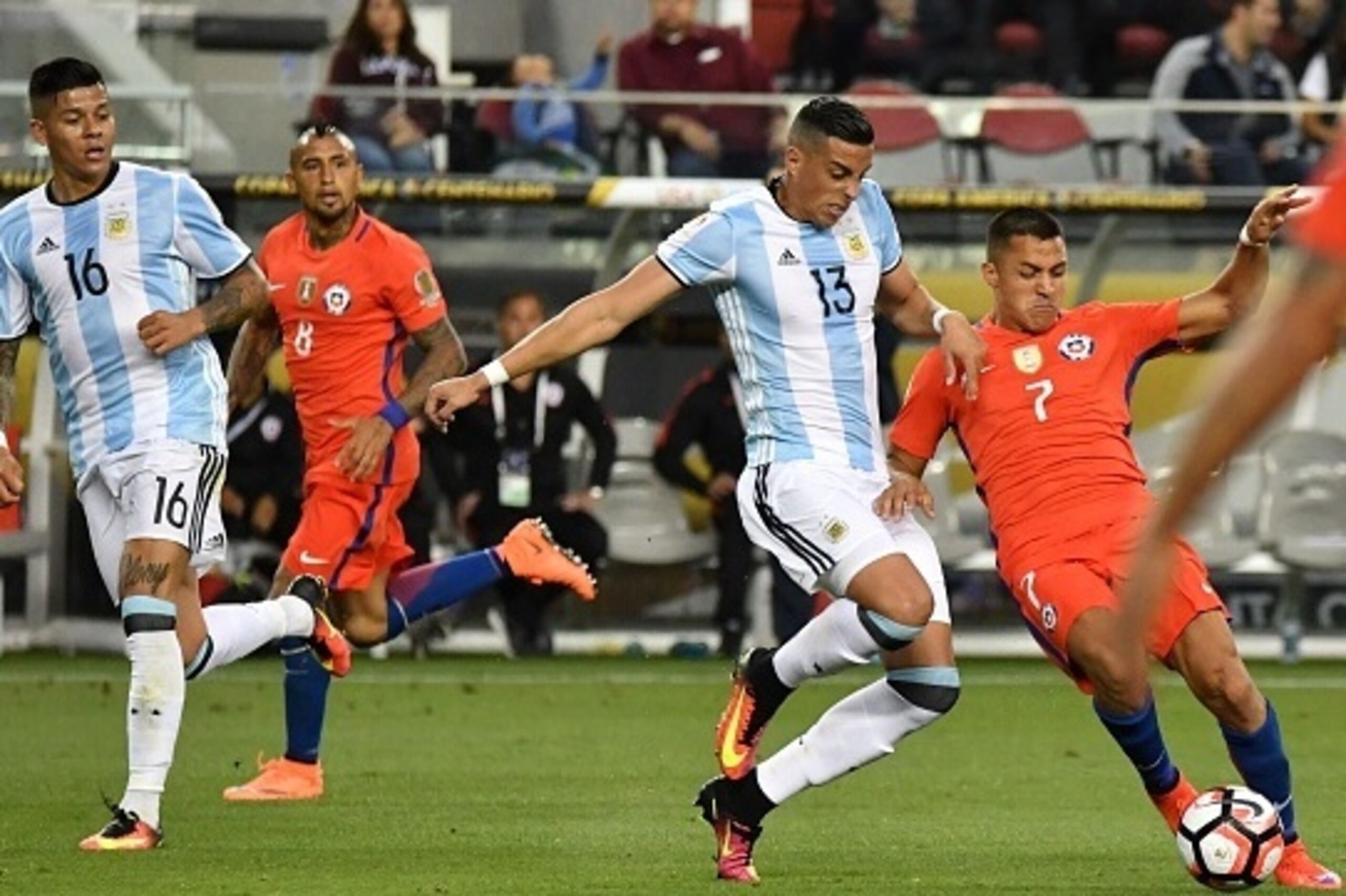
Against Panama, however, both Funes Mori and Otamendi looked far more comfortable. The Everton man completed 74 percent of his passes against the Roja, according to Opta's statistical analysis (h/t Goal Argentina), out of a total of 31 attempted, while he showed less inclination to try long passes than his defensive companions.
On Friday evening, that accuracy rate rocketed to an impressive 93.4% (Goal), behind only Gabriel Mercado and the infallible Banega in the Argentina ranks. Funes Mori and Otamendi's precise movement from the back allowed Argentina to control the pace of the game, and before the entrance of Lionel Messi, the nation were far from their best.
Those numbers coincide with the Argentine's consistency for Everton over the past year, as detailed by Who Scored. In 28 Premier League matches, he averaged an 83.8 percent success rate, at 44 per game, and this number should only rise as he continues his adaptation from the rough and tumble of Argentine domestic football.
Funes Mori's movement against the Canaleros is also telling. In both games so far, Marcos Rojo has played in a far more advanced position than his counterpart on the opposite flank Mercado, featuring as a fourth midfielder in the Chile clash and on a par with Nicolas Gaitan in the second.
This left the Albiceleste exposed at times; both Sanchez and Eduardo Vargas looked to take advantage of the space left by doubling up on the Everton man, who nevertheless acquitted himself as well as could be hoped.
The lesson was learned for Friday. Ramiro pushed out almost to act as an orthodox left-back, with Javier Mascherano accordingly dropping alongside Otamendi to plug the gap while Argentina attacked. Rojo was therefore given freedom to maraud, a gamble that paid off in the final minute as his cushioned header played in Sergio Aguero to finish the rout at 5-0.
It is precisely that tactical and spacial awareness that has been a weakness of Funes Mori's as he has come up the ranks, and his work in that area so far is encouraging.
Finally, the defender has of yet been impeccable in his other blind spot, discipline. Amazingly for a player in his position, he has not given up a single foul, much less received a booking, while Otamendi committed two infractions to stop the Chile onslaught and three against Panama. Funes Mori is focused, calm and settled in the United States, and he's ready to keep surprising people along the way.

The position of the second central defender, the No. 6 in informal parlance, has its own mythology surrounding it. It was the role of the great Daniel Passarella, of course, and El Kaiser helped define an age as he adapted Franz Beckenbauer's famous sweeper into a more swashbuckling figure, breaking up opposition attacks and surging up the field.
Oscar Ruggeri and Walter Samuel continued the legacy, but since the Inter star saw his international career ended by constant injury troubles following the 2010 World Cup, the spot has lay vacant without a real owner.
Funes Mori still has a long way to go before he can be considered even in the same breath as those idols. But he has made an effortless transition first into European football and then into the Albiceleste, and his form at the Copa America suggests he is on the right track as the long-term partner to Otamendi.
Follow Daniel on Twitter at @DanEdwardsGoal
.png?w=2560)
.jpg?w=2560 "Colts Football")





