

Spain Should Test Aduriz and Morata in 2-Striker Systems in Friendly vs. Georgia
There's something you can do when you have two strikers: play them both. Together. And on Wednesday, that's precisely what Spain manager Vicente del Bosque did.
For the final 30 minutes of his side's 6-1 friendly victory over South Korea ahead of Euro 2016, Del Bosque introduced Aritz Aduriz to play alongside Alvaro Morata and shift to a two-striker system.
For La Roja, such a method is largely unfamiliar—it's unfamiliar for most sides in an era dominated by single-striker systems such as 4-2-3-1 and 4-3-3—but in the dying stages of Wednesday's contest, Aduriz and Morata gave a glimpse into the potential of it for Spain.
TOP NEWS

Soccer Stock Check 📈📉

New NFL contenders starting to emerge after Week 4
.jpg?w=2560 "Cardinals Giants Football")
NFL investigating 2 referees for separate viral exchanges
With the score at 5-1, Sergio Busquets played the ball toward the feet of Nolito, who'd drifted centrally from the left. Immediately, South Korea centre-back Hong Jeong-Ho went to press the winger, and at that instant, Aduriz—who'd pushed into midfield—made the sort of gambling run only a striker makes, bolting toward goal even before Nolito had won the contest.
The result? Aduriz surged into space, collecting Nolito's flick. He then threaded it through for Morata.
Goal.
In such circumstances, with the game buried and with little on the line, acts of this sort are often insignificant, but this one felt a little different. For a Spanish outfit defined by its plethora of central technicians, this was incision and purpose delivered by two strikers and a supporting quartet that included a pair of genuine wingers in Nolito and Pedro.
It was a late goal in a rout, yes. But it was also Spain experimenting and finding something—something else.
It's worth trying again. On Tuesday, they'll get that chance in Madrid against Georgia.
Trial "Plan B"
A two-striker system will never be Plan A for Spain and Del Bosque. That's just not the way the Spanish do it, and going into this summer's tournament, a 4-3-3 with David Silva and the in-form Nolito either side of Morata in attack looks the most likely setup.
As ever, though, the concern around Spain ahead of Euro 2016 is the way their dominance in general play doesn't always translate to dominance on the scoreboard. La Roja can often lack end product despite their technical brilliance—of their 23 goals in qualifying, 14 came against the whipping boys of Group C in Luxembourg and Macedonia—and it's why a Plan B featuring two strikers needs to be developed.
During qualifying, such a system was trialled once against Luxembourg in October 2014. That night, Del Bosque paired Diego Costa with Paco Alcacer in a 4-0 win, and as mentioned above, the manager brought on Aduriz against South Korea to play alongside Morata.
It's a method that can significantly alter the dynamic of a game, and that could be particularly important for Spain in second halves at Euro 2016.
The final goal on Wednesday was a good example.
As shown in the image below, it was Aduriz's gambling run that created the move. Before Nolito had even received the ball from Busquets, the Athletic Bilbao striker had set off directly for goal, anticipating his team-mate winning his contest with Jeong-Ho and attacking the space in front of the South Korean defence.
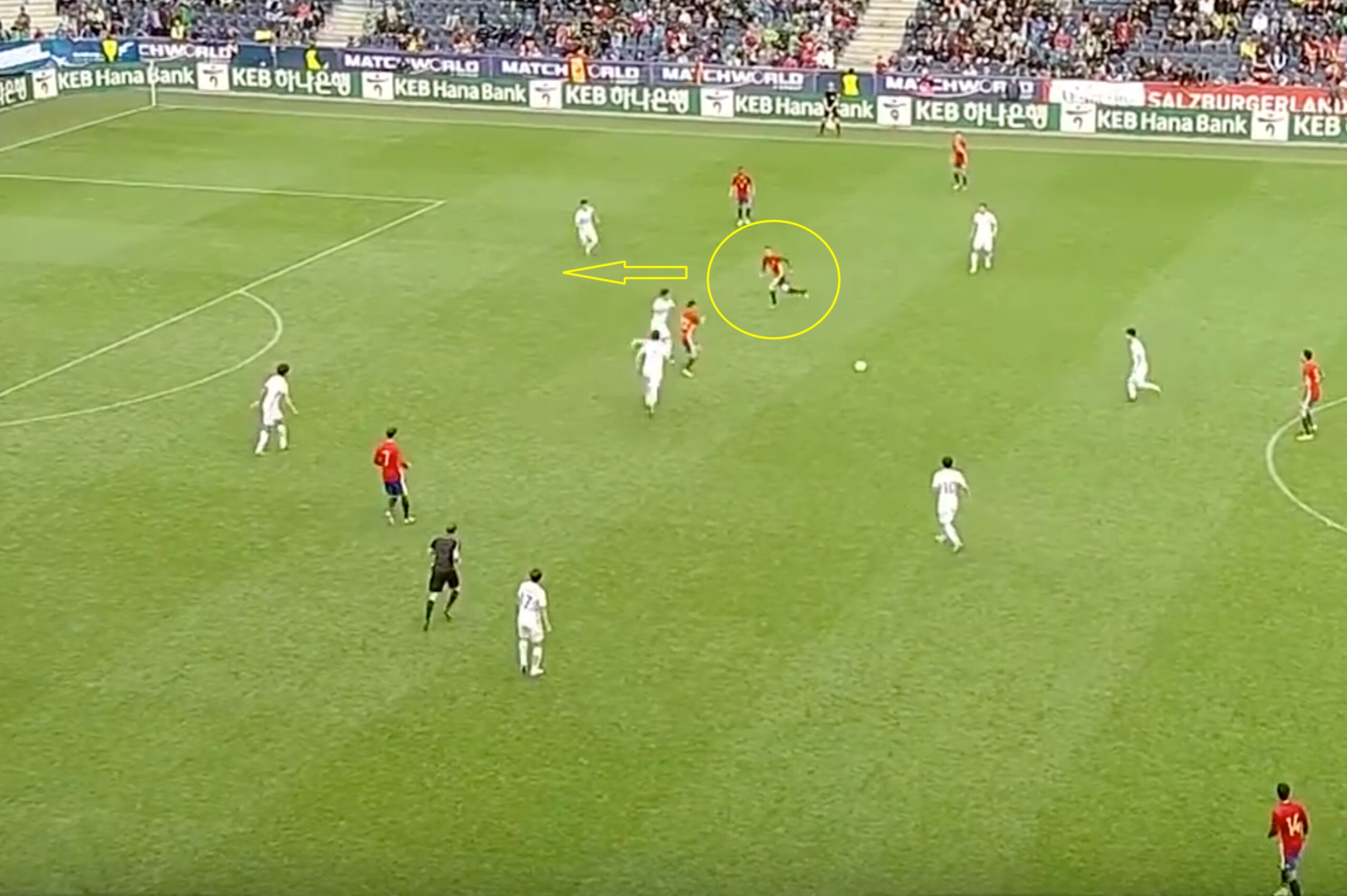
Without Aduriz involved, it's unlikely that goal would have been scored.
A striker's instincts are different from those of a midfielder, and whereas one of Spain's central conductors might have looked to retain possession, Aduriz's instincts took him in a straight line toward goal to link with his forward partner.
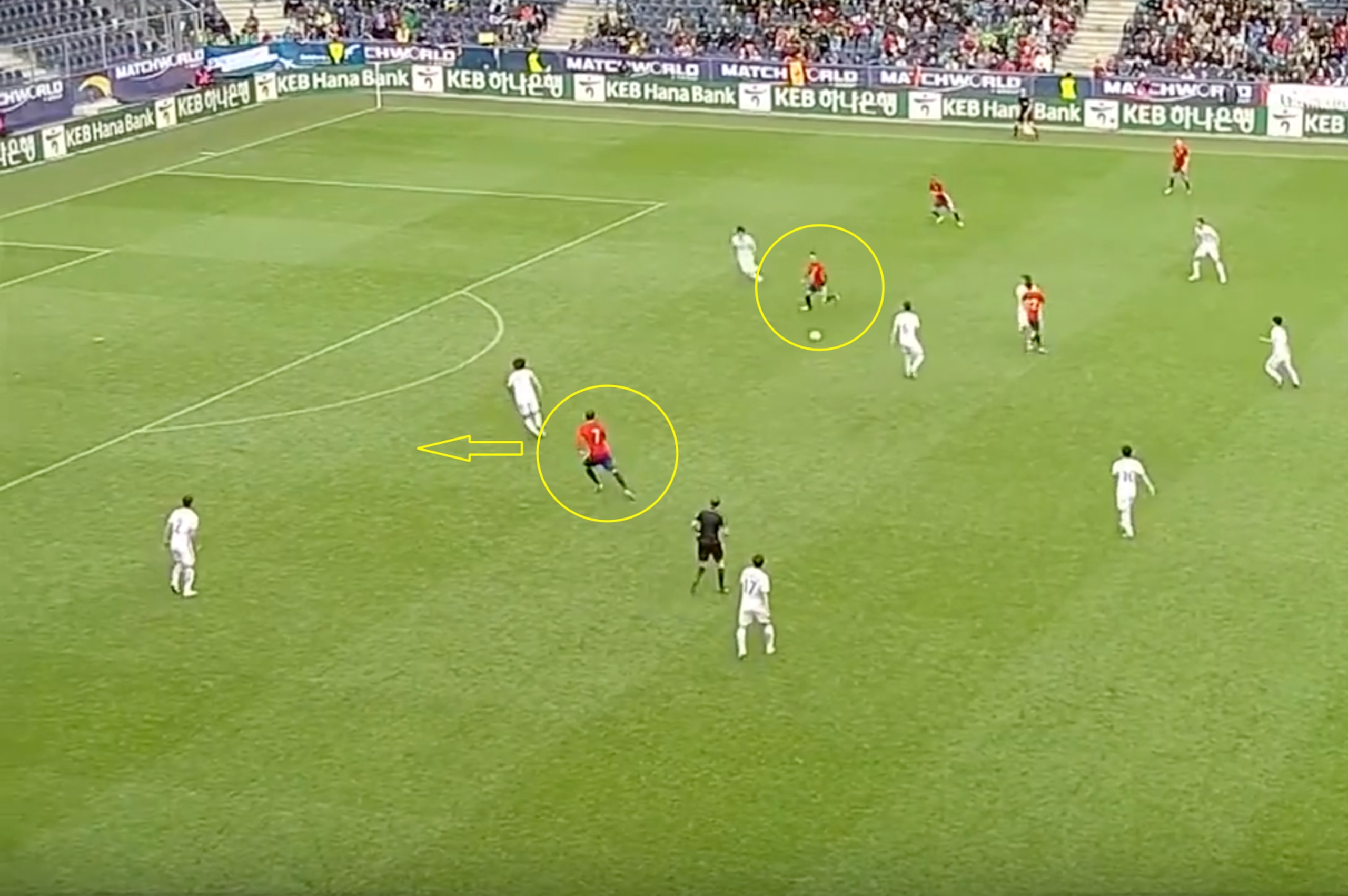
This is the sort of thing Spain can use when teams are having success against them while sitting deep.
Switching from a midfielder-heavy 4-3-3 to a two-striker system changes their opponents' task, and Tuesday's final warm-up clash with Georgia is a perfect opportunity to experiment with different versions of a two-striker setup.
Supplied by Midfield Diamond
When Del Bosque temporarily split from his usual method and used Costa and Alcacer together against Luxembourg, the two forwards operated ahead of a midfield diamond, and that's one of the shapes Spain could trial against Georgia.
In such a system, Busquets would anchor the midfield and Silva would play behind the two strikers. Andres Iniesta would almost certainly take the left-sided role, while any of Cesc Fabregas, Thiago Alcantara or Koke could fill the right-sided berth.
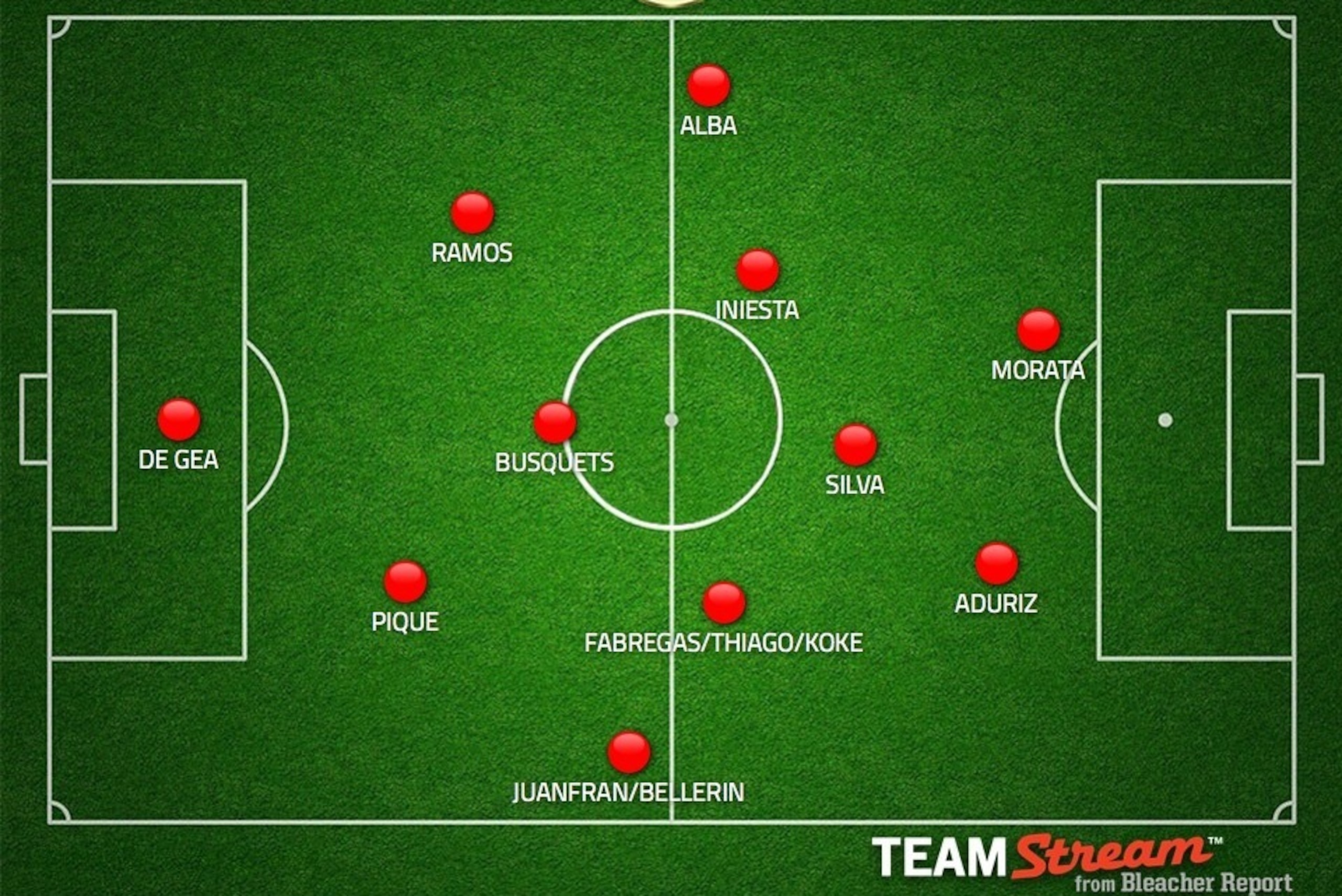
The typical concern with such a shape is that it can be very narrow, but the control such a midfield would offer would allow Spain's full-backs to bomb forward to supply the width—and few full-backs are better at doing that than Spain's.
Indeed, in Jordi Alba and Hector Bellerin—Juanfran is probably first choice at right-back ahead of Bellerin, but the Arsenal man is an intriguing proposition here—Del Bosque has a pair of wide defenders with searing pace, strong dribbling skills and aggressive mindsets.
Both are also excellent at penetrating opposing back fours with darting runs from wide areas, and in the presence of both Morata and Aduriz, they would have multiple options to target with drilled crosses and pull-backs.
Add that to a midfield capable of threading passing sequences through even the tightest of defences, and you have a potentially potent mix.
Supported by Wingers
One of the striking aspects of Del Bosque's use of Aduriz and Morata together in the second half against South Korea was that it came without a plethora of midfielders to maintain control.
Behind the two forwards, the technically excellent Busquets and Thiago were positioned centrally, but either side of that pair were Nolito and Pedro—genuine wingers.
It saw Spain finish the contest playing with an attack-minded 4-4-2 that featured Nolito cutting in from the left and Pedro holding his position on the right:
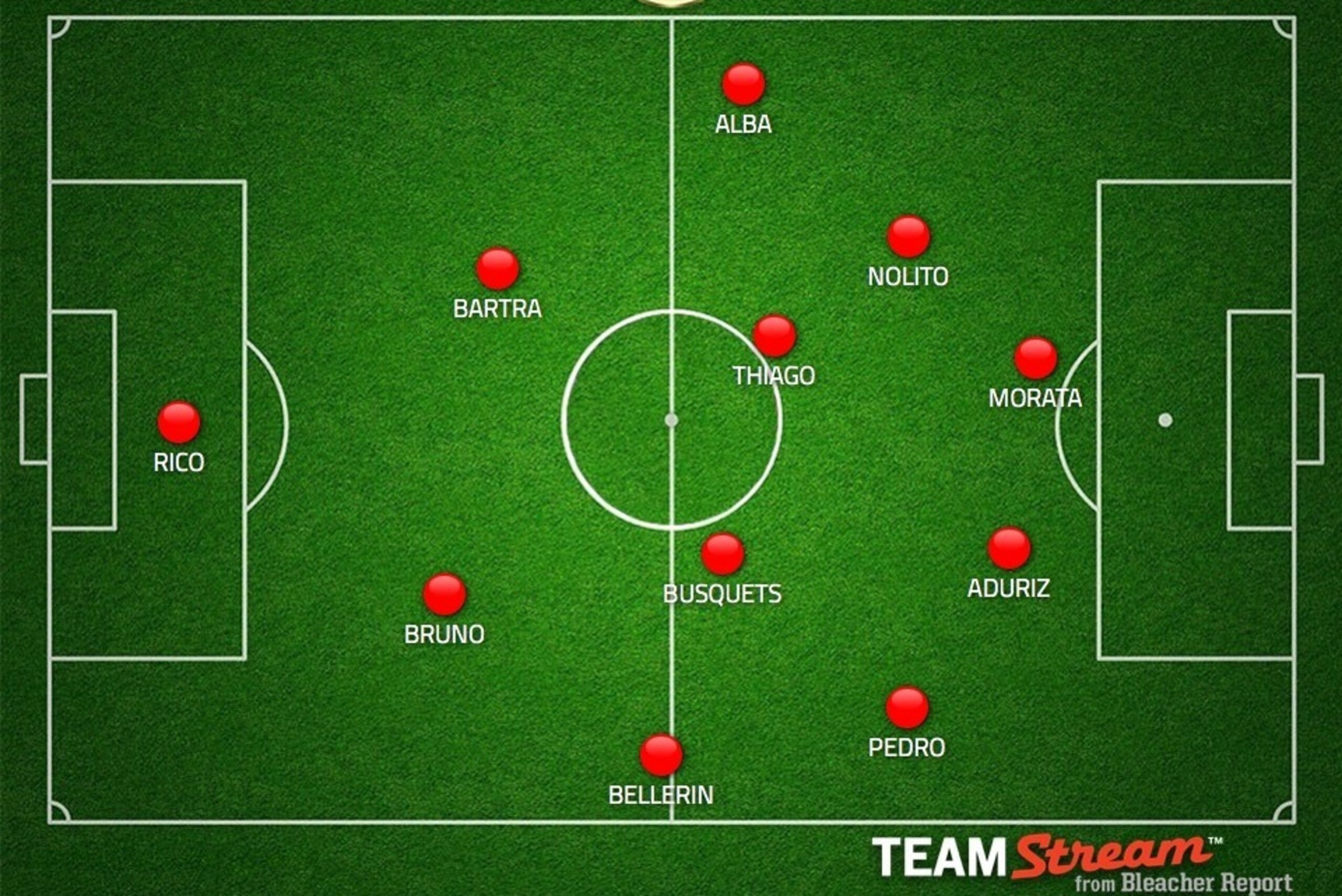
It's unlikely that we'll see a lot of this from Spain given that it compromises their ability to control possession, but it's also an interesting variation to have available.
With out-and-out wide men who can score themselves—Nolito is particularly dangerous from the left, while Lucas Vazquez is another option from the right—opposing back fours can't collapse around Morata and Aduriz.
The use of such a system would result in a more open and frenetic affair, which is not Spain's preference, but it would see La Roja pose a different sort of threat, one that opponents wouldn't be as prepared for.
Against Georgia, this is the sort of option worth trialling, as the existence of a genuine Plan B will be critical for Spain at Euro 2016.

.jpg?w=2560 "Hill Injury Update Football")
.jpg?w=2560 "OBJ Calls Out Giants 😳")
.jpg?w=2560 "Tyreek makes another cryptic post amid Chiefs rumors")



