
5 of the Most Interesting Radio Messages from 2016 Spanish Grand Prix
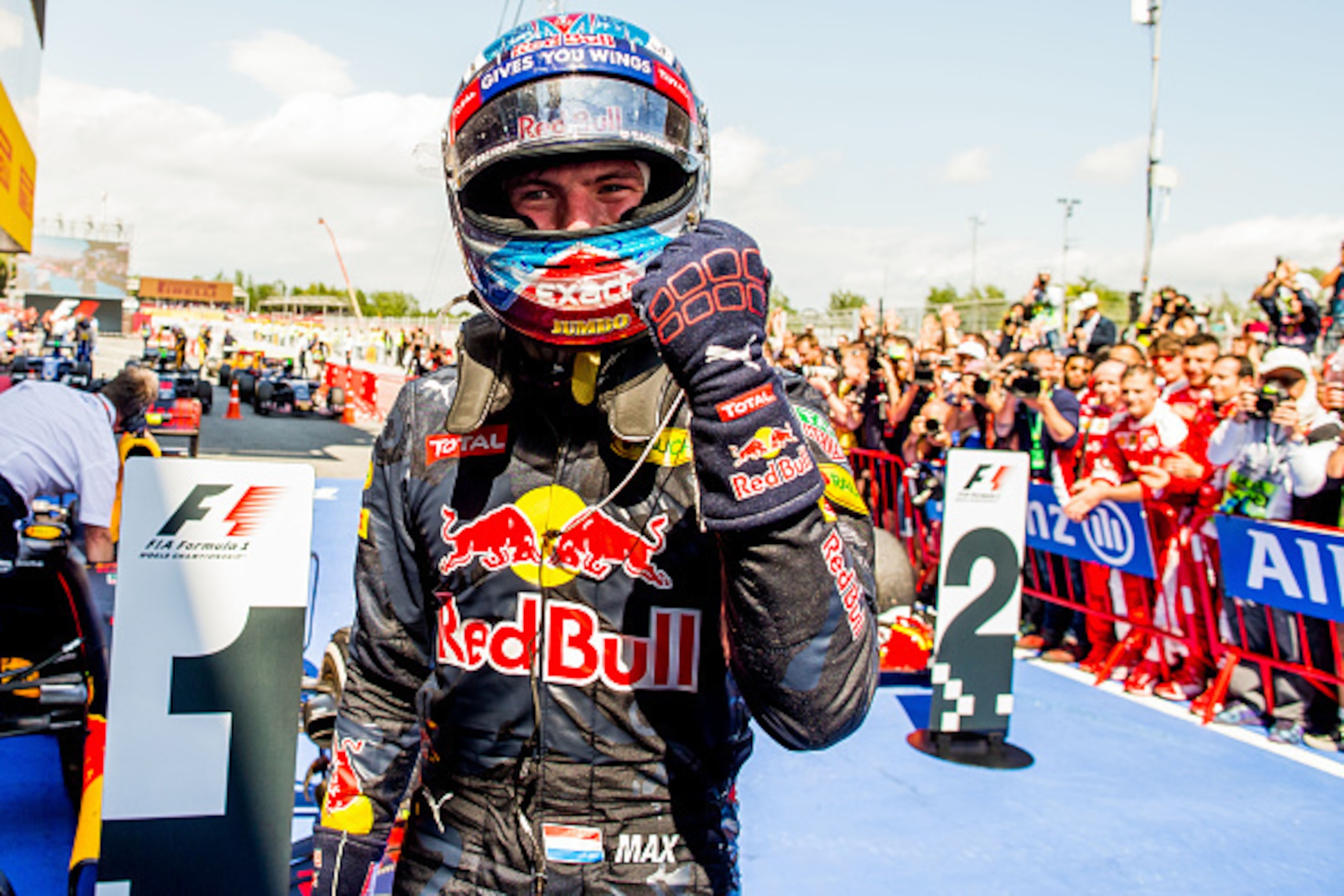
At the age of 18, Max Verstappen became the youngest-ever driver to win a Formula One race in Sunday's Spanish Grand Prix at the Circuit de Barcelona-Catalunya.
After triumphing from fourth on the grid on his Red Bull debut, Verstappen's maiden victory proved he is—as many have predicted since his arrival on the grid last year—on course to achieve great things in the pinnacle of motor racing.
It proved the value of experience in top-level sport can be overemphasised at times.
And it proved just how ridiculous F1's increased team radio restrictions really are, with television viewers prevented from hearing Verstappen's thoughts on his race until the boy wonder took the chequered flag.
With a look at Sebastian Vettel's rant at Daniel Ricciardo, Romain Grosjean's unhappiness with Haas, Marcus Ericsson's battle with Sauber team-mate Felipe Nasr and Jolyon Palmer's frustration with blue flags, here are the most interesting radio messages from Spain.
Max Verstappen Congratulated on Becoming F1's Youngest-Ever Race Winner
1 of 5
In the days leading up the Spanish Grand Prix, Nico Rosberg told Autosport (h/t Eurosport) why he felt the increased team radio restrictions have been a success in 2016.
After several years of the drivers being dismissed as "muppets" spoon-fed information by their engineers, the championship leader believes the new "direction" has provided them with "a real challenge" to work "more on [their] own."
While it might be true the drivers now face a "more intense and complex" test, the positives of the new radio rules are lost on the watching world.
Over the first five races, there has been no indication the restrictions have led to any "freak results"—as Mercedes' Toto Wolff predicted, per Motorsport.com Jonathan Noble—and, if anything, they have robbed spectators of the valuable insight provided by frequent pit-to-car radio messages.
The kind of insight, in fact, that would have been more than welcome as Max Verstappen became the youngest-ever driver to win a race in Spain.
It would have been fascinating to hear the 18-year-old's innermost thoughts as he withstood pressure from Kimi Raikkonen in the closing laps or—at the very least—to hear him call for blue flags as he flawlessly navigated lapped traffic, as team principal Christian Horner later told Noble.
Yet the only time we were allowed to tune in to Radio Verstappen all afternoon was when the Red Bull driver crossed the finish line.
"Yes, yes!" cried one voice from the pit wall.
"Unbelievable, Max. Unbelievable," commented another.
"I can't believe it," Verstappen replied before Horner congratulated his new driver in a similar fashion to the way he celebrated Sebastian Vettel's maiden title triumph in 2010.
"Max Verstappen, you are a race winner! Fantastic, what a great debut! What a debut, fantastic! Great, great job!"
Interestingly, Verstappen's celebrations over pit-to-car radio—despite his tender age—couldn't be more distinguishable from those of Vettel, who once dominated the Red Bull airwaves with ear-piercing screeches of excitement and Crazy Frog impressions.
"Thank you very much, Christian," he responded, absorbing victory in the same remarkably calm, composed manner he has handled almost everything else since making his F1 debut exactly 14 months ago.
It offered a small glimpse into Verstappen's mindset on a landmark afternoon, but it would have been nice to have received a few more over the course of the preceding 66 laps.
Sebastian Vettel Angered by Daniel Ricciardo's Late Lunge at Turn 1
2 of 5
Since his rise to prominence at the beginning of 2014, Daniel Ricciardo has become one of the most confident and opportunistic passers on the Formula One grid—a driver who loves nothing more than a late, great lunge under heavy braking.
On the days it has worked—think his move on Fernando Alonso at the end of the 2014 Hungarian GP—such bravery has established the foundations for a race win.
And even on the days it didn't quite come off—see his collision with Nico Rosberg in Budapest last year—it was almost impossible to criticise him for giving it his best shot, for trying to make something happen, for single-handedly attempting to dispel the myth that modern F1 cars are unable to overtake.
With Ricciardo lurking in his rear-view mirrors in the closing laps of the Spanish Grand Prix, Sebastian Vettel would have known it was a matter of time until his former team-mate came at him.
When Daniel pounced on Lap 59 of 66, Seb was there to meet it, squeezing the Red Bull on the inside of Turn 1 before reclaiming third position on the exit of Turn 2 after Ricciardo ran too deep.
Together, the two rivals had created the most stunning piece of driving F1 had witnessed for some time. But the Ferrari driver, clinging on to the final podium place, didn't see it that way.
"If I don't avoid that, he's just going straight to my car!" he said. "Honestly, what are we doing? Racing or ping-pong?"
After his criticism of Daniil Kvyat in China—and, before that, his verbal game of ping-pong with Alonso at Silverstone 2014—Vettel's latest rant is unlikely to endear him to F1 enthusiasts, with Ricciardo making light of the four-time world champion's comments via his official Twitter account after the race.
Just as Ricciardo is renowned for his overtaking prowess, Vettel—despite later telling the official F1 website he "would have tried" the same move—is building a reputation for being anti-racing.
Romain Grosjean Gets Haas' Weekend off to a Negative Start in Practice
3 of 5
For most competitors, the beginning of a grand prix weekend represents a fresh start and new opportunities.
Any misery from the previous race should be cast aside as the drivers—as they're often at pains to tell us in their teams' painfully dull grand prix previews—look forward to another chance to claim a strong result.
But Haas were prevented from moving on from the disappointment of China and Russia, where a fortunate ninth-place finish very much papered over the cracks, on Friday at the Spanish Grand Prix.
On a gleaming, late-spring morning in Barcelona, Romain Grosjean was a cloud hanging over Formula One's newest team as he wasted little time in confirming the VF-16—a car he once described as "one of the best" of his career, per ESPN F1's Nate Saunders—was just as useless as it had been in Shanghai and Sochi.
"OK, the car is a disaster at low speed," he said with around 23 minutes of FP1 remaining, expressing his dissatisfaction rather than offering useful, constructive feedback to his engineers.
Grosjean and Haas were fortunate they had another 90-minute practice session that afternoon to finally get to the bottom and resolve their problems. But after sending another unhelpful message midway through FP2, Grosjean finished the day exactly as he started it.
"Yeah, something is happening guys. It's just undriveable," he said with 11 minutes left, almost panting as he delivered his words. "You do what you want but I think we are f--king up somewhere."
It would not be totally unfair to suggest Grosjean set the tone for Haas' entire weekend, with the Frenchman running off track and suffering a broken front wing before retiring from 15th place with 10 laps of the race remaining.
After the joy of his consecutive top-six finishes in Australia and Bahrain, Grosjean is becoming the driver we feared he would when joining Haas.


Marcus Ericsson Criticises Felipe Nasr's 'Dangerous' Driving
4 of 5
As noted ahead of the Russian Grand Prix, the battle between Marcus Ericsson and Felipe Nasr was arguably the most intense team-mate rivalry in the opening weeks of the 2016 season.
With Lewis Hamilton and Nico Rosberg wiping each other out on the opening lap in Spain, and with Max Verstappen instantly matching Daniel Ricciardo at Red Bull, that may no longer be the case.
But the final third of the Spanish GP proved there remains plenty of tension between two drivers who haven't been particularly fond of one another since their GP2 days, as Ericsson told Autosport (h/t Eurosport) in January.
Having received the new chassis he desperately craved in Russia, Nasr has been much closer to his team-mate in performance terms over the last two grands prix and, on a two-stop strategy, was ahead of the three-stopping Ericsson on Lap 44.
On four-lap-old medium tyres, 16th-placed Ericsson had a pace advantage over Nasr and launched a move into Turn 1, but he locked up and ran wide, narrowly avoiding an embarrassing collision with the rear of his team-mate's car.
Ericsson was still stuck in the Brazilian's turbulent air on Lap 50 when he complained about Nasr's desperate, highly defensive tactics to a Sauber team who have been short on spare parts since the start of the season and probably couldn't afford to watch their drivers follow in the footsteps of Rosberg and Hamilton.
"He's moving everywhere in the braking zone! Dangerous!" Ericsson shouted.
"Understood, Marcus," replied his race engineer.
"Team-mates. C'mon..."
Perhaps that reminder encouraged the team to intervene and end the battle before it was too late, with Ericsson immediately passing Nasr and managing to hunt down Renault's Jolyon Palmer to finish 12th, equalling Sauber's best result of the season.
Jolyon Palmer and Jenson Button Left Frustrated by Blue Flags
5 of 5
One of the biggest challenges facing drivers who graduate to Formula One with a lower-midfield team is their handling of blue flags.
After challenging for podiums, race wins and titles throughout their time in the junior categories, they merely make up the numbers in the harsh, unforgiving world of F1, where they can spend just as much time staring in their rear-view mirrors—jumping out of the way of the leading cars—as looking ahead.
Jolyon Palmer would have felt that way on Lap 38 of the Spanish Grand Prix, when he found himself in the path of Daniel Ricciardo, who at that point was beginning to watch his chances of victory disappear before his very eyes.
Despite the obvious differences between the Renault and Red Bull cars, their contrasting tyre strategies—Palmer had just began his final stint on the hard-compound rubber, while Ricciardo was edging toward the end of his third stint on softs—meant the Australian wasn't actually closing in on the British driver.
And that left Palmer bemused when his race engineer, Julien Simon Chautemps, informed his driver he had to move aside to allow to Ricciardo lap him.
"OK Jo, we have solid blue for Ricciardo behind. He is the race leader, two seconds behind."
"Can barely see him in the mirrors!" Palmer responded.
"I know, you're doing the same lap time as him."
Although blue flags are notoriously non-negotiable, Palmer decided to bide his time before letting Ricciardo through, almost as though he was prepared to run the risk a penalty to prove how unfair the system can be for backmarkers.
Also proving a blue flag-related point during the race was Jenson Button, who in his desperation to claim a second consecutive points finish for McLaren-Honda was rather brutal in his dismissal of Manor rookie Rio Haryanto.
"Get the car out of the way," the 2009 world champion said on Lap 54. "It's gonna cost us time. I know he thinks he's quick but he's not."
After McLaren's disastrous 2015 season, perhaps Button should consider himself fortunate that he no longer has to worry about obeying blue flags.
All team radio quotes, as well as timing and tyre data, sourced from the FOM television feed, the official F1 website and Pirelli's Spanish GP report.
.jpg?w=2560 "LA Premiere of \"Chad Powers\"")


.jpg?w=2560 "Ugly Jets Scoring Stat 😳")
.jpg?w=2560 "Landing Spots for Trade Candidates 📍")