Diego Simeone Project at Atletico Madrid Threatened by Potential Transfer Ban
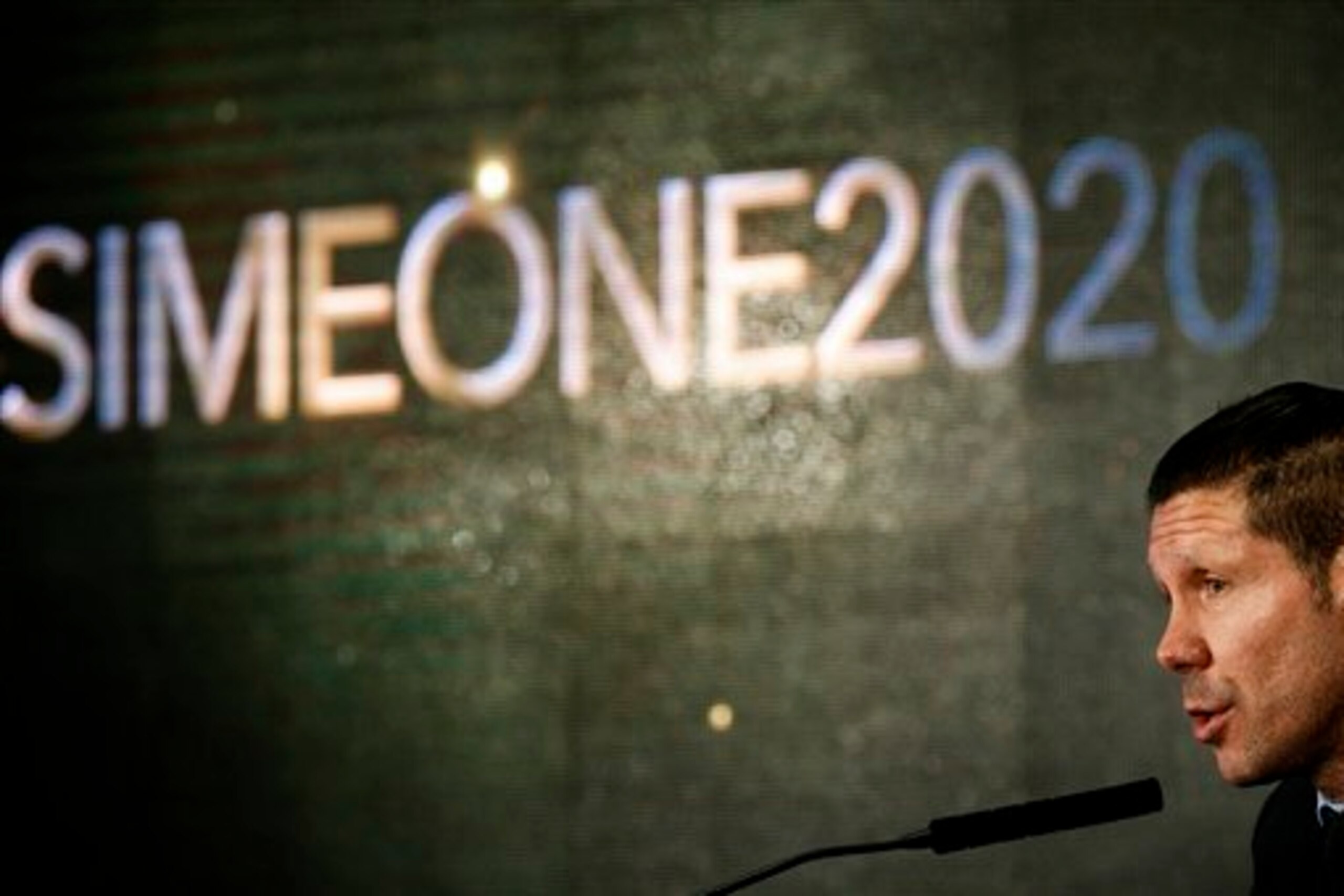
His name was up in lights and the sense of occasion was very real. Behind him, carrying a gold tinge, "#SIMEONE2020" shone bright, its message obvious, the delight it represented palpable.
In signing Diego Simeone to a new five-year contract last March, Atletico Madrid had taken one of their most important steps in decades. With one move, they'd essentially secured their immediate future; for almost four years they'd been steadily building around one man, and this confirmed the club's rise and would prolong the upward trajectory.
It was a big deal. Within minutes, #SIMEONE2020 was trending on Twitter. The hashtag was the basis for a video depicting the club's identity. SIMEONE2020 could even be used as a promotional code by fans to purchase discounted tickets for the club's upcoming game.
TOP NEWS

New NFL contenders starting to emerge after Week 4

Deion Playbook Found at Hotel
.jpg?w=2560 "Cardinals Giants Football")
NFL investigating 2 referees for separate viral exchanges
#SIMEONE2020, then, was everything to this club: a hashtag, a promotional code, a marketing phrase, a signal of intent, a momentous point in its history.
It meant everything because he meant everything.
Almost 12 months on, that remains as true as it did then.
Having stabilised last season after the giddying, historic highs of 2013-14, Atletico Madrid under Simeone are in the title hunt again in La Liga. After Saturday's 3-1 victory over Eibar, Atleti sit just three points behind Barcelona and one ahead of Real Madrid, the club continuing to defy the game's financial realities as the storm started by Simeone years ago still rages down on the banks of the Manzanares.
Saturday marked an important milestone, too. When Fernando Torres turned in Luciano Vietto's cross in the dying minutes, Simeone turned toward the main stand at the Vicente Calderon, looking up to the heavens with a roar and pumping fists. It was Torres' 100th goal in Atleti colours. This was also Simeone's 100th win as manager of the club in just 159 games.
Only two men in league history have reached that tally quicker than him: Miguel Munoz and Pep Guardiola.
It's become inescapable that this is a truly remarkable manager doing truly remarkable things. And yet, might it all be about to get complicated?
In January, the announcement that the club would be hit with a transfer ban by FIFA was a blow, but it was not entirely unexpected. For Atleti and their neighbours Real Madrid, this was something that had been looming for some time, both clubs having prepared for it to an extent.
At the Bernabeu, stockpiling of talent was evident in 2015; at the Calderon, Atleti's squad depth was taken to an unprecedented level. Thus, when the bans were announced (the bans have been subsequently suspended, but the clubs' respective appeals could easily be heard before the summer arrives, meaning the originally planned timing of the bans could still stand), both clubs looked positioned to cope, but for the less glamorous of the pair, this felt like a bigger deal. There were more implications. The long-term impact looked potentially greater.
As with everything at Atleti, Simeone is at the heart of this.
When the Argentinian penned his new contract last year, he spoke of growth and future possibilities. "The club keeps growing," he said, according to AS. "I've made a decision to stay where I am and decisions are sometimes difficult to make in life. Fortunately I've been able to make this decision as I see a club that is moving forward, I see eagerness to grow and people willing to collaborate."
Simeone's message was subtle but important. He wasn't simply prolonging his stay because of his emotional connection with the club or its identity under him. Nor was the decision based on his unparalleled popularity and authority.
Instead, it was based on potential.
Simeone is a fiercely ambitious character. Publicly, the Argentinian regularly downplays his club's goals, but he's fooling no one. As a leader and motivator, he might be unrivalled; as a coach and teacher, he's utterly relentless; his training sessions are notoriously brutal; his preparation is fanatical.
When he took over in 2011, his focus was on establishing a defined identity and channelling into an underdog mentality, but four years on, the goal is to shake the underdog existence and become a new power.

Steps are being taken in that respect. Off the field, Atletico have strengthened their position by securing new corporate partnerships, and a 20 percent stake in the club has been sold to Chinese conglomerate Wanda Group. Atleti are also due to move to their new La Peineta stadium in 2017, while the club's ambition in the transfer market—the key element for Simeone—continues to increase.
This is the growth Simeone was alluding to, but he's also the one making much of it possible. He's the club's face and dominant figure, blazing the path ahead and driving Atletico toward a new existence. To reach it, the club needs him, but he also needs the growth to be continually possible—day after day, week after week, month after month, year after year.
Becoming a new power demands it. But this is where the potential transfer ban becomes extremely problematic.
Atletico are now at a delicate point on their rise. Neither at the start nor the finish of an upward curve, Atleti are smack bang in the middle of it, a commitment having been made to a defined path. As a club, Atletico are built entirely in Simeone's image. As a squad, ditto; they're talented, hungry and extraordinarily disciplined.
But it's not yet complete.
In midfield, Atleti are still a side built around the ageing legs of Gabi and Tiago. Up front, Antoine Griezmann shoulders an immense load due to the limitations of a declining Torres and the curious failure of Jackson Martinez.
Emerging faces are admittedly everywhere—Koke, Saul Niguez, Yannick Carrasco, Vietto, Oliver Torres, Angel Correa, Jose Gimenez and Thomas Partey—but the team remains short on top-end talent. The admission that the club wants Diego Costa back from Chelsea is recognition of as much.
As such, the coming summer was always going to be pivotal for Atletico.
To go to another level, Atleti need goals and dynamism to add to the robust foundations.
At present, the capital club has just 34 goals in 23 league games despite last summer's desire for an internal shift. Ahead of this season, Simeone spoke of his team becoming faster, sharper and playing in space. The shift has been uncomfortable, though. Atletico have occupied an uncomfortable middle ground and are level on goals with the much smaller Celta Vigo.
They're two behind the tiny Eibar.
They're 32 behind Real Madrid.
Growth in the coming summer is dependent upon making bigger splashes in the transfer market to reinforce the club's rise. A marquee striker is required. An elite playmaker is, too. But a transfer ban would scupper any such possibilities and stall progress.
The potential problems might go beyond signings, however. Holding on to key assets is fundamental in maintaining an upward trajectory, and a transfer ban could compromise Atleti's ability to keep Griezmann in the medium-term future.
On his way to becoming one of the world's top five players, Griezmann will soon be hunted by the game's behemoths. Across town, Real Madrid lurk; in Catalonia, Barcelona do, too; far away in Bavaria, Bayern Munich represent the same threat. There's the Premier League's riches as well. To satisfy the Frenchman, Atleti will need titles, and to get them, they'll need help for him.
If it doesn't come, the summer of 2017 looms as a likely exit point for Griezmann. Of course, by then, any transfer ban could have been served, leaving the club able to do business again. But missing out in 2016 and losing Griezmann in 2017 would leave a colossal and difficult-to-fill hole at the Calderon, and Simeone will be aware of the possibility.
It's why the prospect of the transfer ban is so threatening to Atletico: After signing Simeone to a long-term deal, the first two years of the Argentinian's new contract were always going to be the most vital in sustaining growth. And the potential for that growth is why he signed in the first place. Now it could be stunted.
Does this compromise his future as well, then? It's possible.
"We all love Atletico Madrid, and we all want to grow together," Simeone said last March. "There is plenty ahead for us and so much depends on the ball going into the net." It does, but now it depends on much more than that, too.
On the day of #SIMEONE2020, Atletico looked to have no ceiling.
A transfer ban would give them one, and it would give Simeone reason to consider his future elsewhere.
.jpg?w=2560 "Hill Injury Update Football")
.jpg?w=2560 "Titans Giants Football")

.jpg?w=2560 "Tyreek makes another cryptic post amid Chiefs rumors")