Kentucky has had some good moments this season, but it's clear there are major question marks going forward.
The Wildcats lost their third game of the year Tuesday, this time an embarrassing 85-67 blowout at the hands of LSU. While wins over Louisville, Duke and others show this team still has the talent to contend in the SEC as well as nationally, they have a lot to prove before getting to that point.
In addition to the team-wide issues, every player on the roster has to look at himself and figure out how he can improve to help the team. Some are more at fault than others, but none have been perfect through the first two months of the season.
Here is a look at the biggest question marks for each starter to answer over the rest of the year.
Tyler Ulis: Can He Consistently Make Shots from Deep?
1 of 5
Tyler Ulis has seemed to carry the team in recent weeks, at times looking like he has complete control of the game. He is averaging 21.3 points and eight assists in his last three games while remaining a dangerous offensive weapon.
Considering he is also playing just about every minute of every game (at least 38 minutes in seven straight), it's clear just how valuable Ulis is to this team.
The only question at this point is whether his three-point shooting will catch up to the rest of his game. After making 42.9 percent of his shots from beyond the arc last season, Ulis has made just 29.2 percent this year. Poor outside shooting has been a major problem for Kentucky this year, and the sophomore isn't doing much to help.
Interestingly, Ulis has not lost confidence in his shot. He is averaging 6.3 three-point attempts in the last seven games with at least five attempts each time out. This led to 4-of-7 shooting in a win over Louisville but also a few terrible shooting games.
Ulis needs to find more consistency in his outside shot in order to lead Kentucky where it needs to go.
Isaiah Briscoe: Is His Free-Throw Shooting Really This Bad?
2 of 5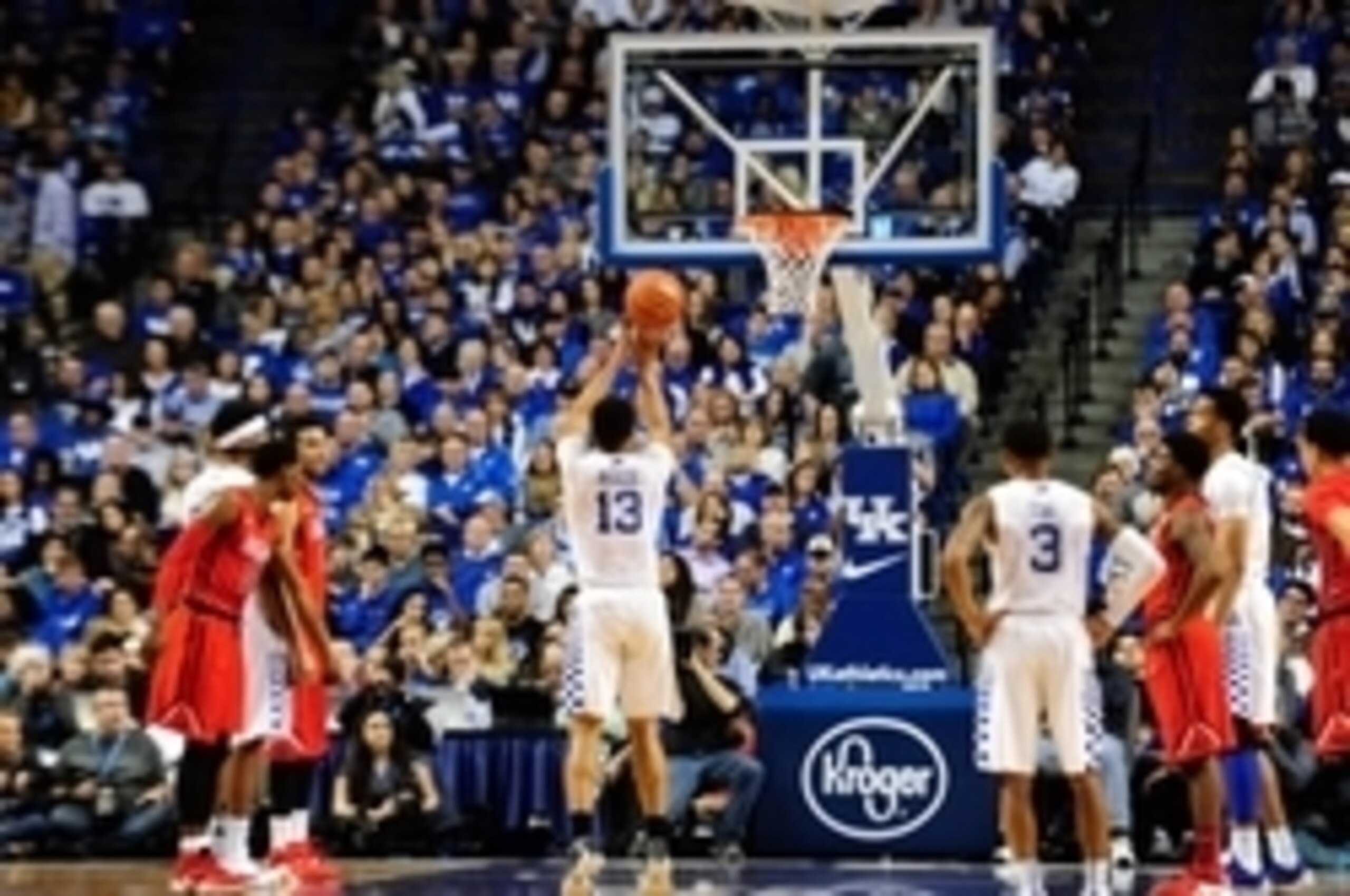
Isaiah Briscoe's free-throw shooting has ranged from "bad for a guard" to "embarrassing for a Division I athlete." This isn't encouraging for the freshman guard.
After a 1-of-7 showing against LSU, Briscoe is now shooting just 35.3 percent from the free-throw line. Not only has this left a lot of points on the table for Kentucky, but it also leads to questions about his style of play and whether he can even remain on the floor.
Briscoe isn't much of an outside shooter either, which means he spends most of his time slashing to the basket and finishing in the paint. Eventually, the scouting report will get out and teams will intentionally foul in order to take away the easy points. Meanwhile, the freshman also can't be trusted to stay in the game late if the Wildcats need to keep a lead with free throws.
A lack of alternatives will keep Briscoe on the court, but he needs to improve from the charity stripe in a hurry.
Jamal Murray: Will He Increase His Efficiency?
3 of 5
Like in the loss to Ohio State, Jamal Murray was great offensively while losing to LSU. The guard scored 21 points to bring his season average to a team-high 17.1 points per game, showcasing the skill set that has NBA teams salivating.
The problem is while he is usually getting his points, it isn't always pretty.
Murray has improved his outside shooting, but he has still only made 41.4 percent of shots from the field this season. He is often too aggressive with the ball and starts forcing bad shots with no chance of going in. Adding this to his 3.1 turnovers per game and there are clear negatives to go with the good so far this year.
According to Sports-Reference.com, Murray has an offensive rating of 107.9 per 100 possessions, which is solid but not the level you would expect of a player of this ability. Not only does he rank behind teammates Tyler Ulis, Alex Poythress and Marcus Lee, but he also trails Skal Labissiere and Derek Willis in this category.
Scoring isn't everything when it takes a lot of possessions to get those points. Murray needs to get smarter with the ball in order to truly reach his potential.

.jpg?w=2560 "Rams Raiders Football")

Alex Poythress: Can He Stay out of Foul Trouble?
4 of 5
One of the themes of the loss to LSU was foul trouble. Marcus Lee was the biggest offender while fouling out in just five minutes of playing time, but Alex Poythress wasn't much better, fouling out with just four points and four rebounds.
While this hasn't often been an issue for Lee, it is one for Poythress. The senior last fouled out against UCLA— another loss for Kentucky. In the meantime, he has been called for at least four fouls in six of the last seven games. The only exception in this stretch was the team's best win over Louisville where the forward had 14 points, six rebounds, three blocks and only one foul. He played a season-high 34 minutes in the victory.
Unlike past seasons in Lexington, the Wildcats are thin in the frontcourt and can't afford to lose starters to the bench for extended periods of time. Poythress is a key player on this roster who contributes much-needed inside scoring as well as defense and rebounding. He needs to be on the floor as much as possible.
Any continued problems with foul trouble will severely hurt Kentucky going forward.
Marcus Lee: Will Defensive Rebounding Catch Up to Offensive Rebounding?
5 of 5
Marcus Lee has been incredibly valuable to Kentucky this season, thanks to his ability to crash the boards offensively. According to KenPom.com, the junior ranks 20th in college basketball in offensive rebounding rate. The problem is he ranks just 384th in defensive rebounding rate.
On the season Lee is averaging only 3.7 defensive rebounds per game, just third on the team. He has the athleticism and aggressiveness to go after offensive boards and turn them into easy putbacks, but he often forgets to box out on the defensive end.
While Lee struggled to stay on the court against LSU due to foul trouble, the Tigers dominated Kentucky in this area with 16 offensive rebounds. This is not something you usually see from a John Calipari-coached team.
Lee needs to stay on the court and keep opponents from getting extra opportunities each possession. Otherwise it doesn't matter how good the defense plays, teams will still be able to score at a high rate.
Follow Rob Goldberg on Twitter for more year-round sports analysis.
.jpg?w=2560 "Steelers Saints Football")

.jpg?w=2560 "Packers Safety Slams Refs 🤬")
.jpg?w=2560 "🚨 Week 8 AP Top 25 Poll")