

5 of the Most Interesting Radio Messages from Abu Dhabi Grand Prix
Lewis Hamilton may have enjoyed the most successful season of his Formula One career in 2015, but the three-time world champion's year failed to end on a happy note in Sunday's Abu Dhabi Grand Prix.
For the third race in succession, Hamilton was beaten by Mercedes team-mate Nico Rosberg, and for the third race in succession he found himself arguing with his own team over his tyre strategy, challenging the pit wall's authority.
Among the most emotional competitors on the current grid, Hamilton requires strong management from his colleagues and his race engineer, Pete Bonnington, won two separate battles with his driver over the course of the 55-lap race.
With analysis of Sebastian Vettel's decision to help Kimi Raikkonen, Fernando Alonso's frustration with McLaren-Honda and Nico Hulkenberg's struggles against Sergio Perez, here are five of the most interesting radio messages from the season finale.
Lewis Hamilton Challenges Mercedes' Strategy Calls Once Again
1 of 5
Three times. Three times he's done it in the last three races.
First it was in Mexico, where he even surprised his own team with his sheer bloody-mindedness. Then it was in Brazil, where what was initially dismissed as a one-off became a more serious, obvious change in mindset.
And now it's happened in Abu Dhabi.
We're not talking about Nico Rosberg's career-best run of three consecutive victories, of course—we're talking about Lewis Hamilton's habit of challenging Mercedes' strategy calls.
After a frustrating race at Interlagos, the three-time world champion spoke of his desire to be given more freedom by his team when it came to the timing of his pit stops, per ESPN F1's Laurence Edmondson.
And for one night only at the Yas Marina circuit, Mercedes bowed to their driver's wishes.
Rather than following Rosberg, who made his final stop on Lap 31, immediately into the pits—as has been the norm in recent races—Hamilton was allowed to stretch his second stint in Abu Dhabi as the pit wall tried something different.
"OK Lewis, we're gonna try and extend this stint," said his race engineer, Pete Bonnington, on Lap 33, according to the FIA television feed, which resulted in a recalculation on the other side of the garage.
"So Nico, if you can just pick the pace up a little bit, we need to close the gap to Lewis," advised the Rosberg's race engineer, Tony Ross, on Lap 35, deciding against informing his driver about Hamilton's plot.
As Hamilton tried to build a lead on his ageing rubber, his attention soon turned to Rosberg's strategy.
"What's the other car tyre choice? What's the other car on?" Hamilton queried, stumbling over his words, on Lap 37.
"Other car's on prime at the moment," replied Bonnington, before informing his driver of the gap to Rosberg.
"OK Lewis, so if we were to stop we would be six seconds behind," Bonnington said on Lap 38. "Nico is currently 16.2 (seconds behind)."
"How much longer do you want me to keep this up?"
"OK Lewis, copy that last message, we've got 18 laps remaining. I think we may, er, stick with the prime tyre, it seems to be holding out quite well."
With that message, Bonnington had ruled out any chance of Hamilton switching to the faster, super-soft compound tyres for the final stint, when he would hope to catch and pass Rosberg for the victory.
As a result, the three-time world champion began to seriously consider finishing a race of two-to-three stops with just one visit to the pits.
"If I was to back off right now and look after these tyres 'til the end, how much, how slow can I go per lap?" Hamilton asked on Lap 41.
"Er, Lewis, I think that would be pretty much impossible to do, so I think what we're currently planning is the way to go."
"But please give me the calculation," the champion persisted.
Knowing his driver would have to complete an impossible 44 laps on the same set of tyres for his master plan to work, Bonnington said: "Yeah Lewis, it's not even bothering, er, working the numbers. It would be a real gamble and it wouldn't pay off, I can guarantee it."
"The reason I'm asking is because these tyres still feel good."
Hamilton, of course, pitted for soft-compound tyres at the end of that lap and rejoined around 13 seconds behind Rosberg—further behind than he would have been had he stopped instantly after his team-mate.
Perhaps this was Mercedes' way of reminding Hamilton that the team—with their sensors, their telemetry data and their computers—know best.
Lewis Hamilton Refuses to Change Engine Setting
2 of 5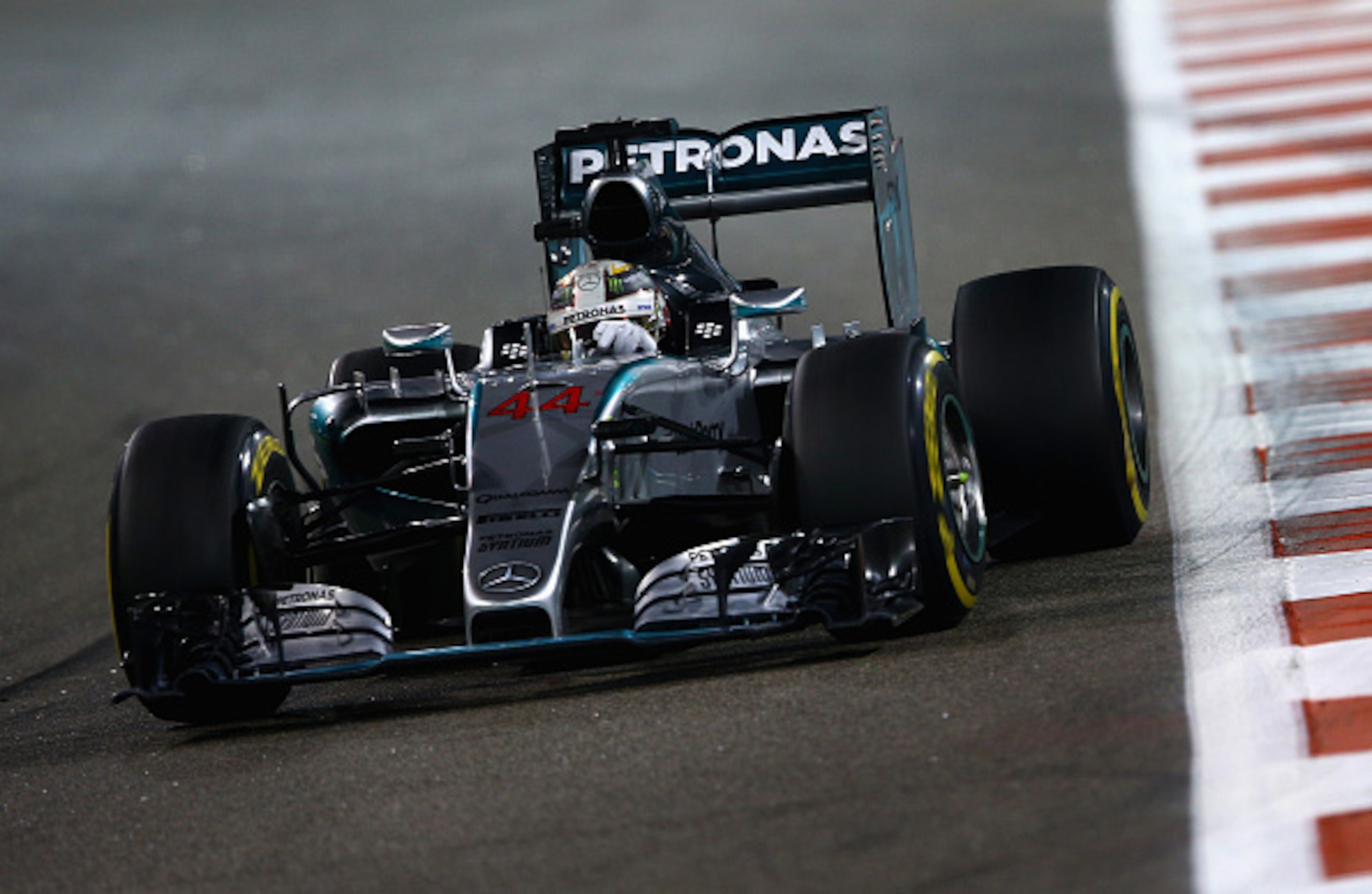
After Lewis Hamilton's final pit stop left him too far behind Nico Rosberg to mount a serious challenge for the win, the team decided to kill the race between the pair and coast to the finish in the closing stages of the Abu Dhabi GP.
The Mercedes drivers are often told to switch engine settings—or Strat Modes, as they are called—during grands prix, allowing them to increase or decrease the performance of their power units depending on the state of their race.
And given that Rosberg was given permission to use Strat 3 during his recovery drive in September's Japanese GP having previously been instructed to protect his engine, we can safely assume that the higher the setting, the less power the drivers will have at their disposal.
In search of his 44th career win, however, Hamilton wanted all the power and every possible tool to overhaul his team-mate and cap his best-ever season with an 11th victory.
But his quest for personal glory clashed with the team's hopes for a 12th one-two finish of 2015, leading to a rather petty interaction between the three-time world champion and Pete Bonnington.
"OK Lewis, that'll be Strat Mode 10, Strat Mode 10. If you do not comply then we'll just, er, turn Nico to Strat 6," warned Bonnington on Lap 51, per the FIA TV feed, utilising his tried-and-tested technique of threatening Hamilton with Rosberg.
Hamilton, though, didn't reply or comply, leaving Bonnington with no option but to follow through his threat.
"So Nico, go Strat 6. Strat 6," Rosberg was instructed by Tony Ross on Lap 52, with the German instantly acting on his team's request.
Meanwhile, the silent treatment he was being subjected to only saw Bonnington become ever more firmer with his driver and, later that lap, again ordered the setting change.
"Strat Mode 10, Strat Mode 10. That is an instruction."
Although Hamilton again chose not to reply, he did—as he always does with his numerous strategy-related queries—eventually follow the team's lead, letting Rosberg revert to a more conservative setting of his own.
"Strat 10 please, Nico," Rosberg was told.
Ahead of the race, Rosberg told Motorsport.com's Pablo Elizalde that—as a result of his engine failure at Monza—he was forced to use an "extremely old engine" in Abu Dhabi.
And while it is highly unlikely, a conspiracy theory might suggest that Hamilton—knowing his team-mate's power unit was approaching the end of its life—purposely forced Rosberg to use an aggressive setting in the hope his engine would fail in the final laps of the race.
Yet the lengths Mercedes went to ensure Hamilton followed their request was another reminder that teams must not only manage temperatures and wear rates but egos and personalities.
Who'd be a race engineer?
Sebastian Vettel Plays the Team Game and Lets Kimi Raikkonen Past
3 of 5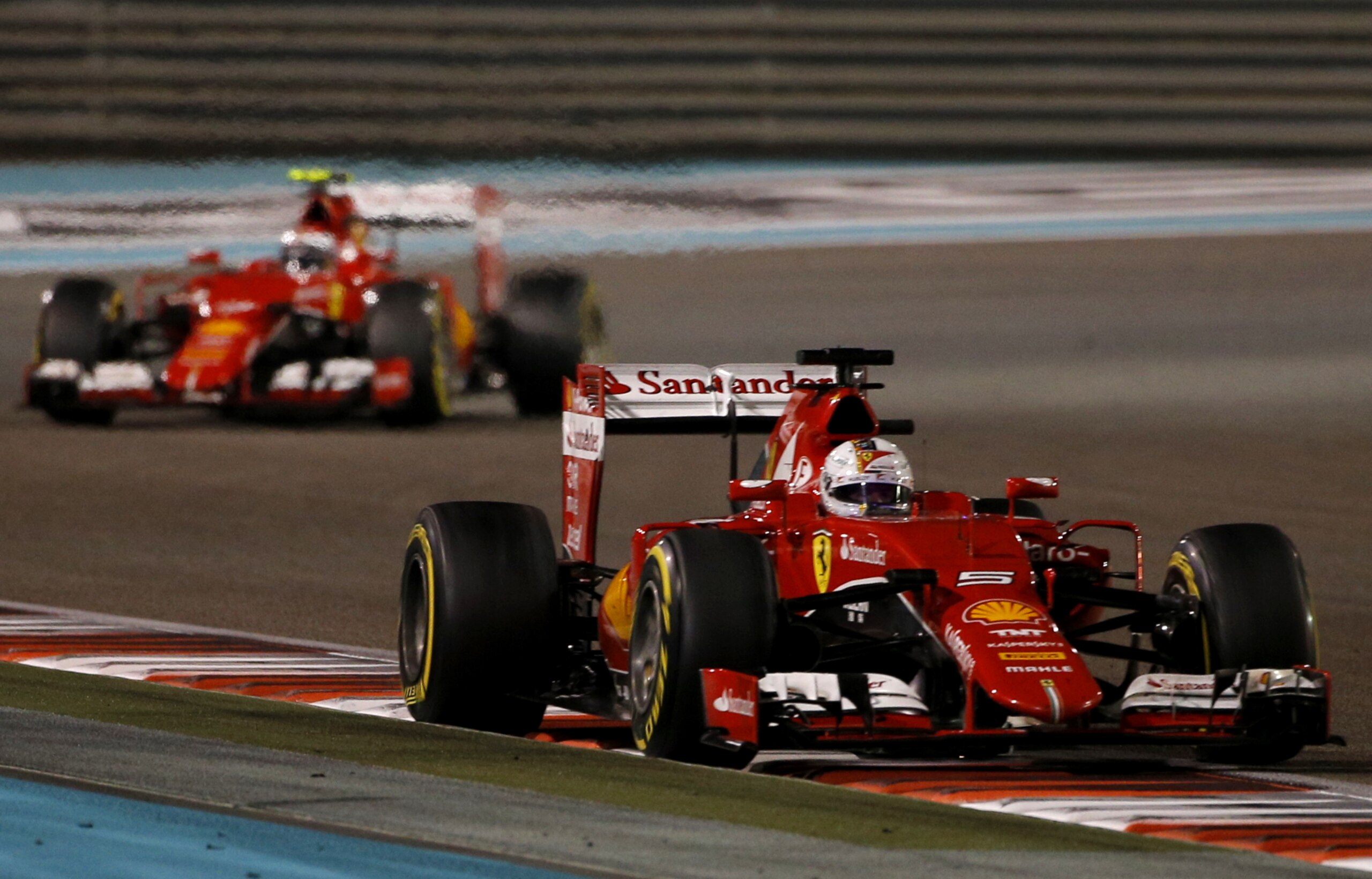
The relationship between Sebastian Vettel and Kimi Raikkonen has been a key factor in Ferrari's successful season and, indeed, is arguably the biggest reason why the latter has been retained for 2016.
In Raikkonen, Vettel has an ally he can trust, someone who—as he told BBC Sport's Andrew Benson around 18 months before the pair became Ferrari team-mates—has always been fair and "really straight" with him.
As such, the man who once ignored team orders to rob a grand prix victory from his Red Bull team-mate, Mark Webber, has mellowed and is far more likely to play the team game with a driver he respects.
And that is what we witnessed in the opening phase of the Abu Dhabi GP when Raikkonen, having made his first pit stop on Lap 10, closed up behind Vettel, who was stretching his first stint on the more durable soft-compound tyres as he recovered from 15th place on the grid.
In the knowledge that Raikkonen, pursuing the Mercedes cars of Nico Rosberg and Lewis Hamilton, was in a completely different race to him, Vettel needed no invitation to step aside for his friend, gifting third position to Kimi at Turn 11 on Lap 16 before checking whether he'd done the right thing.
"That was the plan, to let him by, right?" Vettel asked, per the FIA TV feed.
"Yeah, was good," replied his race engineer. "So now still gaining on people behind, so keep pushing like this. Try to stay on Plan A (a two-stop strategy)."
While Vettel is willing to offer the occasional concession to Raikkonen, the four-time world champion is not exactly a charity. So when the Ferrari team-mates found themselves in an identical position later on, Vettel appeared to be less enthusiastic when it came to moving aside.
Presumably Raikkonen—in an unaired message—complained he was being held up by Vettel in the same way he has criticised so many drivers over the course of 2015, leaving his race engineer, Dave Greenwood, to explain that the German had already been warned to get out of the way.
"Sebastian has been told, he's been told," a frustrated Greenwood said on Lap 35, before learning that Vettel was willing to comply.
"OK, he'll swap," Greenwood confirmed as Vettel promptly released Raikkonen at Turn 1.
Although Raikkonen is a driver he deeply admires, old habits are evidently dying hard for the four-time world champion.

.jpg?w=2560)
Fernando Alonso Desperate to Be Put out of His Misery by McLaren-Honda
4 of 5
Fernando Alonso has experienced one of the most troubled, character-testing seasons of his entire Formula One career in 2015, and he saved the worst weekend of his year until last.
The two-time world champion was denied a place in the second segment of qualifying after suffering a puncture on his final run in Q1, the kind of unfortunate incident that tends to occur when a team or driver is stuck in a rut.
His race got off to the worst possible start when he collided with Felipe Nasr just metres off the line, slamming into Pastor Maldonado—an innocent victim on this occasion—at Turn 1, prematurely ending the Venezuelan's year.
And after stopping for repairs at the end of the first lap, the finest driver of his generation was handed the indignity of a drive-through penalty.
It was at the halfway stage of the race when Alonso, with only the spluttering sound of his Honda V6 turbo power unit for company, pleaded for his McLaren team to retire his car if the safety car, which would have allowed the Spaniard to unlap himself and fight for positions, didn't imminently appear.
"OK, if we don't have a safety car, I will retire the car," Alonso told the pit wall on Lap 26, per the FIA TV feed.
The safety car, though, wasn't required during the race and Alonso, despite his desperation to withdraw, went on to finish two laps down in 17th place.
Yet as noted after the grand prix, his comments—on a weekend he was, as reported by BBC Sport's Andrew Benson, again rumoured to be taking a sabbatical for 2016—offered a revealing insight into his state of mind and his lack of commitment to the lost cause at McLaren.
Even Alonso, the man who never gives up, can no longer withstand the pain.
Nico Hulkenberg Has No Answer to Force India Team-Mate Sergio Perez
5 of 5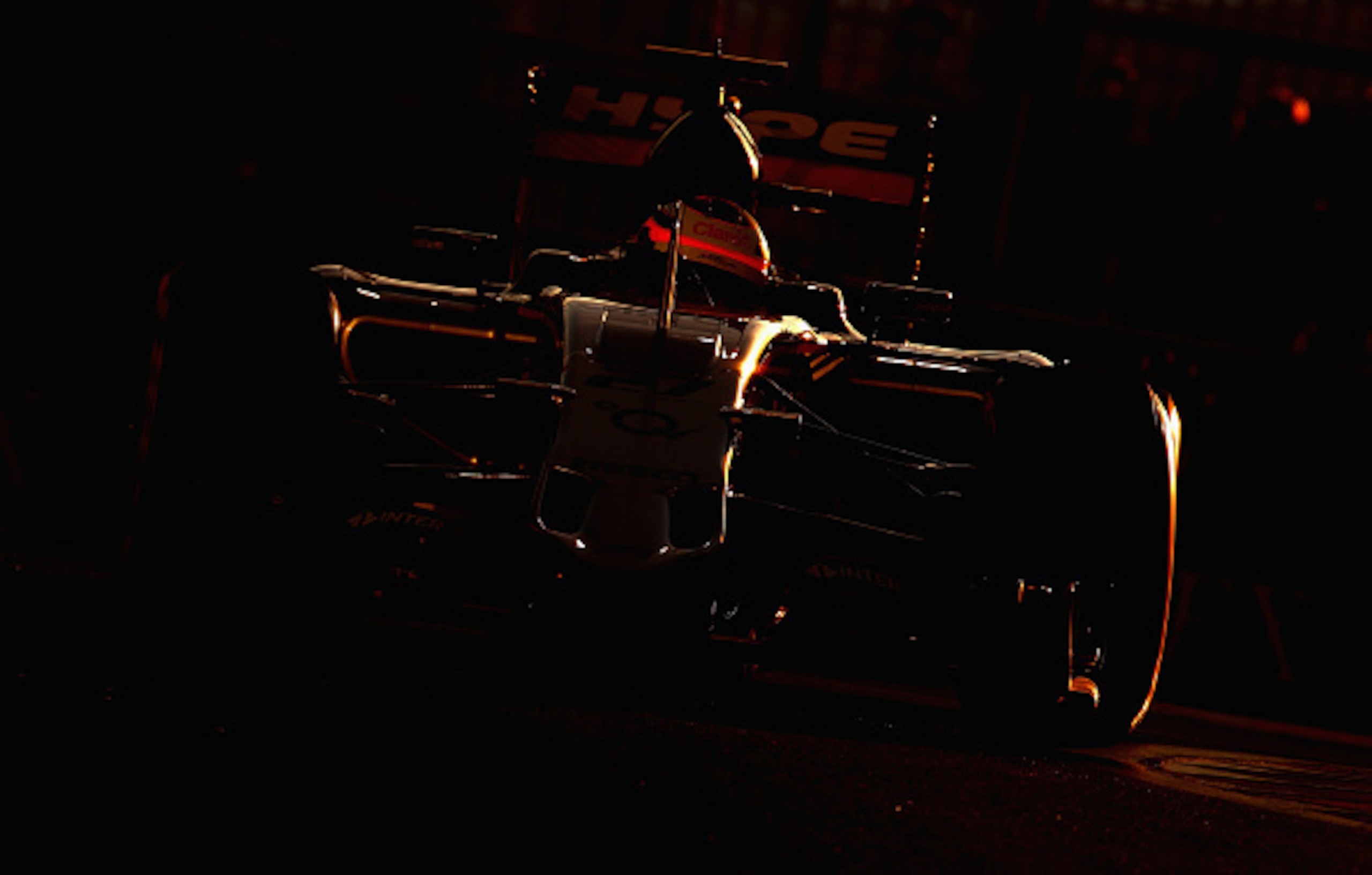
Why did Sergio Perez suddenly emerge as Force India's lead driver in the second half of 2015?
Has he, now approaching his 26th birthday, simply matured both as a driver and a man? Have his strong performances been a direct result of the homely, accommodating atmosphere at Force India?
Or did the team's B-spec VJM08 car, introduced at July's British GP, simply suit his driving style better than his highly rated team-mate Nico Hulkenberg?
From the outside, it is difficult to pinpoint a single reason why Perez has found the consistency to complement his speed and recorded four top-five finishes—including a podium result in Russia—in the final nine races of the season.
But far more concerning is the fact that Hulkenberg cannot explain the difference between the drivers.
As Perez produced his best qualifying performance of the year to start fourth—just 0.133 seconds behind third-placed Kimi Raikkonen, per the official F1 website—Hulkenberg was forced to settle for seventh having set a time 0.502 seconds slower than his team-mate.
When team-mates are separated by such a huge margin, it is often as a result of the slower driver making a mistake or suffering a technical problem.
But Hulkenberg was adamant that his effort was a near-perfect lap, insisting he had extracted as much as he possibly could from his machinery.
According to the official F1 website, he told the team: "That's really as good as it gets from me guys—I don't know where I should find the other time..."
Hulkenberg's best, it seems, is no longer good enough to beat Perez, and the German will have to find that extra time from somewhere between now and the start of 2016.




.jpg?w=2560 "2 NFL Officials Suspended")

.jpg?w=2560 "Viral Rams Coach Vid 🖕")