

Lassana Diarra Leads the Way into the Light for France
It is in the most trying and bleak of times that the human spirit can show its capacity to shine through the darkness. This weekend should have been one of great joy for Lassana Diarra, making his first start for France in his hometown of Paris—against world champions Germany—since returning to the squad last month after five long years out of the picture.
As we now know, Diarra's 80 minutes of accomplished midfield play in France's win were the least significant part of his evening. Shortly after leaving the pitch, the midfielder discovered that his cousin, Asta Diakite, was one of the victims of the horror unfolding all around the capital and of which the players were only just becoming aware, with a total of 129 people confirmed dead in the series of terrorist attacks (one of which, of course, was outside the Stade de France itself).


.jpg?w=2560)
Diarra's statement on social media, reproduced below, was stunningly eloquent and indicative of a real class act. While underlining the scale of his personal loss—he describes Asta as a big sister—he looks at the big picture and urges his country "to stay united against a horror which has no colour, no religion."
"#PrayForPeace pic.twitter.com/lsOpaSxN62
— Lass Diarra (@Lass_Officiel) November 14, 2015"
Here is the translation of the full text, via Eurosport:
"Following the dramatic events yesterday in Paris and Saint Denis, it is with a heavy heart that I heard this news today.
As you may have read, I was touched personally by the attacks. My cousin, Asta Diakite, was among the victims of one of the shootings yesterday, along with hundreds of other innocent French people. She was like a big sister to me.
In this climate of terror, it is important for all of us who represent our country and its diversity to stay united against a horror which has no colour, no religion. Stand together for love, respect and peace.
Thank you all for your messages, take care of yourselves and your loved ones, and may the victims rest in peace.
"
His dignity is quite remarkable. We already knew Diarra was a man of fortitude. With his top-level career widely written off after a contract dispute with Lokomotiv Moscow essentially froze his career, the 30-year-old midfielder has picked up the thread with gusto this season. Joining Olympique de Marseille after a year of inactivity, he has been one of the best players in Ligue 1 this season, which earned him his unlikely international recall.
This, however, is something else, something of significance and (hopefully) consequence that transcends sport. Friday's atrocities couldn't have been closer to home for Diarra. He grew up, as L'Equipe's Monday print edition described, on Rue Ramponeau in the city's Belleville quartier, less than a kilometer away from Le Petit Cambodge restaurant on Rue Bichat, the scene of one of the attacks. It's also less than two kilometers from Le Bataclan, the concert hall that saw the bulk of the night's fatalities.
The long road towards turning Diarra's words into deed will begin for the national team at Wembley on Tuesday night, with the friendly against England going ahead and the Marseille player having passed on French Football Federation President Noel Le Graet's offer to drop out (as per Le Figaro, in French).
Since Friday, reports on the squad's feeling about fulfilling the fixture have varied, with Matt Hughes and the well-connected Julien Laurens reporting in the Times (h/t the BBC's Neil Henderson in the tweet below) that some members of the squad were upset by Le Graet's unilateral decision to go ahead with the Wembley fixture. Captain Hugo Lloris confirmed in Monday's press conference that the players were told that the match would take place as originally planned (as per BBC Sport).
To talk about football as a symbol of hope or even a conduit to future peace seems awfully trite right now. Diarra's loss reminds us of this. Footballers aren't heroes or supermen, but people whose lives, hopes and dreams hang by a thread, just like the rest of us, regardless of how much they have in the bank. They are not immune from the fragility of human life.
Yet the reality is that France, as much as any European nation, knows the uniting effect that hosting an international tournament can have, and that can't be ignored as they move forward to Euro 2016. It had previously been seen as the potential crowning glory of the careers of the fabled "1987 generation," led by Karim Benzema and now joined by the returning Hatem Ben Arfa.
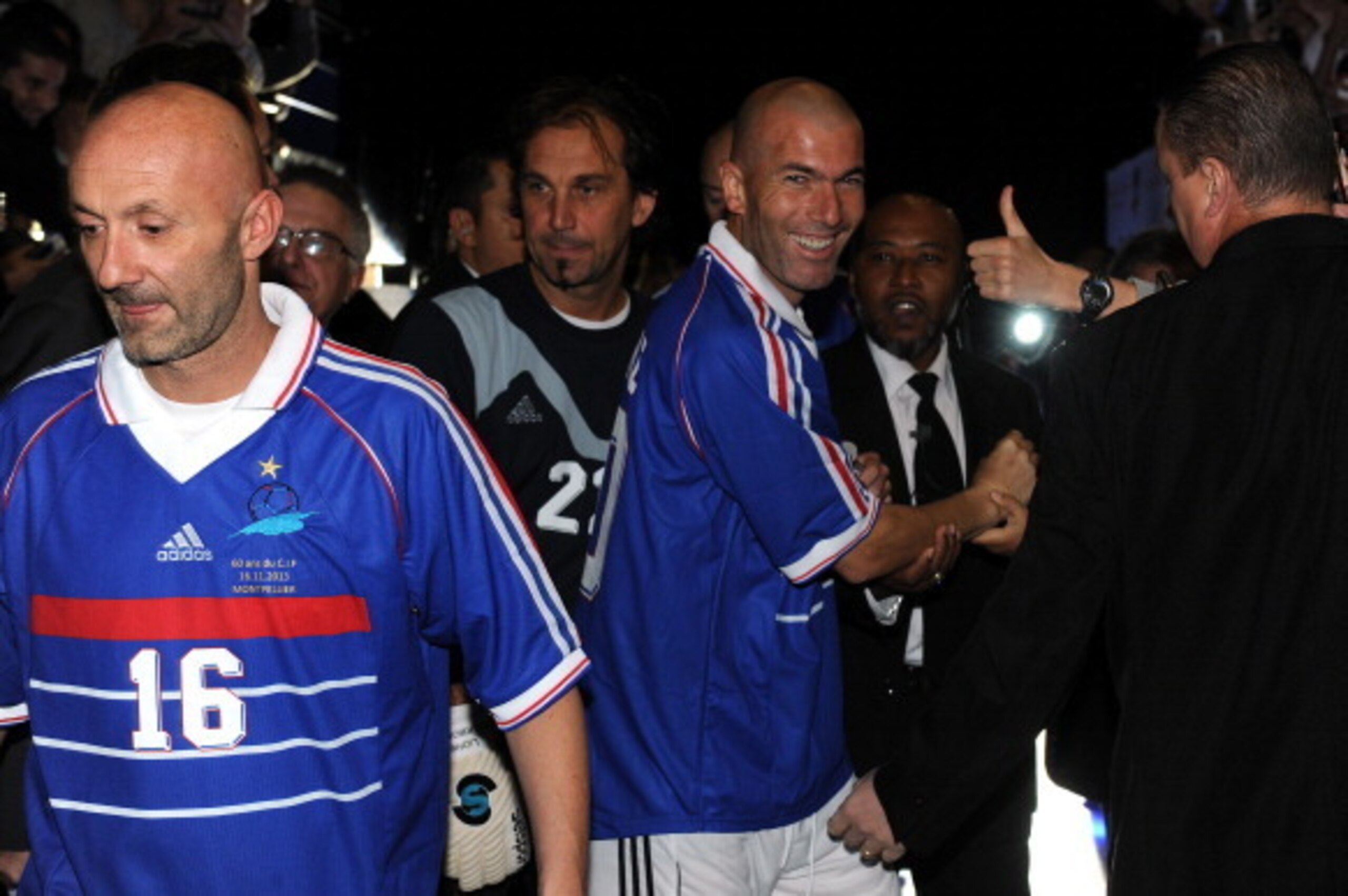
Now, its significance, and the parallels with the 1998 World Cup, are even greater. The breathtaking success of Aime Jacquet's "black-blanc-beur" (black, white, Arab) team of mixed origins seemed to mark a new age of multiethnic tolerance and to provide the ultimate riposte to Front National leader Jean-Marie Le Pen's criticism of the amount of what he deemed "foreigners" in the group (as per Liberation).
Jacquet told Andrew Hussey in the Observer in 2006 that he was "personally disappointed that a politician should say such things." The coach then went on to hit the nail on the head about the team's symbolic importance despite saying his players hadn't really thought about or discussed that aspect of their achievements.
"Sport is played with companions," Jacquet told Hussey, "and it is therefore naturally all about integration."
French football's history—and, specifically, the history of the national team—is all about immigration and integration. Raymond Kopa, arguably the first bona fide French star on a global level after shining for Stade de Reims in the first-ever European Cup final in 1956 and subsequently doing likewise for Real Madrid, was born in northern France to Polish parents. He had been born Raymond Kopaszewski before shortening his family name as a teenager.
Leaping forward, the 1984 European Championship success was built around the midfield four "Le Carre Magique," or the Magic Square, composed of Alain Giresse, Luis Fernandez, Jean Tigana and Michel Platini. Tigana was born in Mali (then French Sudan), Fernandez was born and raised in southern Spain until the age of eight, and Platini's parents were both from Italian families. Zinedine Zidane, born in Marseille to Algerian parents, was the emphatic reference point for multiculturalism in 1998.
What we can't pretend is that football was then, or is now, a simple cure for social ills. The honeymoon after the triumph of 1998 was not a long one. In October 2001, less than a month after the 9/11 attacks on New York City's Twin Towers, the friendly between Les Bleus and Algeria was abandoned after Franco-Algerian youths, many chanting slogans in support of Osama bin Laden, invaded the Stade de France pitch (as recounted by Hussey in that Observer piece). It had been the first meeting between the sides since Algerian independence in 1962, and it was hugely significant.

If 1998 painted a nice picture of diversity and harmony, it's clear the World Cup win only offered a placebo. Two national team stalwarts, Laurent Blanc (in 2011, as reported by the BBC) and Willy Sagnol (last year, as per Sud Ouest, in French), have been mired in controversy after making comments that have appeared to lean on racial stereotypes. So that sense of disenfranchisement for immigrants and their children is hardly dissuaded by these examples.
That sense of fracture around the national team has hung over France for years now. Samir Nasri, speaking to the Telegraph's Henry Winter last year, talked about how "it's more difficult in France (being Muslim)." The Manchester City midfielder gave the impression of an increasing sense of alienation from his home nation, where he said he had enjoyed a happy childhood.
Fred Poulet, who directed Substitute, the film documenting former Milan player Vikash Dhorasoo's experience at the 2006 World Cup, told me in 2010 (via ESPN FC) that "(critics) made the most of the ethnic origins of the players" after France's meltdown at the 2010 edition.
"It's always the same. If a player gets out of a flash BMW and he's an Arab, then he's arrogant. If he's white, he's made it. Liberté, égalité, fraternité—but not for those blokes there. When we're winning, we're together, but when we're losing, we're not. The reality of French society is 2010, not 1998."
Football doesn't have the answers to healing the scars of Friday's tragedies, nor should it be expected to have them. Yet it is a part of society, and a very visible part of it at that, where these inequalities are on display, loud and large. To heal, Paris—and France—needs genuine unity, not just a temporary acquiesce for show.
Lassana Diarra is a reserved character, rarely expressing himself in front of the media. Yet here, his words are a shining example. Going forward from here and into Euro 2016, France's national team and the FFF need to do their bit to contribute to a brighter future by making sure Diarra's words are made reality. France needs to do 1998 all over again, but this time, it needs to do it better.
.jpg?w=2560 "Rams Eagles Football")
.jpg?w=2560 "Falcons Saints Football")
.jpg?w=2560 "Injury-stricken Seahawks signing veteran RB")

.jpg?w=2560 "2 NFL Officials Suspended")

