

Jese's Time Will Come at Real Madrid If the Club Is Prepared to Be Patient
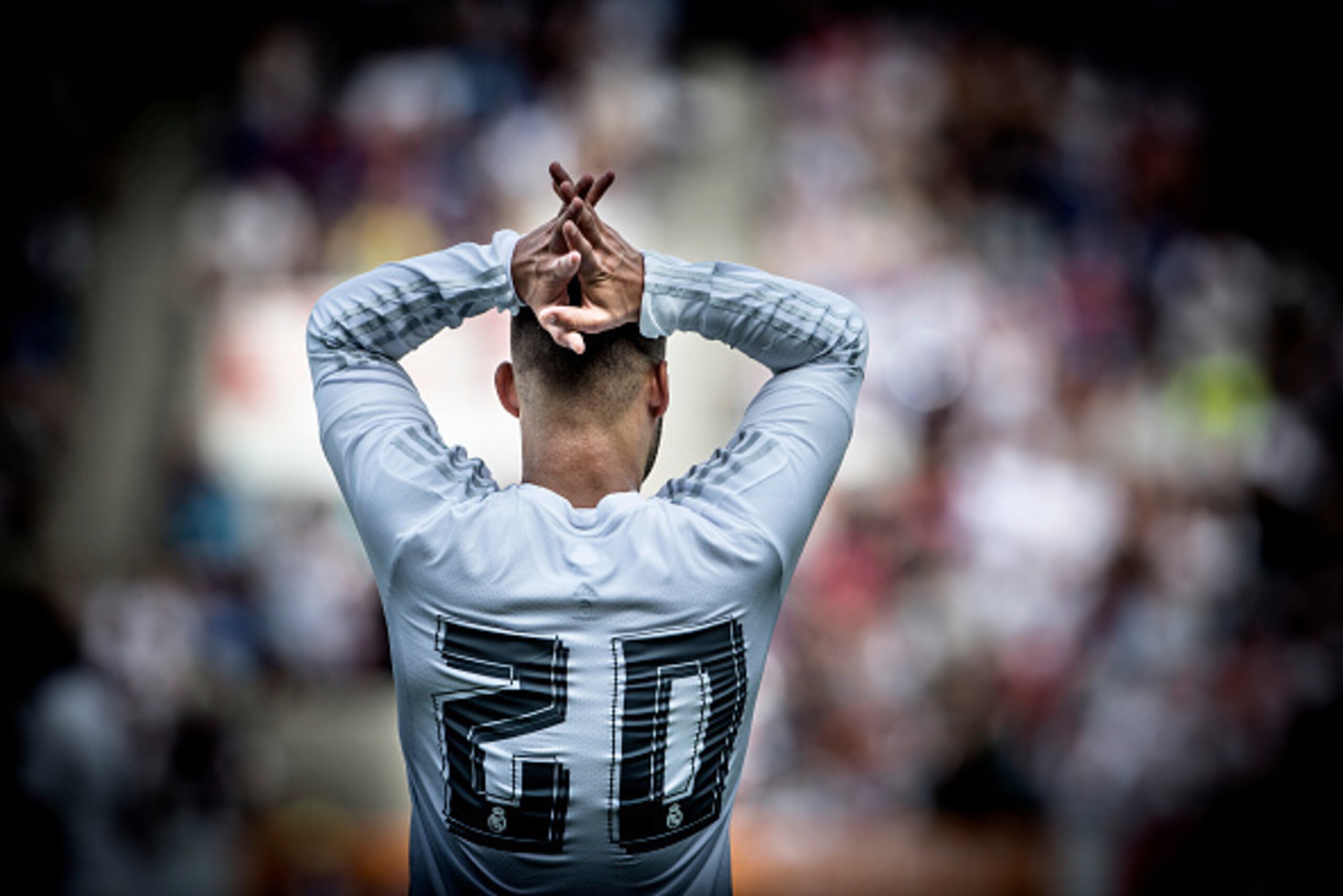
The clock read just 2:52, and already Jese had made a statement. A bold one.
Following a clearance, the Real Madrid forward had collected the ball deep in his own half and, with little ahead of him, squared up to Serge Aurier. For a split second he paused, assessing his limited options, before basically saying: "Come on, then."
It was vintage Jese.

.jpg?w=2560)

In characteristic bullishness, the 22-year-old played the ball ahead of himself down the sideline and exploded past Aurier, hauling Madrid up the pitch on his own and firing a warning shot to Paris Saint-Germain in the process.
Inside the ground at that instant, it felt as though this might be his night. His occasion. His form had been building in the preceding weeks, with goals against Levante and Las Palmas coming either side of a strong opening half against Celta Vigo. Thanks to injuries, he'd been afforded his chance, and at home against PSG, on a marquee European night, the stage felt set for him. AS had called it "Jese's moment."
But it didn't happen. Not at all. His danger never followed his warning.
After 2:52, Jese was scarcely seen again. By half-time, he'd had fewer touches than Keylor Navas in goal. By the hour mark, he was sitting on the bench.
His moment had passed him by.
In the stands, frustration was evident toward the young forward, the reception for him when substituted for Lucas Vazquez rather muted. Later in the press room, Real Madrid manager Rafa Benitez had to defend him, insisting it would be wrong to "single him out."
In the wake of anticipation had come disappointment, leaving behind it a certain expression of waning patience. And even if it isn't entirely justified, its existence is understandable.

For Real Madrid and the Bernabeu, it's been a long time since Jese's explosion in early 2014 was witnessed, and almost two years on, there's a sense he hasn't genuinely progressed from there. Though his nine-month absence due to a serious knee injury is recognised, though the difficulties of forcing his way into a star-studded XI are clear, those connected to Real Madrid want more.
They want flashes of brilliance to become sustained streaks. They want the obvious talent to materialise. They want him to find another level.
And the thing is he probably will.
But only if given time.
For Jese, the issue is that he's a victim of his own success. Because of the captivating nature of his early-2014 arrival, the expectation on him is immense, perhaps impossible to meet at this stage of his career. Like he did when announcing himself, the demand is for month-long barrages. For 90-minute exhibitions. For dominant stretches in front of goal—the five-in-five-games sort.
What's more, his path to the first XI heightens the focus on him. As a product of the club's academy, there's a romanticism that he represents, and it intensifies the glare on his performances and further heightens the expectation.
"In the summer," wrote AS prior to the PSG clash, "some believed that the future of La Fabrica—Real Madrid's conveyor belt of footballers—may even have rested on Jese's success."
That's some burden to carry. And it's one he won't shrug off overnight.
A look around Europe shows that even the very best forwards rarely sparkle on a consistent basis at major clubs in their early 20s.
When he first moved to Real Madrid in 2009, Karim Benzema was a perfect example of that. So was Zlatan Ibrahimovic at Juventus. So was Robin van Persie at Arsenal. So was Luis Suarez in his first year at Liverpool. So was Robert Lewandowski in his first season at Borussia Dortmund. So was Alexis Sanchez at Udinese.
Those are just a few examples, and you might even say Memphis Depay in his opening months at Manchester United is a good example right now.
What's clear is that the evidence points toward out-and-out forwards requiring more time to mature, to blossom, than their counterparts elsewhere, and Jese will likely be no different. But what's so encouraging for the Real Madrid man is that so much of the raw package is already there.
Even in limited playing time, Jese has showcased the sort of traits that suggest he's an elite forward in the making. Along with quick feet and an array of tricks, there's a rugged power that's impossible to ignore in the man Carlo Ancelotti once described as an "insane talent." Instead of skipping past opponents, he storms past; instead of caressing shots, he smashes them.
Jese has that explosive quality—a directness to his game that defenders fear, and his technical ability is accompanied by a certain force.
And then, there's the personality.

Though he's just 22, there's a swagger to Jese that's important. All elite forwards carry that inner belief that they are elite, a comfort in the spotlight, and the Canary Islander embodies that. He's got that confidence that borders on arrogance, that puff-your-chest-out quality that's a hallmark of stars.
He's a long way yet from being the finished product, but the ingredients are there.
The environment might soon be as well.
Approaching 31, Cristiano Ronaldo won't be at Real Madrid forever. According to Globo Esporte (via ESPN), Ronaldo's agent Jorge Mendes has insisted his client will retire at Madrid, but precedent says he won't. Greats rarely do in Chamartin: Alfredo Di Stefano didn't. Raul didn't. Emilio Butragueno didn't. Pirri didn't. Hugo Sanchez didn't. Fernando Hierro didn't. Michel didn't. Guti didn't. Iker Casillas won't.
At some point in the near future, the Portuguese will move on, and in his absence it's easy to envisage an attack led by James Rodriguez, Benzema, Gareth Bale and Jese—the former two supplying the polish, the latter two supplying the power.
Jese can belong in that company. "He is on the right path," said Benitez of his young forward. And the manager is right: he is.
He just needs to be given time to travel down it.
.jpg?w=2560 "Rams Eagles Football")
.jpg?w=2560 "Falcons Saints Football")
.jpg?w=2560 "Injury-stricken Seahawks signing veteran RB")

.jpg?w=2560 "2 NFL Officials Suspended")

