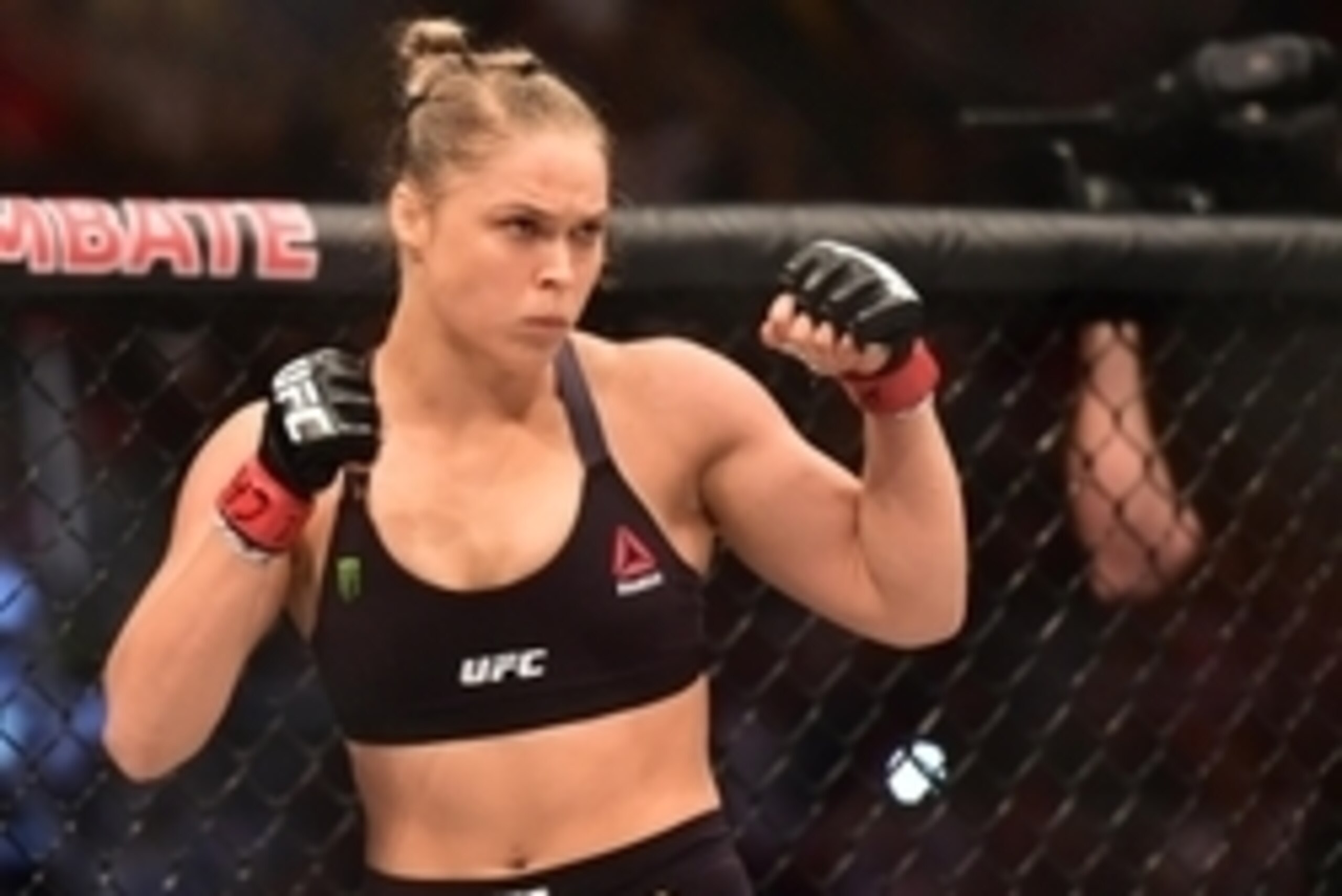
The Complete Guide to UFC 193: Rousey vs. Holm
Since she made the full-time switch to MMA in 2013, Holly Holm has been on a collision course with Ronda Rousey. The former boxing champion, some pundits and fans have said, has a real chance of defeating the grappling-first UFC queenpin.
Now that the time has arrived, in the aftermath of two somewhat underwhelming performances and Rousey's string of unreal dominance, oddsmakers are less confident in Holm's chances. She stands as a 12-1 underdog at UFC 193, which goes down Saturday night at Etihad Stadium in Melbourne, Australia.
Still, at least on paper, Holm provides a challenge Rousey has never seen before in the form of world-class striking.
Rousey has become an international superstar by any metric, with film roles and regular appearances in the mainstream media, and she is undeniably the main attraction. The rest of the card, however, still holds real intrigue.
In the co-main event, strawweight champion Joanna Jedrzejczyk defends her belt for the second time against Valerie Letourneau. The Pole seems to be on the verge of stardom herself with her fan-friendly style and charisma, and the UFC is looking to capitalize on Rousey's success by introducing a second yet very different female champion to a wide audience.
Aside from the out-of-place heavyweight bout between Stefan Struve and Jared Rosholt that opens the pay-per-view portion of the event, the rest of the main card caters to the 55,000-plus Australian fans who will pack into the biggest venue in the promotion's history.
Aging but popular heavyweights Mark Hunt and Antonio Silva will run it back after their first fight ended in a draw in December 2013. Flashy striker Uriah Hall takes his fifth fight in 2015 against Australia resident Robert Whittaker in an outstanding middleweight matchup.
The preliminary card is full of Australian fighters. The highlights are talented prospect Jake Matthews headlining the Fox Sports 1 portion of the broadcast and the flyweight scrap between Ben Nguyen and Ryan Benoit that opens the Fight Pass prelims, which should be a barnburner. Otherwise, there is little of interest even to hardcore fight fans.
Let's take a look at each individual matchup.
The Fight Pass Prelims
1 of 7
Flyweights
Ben Nguyen (13-5; 1-0 UFC) vs. Ryan Benoit (8-3; 1-1 UFC)
Two power-punching flyweights meet in an exciting matchup to open the evening's festivities. Ben Nguyen debuted in impressive fashion with a first-round knockout of Alptekin Ozkilic in May, while Benoit overcame a rough first round against Sergio Pettis to finish him with an enormous barrage of punches in the second. This has the makings of an outstanding fight.
Both Benoit and Nguyen are strikers. Nguyen, an American who resides in Australia, tosses out smooth, technical punch-kick combinations from both stances and carries real power in his hands. Benoit is a physical specimen with great athleticism and explosiveness, and his game relies on his big power. His left hook in particular is murderous, and he works at a quick pace and throws solid combinations in the pocket.
This should be fun. Both fighters will likely be content to bang it out on the feet, and in that scenario, Benoit should have a slight edge by virtue of his greater power and speed. The pick is Benoit by knockout in the second round.
Lightweights
James Moontasri (8-3; 1-2 UFC) vs. Anton Zafir (7-1; 0-0 UFC)
Elite taekwondo practitioner and Black House product James Moontasri returns to action against the debuting Anton Zafir. Moontasri badly needs a win here, as a first-round submission loss to Kevin Lee dropped him to 1-2 in the UFC and has him on the verge of a pink slip. The 28-year-old Zafir enters the UFC on short notice to replace Brendan O'Reilly.
Flashy kicks and questionable fight IQ are the hallmarks of Moontasri's athletic, high-energy game. The former world-class taekwondo competitor throws vicious, brutal kicks of all varieties and mixes in flying knees and hard punching combinations. His takedown defense is competent. Zafir isn't a great athlete but is well-rounded and has a strong top game.
The story of this fight is the physical mismatch. Moontasri is bigger, stronger and a near-elite athlete by any standard, while Zafir is slow relative to UFC-level competition and doesn't have the wrestling acumen to wear down the American on the mat. The pick is Moontasri by knockout in the first round.
Welterweights
Richard Walsh (8-4; 1-2 UFC) vs. Steve Kennedy (22-7; 0-1 UFC)
Australian welterweights meet in a solid matchup as The Ultimate Fighter: Nations contestant Richard Walsh draws Steve Kennedy. Walsh is on a two-fight losing streak after suffering a first-round knockout at the elbows of Alan Jouban in February and prior to that was absolutely robbed against Kiichi Kunimoto. Kennedy debuted against Peter Sobotta in June and tapped to a rear-naked choke in the first round.
The 26-year-old Walsh is an aggressive and dangerous fighter. He slings potent punch-kick combinations as he works his way forward into the clinch, where he has a strong arsenal of knees, elbows and trips. Kennedy is well-rounded, with a Brazilian jiu jitsu black belt and experience as a pro boxer, but he is slow and doesn't put his skill sets together particularly well.
This is Walsh's fight to lose. He's younger, faster and more aggressive, hits harder and is a much better wrestler. Walsh should push the plodding Kennedy up against the fence, work him over in the clinch and eventually finish with strikes. The pick is Walsh by knockout in the second round.
Middleweights
Dan Kelly (9-1; 2-1 UFC) vs. Steve Montgomery (8-3; 0-1 UFC)
Australian Olympic judoka Dan Kelly draws American Top Team's Steve Montgomery in the Fight Pass headliner. Kelly fell to the punches of Sam Alvey in May but prior to that had run off two wins to start his UFC career. Tony Sims brutally knocked out Montgomery in his promotional debut in July, and the American moves up to 185 pounds to seek a new lease on his UFC career.
Despite his judo background, Kelly likes to strike. The southpaw has a nice straight left and right hook, but his real strength lies in his clinch takedowns and potent top game.
Montgomery is a rangy 6'4" and uses his height well, with a sharp jab, nice straight left and powerful left kick along with a dangerous arsenal of counter knees from the southpaw stance. He's strong in the clinch, where his height gives him great leverage.
The oddsmakers have tabbed Montgomery as a minus-250 favorite, which is somewhat puzzling. Kelly should have a big advantage on the ground if he can get it there, and he's not a bad striker. Despite all that, Montgomery's youth and learning curve give him real potential, and 185 pounds is a better weight for him. The pick is Montgomery by close decision.
The Fox Sports 1 Prelims
2 of 7
Flyweights
Richie Vaculik (10-4; 1-2 UFC) vs. Danny Martinez (17-7; 0-3 UFC)
Low-level flyweights meet in what should be an entertaining loser-leaves-town matchup. Australia's Richie Vaculik has dropped two of his three bouts in the promotion—the most recent a knockout loss to Louis Smolka a year ago—while the American Danny Martinez has yet to win a fight in three tries.
Vaculik is competent everywhere. He has a nice combination punching arsenal on the feet with particular skill on the counter, wrestles well and does excellent work from top position, but he's hittable and not a great athlete. Martinez is a wrestler by trade and also owns a decent in-and-out striking game. He's physical, he has some power and he's seriously durable.
The Australian should have a massive advantage here if he can keep it standing, and that shouldn't be a problem. The pick is Vaculik by one-sided decision.
Light Heavyweights
Anthony Perosh (15-9; 5-6 UFC) vs. Gian Villante (13-5; 3-3 UFC)
The 43-year-old Australian MMA pioneer Anthony Perosh returns to action against Long Island's Gian Villante in a decent light heavyweight scrap. The Aussie has alternated wins and losses in his last five, most recently falling under Sean O'Connell's fists in May.
Villante looked like he'd finally put everything together in wins over O'Connell and Corey Anderson, but he ate a big punch in a fight he was winning against Tom Lawlor in July and came up short.
The American is big, physical and surprisingly proficient on the feet. Although he is quite hittable, his durability, cardio and work rate make him dangerous. Strong takedown defense allows him to string together punching combinations that he punctuates with vicious low kicks.
Perosh's background is in BJJ, and despite his age, he remains a killer from top position with a brutal mixture of ground strikes, passes and submissions. He has become a solid striker with surprising pop in his hands and uses his punches nicely to set up his takedowns, but both offensively and defensively, his wrestling technique is subpar.
This is Villante's fight to lose. He should be able to stuff the takedowns, work his low-kicking game and wear down the aging Australian for the finish. The pick is Villante by knockout in the second round.
Welterweights
Kyle Noke (20-7-1; 5-3 UFC) vs. Peter Sobotta (15-4-1; 2-3 UFC)
Australia's Kyle Noke draws Germany's Peter Sobotta in a solid matchup of mid-tier welterweights. Sobotta returned to the UFC in May after a more-than-four-year absence and has won two in a row since then. Noke, a longtime promotional veteran, rebounded from a loss to Patrick Cote with a close decision win over Jonavin Webb in May.
Noke isn't a great athlete at this point in his career, but he's physical and well-rounded. He throws nice kicks on the feet, is a solid but not outstanding wrestler and grapples well on both the top and bottom.
Sobotta has made massive improvements since leaving the UFC, adding a slick southpaw striking game to go along with well-timed takedowns and opportunistic grappling on the mat.
It seems clear that the veteran Noke is somewhat past his prime, while Sobotta is in his prime. The German, a cleaner and higher-output striker, is much quicker and dangerous on the mat, all of which gives him multiple avenues to victory. The pick is Sobotta by decision.
Lightweights
Jake Matthews (9-1; 2-1 UFC) vs. Akbarh Arreola (23-9-1; 1-2 UFC)
The 21-year-old Jake Matthews, a native of Australia, makes his fourth appearance in the UFC against Mexico's Akbarh Arreola. Matthews competed on The Ultimate Fighter: Nations as a raw 19-year-old and won his first two UFC bouts before falling short against James Vick in May. Arreola, a 13-year veteran of MMA, dropped a decision to Francisco Trinaldo in his last outing.
The Australian is a massive favorite here, and this seems like a setup to give him a convincing win in front of the home-country crowd.
Matthews has great strength, speed and athleticism, but he's still learning how to blend that physicality with his skills. His striking is basic but powerful, with single kicks and a sharp 1-2, but he's hittable at range and lacks much variety. His strength lies in his trips and shot takedowns and his aggressive, submission-oriented grappling game, as well as the way he seamlessly transitions from phase to phase.
Arreola is aggressive and dangerous on the mat, but he's slow, plodding and a genuinely bad wrestler. Kicks are the strength of his southpaw striking arsenal, and he is exceptionally durable, while his submission game is opportunistic. On the downside, he can be controlled from the top.
Everything in this matchup, from wrestling skill to physicality to youth, favors Matthews. He should be able to outstrike Arreola on the feet, but it seems more likely that he'll work takedowns and punish the Mexican fighter from top position before sneaking in a choke. The pick is Matthews by second-round submission.
Stefan Struve vs. Jared Rosholt
3 of 7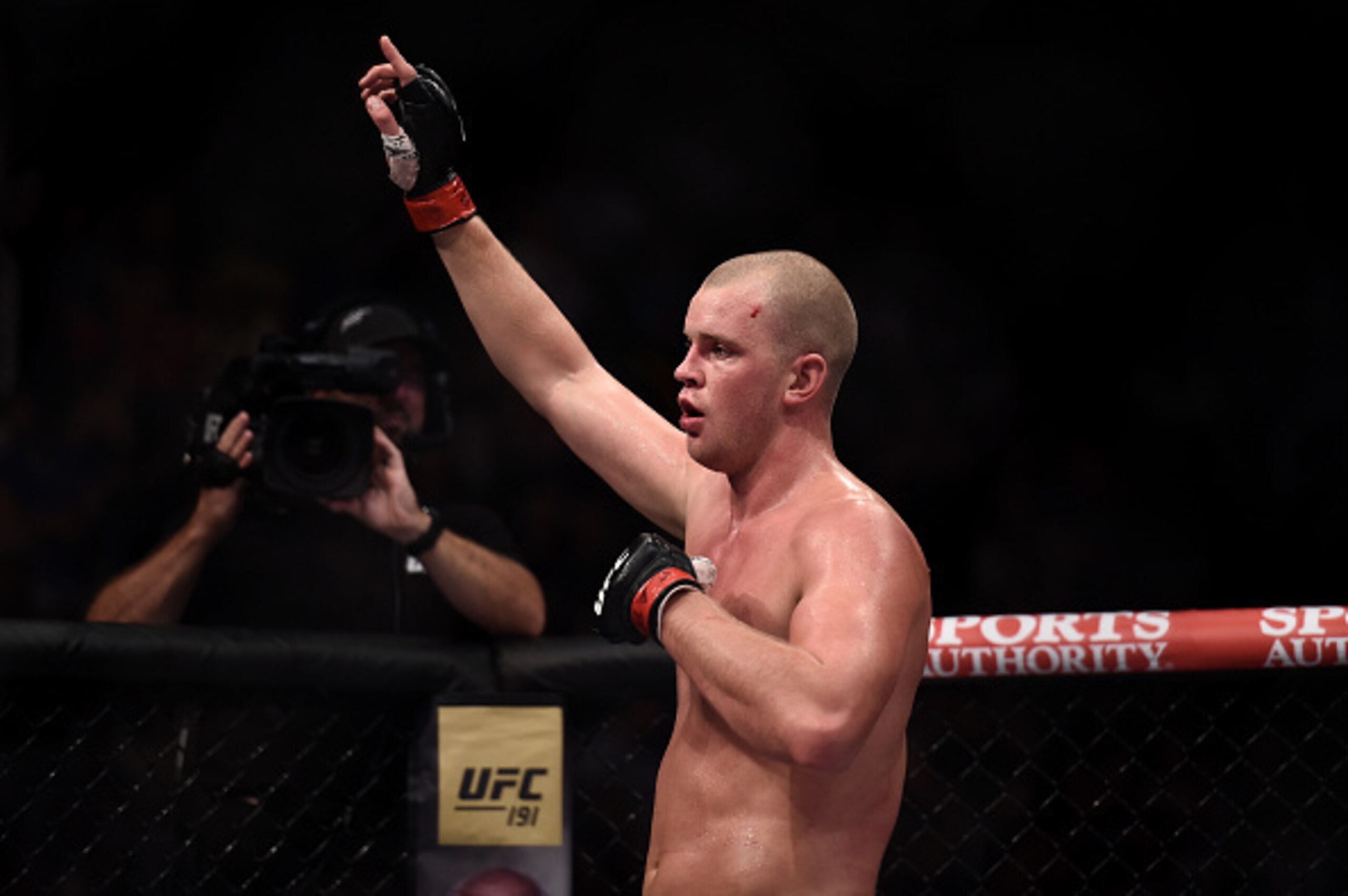
Heavyweights
Stefan Struve (30-7; 10-5 UFC) vs. Jared Rosholt (13-2; 5-1 UFC)
A solid heavyweight matchup opens the main card as Dutch veteran Stefan Struve takes on former Oklahoma State wrestler Jared Rosholt. Struve went through a series of issues, including being diagnosed with a heart condition, suffering a broken jaw, experiencing a layoff of nearly two years and suffering two consecutive knockout losses. The 27-year-old finally got back on track with a decision win over Antonio Rodrigo Nogueira in August, nearly three years after his last victory.
Rosholt rebounded from his first loss in the UFC—a first-round knockout to Alexey Oleinik—with a pair of victories in 2015. He finished Josh Copeland in the third round in March and then took a decision win over Timothy Johnson in August.
The winner will be a consensus top-10 heavyweight, with bigger things looming on the horizon in a rapidly aging division.
After years of committing to firefights in the pocket that minimized his enormous reach advantage, the 7-foot Struve is finally learning to effectively use his length under the tutelage of Henri Hooft and the Blackzilians. Where his rangy tools—jabs, snapping front kicks and hard round kicks—were once occasional afterthoughts, they're now the bread and butter of his approach.
His footwork is still iffy, and he doesn't circle off the cage with enough urgency, but he's improved massively. The big Dutchman now sticks and moves with some regularity and only occasionally plants his feet to throw surprisingly powerful punching combinations. Don't let his awkwardness fool you: Struve can crack, and he's legitimately dangerous.
The problem is defense. Even when he tries to stay on the outside and doesn't commit to brawling in the pocket, he's terribly hittable and has a bad habit of moving backward in straight lines without moving his head.
If his opponent gets inside his reach, Struve is happy to dive into the clinch. His height gives him tremendous leverage on the double-collar tie, and he throws devastating knees, but it's a disadvantage versus opponents who can push him against the fence and secure a body lock.
Defensive wrestling has never been Struve's strong suit, and prior to his last several fights, he was one of the worst in the UFC. He's much better now, with solid head pressure and limp-legging against single legs and good balance in the clinch, and if taken down, he excels at scrambling back to his feet. He offers nothing as an offensive wrestler.
On the mat, Struve is quite dangerous. He loves the triangle-armbar-sweep series from his back, and in the past he has been far too willing to play guard. On top, he drops bombing ground strikes, passes with aplomb and has a variety of topside submissions.
While Rosholt has made improvements to his other skills, he remains a wrestler first and foremost. His strikes come as single punches and kicks after leaping into range from a great distance, which limits his volume and leaves him vulnerable to counters. He isn't comfortable in the pocket, and his punches serve mostly as distractions from his takedowns.
Once he gets his hands on his opponent, Rosholt is suffocating. The three-time All-American chains together singles, doubles, knee taps and trips as he pushes his opponent against the fence, and while not a clean finisher, it's almost impossible to escape.
His control game mixes wrestling rides and more traditional top control with solid passes, hard ground strikes and an array of topside-submission attempts.
Rosholt isn't terribly dangerous in any phase, with limited power on the feet and a limited submission game, but he's a solid grinder who is making real strides.
Betting Odds
Struve (-135); Rosholt (+115)
Prediction
There are two real possibilities in this fight. In the first, Rosholt exploits Struve's questionable defensive wrestling skills and controls him on the ground and against the fence long enough to win a decision. In the second, Struve's improvements in his range striking keep the tentative, hittable Rosholt at distance either until the Dutchman lands a knockout strike or until the final bell for a decision.
The second scenario seems more likely. Rosholt seems to have lost his confidence in his range striking, and he doesn't have the kind of dangerous power that has spelled doom for Struve in the past. The pick is Struve by decision with a strong possibility of a knockout.
Uriah Hall vs. Robert Whittaker
4 of 7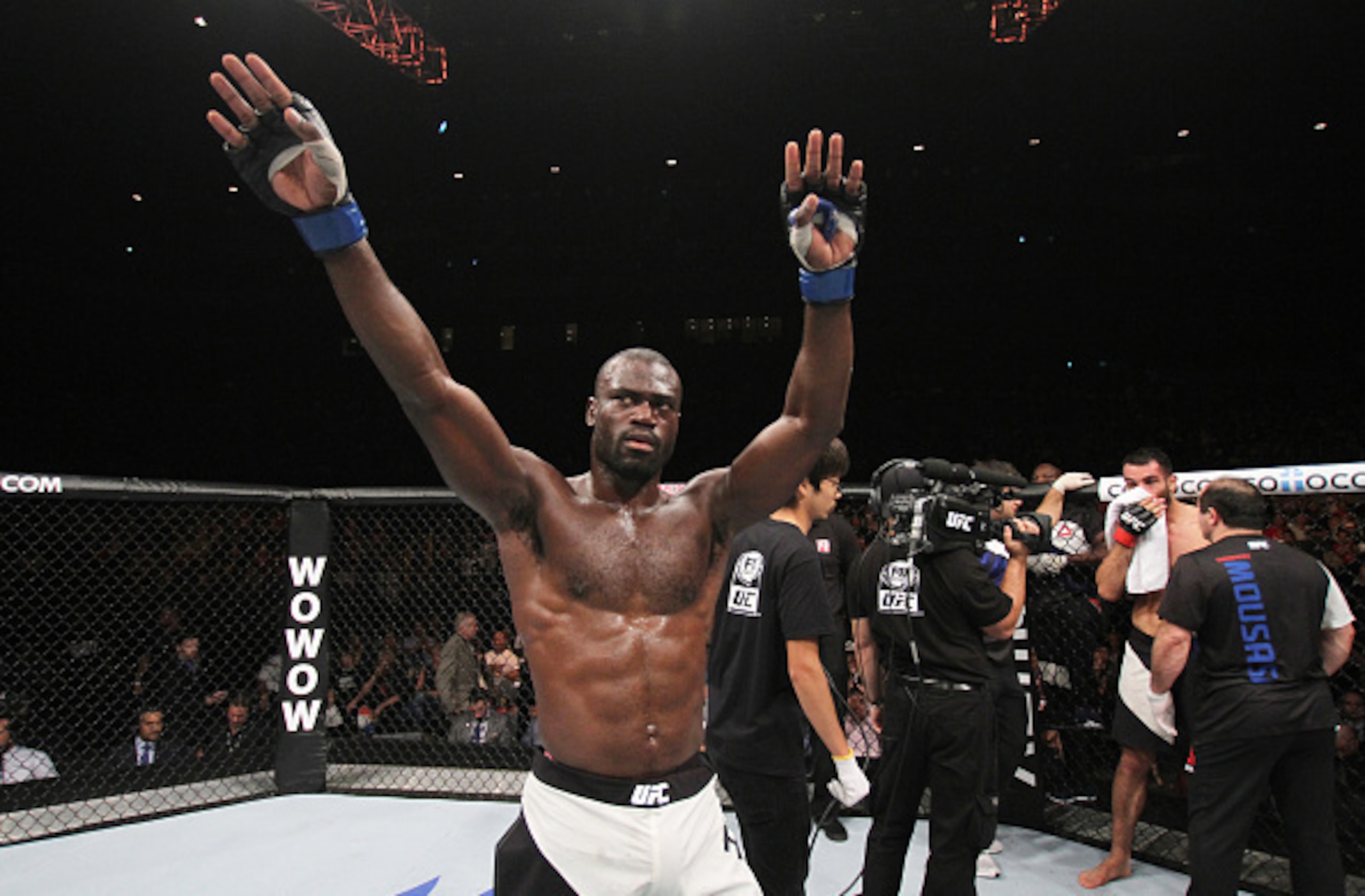
Middleweights
Uriah Hall (13-5; 5-3 UFC) vs. Robert Whittaker (14-4; 5-2 UFC)
Uriah Hall steps in on short notice to replace Michael Bisping for his fifth UFC appearance in 2015. The New Yorker is coming off by far the biggest win of his career, a spectacular jumping spinning back kick followed by a flying knee against Gegard Mousasi only six weeks ago. Prior to that, he knocked out Oluwale Bamgbose and lost a close decision to Rafael Natal.
Standing across the cage from Hall will be Australian resident and The Ultimate Fighter: The Smashes winner Robert Whittaker. The former welterweight is still only 24 and has settled in nicely at 185 pounds with a pair of devastating knockouts over Clint Hester and Brad Tavares.
This should be a fantastic fight with real stakes on the line. The winner will secure a spot as a top-10 middleweight and as new blood in a rapidly aging division.
Whittaker is in the process of becoming a special striker. His powerful, quick hands are the centerpiece of his approach, and he consistently works behind a stiff jab as he circles, cuts angles and attacks. The left hook is his money punch, which he throws as a lead off the threat of the jab as a backstepping counter to cover his retreat and, most devastating, as a counter in the pocket.
When he finds his rhythm, Whittaker is lethal. He works at a quick pace, routinely throwing 20 or more strikes in a minute and puts together smooth three- and four-punch combinations that he occasionally punctuates with kicks. An organic striker, he throws around, over, under and through his opponent's guard and mixes in elbows to take advantage of a defensive shell.
Despite his lack of height at 185 pounds, Whittaker fights long. The jab sets the distance and so too does a steady diet of front and round kicks. Although he often commits to exchanging in the pocket, he is an excellent defensive fighter, coupling smooth head movement with parries and a tight guard.
The rest of his game ranges between solid and outstanding. Whittaker is an ace defensive wrestler, and offensively, he has a lovely and authoritatively finished blast double that he could afford to use more often. He's not a special grappler, but he is competent from top position and is difficult to hold down.
Like Whittaker, Hall is a striker by nature, but a very different one. An extraordinary athlete with great speed and power, he flicks out a steady diet of front and round kicks at range and uses a piercing jab as he circles and moves in the center of the cage. He's a gorgeous counterpuncher with a clean, powerful straight right.
The flashy aspect of his game lies in his array of spinning kicks: wheel kicks, spinning back kicks, spinning hook kicks and jumping spinning back kicks to the head are all in his arsenal, and he throws them with great accuracy and timing. The occasional flying knee complements his kicks and punches.
The rest of Hall's approach has improved dramatically. He's an excellent defensive wrestler and has a superb double leg of his own, and from top position his strikes are brutal. It's harder to control him from the top, and his defensive grappling has become competent at the very least.
Hall's issue has always been urgency. An out-fighter who prefers to operate in the center of the cage, he simply doesn't react well to consistent pressure. He has trouble maintaining his volume against aggressive opponents and gives away rounds and entire fights waiting for the perfect shot, rather than a succession of good ones. He's hittable, particularly when backing up, and relies too much on distance for defense.
Betting Odds
Hall (-140); Whittaker (+120)
Prediction
While Hall is a slight favorite, likely by virtue of his recent success and more superficially dangerous striking arsenal, Whittaker is the better fundamental striker. He throws more, he has more efficient and effective footwork and he's a drastically better boxer in the pocket. Moreover, this is Hall's fifth fight in 2015; one has to wonder whether that will take a toll on his body.
Barring the kind of strike that felled Gegard Mousasi, Whittaker's versatile and precise footwork, greater volume and sharp counterpunching should be enough to net him the win here. The pick is Whittaker by decision.
Antonio Silva vs. Mark Hunt
5 of 7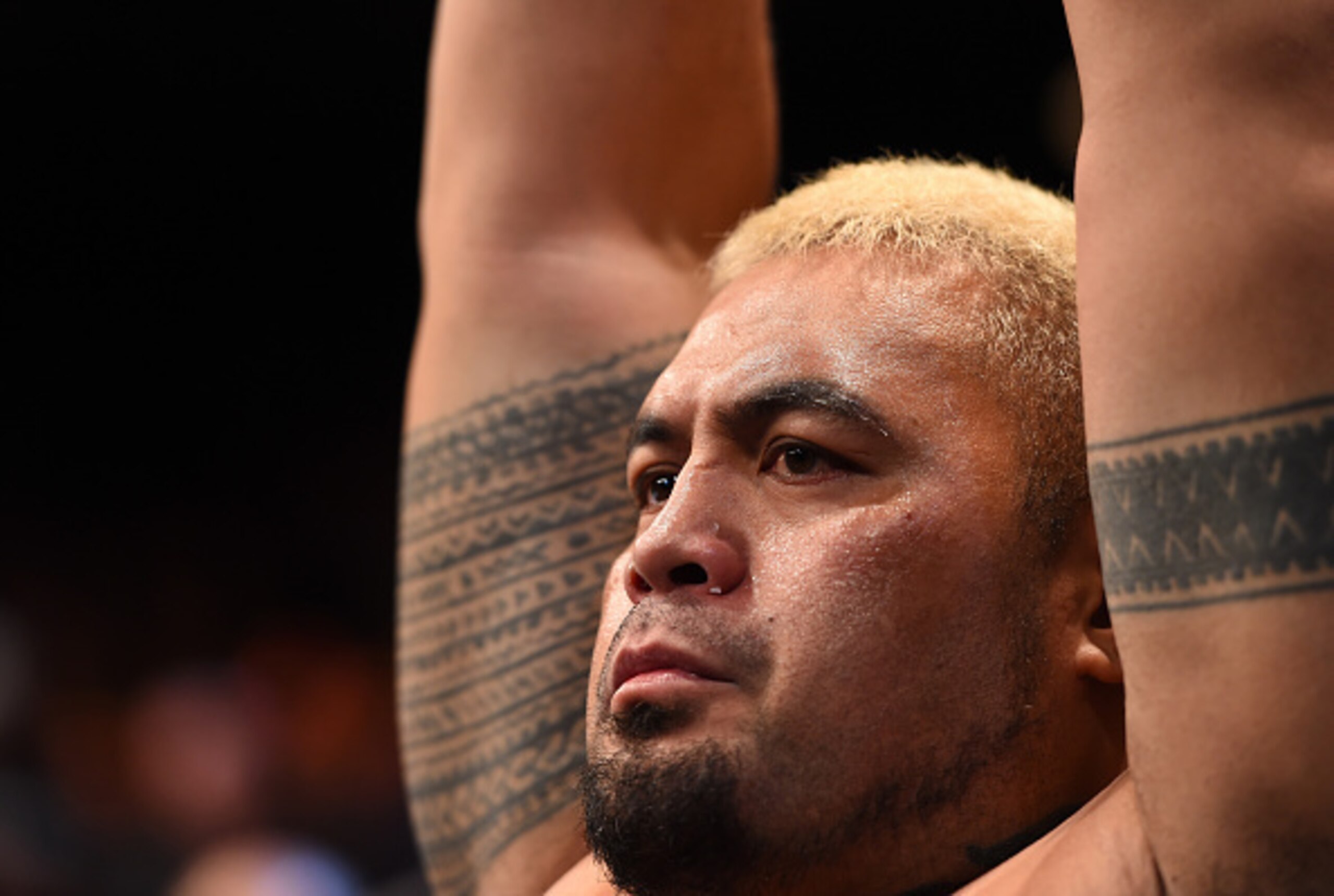
Heavyweights
Antonio Silva (19-7-1; 3-4-1 UFC) vs. Mark Hunt (10-10-1; 5-4-1 UFC)
Mark Hunt and Antonio Silva meet in a rematch of one of the best heavyweight fights of all time. Their matchup in December 2013 was a five-round war that ended in a draw, and it was something of a high-water mark for both fighters; since then, the two are a combined 2-4, with all four of those losses by knockout.
The Brazilian got back on track with a knockout win over Soa Palelei in August, but prior to that he looked downright terrible against Andrei Arlovski and Frank Mir. Hunt knocked out Roy Nelson in September 2014, but then he fell to a Fabricio Werdum flying knee in November, and in May, Stipe Miocic brutalized him in a one-sided beating.
In the thin heavyweight division, no fighter is more than two fights from a title shot, so there are still real stakes involved here. One hopes, however, that the 41-year-old Hunt would use a win as an impetus to retire, while Silva likewise shouldn't be long for the sport.
Despite his advancing age and obvious physical decline, Hunt remains an exceptional athlete with shocking quickness, ridiculous strength and huge power in his hands. He fights long despite standing only 5'10", working behind a punishing jab and strong low kicks. The left hook is his bread and butter, and he throws it as a leaping lead, a check hook and as a backstepping counter. His right uppercut is forceful and well-timed.
The real strength of Hunt's game lies not in the variety of strikes he throws or even his power, but instead it's in his crafty and layered approach. His timing is outstanding, and he's exceptionally accurate with his power punches. He also excels at changing speeds, showing a slow jab or right hand and then whipping the left hook at full force in the same way a baseball pitcher follows a changeup with a fastball.
Hunt's takedown defense is above-average, and his low center of gravity makes it difficult to get in on his hips for shots. If taken down, he excels at scrambling, but as he tires, he offers progressively less in both categories.
Formerly a pure striker, Hunt has an explosive and authoritative double leg that he uses from time to time. From the top, his power carries over into thunderous ground strikes, and while not an outstanding grappler, he is quite sound.
Age has affected Hunt in two clear ways. First, his formerly iron chin has cracked, and he can't eat the kinds of shots he once shrugged off. Second, and perhaps more important, it's grown harder for him to work himself into the kind of shape necessary to fight at pace for extended periods. He looks to be in excellent shape for this fight, though, after going vegan and reportedly dropping more than 40 pounds.
Silva was forced to discontinue testosterone-replacement therapy—due to a serious pituitary condition, he was one of the few fighters with a legitimate case for it—following the first fight with Hunt, and he didn't look like the same fighter against Mir and Arlovski. Without making any assertions, it suffices to say that he looked much more like his old self physically against Soa Palelei in August.
When he's on, as he was against Palelei, Bigfoot is a surprisingly diverse and dangerous fighter. While not quick per se, he moves better than his size would suggest, and he flicks out a nimble array of front, side and round kicks. The one-two is his bread and butter, and he packs brutal force in his right hand.
While he is technically competent and powerful at range, his striking is at its most effective when it carries him forward into the clinch. The Brazilian is ridiculously strong and has a nice array of trips that he mixes with strong knees and control against the fence. Defensive wrestling is a strength, and he can hit the occasional shot takedown.
As serviceable as he is on the feet and in the clinch, Silva does his best work from the top. He has an unshakable base, surprisingly smooth and technical passes and unleashes some of the hardest ground strikes in the sport. His control is stifling, and few can survive under him for more than a couple of minutes.
Betting Odds
Hunt (-255); Silva (+215)
Prediction
Both fighters' physical decline and Silva's hormone levels make this a difficult fight to predict. Will we get the Hunt who fought five hard rounds against Silva the first time or the one who gassed in seven minutes in his last two outings? Will we see the Silva who looked depleted against Mir and Arlovski or the one who had pep in his step against Palelei? It's difficult to tell beforehand.
Hunt is and should be the favorite, though. Silva's chin hasn't improved, and neither have his takedowns. If this scenario stands, the former K-1 champion should have a substantial advantage. The pick is Hunt by second-round knockout.
Joanna Jedrzejczyk vs. Valerie Letourneau
6 of 7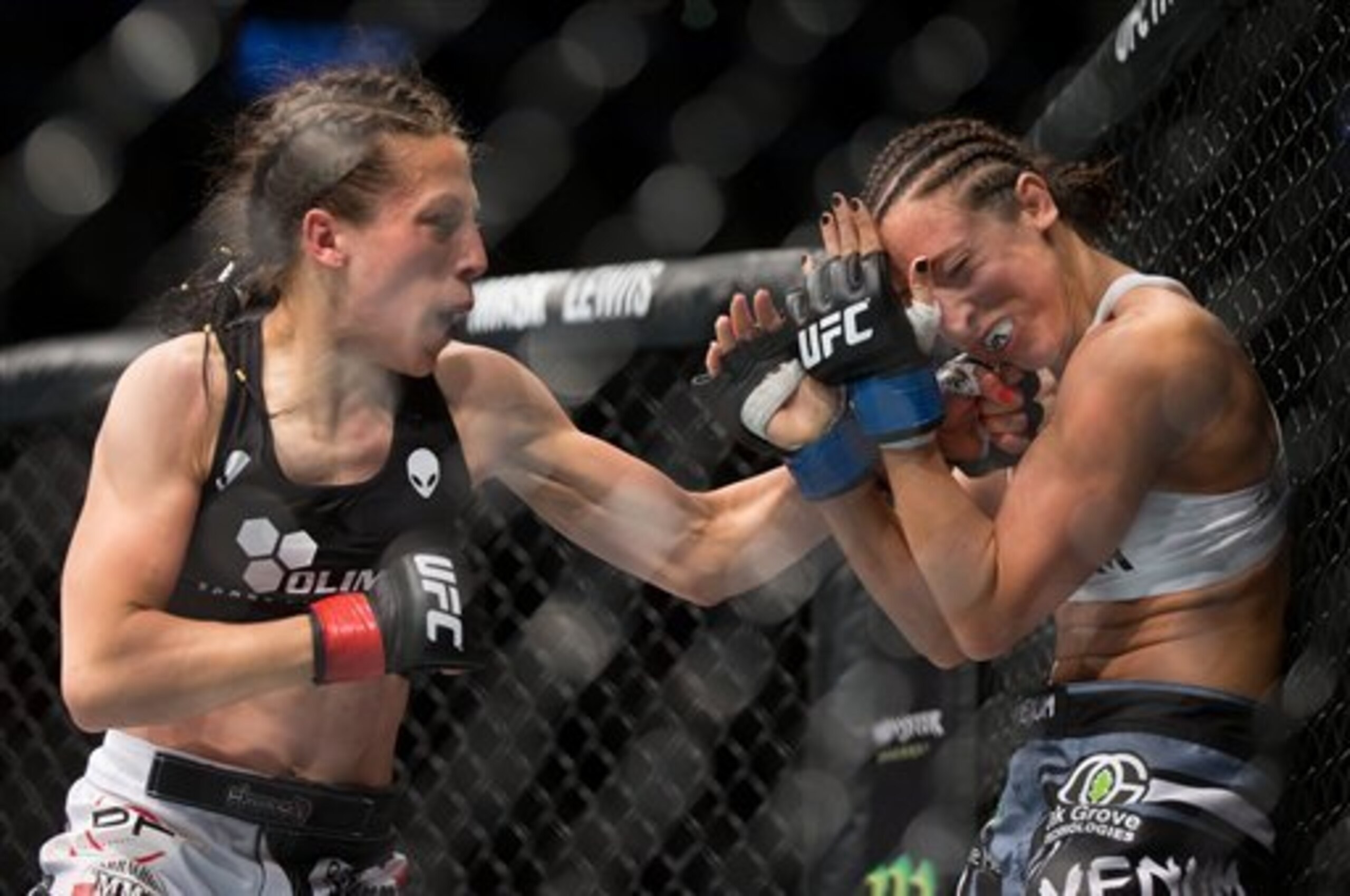
Women's Strawweight Championship
Joanna Jedrzejczyk (10-0; 4-0 UFC) vs. Valerie Letourneau (8-3; 3-0 UFC)
Strawweight champion Joanna Jedrzejczyk makes the second defense of her title against Canada's Valerie Letourneau in a solid bit of last-minute matchmaking. Claudia Gadelha was initially supposed to be Jedrzejczyk's opponent, but an injury forced the reshuffling, and the Canadian was in the right place at the right time and presented the right stylistic matchup.
Jedrzejczyk, a native of Poland and former kickboxer, burst onto the scene with an upset win over Gadelha last December. She then upset the first strawweight champion, Carla Esparza, in a dominating performance in March. Jessica Penne was Jedrzejczyk's first title defense, and to put it bluntly, the champion beat the crap out of her for three rounds until the referee mercifully stopped the proceedings.
Her style is exceptionally entertaining, even to women's bantamweight champion Ronda Rousey.
"She's not a point-fighter," Rousey said, via UFC on YouTube. "She's all about being completely dominant at all times. And, she really ties everything together so well that it's not like you're watching a brawl. You're watching really high-level problem-solving."
Letourneau, a product of American Top Team, is 3-0 in the UFC and has won both of her fights since making the difficult cut to 115 pounds. An upset win over Maryna Moroz in August secured the title shot.
It's hard to see this as anything other than a fight designed to grant Jedrzejczyk some of Rousey's fame on a card headlined by the women's bantamweight champion. There's nothing wrong with that, but the oddsmakers have little faith in Letourneau's ability to put up a real fight.
Letourneau is a striker by trade—and a better one than she's getting credit for at the moment. She likes to fight on the outside and works behind a crisp jab and front kick. She then moves in behind the straight right-left kick or vice versa.
The Canadian counters nicely in the pocket, usually with the straight right, and has a quick trigger. Lever-punching, where she follows one right hand immediately with a second right, is another tendency. Her left hook is an excellent punch, particularly as a counter; she could stand to throw it more often.
Letourneau is defensively sound at range and is rarely there to be hit, but in the pocket, she relies far too much on her toughness and willingness to throw rather than good head movement and a tight guard. Pace is a strong suit, and she works quickly.
The rest of the American Top Team product's game is solid. She has a nice double-leg and inside trip and is competent in the clinch, but she excels in neither phase. Aggression with strikes, passes and submission attempts characterize her ground game, but she often gives up position and doesn't have a great base on top.
Jedrzejczyk is one of the best MMA strikers, regardless of gender or weight class, and has a strong claim to being the very best. She spent years training under Ernesto Hoost, one of the all-time great Dutch kickboxers and a multiple-time K-1 Grand Prix champion. Her game has drawn comparisons to Chuck Liddell, but even in his prime, the Iceman could only dream of being as technically sound as Jedrzejczyk.
The Pole can do it all on the feet. A piercing jab is her bread and butter, and she uses it to impose her height and reach advantages and move her opponent's hands and head around. Once she has established her longest punch, the champion goes to work with smooth, powerful head-body combinations of two to five punches. Her hands are exceptionally quick, and her mechanics are almost perfectly efficient.
The champion's command of striking intangibles is off the charts. Her shot selection is organic and adaptive as she works around, under and through her opponent's guard. Her understanding of distance is outstanding, and she changes speeds beautifully. She's equally comfortable pressuring, working counters off the back foot or operating in the pocket.
As she grows more comfortable with her already-outstanding takedown defense, Jedrzejczyk has added more kicks to her arsenal. Along with the jab, a consistent front kick to the head and body helps to set the distance, and she has begun to punctuate her punching combinations with vicious Dutch-style round kicks to the legs, body and head.
It's difficult to overstate how good Jedrzejczyk's defensive wrestling has become. Her hips are incredibly strong, her sprawl is outstanding and her balance in the clinch is exceptional. It's not just that the champion stuffs takedowns; she uses elbows and knees to punish her opponents for having the temerity to even try in the first place.
To top it all off, Jedrzejczyk works at one of the best paces in the sport. She routinely throws more than 20 strikes per minute and sometimes goes above 30 as she gets her rhythm. Nobody in the division can keep up with her, and yet she manages to stay defensively sound with clean head movement, angles and command of the distance.
Betting Odds
Jedrzejczyk (-2150); Letourneau (+1300)
Prediction
This is a huge mismatch. Letourneau is a striker with a few ancillary skills, and Jedrzejczyk is miles beyond her both physically and technically. The American Top Team product will try to mix things up with wrestling, but her takedowns aren't good enough to get it to the mat, and on the feet she's badly outmatched.
Letourneau is durable and reasonably technical, and she'll make Jedrzejczyk work for a brief while. Once the champion finds her timing and her range, however, it's all over. The pick is Jedrzejczyk by a brutal second-round knockout.
Ronda Rousey vs. Holly Holm
7 of 7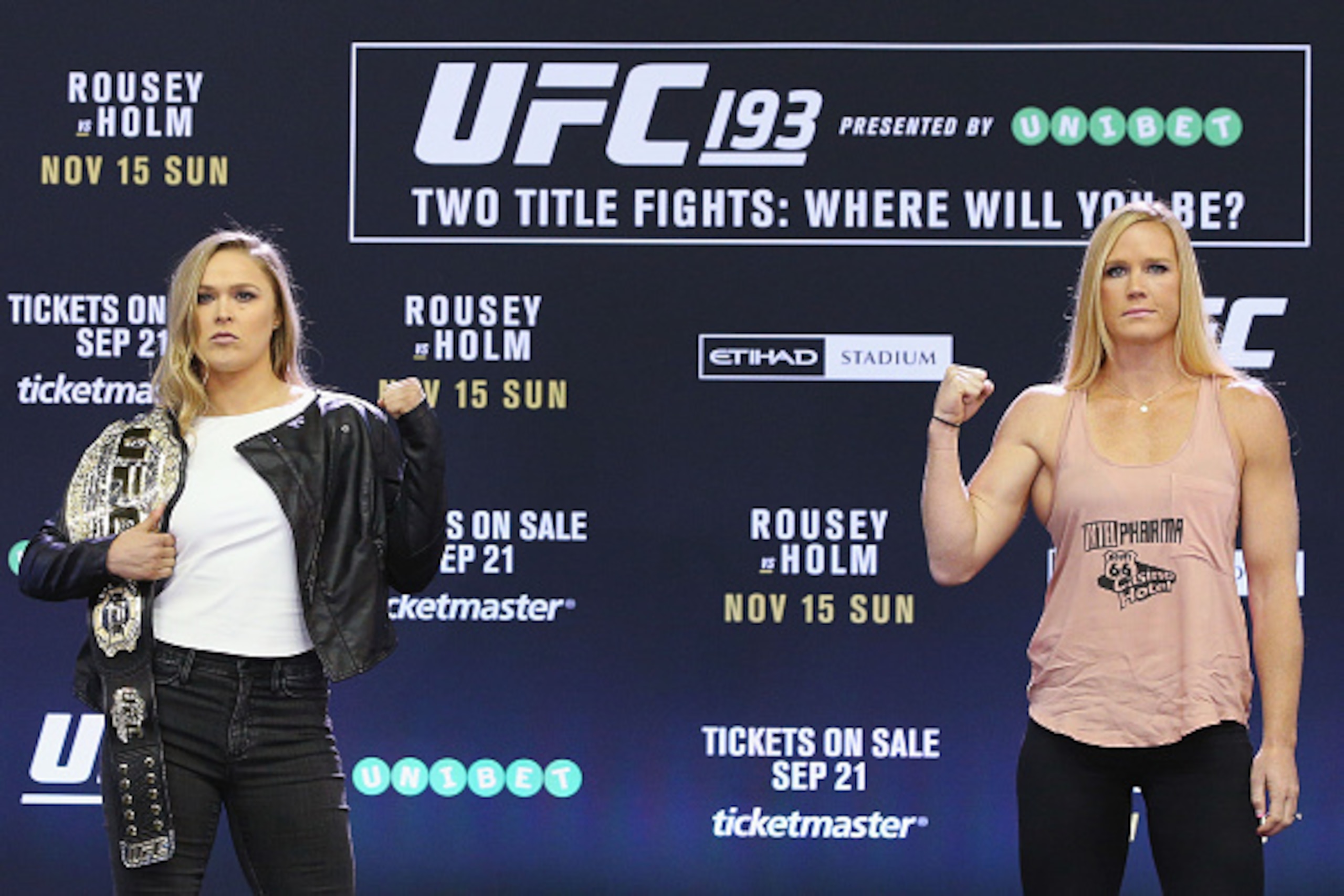
Women's Bantamweight Championship
Ronda Rousey (12-0; 6-0 UFC) vs. Holly Holm (9-0; 2-0 UFC)
Women's bantamweight champion Ronda Rousey makes the seventh defense of her title against former boxing champion Holly Holm in the evening's main event. The champion has rolled through her last four opponents in a combined 130 seconds, most recently Bethe Correia in August, but Holm's striking pedigree might give her a better chance.
Might.
The former boxer has been somewhat underwhelming in two UFC appearances, despite the enormous amount of hype with which she entered the promotion. She beat Raquel Pennington in a close fight in February and then suddenly seemed to remember how much better she was than Marion Reneau in the middle of the fight. She has yet to finish a UFC opponent.
For Rousey, this fight is yet another step on the ladder to cementing herself as a viable superstar draw across the planet. Holm isn't expected to be competitive, and even surviving out of the first round would probably count as a win for her.
Holm, for her part, has little interest in observers telling her about the odds.
"I am sick of hearing, 'Do you think you can win?'" she said to the Washington Post's Rick Maese. "Like, who takes a fight going, 'I don’t think I can win. I'm just here.' I don’t understand that."
She presents an interesting stylistic challenge. The challenger is a pure southpaw striker who prefers to fight on the outside. Despite her boxing background, she relies heavily on kicks and uses a steady diet of front kicks, oblique kicks to the legs and lead-leg side kicks to the leg and body to set and maintain her preferred distance.
When she commits to it, which is rare, Holm has a crisp, clean jab, but the cross is her preferred and most useful punch. Still, her mechanics are somewhat off and usually involve her throwing her weight forward into the punch. Her MMA arsenal takes advantage of what would normally be an issue by following the straight left with right kicks in a blitzing, forward-moving attack.
While not a serious power threat, Holm is dangerous, since the combination of the straight left and left kick creates opportunities for both. If the opponent slips to avoid the straight, she's ducking into the high kick. If she reaches out to parry the straight, she's opening her guard to a high kick. If she pins her hands to the side of her head to defend the kick, the straight is open down the middle. Either way, the body kick is open.
Constant movement, solid angles and working at the longest possible range make Holm a tough opponent to trap against the fence. She has great raw foot speed and a long, rangy frame, and that too makes it difficult to get the fight out of her wheelhouse.
Thus far, Holm's other skills have been competent. She's strong in the clinch if not offensively gifted, her takedown defense has been good and her command of space and distance makes it difficult to get a real shot on her in the first place. We know little about her ground game.
The champion's hallmark is aggression. Everything about her game is predicated on forward movement and pressure, and she has built a coherent, fluid game that transitions neatly from phase to phase around that aggressiveness.
Rousey works her way forward behind a stinging jab and decent, if not outstanding, pressure footwork. If her opponent has the guts to plant her feet and fire back, the champion is happy to exchange shots, banking more on her durability, speed, natural power and solid punching mechanics than technical skill in the pocket. She's hittable, but nobody has been able to hit her hard enough to give her pause.
Her physical gifts are truly off the charts, and while she has yet to show consistent and sharp pressure footwork, her raw speed and athleticism make it difficult for her opponents to get out of the way. She's on them in a flash, and her powerful punches detract from the fact that Rousey is really only trying to grab hold so she can work her clinch game.
The tie-ups are Rousey's wheelhouse. Her judo background gives her a dizzying array of takedowns, from foot sweeps to hip tosses to trips and dozens of variations of each, and she complements that threat with vicious elbows and knees. Worry too much about the takedowns and you're liable to eat a series of knees to the liver; worry too much about the strikes and you'll go flying through the air.
Rousey describes her style in the clinch as a chain of multiple options. As she said to Lance Pugmire and Priya Krishnakumar of the Los Angeles Times.:
"It's hard to describe the way I'm thinking. I have this action and so many reactions that can come from that. They pick one and I have so many answers. I have an answer to this one and there's so many reactions to that answer. I know the reactions that make sense and I'm prepared for the ones that don't.
"
On the mat, Rousey is effectively a sprint grappler rather than a methodical type of top player. She looks to land in dominant positions and immediately transition to the armbar, or if her opponent tries to scramble, she looks to find the submission in those transitions.
If it's not there immediately, she'll simply stand up and work another takedown rather than force an extended grappling exchange.
Betting Odds
Rousey (-1900); Holm (+1200)
Prediction
Rousey is a massive favorite and with good reason: She has been unbelievably dominant, while Holm has neither the finishing tools to give her pause on the feet nor the wrestling and grappling pedigree to win those exchanges against an Olympic Judoka.
What Holm can do, however, is make the fight ugly and frustrate the champion. Rousey's pressure footwork isn't outstanding, and Holm has decades of experience at sticking and moving. She works at such long range that the champion will have some issues getting inside and staying there, and Holm is competent enough to break off the clinch a time or two and scramble if taken down.
Holm has fought in that vein many times in the past, and her coaches—Mike Winkeljohn and Greg Jackson—have successfully trained elite fighters for precisely that game plan before. This is essentially the same strategic puzzle that Carlos Condit-Nick Diaz posed three years ago.
The challenger can't do that forever, however, and eventually Rousey will either catch her with a big punch or, more likely, Rousey will work a takedown and catch the submission. It's unlikely to be highly entertaining before that.
The pick is Rousey by third-round submission.
Patrick Wyman is the Senior MMA Analyst for Bleacher Report. He can be found on Twitter.
All betting odds via Odds Shark.


.jpg?w=2560 "Raiders Could Start Mendoza")


.jpg?w=2560 "Rodgers Iced Out on Plane 💎")

.jpg?w=2560 "🚨 Week 8 AP Top 25 Poll")
.jpg?w=2560 "Packers Safety Slams Refs 🤬")

.jpg?w=2560 "Fantasy Waiver Wire Stars 🤩")