Tim Sherwood's Tactical Blunders Giving Aston Villa Itchy Trigger Finger
Tim Sherwood was parachuted in as Aston Villa’s saviour on February 14, 2015, tasked with steering the storied English club clear of the Premier League drop zone—a zone they had become all too familiar with in recent seasons.
Years spent narrowly evading its grasp under Alex McLeish and then Paul Lambert had worn on the club, the fanbase and the players. Sherwood burst through the door, promised change and briefly delivered, but Villa have once again seceded back into the relegation places and have mustered just four points from eight Premier League games in 2015-16.
The job Sherwood did from February to May deserves praise and recognition; there are not many men in football who could have lifted the spirits of such a downtrodden group of players and inspired them to win close to 50 percent of their remaining matches. The former Spurs boss ducked into the trenches and roused his troops at the pivotal hour, but now the charm has worn off, it’s clear his men are doubting him.


Sherwood has committed a slew of managerial errors this season, frequently botching XI selections or in-game tactical decisions. Supporters have grown frustrated with his seeming inability to simply pick his best players in a starting lineup—a feeling vindicated after watching the man himself spend most games trying to repair his own errors using precious substitutions.
Over the last two months he’s dropped three clangers that have directly cost Aston Villa between three and nine points, and every mistake brings a heap of pressure.
The Crystal Palace Debacle
In late August, Villa visited Selhurst Park to take on Crystal Palace on a steaming-hot afternoon. With three points in the bag after the opening weekend, a narrow loss to Manchester United the week before excused as “typical” and Jack Grealish re-entering the XI after spending just over a month struggling with injury, things were looking rosy.
That day, Sherwood opted to play a 4-4-2 diamond—a wise choice—with Grealish at the tip, Carlos Sanchez at the base and Gabby Agbonlahor partnering Rudy Gestede up front. Eagles manager Alan Pardew admitted to journalists after the game that his side struggled with the system Villa used initially, failing to settle on the ball or attack.

The base midfield three here is of particular note: Sanchez is your prototypical anchor, he’s perfect for it, and the Idrissa Gueye-Ashley Westwood partnership just ahead of him provided legs, energy and tactical balance. It was, for all intents and purposes, the ideal midfield for an away Premier League game; it had enough about it in every aspect to thrive on a battleground like Selhurst Park.
For context, a point here for Villa would have been a very good result. There was no need to try to force a win; the approach Sherwood originally chose was working a treat. Sanchez, arguably the game’s best player, broke up play in demonic fashion, and his colleagues performed a simple role: give the ball to Grealish and let him weave forward.
But Sherwood’s attacking itch got the better of him, and he introduced Adama Traore in the 69th minute—a flying winger—at the expense of Sanchez. Within seconds, Palace waltzed straight through the centre of the pitch—the area Sanchez had just vacated—drew a centre-back out of position and forced a corner. From the delivery, Scott Dann powered home the opener with a wicked header.
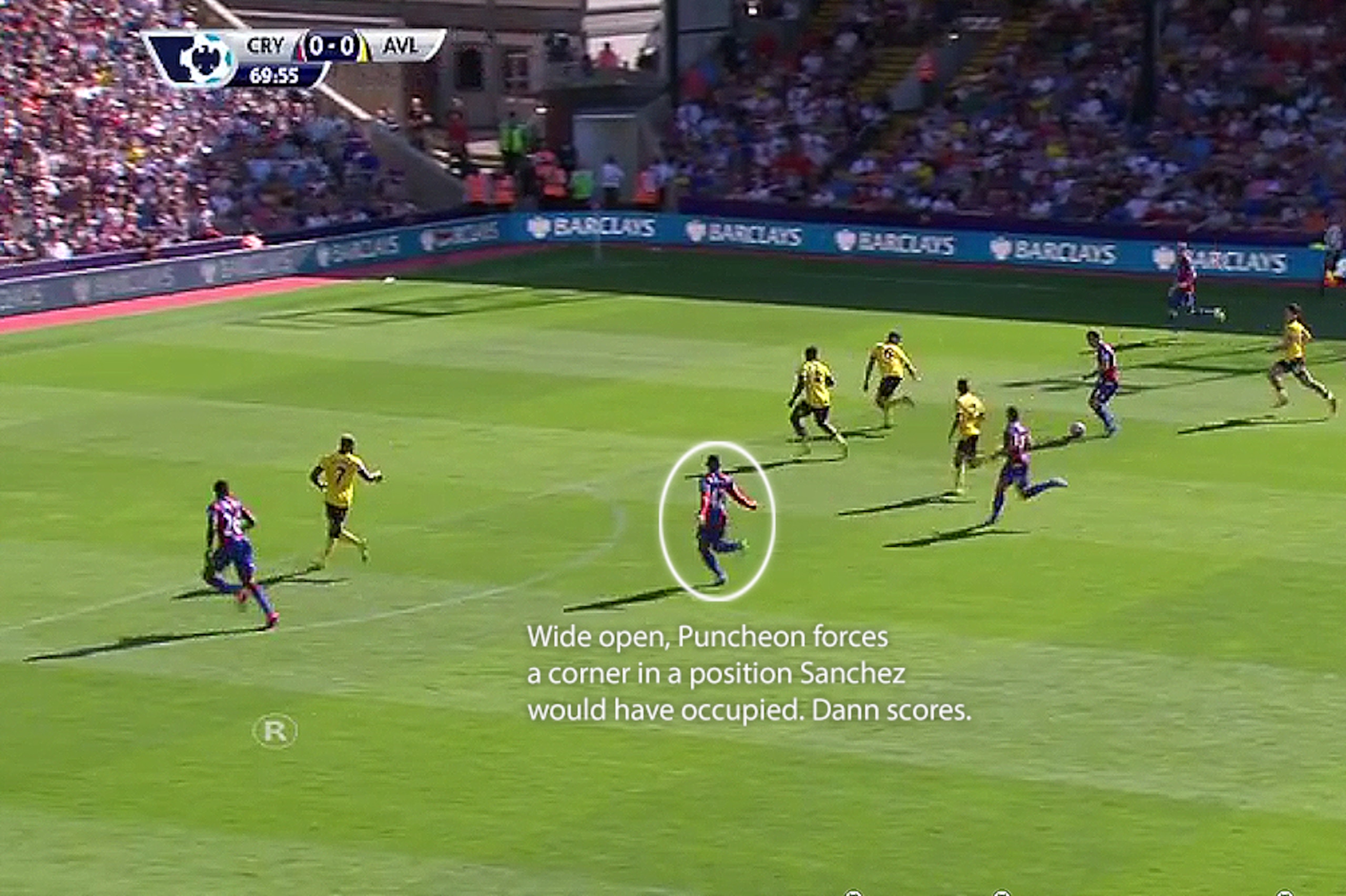
Sherwood will try to hang his hat on the fact Adama forced an equaliser almost immediately, searing past two players and causing Pape Souare to stab into his own net, but the truth is, the back end of Villa’s midfield was wide-open for the rest of the game. Palace sauntered up the pitch with ease following Sanchez’s removal, and their eventual winning goal via Bakary Sako certainly felt inevitable.
In the final minutes, as Villa chased a recovery, Sherwood opted not to use any more substitutes, despite it becoming clear Grealish could barely run due to muscle stiffness—an expected side effect of missing an entire pre-season and the first two league games. €20 million pair Jordan Ayew and Jordan Veretout sat motionless on the bench as Sherwood watched on.
The Leicester City Collapse
Two goals to the good against a flying Leicester City side, thanks to lovely strikes from Grealish and Carles Gil, sparked the away section of the King Power Stadium into full voice. There was just over an hour played, with two goals in the bag against a Midlands rival—what could possibly go wrong?
Strange decisions and strange substitutions sparked a downfall of epic proportions. The Foxes completed a brilliant comeback as Nathan Dyer netted the winner in the 89th minute, and credit to them for finding the cutting edge, but Sherwood held up the white flag and surrendered those points in alarming fashion.
At 2-0, Villa brought on Ayew for Gil—a classic trade of guile and silkiness for brawn and power. Sinclair moved right to help track the marauding Jeffrey Schlupp, and Ayew took the left side, tracking Ritchie De Laet. So far, so good.

But then De Laet scored (from a corner), and Leicester nosed their way back into the game. Sherwood panicked and brought on Gestede up front, likely intended as a focal point, but also shifted the formation away from 4-2-3-1 to 4-3-3—which meant bringing Grealish inside to a No. 8 role.
Grealish has an abundance of qualities and is one of the pre-eminent young attacking talents in the league, but he’s not strong enough or disciplined to track runs and jockey markers from a flat central-midfield position. Leicester began burning past him and targeting his pocket of the pitch to instigate attacks, and they were handsomely rewarded.
All the while, Veretout—a snappy, aggressive, hardworking No. 8—again sat on the bench. Even Kieran Richardson would have been a better shout, but he remained motionless on the pine, too.
The Stoke City Catastrophe
On October 3, fans filed loyally into Villa Park ahead of their side’s clash with Stoke City, hoping and praying for a result of any kind.
Given the fixtures that awaited them after the winter break—Chelsea away, Swansea City at home, Tottenham Hotspur away, Manchester City at home, then Everton away—they knew a point here, at the very least, was of paramount importance.
They garnered none.
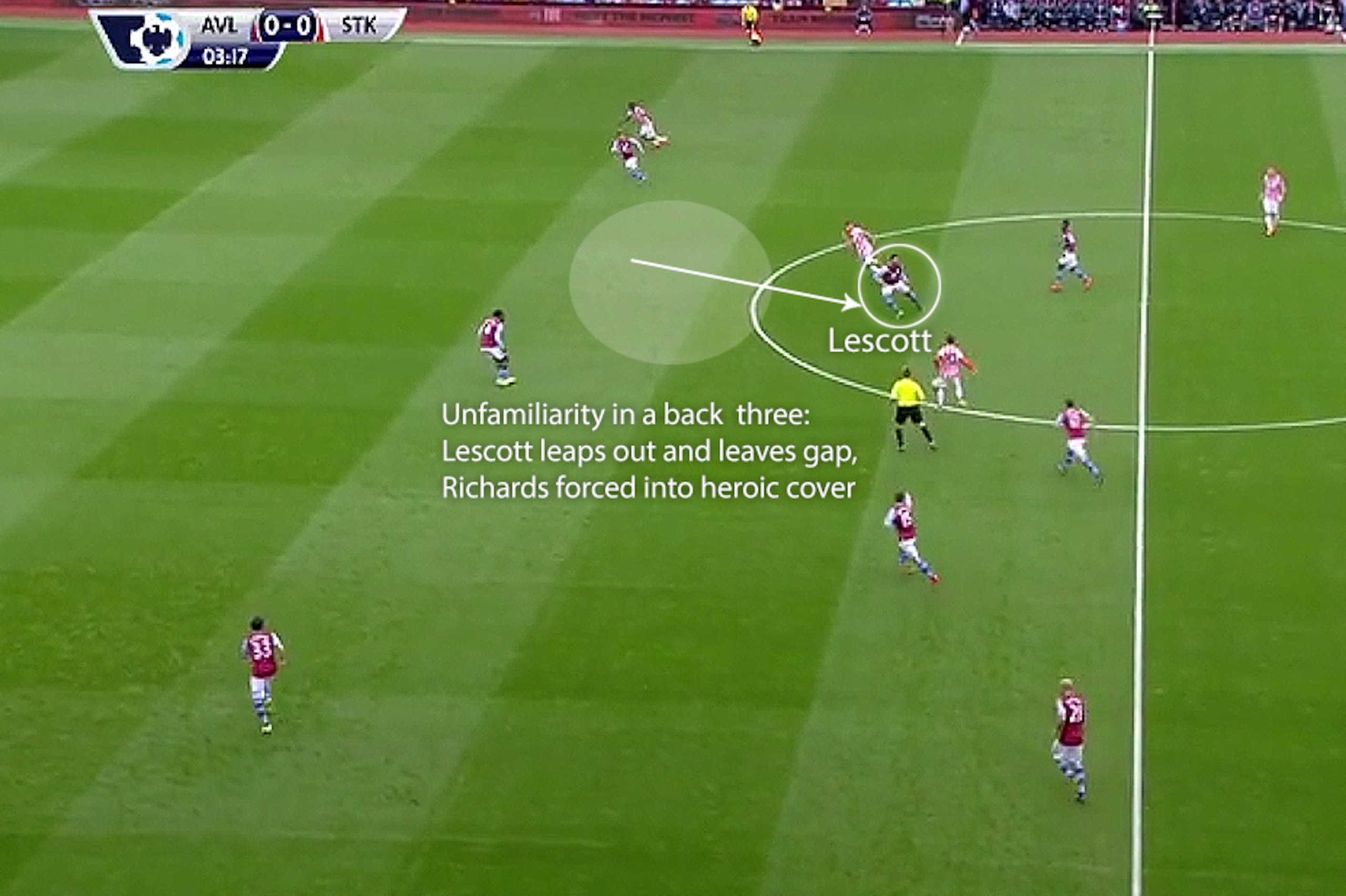
For this match, Sherwood deployed a 3-5-2 formation—the first time the team have played it under his stewardship, discounting a reserve pre-season game in which Aleksandar Tonev played and scored.
Fans recoiled in surprise upon realising this—the system evokes unwelcome memories of bland, atrocious football under predecessor Lambert—and it didn’t turn out much better in practice.
The key issue here was the disconnect between Gestede, a powerful target man, and his supporting “width.” In a 3-5-2, the wing-backs provide all of the width and play a byline-to-byline role; they have to be able to dribble, track and, most importantly (if you’re playing with Gestede), cross the ball well.
Why, then, did Sherwood opt for Alan Hutton over Leandro Bacuna on the right—a player tailor-made for the right-wing-back role? The wide men were overwhelmed anyway; Hutton and Jordan Amavi were hit two-on-one most times, couldn’t cope defensively due to the numbers and found it tough sledding moving forward.

Gestede has proved to be an aerial monster, but his technical level leaves a lot to be desired, necessitating a good, skilful player be paired with him up front in order to play through the middle. Scott Sinclair has his virtues, but he wasn’t the right choice for the role. Fans saw Sinclair toiling, being dispossessed frequently, and pointed with exasperation to Grealish and Gil, who were sat on the bench kicking their heels.
Under Pressure
Sherwood has brought some good players to the club, and the squad is stacked with talent, but it’s being misused.
Doubts are now swirling as to whether Villa can afford to hold onto the man who saved them last season past October—the Daily Mail’s Matt Lawton recently outlined just how precarious his position is—and the feeling is that, had the next fixture following the international break been at Stamford Bridge, chairman Randy Lerner would have already acted.
Sherwood’s been bitten by the loss of key men Ron Vlaar, Fabian Delph and Christian Benteke, while injuries to Gil, Grealish, Jores Okore and Adama have also stung. But as credible as those issues are and as heavily as they have impacted the start to the season, he piles pressure on himself by making bad decisions.

For example: Why does Joleon Lescott continue to play ahead of Ciaran Clark? The former has started every game since joining on deadline day despite severely underwhelming, while the latter—undeniably one of Villa’s better players this season—has been relegated to the bench.
That’s just one of many conundrums engulfing the club, and fans are beginning to tire of questioning almost every aspect of decision-making taken by Sherwood.
The ice is paper-thin, and unless the boss pulls a rabbit out of the hat at Stamford Bridge, he might be gone soon.
It’s a shame, as Sherwood eschewed his reputation as a “4-4-2 attack merchant” last season and brought real spark and ingenuity to the team’s play.
All that good work has been forgotten, though, and the next few weeks serve as a platform for him to either fly or die as manager of Aston Villa.

.jpg?w=2560 "Colts Football")

.jpg?w=2560 "NFL House in Paris Closes for Protests (AP)")


.jpg?w=2560 "Malik Beasley Negotiating Plea Deal (AP)")