

Even in Defeat, Marcus Mariota Provides Optimism for Future of Tennessee Titans
When you have arguably the greatest debut a rookie quarterback has ever had, it's inevitable the following performance will be more of a disappointment.
Marcus Mariota found this out in Week 2 against the Cleveland Browns. The Tennessee Titans quarterback followed up his four-touchdown, 209-yard passing performance against the Tampa Bay Buccaneers with a two-touchdown, 257-yard performance against the Browns.
Although those raw numbers are still impressive, they came on more than double the pass attempts and with some fumbles.

Of all the criticisms of Mariota during the draft process, the most legitimate was ball security. He had 27 fumbles in three seasons at Oregon. Against the Browns, he had three fumbles with one more that a late delay-of-game penalty negated.
In Week 1, Mariota was able to get rid of the ball quickly and didn't have to hold it against pressure. In Week 2, he was put in the completely opposite situation. Not only were the quick throws not as easily available, but his offensive line was consistently overwhelmed to the point that he didn't have time to do anything comfortably.
The Titans lost their best offensive lineman during the first half—right guard Chance Warmack—but even before then the line was struggling. The Titans couldn't comfortably move the ball on the ground to ease the pressure on Mariota either.
When they did successfully run, they gained big yardage on outside runs with Dexter McCluster.
While Mariota's fumbles were an issue that can't simply be ignored, it would be unfair to point to his losing the ball four times and suggest it is reflective of his skill set. In truth, two of the fumbles weren't avoidable. They were plays that would likely have resulted in fumbles against any quarterback.
Unsurprisingly, the two fumbles that weren't Mariota's fault came during the final two minutes of the game.

Having an offensive line so overwhelmed that it is incapable of preventing quick pressure against a four-man rush with an extra blocker puts huge pressure on the quarterback. Finding an outlet for the ball that quickly is often impossible because your receivers are outnumbered downfield.
That was what happened for Mariota's first fumble during the final two minutes of the game.
His eyes were looking downfield in such a way that cornerback K'Waun Williams was coming from his blind side. Mariota reacted to his arrival late because he never saw him, giving Williams an opportunity to punch the ball in his grasp.
Mariota could have been quicker to evade the defender, but the more realistic expectation would be for him to cover the ball and protect it. Considering the Titans were chasing the game at this point, that wasn't an option either, though.
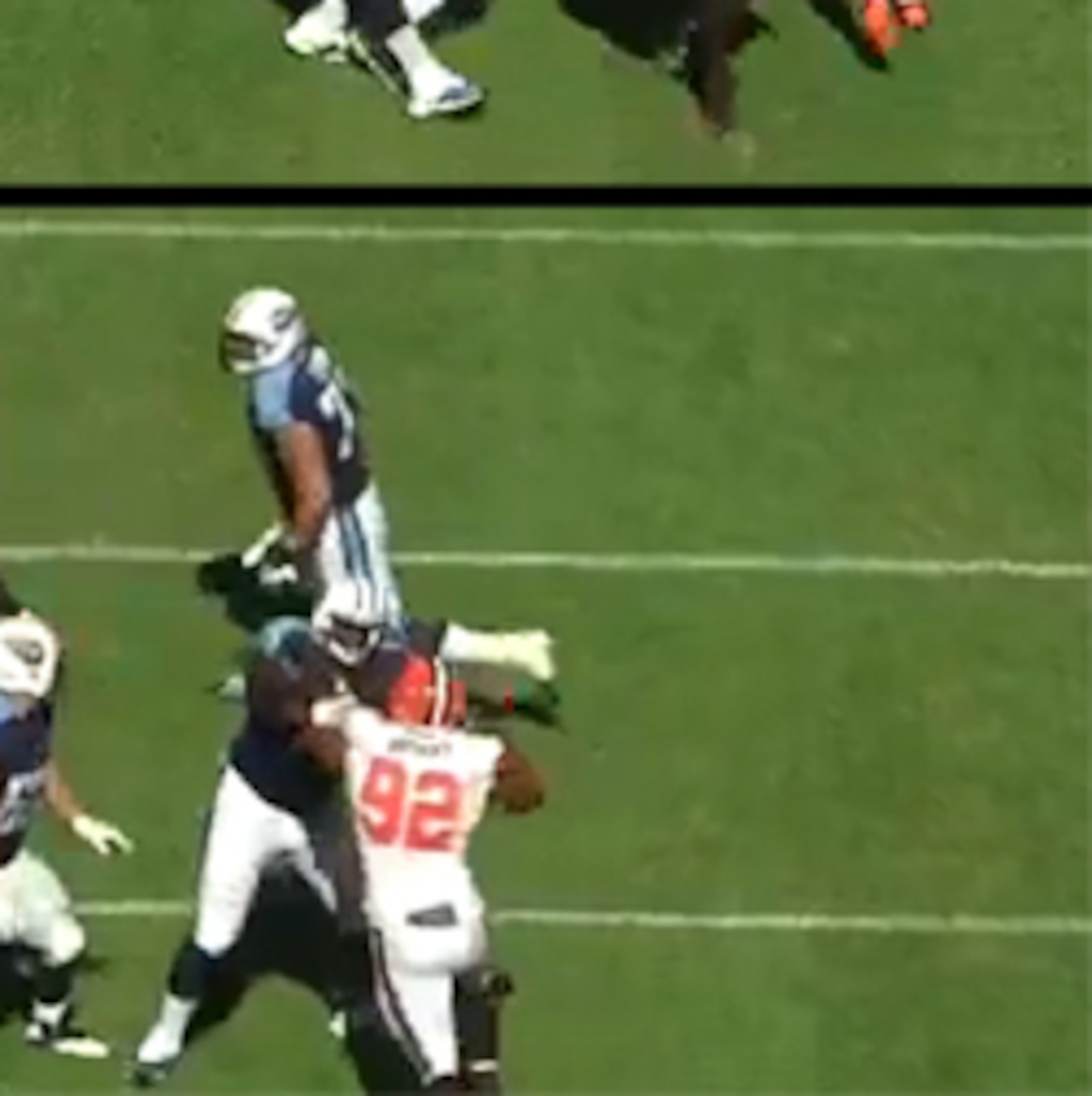
For his final fumble, Mariota was again hit on his blind side. This time it came in a more typical manner as his left tackle was beaten at the snap. Taylor Lewan appeared to blow his assignment as his eyes were drawn to the defensive tackle, and he set inside rather than dropping backward.
As the top of the above image shows, Lewan's shoulders are quickly facing the complete opposite direction to his teammates. This is because he is immediately trying to recover his positioning.
The Titans would have had a chance at a touchdown if Lewan had executed his block effectively. Instead, Mariota was hit from behind just as he began his throwing motion to find Kendall Wright on a double-move route deep downfield.
Mariota's other two fumbles were a result of him carrying the ball in one hand.
While it would be unrealistic to mark this off as something the coaching staff can fix simply, it is something it should be able to work on over time. Encouraging the quarterback to use both hands when possible isn't like teaching him how to read progressions or react to pressure in the pocket.
It's much more simplistic than that. Mariota only needs to apply himself often enough to alter his approach; it's not something that requires excess talent or years of work to refine.
The fumbles were more headline-worthy because of Mariota's past and because they are essentially turnovers from the quarterback's point of view even if they go unrecovered by the defense. More significant a criticism from this game should be about Mariota's accuracy.
The 21-year-old missed a number of throws he would expect to make. Late in the game he overshot two sideline routes. Those plays are less of a concern at this point of his career than the shorter passes are.
Coming out of college it was clear Mariota needed to refine his deep ball. He wasn't a bad deep passer or a weak-armed quarterback, but his ball placement needed to be more consistent. Where he excelled in terms of accuracy was on short and intermediate passes.
His connections on shorter passes in Week 1—particularly with Kendall Wright—highlighted this. In Week 2, his miscues reminded everyone he is still a developing player.

During the first quarter, the Titans called a play that is going to be a staple of their offense with Mariota moving forward. It is a packaged play where Mariota has the option to pull the ball and pass or hand it off to the running back depending on what the defense does.
On this play, Mariota pulls the ball because he sees the linebackers coming forward aggressively. This leaves wide-open space for Dexter McCluster running the slant route.

A free linebacker approaching Mariota from the middle of the field forces the quarterback to arc the ball more than he would want to, but he still should have hit McCluster in stride. Instead, he pushes his pass too far forward and completely misses the running back.
Had he completed this pass, it would have been an easy first down.
That was his most blatant miss, but potentially his worst throw of the game came when he was looking for Harry Douglas on a pass to the sideline. Douglas was blanketed by Tramon Williams in coverage, but Mariota tried to fit the ball to him outside.
When Williams turned around with Douglas at the top of his route, the ball arrived just inside of the cornerback. He dropped the pass, but it should have been an interception on a pass that was nowhere near where it needed to be.
While Mariota's accuracy was concerning throughout this game, he showed off elements of his skill set many suggested he didn't have during the draft process. Mariota didn't wilt against the constant pressure, nor did he run out of the pocket without good reason on a regular basis.
During the draft, Mariota was regularly labelled as a system quarterback. The term is ambiguous but essentially suggests he can't work from the pocket.
To work from the pocket a quarterback has to show off footwork and awareness to mitigate pressure while being able to read defenses at speed. Mariota played in a system at Oregon that wasn't similar to most NFL offenses, but he was still tasked with making reads and moving in the pocket.
Against the Browns, under the kind of pressure the Titans offensive line was consistently giving up, Mariota worked from the pocket.
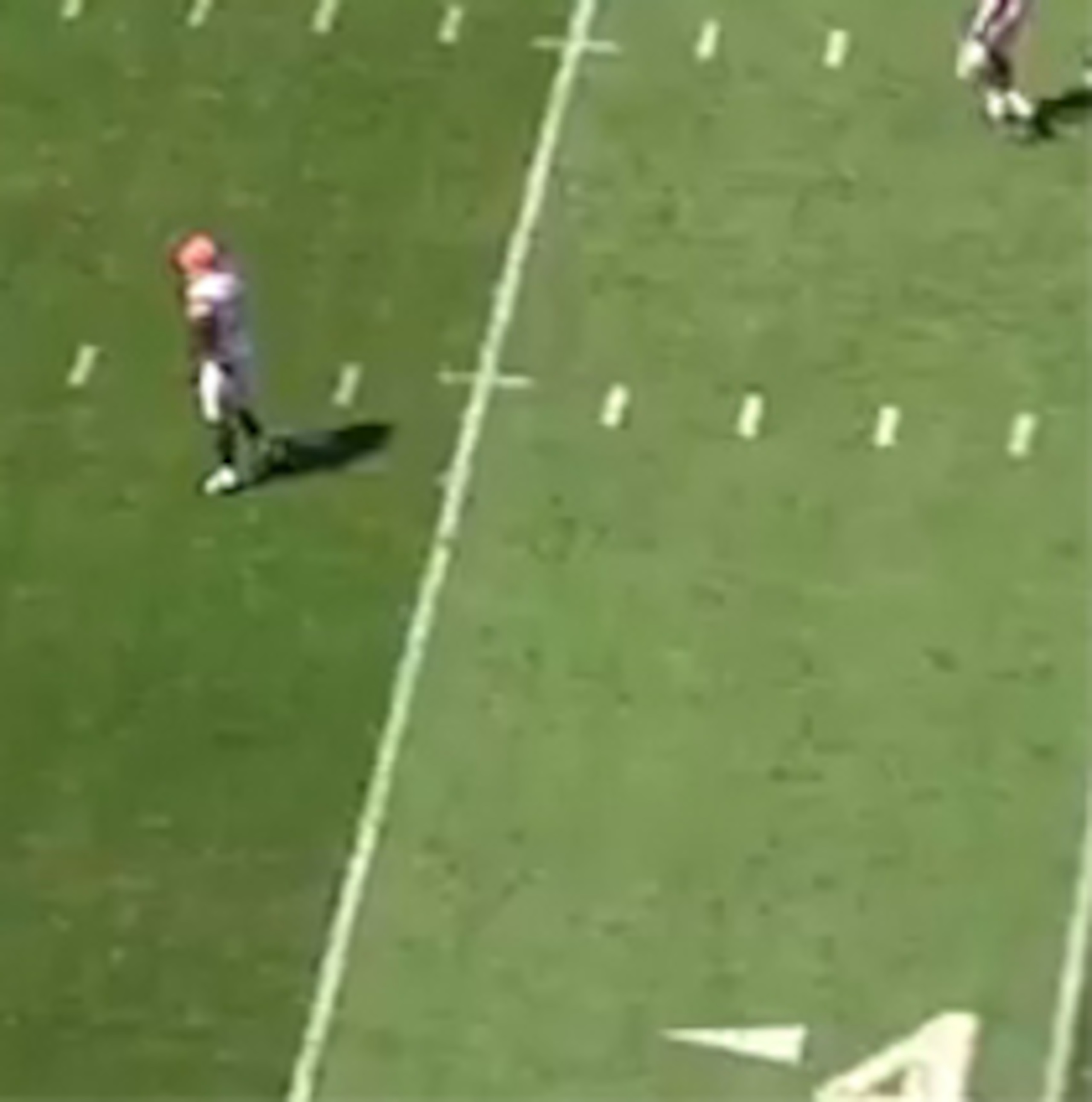
As was often the case, Mariota was facing a long third down in this situation. It was 3rd-and-7 deep in Titans territory. The Titans spread the field with four players in receiver positions; one is a tight end in the right slot.
The Browns aren't moving defenders around the line of scrimmage, but they are masking their intentions by being so aggressive in their alignment up front while keeping both safeties deep.

When the center snaps the ball, the Browns send five defenders after Mariota in the pocket. The quarterback has time to establish himself and look to his left, where he has two receivers running complementary routes. Wright is running a short curl route, while Justin Hunter runs downfield.
On the other side of the formation, the Titans have rotated a safety down to play man coverage against the tight end.
It's clear that Mariota comes off his first read and locates his tight end on the backside of the play. However, when you look closer at the movement of his helmet and the positioning of his shoulders as he sets and resets his feet in the pocket, it appears he actually progresses through three receivers.
His initial look is to Wright on the shorter route, a route that wouldn't gain a first down unless the defensive back played it poorly. His second went to Hunter down the sideline, and his third came back across to his tight end.

Most importantly, the quick decision Mariota made was the right decision. He recognized the deep safety coming across the field to cover Hunter and understood his backside tight end was open against man coverage with a clean throwing lane to attack.
While doing that, he made a subtle adjustment in the pocket.
This was one of the few plays when Mariota's pass protection held up initially, but it inevitably began to crumble. From his blind side, because he was looking to his left, Mariota felt the pressure coming in from the right side.
He maintained his balance and kept his eyes downfield as he shuffled forward to deliver the ball from a clean space between his tackles.
If this play doesn't fit your system, then your system is the problem, not your quarterback. Mariota has always possessed the ability to make progression reads and adjust in the pocket. He may have played in a quarterback-friendly system in college, but he wasn't reliant on it.
Late on when the Titans desperately needed a big play, Mariota delivered again.

On 4th-and-6, Mariota comes off his first read quickly. He would have had an opportunity to throw the ball to his deep corner route, but chances are he knew where he was going as soon as he saw it was man coverage to that side of the field.
Mariota brought his eyes back to the other side of the field, where he had one underneath receiver and one receiver running a deep in route from the outside.
The speed at which Mariota releases the ball has been well-documented. In the top part of the above image, Mariota is actually in the middle of pump-faking the ball. Before the incoming defender can touch him, he brings the ball back and releases it cleanly with his incredible speed.
Mariota's pump fake was designed to draw the underneath linebacker forward. It worked.
Although the quarterback may not necessarily have needed to keep the linebacker from staying at the depth he wanted to stay at, it gave him a wider throwing lane. Mariota was able to place the ball in a spot where his receiver, Dorial Green-Beckham, could reach up to pull it in for a touchdown.
Mariota put this ball in a spot where the trailing defensive back couldn't get it and took a hit in the pocket from the edge defender as soon as he released it.
Because of who Mariota is and his reputation during the draft, there will be skepticism that he meant every movement he made on this play. It's impossible to get inside of his head, so the only way to judge this element of quarterback play is by looking at consistency.
If the quarterback does this every so often, it's likely just luck. If he is doing it with regularity, then he has a clearly defined process.
Many top prospects who leave college enter the NFL and are incapable of making these types of plays for their first full season. Some never develop the consistency or even the ability to make these types of plays. Mariota can't prove his consistency over the first two games of his career, but he has proved his ability.
The Titans understand that. Not only are the coaches and players all saying the right things publicly, but it is also reflected in how head coach Ken Whisenhunt has set up his offense. He has made some adjustments to help his rookie, but he isn't being overly protective.
Much like Teddy Bridgewater last season, Mariota has largely been thrust into the starting role without limitations.
Without a strong running game or dominant defense to rely on, the Titans can't be overly cautious with Mariota. They may be using screen passes, option runs and rollouts, but those plays have been pieces of the offense rather than the foundation of it.
In short, the coaching staff has found the perfect balance between simple design for short-term success and tough exposure for long-term growth.
Mariota is going to be inconsistent, and there will likely be some disastrous displays behind that offensive line. Yet, even without reading too much into a small sample, the early signs suggest he can be a high-quality starter in the NFL.
Then again, he could just be a product of Whisenhunt's system.

.jpg?w=2560 "Rams Eagles Football")

.jpg?w=2560 "Grading WWE Raw 🔠")


