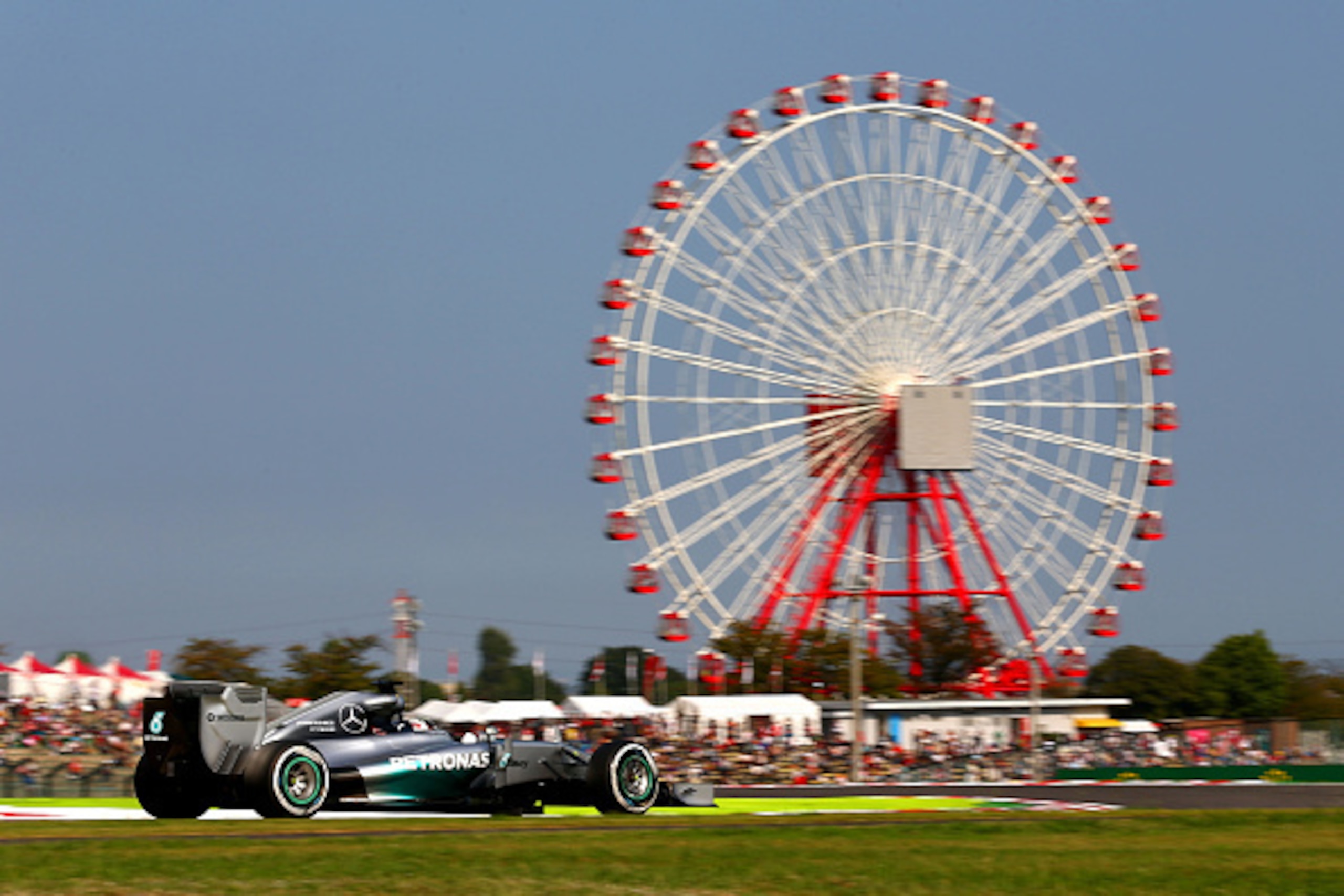

Japanese Grand Prix 2015 Preview: Start Time, TV Times, Weather, Schedule, Odds
Just one week after the competitive order was turned on its head in Singapore, Formula One arrives at Suzuka for the 2015 Japanese Grand Prix.
All eyes will be on Mercedes as they seek to reassert their dominance, but away from the track, the thoughts of many will be with the family and friends of Jules Bianchi. The young Frenchman suffered severe head injuries during last season's Japanese race and died in July this year.
For the Manor Marussia and Ferrari teams especially, it'll be a very emotional weekend.
Sebastian Vettel is the current driver with the most wins in Japan, streets ahead of his rivals with a total of four. Lewis Hamilton and Fernando Alonso have each won two Japanese grands prix while Kimi Raikkonen and Jenson Button have one victory apiece.
Nico Rosberg will be looking to add his name to the list of winners this weekend, but his hopes—and those of Hamilton, Vettel and Raikkonen—will hinge on whether Mercedes can get their season back on track.
We'll find out on Sunday if they can. Fast, flowing Suzuka couldn't be more different to the slow, tight Marina Bay circuit—if Ferrari are on top again here, the guard will truly have changed.
Read on for a full preview of the weekend ahead, including a circuit map and detailed guide, TV times, session times, tyre and DRS information, current standings, weather and odds.
Current Drivers' and Constructors' Standings
1 of 6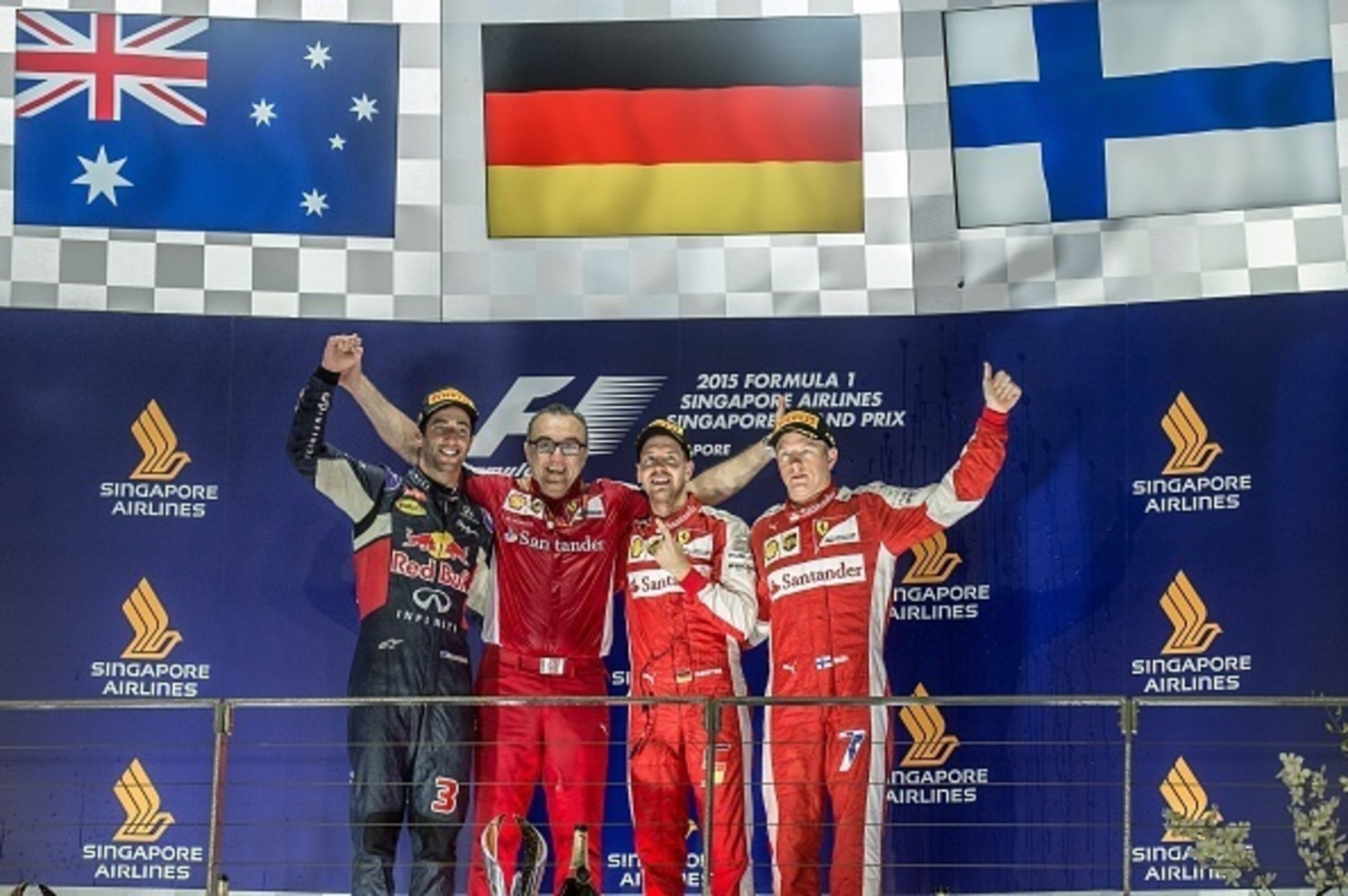
Sebastian Vettel's victory in Singapore moved him to within 49 points of championship leader Lewis Hamilton.
Valtteri Bottas is up to fifth after team-mate Felipe Massa failed to score, and Daniel Ricciardo is back on top at Red Bull.
The current top 10 drivers are:
| 1 | Lewis Hamilton | 252 |
| 2 | Nico Rosberg | 211 |
| 3 | Sebastian Vettel | 203 |
| 4 | Kimi Raikkonen | 107 |
| 5 | Valtteri Bottas | 101 |
| 6 | Felipe Massa | 97 |
| 7 | Daniel Ricciardo | 73 |
| 8 | Daniil Kvyat | 66 |
| 9 | Sergio Perez | 39 |
| 10 | Romain Grosjean | 38 |
Mercedes only scored 12 points in Singapore and saw their lead in the constructors' championship cut to 153 points. The Jaws music is playing at Williams as Red Bull edge ever closer, while Force India, Lotus and Toro Rosso are all in with a shot of taking fifth.
The current constructors' standings are:
| 1 | Mercedes | 463 |
| 2 | Ferrari | 310 |
| 3 | Williams | 198 |
| 4 | Red Bull | 139 |
| 5 | Force India | 69 |
| 6 | Lotus | 50 |
| 7 | Toro Rosso | 41 |
| 8 | Sauber | 26 |
| 9 | McLaren | 17 |
| 10 | Manor | 0 |
Data sourced from the official F1 website.
Suzuka Circuit
2 of 6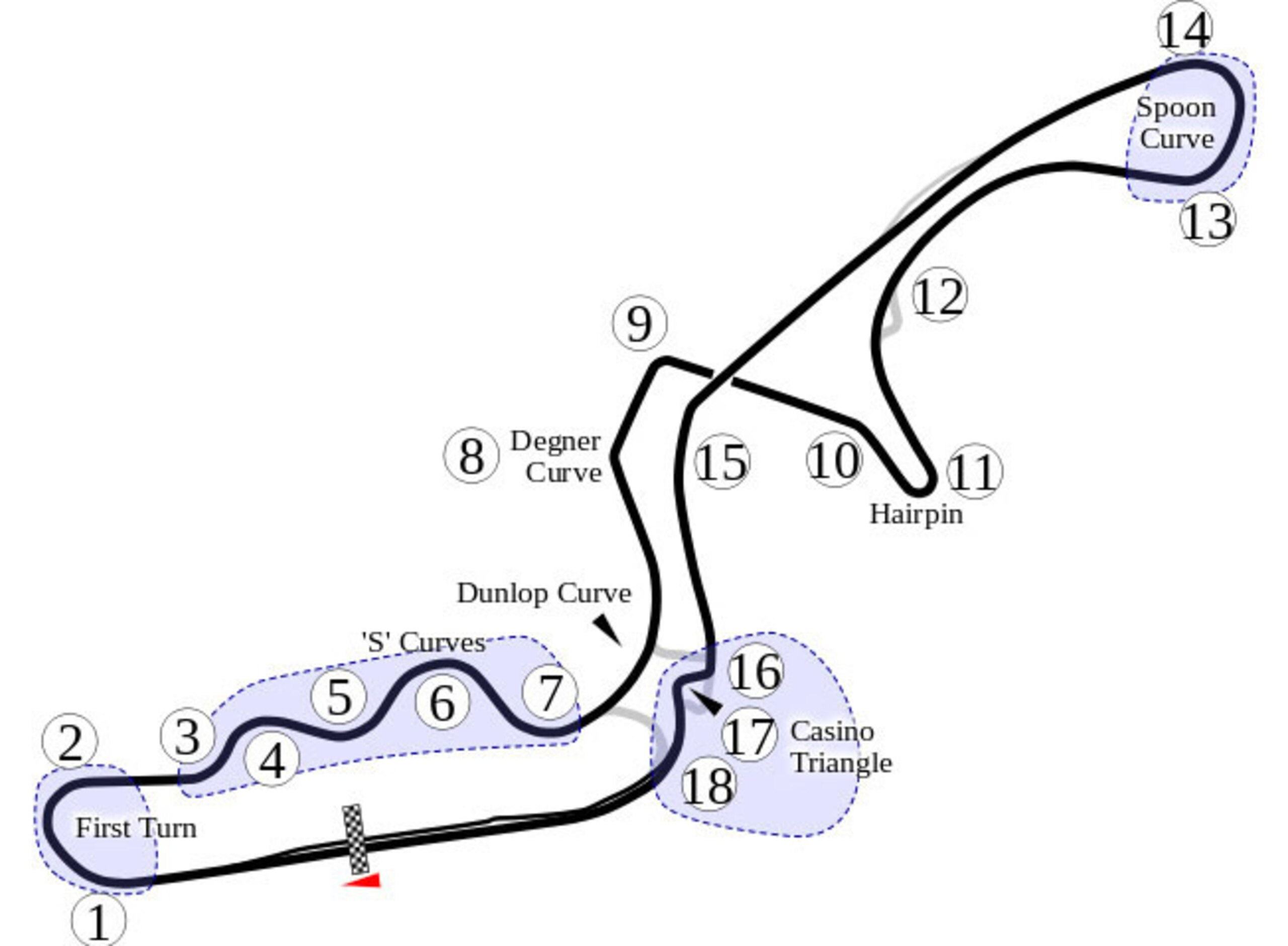
The fast, flowing and, quite simply, beautiful Suzuka circuit was built as a Honda test track in the 1960s.
It hosted its first non-championship Formula One race in 1963 and was a part of the official calendar for the first time in 1987.
Since then, it has been the venue for the Japanese Grand Prix every year bar two.
Corners like 130R, the S-Curves and Spoon are famous the world over, but this is a rare circuit at which every single corner is challenging. Tenths can be lost absolutely anywhere and mistakes rarely go totally unpunished.
Turns 1 and 2
A lap begins on the pit straight with a lengthy run, downhill all the way, to Turn 1. The drivers approach this tough right-hander at speeds in excess of 320 kilometres an hour, turn in and brake less than 50 metres from the apex.
Bleeding off speed through the corner and braking all the time, the car drifts wide at the exit and the driver turns in to the tighter right of Turn 2. A bit of throttle-feather keeps the pace up through the corner, then it's back on the power as early as possible and out on to a short straight.
Taken as a long, double-apex corner, Turns 1 and 2 are often overlooked in favour of its more famous brothers and sisters. An in-car camera view is needed to truly appreciate what a great pair of turns these are.
Turns 3, 4, 5, 6 and 7
The drivers accelerate uphill and into one of the greatest corner sequences the world will ever see. Every corner exit leads into the entry of the next, and a mistake in one turn will result in a time loss in the next.
The first, uphill left (Turn 3) is taken with just a quick lift off the throttle before a dab of the brakes for an optimal, tight line around the medium-speed right-hander of Turn 4. The car drifts wide at the exit, but the driver drags it back into the middle of the road before turning in to left-hand Turn 5, balancing the throttle as he goes.
Right-hand Turn 6 is the slowest part of the S-Curves, but even here speeds rarely drop below 160 kilometres an hour. The track dips down mid-corner before heading back uphill again at the entry to the longest and fastest S-Curve, the left-hand Turn 7 (Dunlop).
There are two parts to this corner—the initial turn-in and patient feathering of the throttle all the way to the apex, followed by a flat-out blast around the long, open corner exit.
Dunlop is where Jules Bianchi crashed during the 2014 race, sustaining injuries that would later claim his life. It won't be an easy corner for anyone to drive through this weekend.
Turns 8 and 9
The cars exit Dunlop and head gently downhill toward the extremely challenging Degner curves. They are named in honour of motorcycle star and Cold War defector Ernst Degner, who suffered severe injuries in a crash here when the corners were a single, longer turn.
Turn 8 (Degner 1) is a fast, right-hand kink with a little dip at the apex that can unbalance the car at the exit. Providing they get through unscathed, the drivers take plenty of kerb at the outside and brake almost straight away for the tighter right-hander of Turn 9 (Degner 2).
The corner's banking helps the driver take reasonable speed through here—but it's easy to take just that little too much. Expect to see plenty of cars running wide over the exit kerbs over the course of the weekend.
Turns 10 and 11
Coming out of Degner, the drivers get the power down as quickly as possible and accelerate under the bridge.
Turn 10 is a fast, right-hand kink taken at full throttle. As soon as they're through the apex, the drivers brake hard for the slow, left-hand hairpin of Turn 11. Taken at around 75 kilometres an hour, this is one of Suzuka's slowest corners.
We could see some passing here in Sunday's race, especially when the field is bunched together on the opening lap.
Turns 12, 13 and 14
The cars accelerate out of the hairpin and head into the long, undulating right-hander of Turn 12. In the dry, it's more a curved straight than a corner, so little driver input is needed, but it leads into one of the most difficult corners in the world—the double-apex left-hander of Spoon.
From close to 300 kilometres an hour, the drivers brake carefully down to around 200 kilometres an hour for the first apex. The track continues to sweep to the left, and the driver delicately balances the throttle before braking for the second apex.
The throttle is taken back up slowly and smoothly at the exit, and the cars head off for a short break on the back straight.
Turn 15
The cars reach speeds of around 320 kilometres an hour as they steam over the bridge (they went under it just after Degner) toward Suzuka's most famous corner, 130R (Turn 15).
Its name, indicating the corner has a radius of 130 metres, isn't entirely accurate nowadays—it was reprofiled into an easier, double-apex turn following Allan McNish's incredible crash in 2002. But 130R sounds much better than "85R and 340R," so the old name remains.
The drivers attack the turn flat-out, not even considering a lift. It's not as much of a challenge as it once was but watching a car go through here remains one of the highlights of the season. Like Turn 1, an in-car view is needed to really appreciate it.
Turns 16, 17 and 18
At the exit of 130R, the drivers drift to the left-hand side of the circuit and brake hard for the slow, right-left chicane comprising Turns 16 and 17.
Overtaking is possible at the entry if the attacking driver has a lot more pace, but we're not likely to see a lot of it on Sunday.
As soon as the second apex is cleared, the track begins to curve into the right-hander of Turn 18, which can make getting back on the power tricky. But once the throttle is floored, it stays there as the cars power through the exit of the corner and back out on to the pit straight.
Pit Lane
The pit lane entry is on the right on the inside of Turn 18. The exit is on the right-hand side of the pit straight just before Turn 1.
Tyres and DRS
3 of 6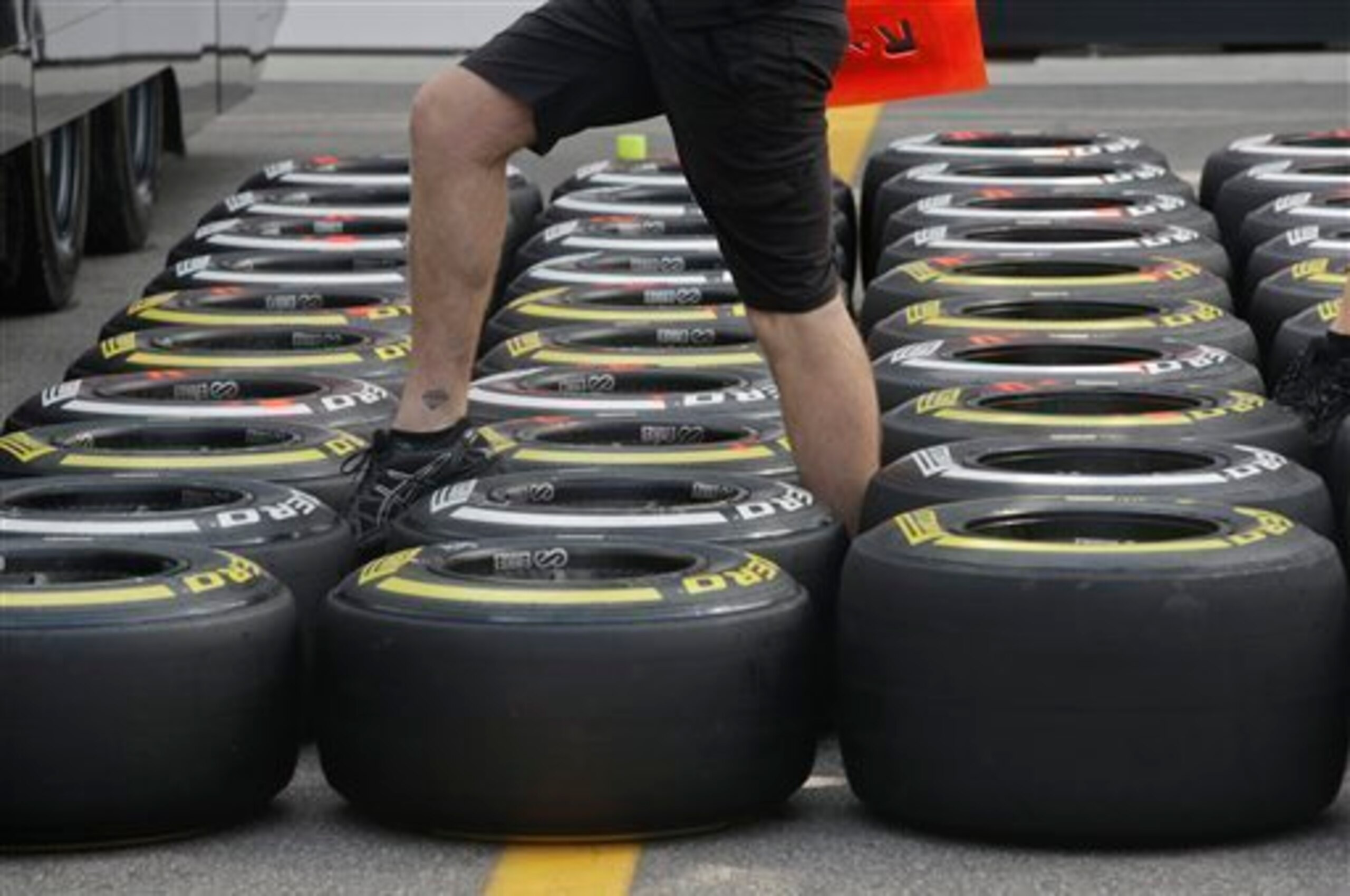
Suzuka has a relatively abrasive surface and is filled with long, medium- and high-speed corners.
Significant and sustained lateral loadings are put through the tyres in corners like Spoon, Dunlop and 130R, while the lack of a break between many of the corners—especially the sequence from Turns 1 to 9—gives the rubber little chance to cool down.
To cope with these heavy demands, Pirelli is supplying the white-marked medium and orange-marked hard compounds for the Japanese Grand Prix. This is the most-durable combination available.
The medium will be the tyre of choice for qualifying, but the lap time difference between it and the hard should be small—Pirelli expects it to be just six- to eight-tenths of a second.
Providing it stays dry, two stops should be the favoured strategy.
DRS
Suzuka is one of only two circuits on the 2015 calendar—the other being Monaco—with a single DRS zone. This is due to there only really being one safe and suitable place to put it.
The zone has its detection point between 130R and the final chicane. The activation line is on the entry to the pit straight, and the zone ends with braking for Turn 1.


Weather
4 of 6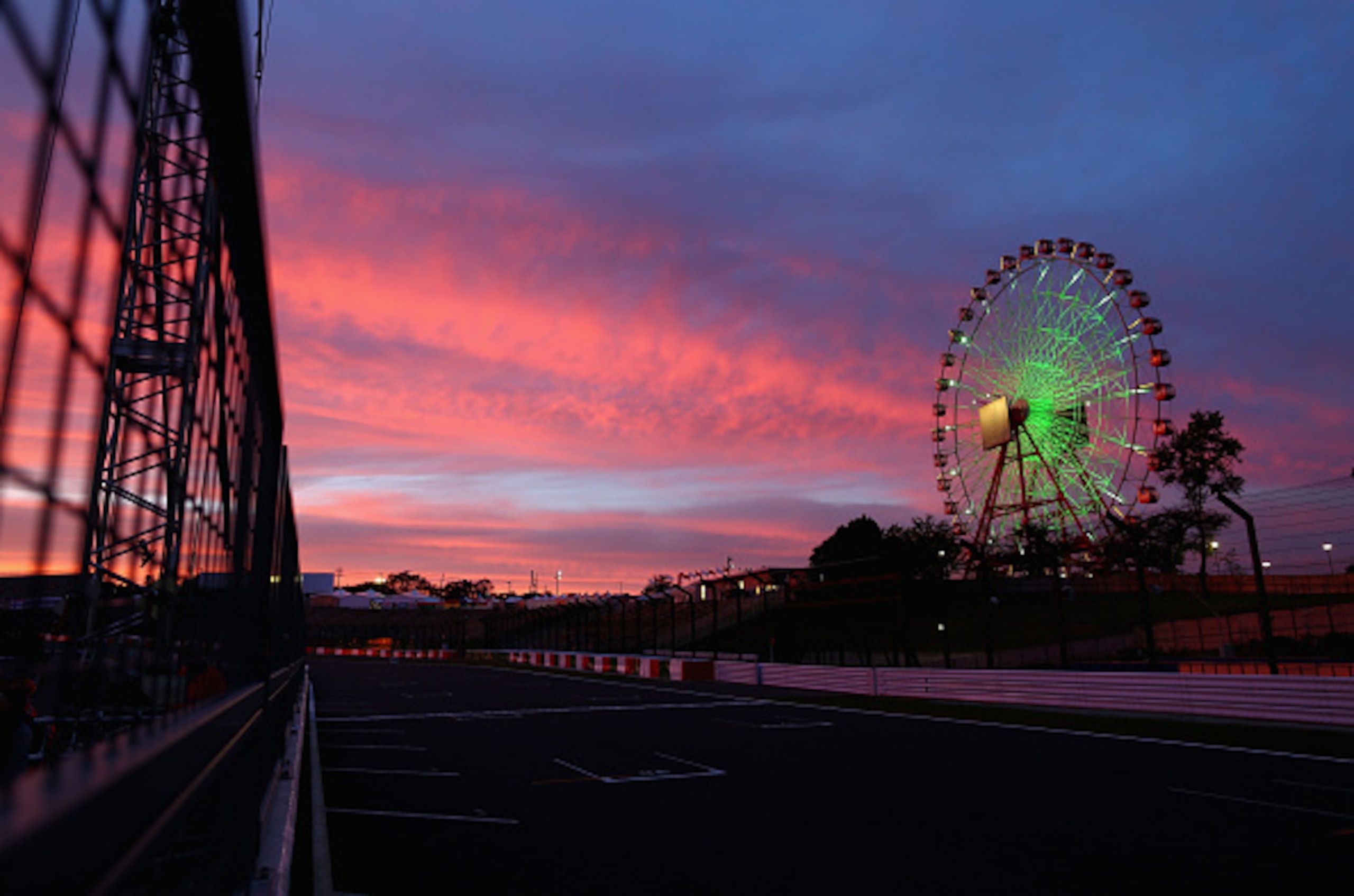
Suzuka lies on the eastern coast of Honshu, the largest of the Japanese islands. The region has a humid subtropical climate with quite hot summers and mostly mild winters. September is the third-warmest month, with average daily temperatures in the mid- to high-20s degrees Celsius.
Rain falls all year round, but September tends to be a wetter-than-average month.
The forecast for the weekend ahead suggests we'll see temperatures close to the long-term average, but there's a lot of unpredictability on the precipitation side. A significant amount of rainfall is expected over Friday night, but this could turn up early and affect practice. Behind it, showers are possible for Saturday's qualifying session.
Sunday looks like the day with the lowest chance of rain, but the odd shower cannot be ruled out. A clearer picture will emerge as we get closer to the weekend.
BBC Weather will have the latest for the region—their closest forecast is for Nagoya, around 45 kilometres from the circuit. Accuweather will have the latest forecast for Suzuka.
Odds
5 of 6
Lewis Hamilton retains his position as pre-qualifying favourite, but Sebastian Vettel has finally broken the Mercedes monopoly.
The Red Bulls have shorter odds than last time out, as do the Williams pair.
The top 10 favourites are:
| Lewis Hamilton | 10-11 |
| Sebastian Vettel | 7-2 |
| Nico Rosberg | 4-1 |
| Kimi Raikkonen | 16-1 |
| Daniel Ricciardo | 33-1 |
| Daniil Kvyat | 50-1 |
| Felipe Massa | 50-1 |
| Valtteri Bottas | 50-1 |
| Sergio Perez | 250-1 |
| Nico Hulkenberg | 300-1 |
Selected Others
The safety car appeared twice during the Singapore Grand Prix, and the bookies expect to see it again at Suzuka. It's 3-10 to come out at least once; a no-show is 11-5.
Mercedes and Ferrari should fill out the top four on pace alone, but the battle behind them will be tight. Daniel Ricciardo is 4-7 for a top-six finish with Valtteri Bottas 8-11. Felipe Massa and Daniil Kvyat are both 5-6.
And we couldn't forget McLaren on engine-partner Honda's very own track. It's 750-1 for a McLaren driver to win the race and 1000-1 that either Fernando Alonso or Jenson Button will qualify on pole. Looking at more realistic targets, both are 7-2 for a points finish.
All odds sourced from Oddschecker.com and correct at the time of publication.
TV Times and Session Times
6 of 6
As always, the Japanese Grand Prix weekend will consist of three free practice sessions, qualifying and the race.
The session times are as follows:
| Practice 1 | Friday | 10 a.m. |
| Practice 2 | Friday | 2 p.m. |
| Practice 3 | Saturday | 12 noon |
| Qualifying | Saturday | 3 p.m. |
| Race | Sunday | 2 p.m. |
All times given are in Suzuka local time (JST, UTC+9). The official Formula One website has a useful tool on its homepage to convert them to your own time zone.
TV Times
In the United Kingdom, live coverage of all sessions will be provided by Sky Sports F1 and the BBC across channels One and Two. The programming times are as follows (all times BST):
| Practice 1 | Friday | 2 a.m. | 1:45 a.m. | 1:55 a.m. (Two) |
| Practice 2 | Friday | 6 a.m. | 5:45 p.m. | 5:55 a.m. (Two) |
| Practice 3 | Saturday | 4 a.m. | 3:45 a.m. | 3:55 a.m. (Two) |
| Qualifying | Saturday | 7 a.m. | 6 a.m. | 6 a.m. (One) |
| Race | Sunday | 6 a.m. | 4:30 a.m. | 5 a.m. (One) |
Free-to-air highlights of qualifying and the race will be shown on the BBC.
In the United States, live coverage is provided by NBC network on NBCSN and NBC Sports Live Extra (SLE). The times are as follows (all times EDT):
| Practice 1 | Thursday | 9 p.m. | 9 p.m. (SLE) |
| Practice 2 | Friday | 1 a.m. | 1 a.m. (NBCSN) |
| Practice 3 | Friday | 11 p.m. | 11 p.m. (SLE) |
| Qualifying | Saturday | 2 a.m. | 2 a.m. (NBCSN) |
| Race | Sunday | 1 a.m. | 12:30 am (NBCSN) |
Enjoy the weekend!
Follow me on Twitter for occasional updates on new articles and thoughts about the F1 world, or if you have any questions or comments.

.jpg?w=2560)

.jpg?w=2560 "Viral Rams Coach Vid 🖕")