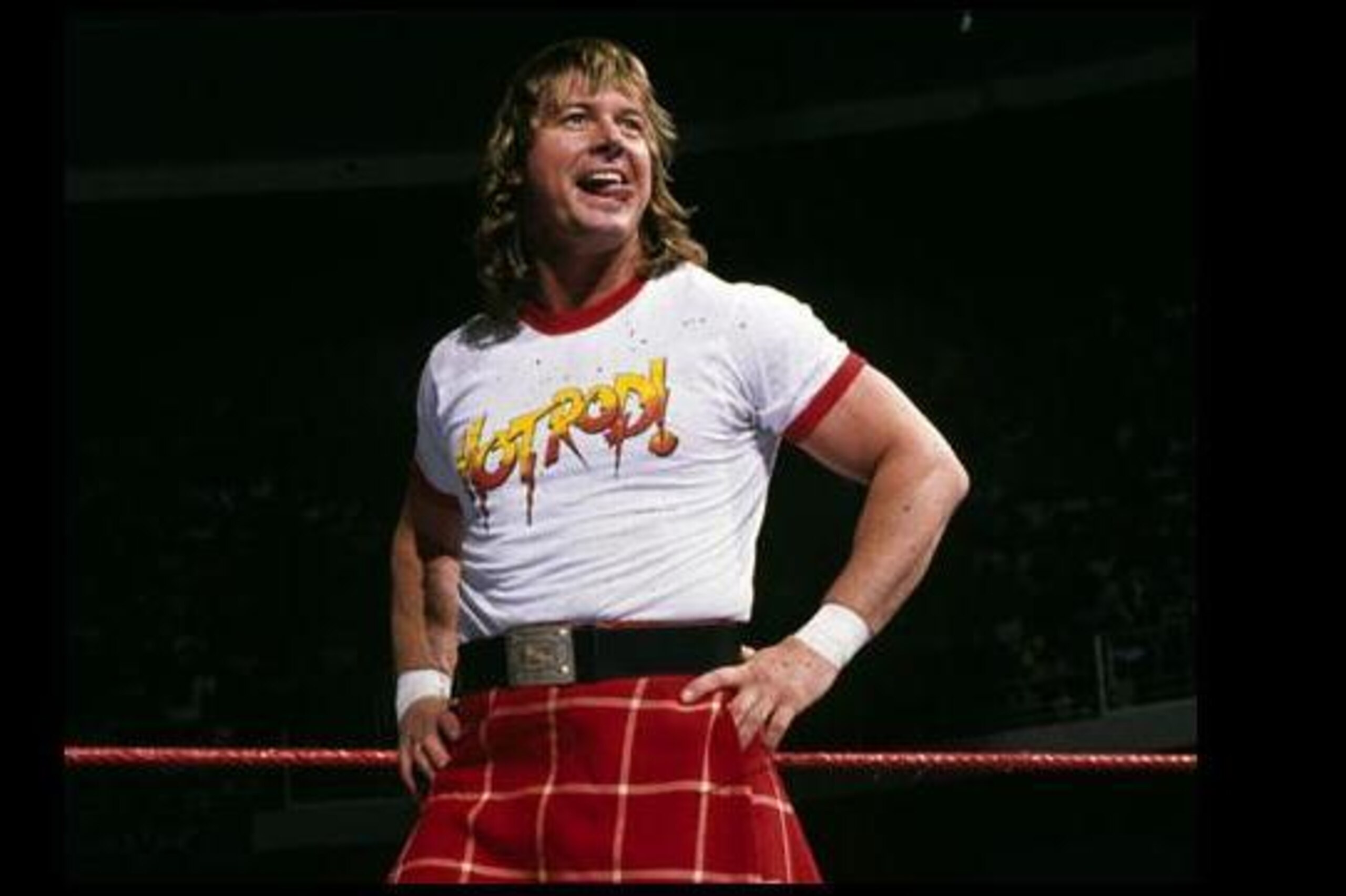
Roddy Piper Was Vital Figure in WWE's Rise to National Prominence
You can't tell the story of WWE's evolution into the sports-entertainment giant that it is today without "Rowdy" Roddy Piper. You can't tell WrestleMania's origin story or discuss the impact of Hulkamania on the industry without mentioning Piper's name several times over.
In many ways, Vince McMahon built his empire on the wide, muscular back of Hulk Hogan, but Piper was key to WWE's rise as well. He was Lex Luthor to Hogan's Superman.
The Hall of Famer passed away on July 31, as WWE announced on its website. That has wrestlers and fans alike reflecting on Hot Rod's career and the deep imprint he left on pro wrestling.
.jpg?w=2560)

.jpg?w=2560)
WrestleMania, Hulkmania and the Rock 'n' Wrestling period all changed that industry forever. This is when the business shifted from a regional niche enterprise to a pop culture phenomenon, from an art form practiced in armories to one capable of filling stadiums. And Piper was at the center of all of it.
When McMahon took over for his father, he had visions of expanding what was then the World Wrestling Federation. He wanted to go national, and eventually global.
What he had in mind was unheard of. The country was split into a patchwork of regional territories. The promoters all mostly stuck to their own corners of the map; intrusion upon those understood borders was tantamount to an invasion.
Verne Gagne operated American Wrestling Association in the Minnesota area. Don Owen laid claim to the Pacific Northwest. Eddie Graham ran the Florida scene.
In order to take on these men, and to take on the National Wrestling Alliance as a whole, McMahon needed top talent. Why would an audience choose his product over Owen's or Graham's if it wasn't significantly better?
And so McMahon pilfered from his competitors, taking Hogan and Gene Okerlund, Jesse Ventura and Bobby Heenan from the AWA. He added Greg Valentine, Big John Studd and Wendi Richter. Piper came from Jim Crockett's Mid-Atlantic territory, the Canadian in a kilt proving to be as vital on McMahon's chessboard as the king.
Hogan was the clear centerpiece.
He was larger than life, a superhero, a kid-friendly megastar who blended right in with McMahon's vision of wrestling merging with pop culture. In Hogan, McMahon had his central hero and face of the company. To capitalize on that, he needed to pit him against the right archenemy.
Piper was perfection in that role.
In many ways, he was the complete opposite of Hogan. He was foreign (WWE played up his Scottish heritage, not his Canadian citizenship) while Hogan was all-American, the conniving cheater as opposed to the squeaky clean, vitamin-endorsing babyface.
When Hulkamania was set to explode, McMahon pegged Piper as the guy to light the fuse.
McMahon looked to build momentum off Captain Lou Albano's appearance in a Cyndi Lauper music video. After Albano briefly entered the realm of pop music, Lauper, a red-hot star at the time, stepped in the ring as a means to meld two worlds.
When Lauper presented Albano with an award at Madison Square Garden, Piper was right there, claws out, a predatory look on his face.
He interrupted the proceedings, smashing the gold record over Albano's head. Moments later, he was sent squirting out of the ring in fear when Hogan arrived to save the day. And so WrestleMania's first marquee rivalry began.
In 1985, MTV aired The War to Settle the Score with Hogan and Piper at the top of the card.
The world title ended in chaos. With the referee knocked out, Piper and Paul Orndorff issued a two-man beatdown of The Hulkster. Soon, Mr. T, Lauper and others crowded the ring. This wasn't just a showcase of WWE to a new audience—it was an advertisement for WrestleMania.
Mr. T brought his star power to the squared circle to form a superteam of sorts with Hogan.
The buzz around that duo was a huge part of why so many folks chose to catch the supercard on closed-circuit TV. But what would the hype around that match have been without the proper heel standing opposite them?
Piper's mastery at being an irritant, his ability to play the sneering, cocky, bombastic villain elevated that main event and that industry-changing show overall. Fans surely wanted to see Hogan triumph but were just as interested in seeing someone kick Piper's ass.
During his entrance that night, you could see fans hurl bits of trash into the ring at him.
That dynamic is why the angle worked. Even with all the added spectacle and big names, its reliance on traditional heel heat was key. Not to mention that a bout featuring the limited-worker Hogan and non-wrestler Mr. T needed a ring general who could provide a solid base on which to build the match.
Piper's role as chief agitator certainly didn't end at WrestleMania.
In November of '85, with the Piper-Hogan rivalry still hot, WWE created The Wrestling Classic, a pay-per-view event that featured a 16-man tournament. Piper challenged Hogan for the world title that night.
Like so many of their bouts, it ended in a disqualification. Hogan never truly got the upper hand on Piper. The snake would always slip from the hunter's grasp, always scuttle back off into the grass until it was ready to attack again.
This kept the story from every truly ending. This kept fans wanting to see Piper pay, for Hogan to fully trounce him.
Their feud even extended to an animated plane. As part of the speeding hype train that was Hulkamania, WWE produced Rock 'n' Wrestling, a cartoon featuring the company's most colorful characters. In this venue, like in real life, Piper and Hogan were pitted as the top bad guy and good guy, respectively.
It was often Hot Rod who got called upon to do the show's live-action segments, playing Hogan's grating foil as he did on traditional WWE programming.
Piper moved on to face off with Mr. T, the two meeting at WrestleMania II in a boxing match. He continually held the audience's attention with his innovative Piper's Pit segments. He kept leaving the ring to pursue a movie career, but the ring kept calling him back.
Feuds with Adrian Adonis, Bad News Brown and Bret Hart eventually followed.
As entertaining as all of those were, they didn't help shape a growing phenomenon the way his battles with Hogan did. When McMahon slid all his chips toward the center of the table and asked that the national wrestling audience tune in to his brand of the mat game, it was Piper butting heads with Hogan that made that bet pay off.
McMahon had chosen the right hero to point the spotlight at, and luckily for him and WWE, the boss also found the ideal nemesis in Piper.

.jpg?w=2560 "Injury-stricken Seahawks signing veteran RB")
.jpg?w=2560 "2 NFL Officials Suspended")


.jpg?w=2560 "Mahomes' Wife Trolls Kubiak 💀")
.jpg?w=2560 "Viral Rams Coach Vid 🖕")