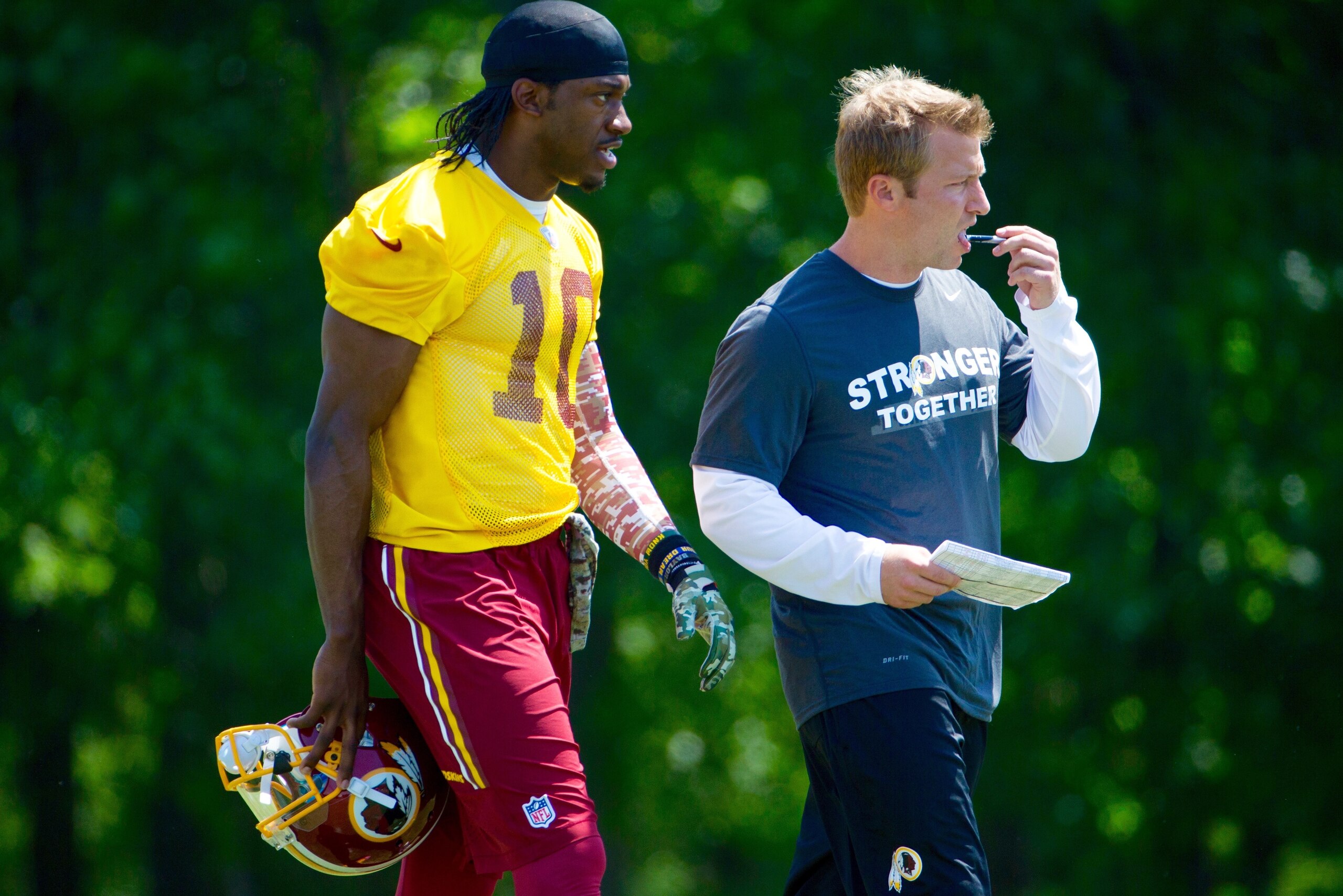

How Scheme, Coaching Can Save Robert Griffin III and the Washington Redskins
Three years since he was drafted, everybody's still talking about Robert Griffin III. Only now, the narrative has changed from waxing lyrical about a young star who has redefined the quarterback position.
Instead, everybody now wants to know how to fix RG3. Multiple serious injuries, dreadful mechanics and more public spats with coaches than letters in his name have sent Griffin tumbling from the NFL's summit to its scrapheap.
Anonymous league personnel think he's an egomaniac who is done, per Chris Wesseling of the league's official site (h/t ESPN's Mike Sando). Andy Benoit of SI.com's MMQB ranked him second-to-last among the league's projected 32 starters headed into the 2015 season. Former Washington Super Bowl-winning passer Joe Theismann disagreed.
.jpg?w=2560 "49ers Giants Football")
.jpg?w=2560 "Commanders Vikings Football")
There's no shortage of people (yours truly included) who'll tell you what's wrong with Griffin. There's also an ample number of people who will tell you how he can be fixed.
B/R's Mike Tanier thinks it needn't be all doom and gloom, provided Griffin and head coach Jay Gruden can finally find a middle ground based on an offensive scheme that suits both. Meanwhile, Tanier's fellow B/R writer Ty Schalter believes only a full commitment from Griffin, both in the film room and on the practice field, to iron out his weaknesses, can salvage his potential.
It seems like everyone has a theory, so here's my two cents.
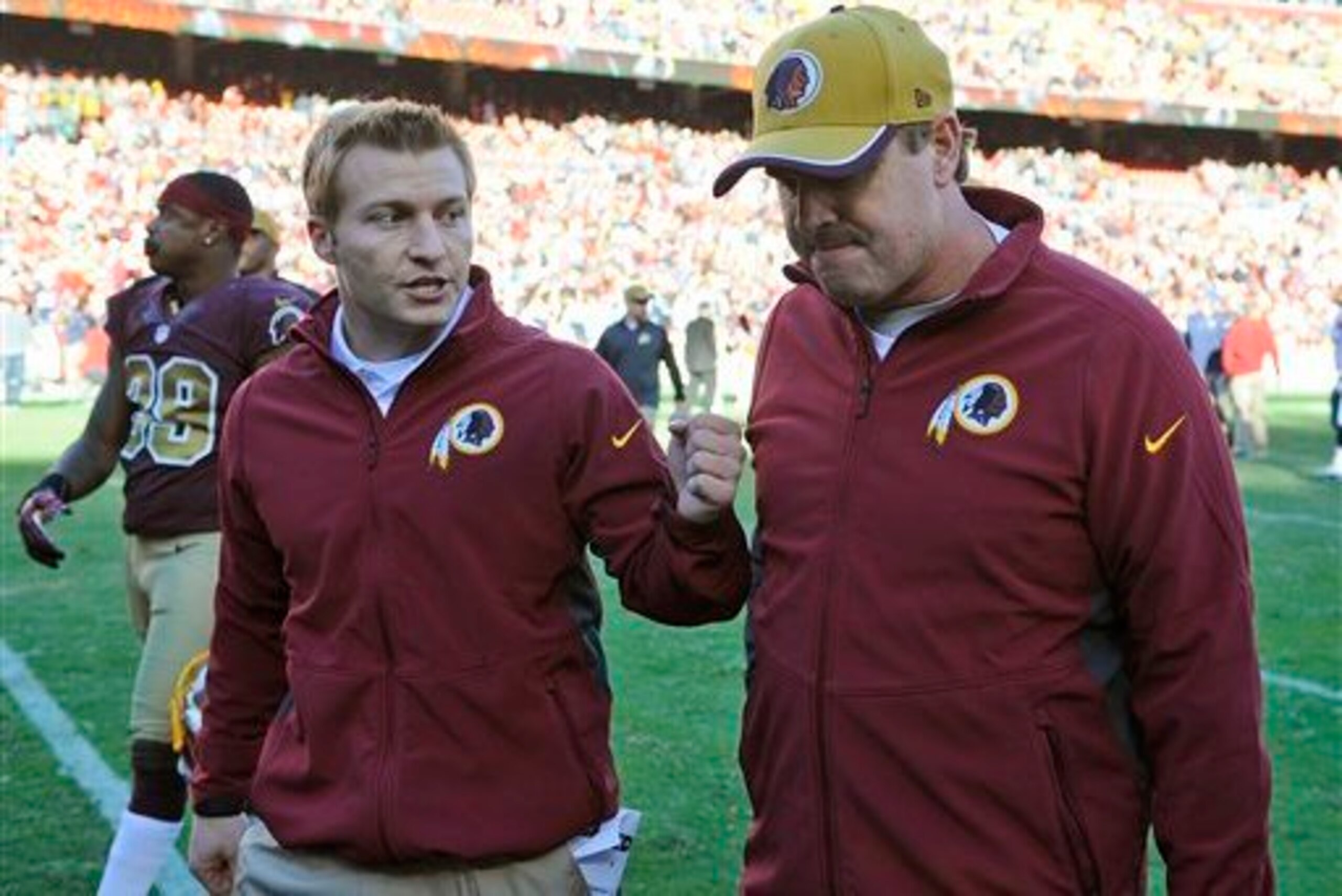
There are three ways for Gruden, offensive coordinator Sean McVay and new quarterbacks coach Matt Cavanaugh to package an offense Griffin and the Redskins can win with in 2015.
It will be a scheme predicated on three schematic nuances: a bunch, some trips and the pistol.
Here's how Washington can use those things to save its supposed franchise quarterback.
Good Things Will Come in Bunches and Stacks
Writing for the league's official site back in 2011, Pat Kirwan described a classic bunch look the following way:
"A bunch principle is when three eligible receivers are close together before the snap of the ball -- usually all within 5 yards of each other. Because of their close proximity, it makes it very difficult to play man-to-man coverage because if the three eligible receivers crisscross at the snap of the ball -- better known as a 'star' route -- one defensive player is going to lose the receiver he is assigned to and there is an easy quick completion. Most defenses check to a zone call against a bunch look in order to be sound against the star route.
"
Since then, bunch formations have become a staple of modern NFL offenses. They are a great way to take a defense out of its comfort zone, particularly in coverage.
Bunch sets make defenses obvious. They create easy coverage looks and open up receivers off route combinations run in unison by multiple playmakers.
The approach has worked wonders for Griffin in the past. In fact, it was the foundation for his most accomplished performance in a Redskins jersey since 2012.
That came in Week 10 of the 2013 season on the road against the Minnesota Vikings. For nearly three quarters, Griffin looked well on his way to becoming a refined, fully rounded pro quarterback.
A trio of plays from the final two minutes of the opening half reveal how bunch sets and stacked receivers helped make him look good.
In the first example, the Redskins had set up a bunch set to Griffin's right. Santana Moss was at the tip of the bunch (1) with Leonard Hankerson outside him (2) and tight end Jordan Reed (3) as the inside receiver:

Pre-snap, Reed was sent in motion to join wideout Pierre Garcon on the other side of the formation. Washington now had stacked receivers on either side of the defense:

At the snap, the underneath receivers, Reed and Hankerson, locked up short-range covering defenders. At the same time, Garcon ran a deep in-breaking slant into the void behind the underneath coverage and the deep safety:
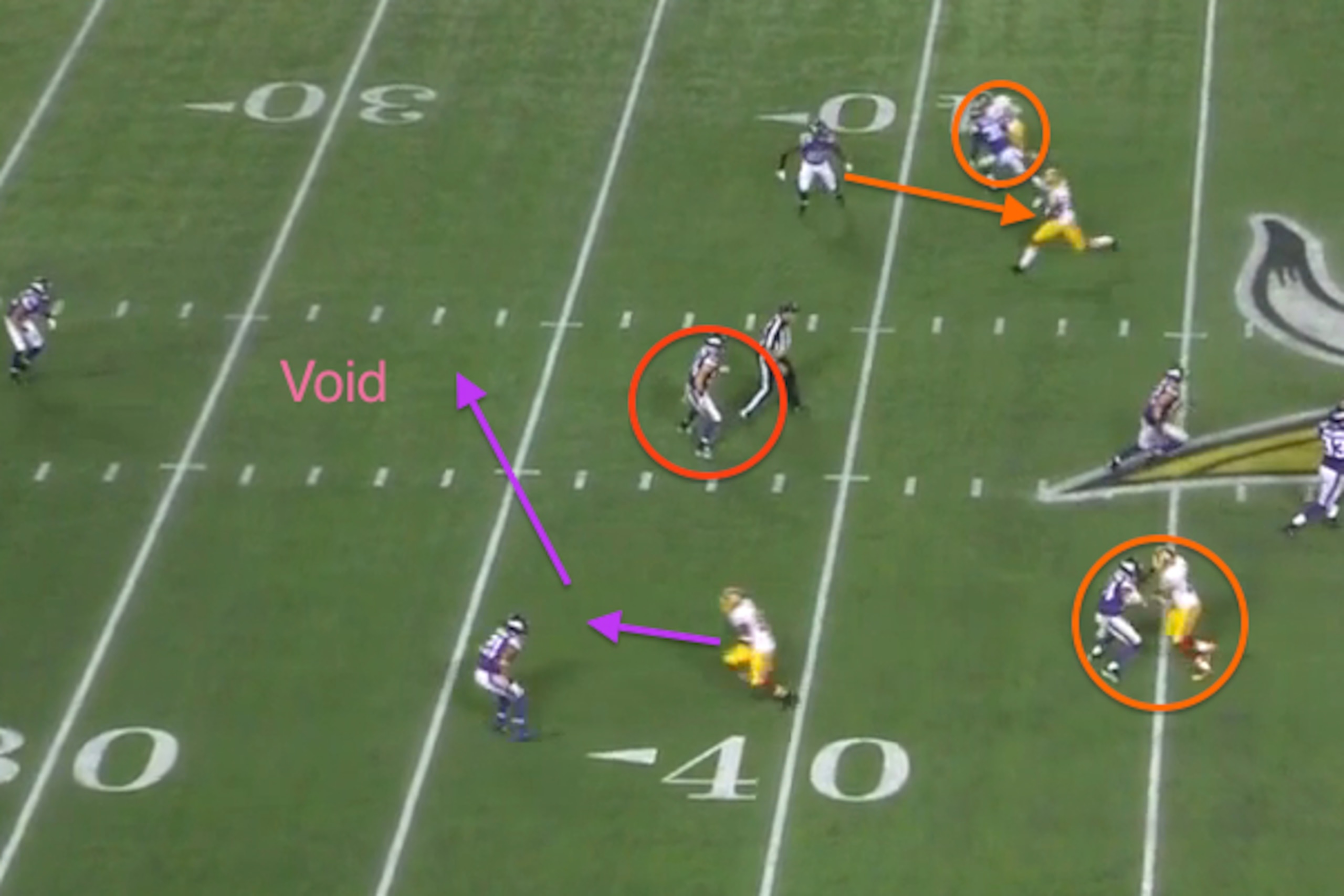
The Vikings had set up their coverage to lock up receivers underneath with deep-safety help behind it. Linebacker Chad Greenway (52) was supposed to act as a free, floating robber in the middle.
By motioning out of the bunch set into a double-stack look, Washington split Minnesota's coverage in two. Griffin now had four options; whichever one Greenway didn't undercut and the deep safety didn't rotate toward would be his target.
In this case, that meant Garcon. Greenway was committed to the underneath routes, while the free safety was still guessing which of the four he should double:

With Garcon now free on the inside, it was an easy throw-and-catch for 12 yards:

Setting up bunch looks can force defenses into obvious coverage shells. The Vikings went man coverage on the initial bunch, then maintained it once Reed went in motion. Straight away, Griffin had a pre-snap read, something he often struggles with, deciphered.
Once his quartet of receivers took off, Minnesota couldn't cover them all. The Vikes' deep safeties had too many decisions to make. Griffin was guaranteed an open receiver somewhere. Knowing this, he could get rid of the ball quickly, something else often alien to him.
But the bunch wasn't the only way the Redskins outwitted the Vikings and made Griffin's job easier.
Take a Trip Down Memory Lane
Washington also had great success with the trips formation. That's a trio of receivers aligned on the same side but not bunched together.
Then-head coach Mike Shanahan and his offensive coordinator, son Kyle, designed two trips looks intended to create lightning-fast reads and throws for Griffin.
The first saw, from the outside in, Josh Morgan, Santana Moss and Jordan Reed (on the line) aligned in trips. This look again forced Minnesota into an obvious coverage shell:
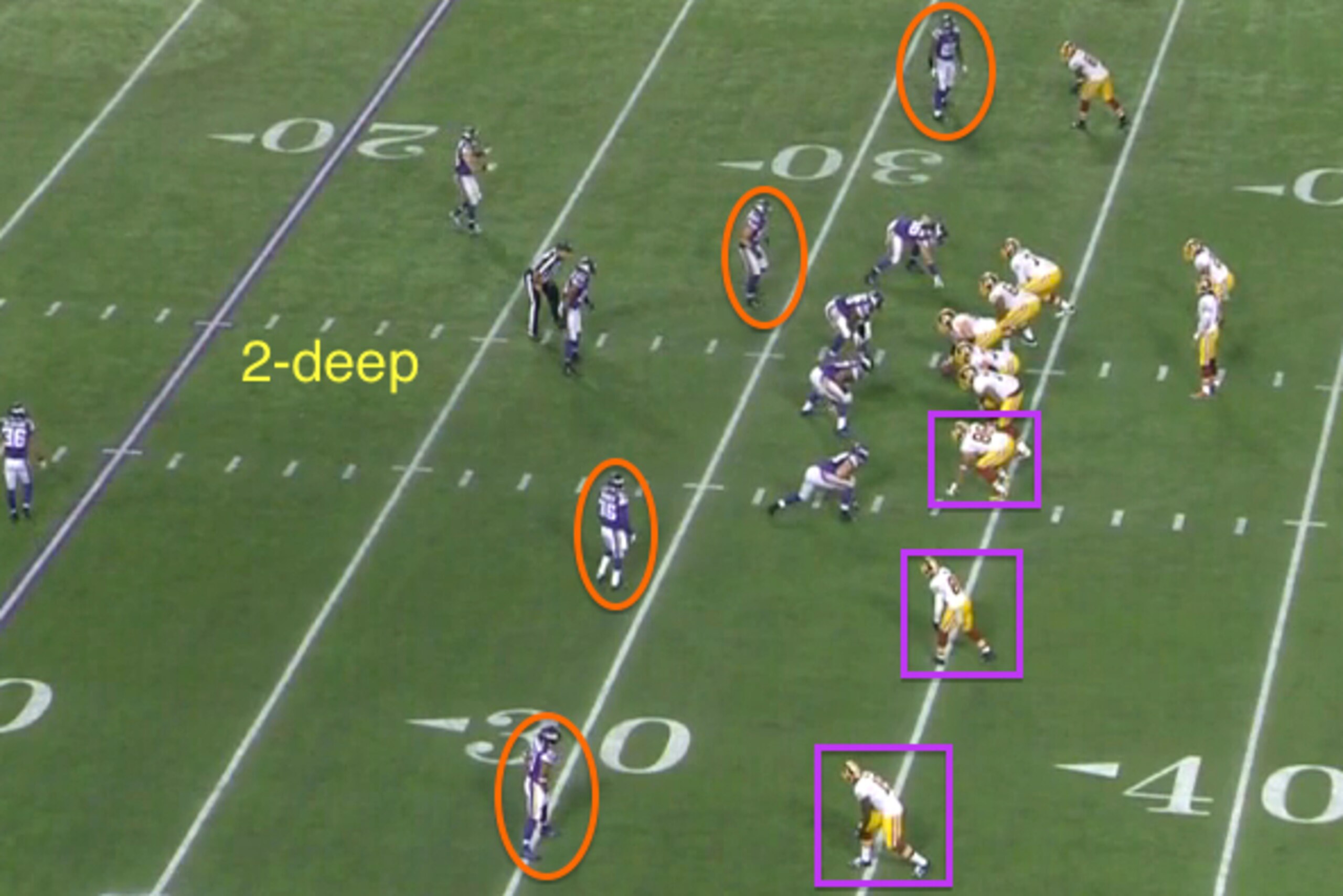
The Vikings tried to counter with man coverage underneath and a two-deep shell behind it. They were showing Griffin a 2-Man coverage look.
Once the ball was snapped, Morgan and Moss released to lock up their covering defenders. At the same time, Reed crept off the line to receive a quick-hitting screen pass:

Reed was a quick and easy first read for Griffin. But notice on the other side how running back Roy Helu Jr. (circled) had also released to offer Griffin a simple second read.
Griffin almost instantly flipped the ball Reed's way, while Morgan and Moss established their blocks. They were now a two-man convoy for Reed in space:
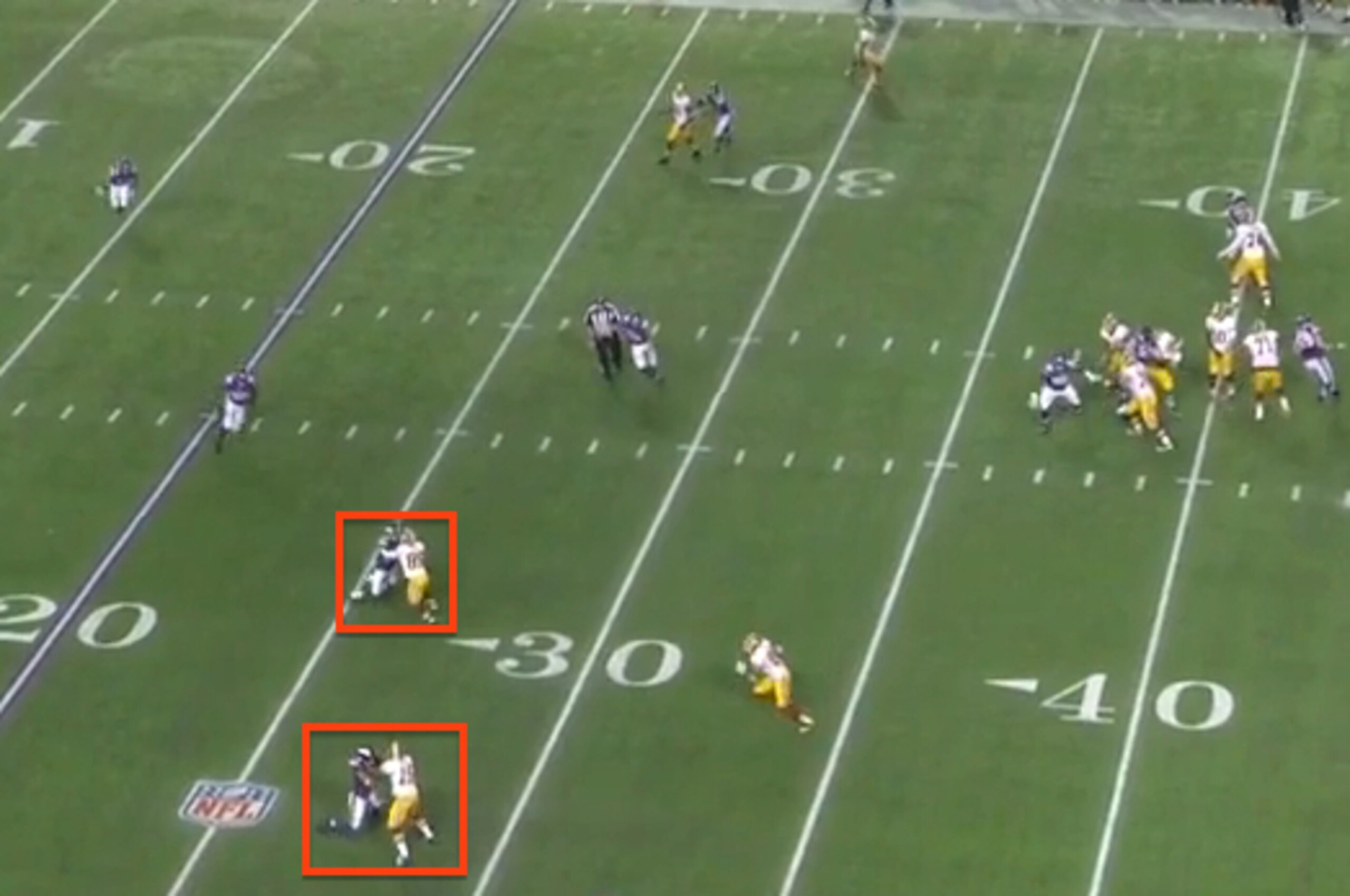
Reed soon powered his way through the alley those blocks had created to gain 12 more yards:
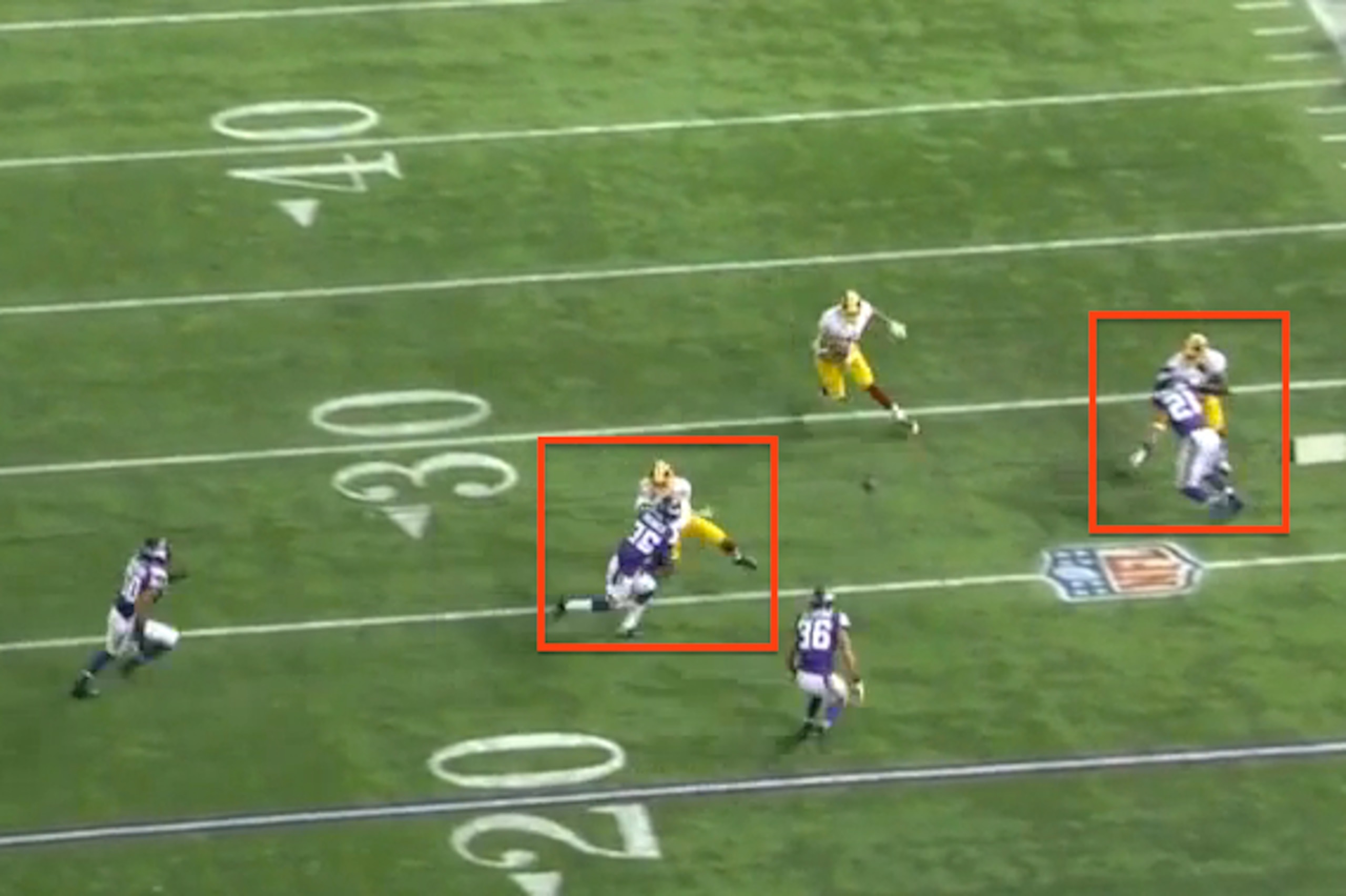
This play was like stealing for the offense. Washington's coaches had given Griffin an easy target to hit. He couldn't go wrong on what was almost an airborne running play.
More important, Griffin had options, if Reed was picked up, he could simply have turned and dumped the ball off to Helu. This is the kind of high-percentage play concept and design that makes a quarterback's job easier.
Surely that has to be the goal with Griffin.
It certainly was on the next play when Washington showed Minnesota a trips look on the other side of the formation. This time, Reed and Moss were flexed in the slot, while Garcon aligned on the outside:
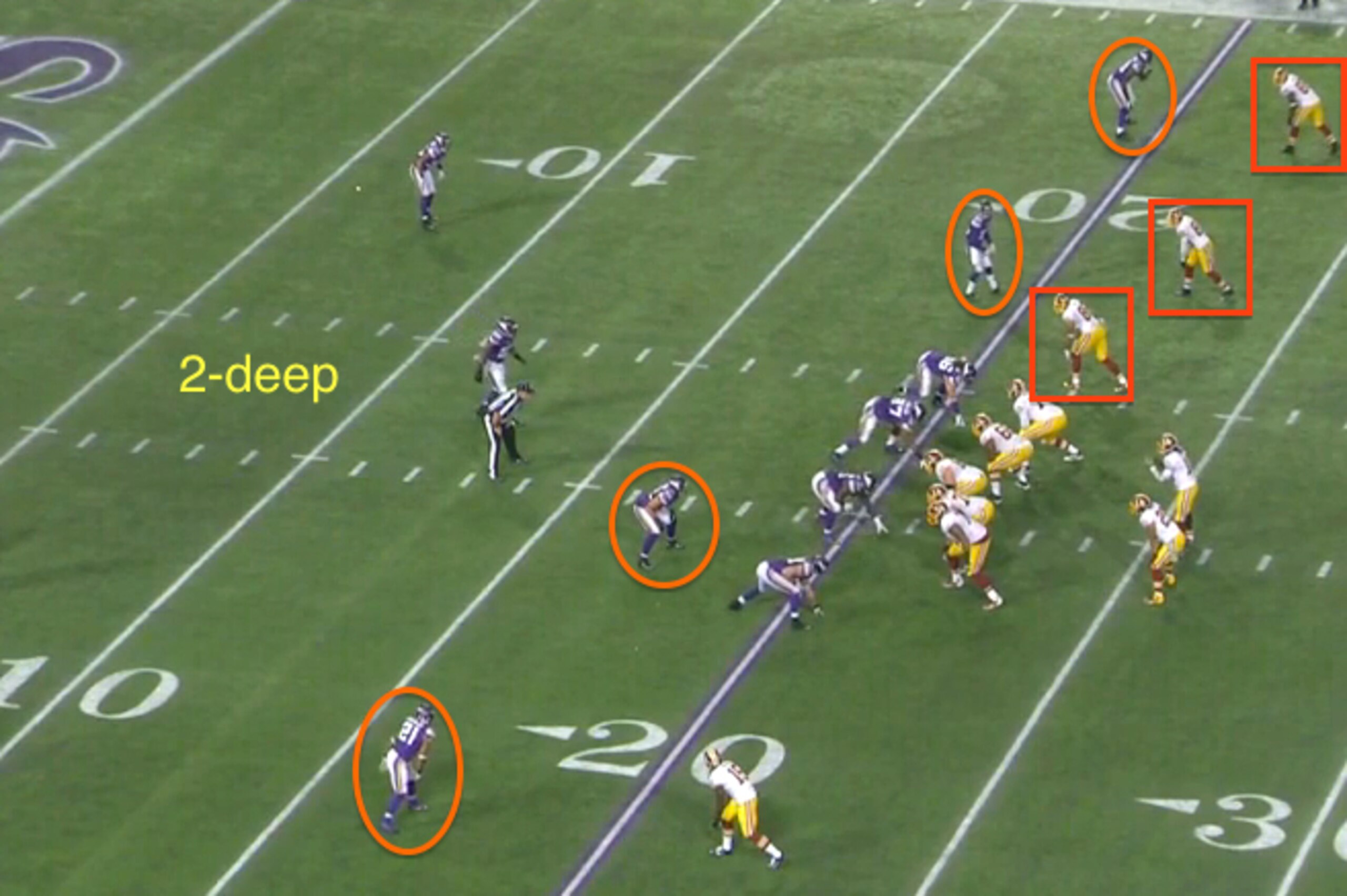
Again, the Vikings were forced into adopting a basic and easy-to-read Cover 2 shell. The look was soon picked apart by the Redskins' route combinations.
As Griffin dropped back, he saw Reed and Moss combine to create a two-on-one situation against Minnesota's nickelback:

Whichever way the nickelback guessed, he'd leave a wide-open receiver. He chose Reed and left Griffin an obvious and easy window to connect with Moss:
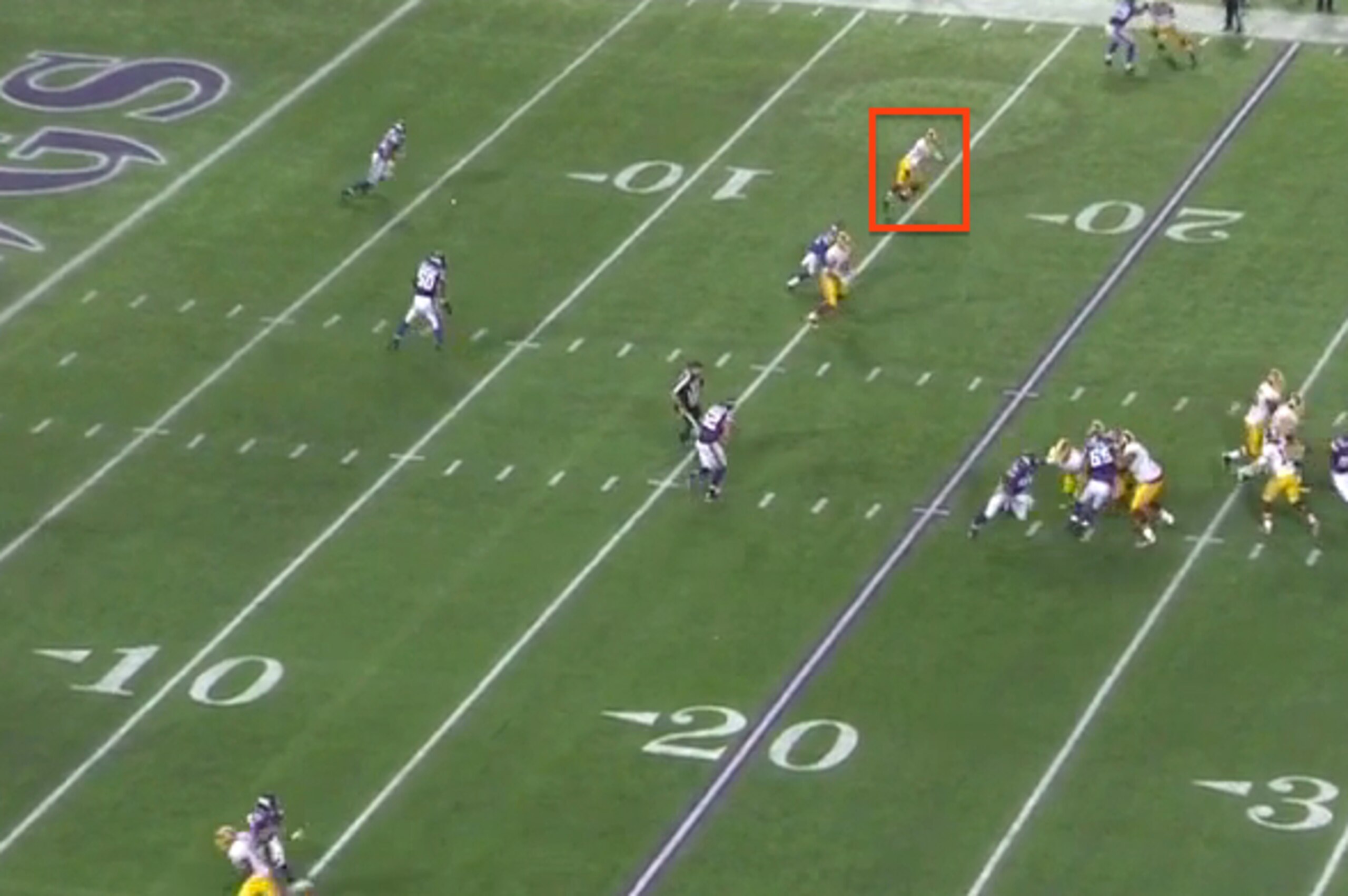
Griffin promptly made the connection for 13 yards:
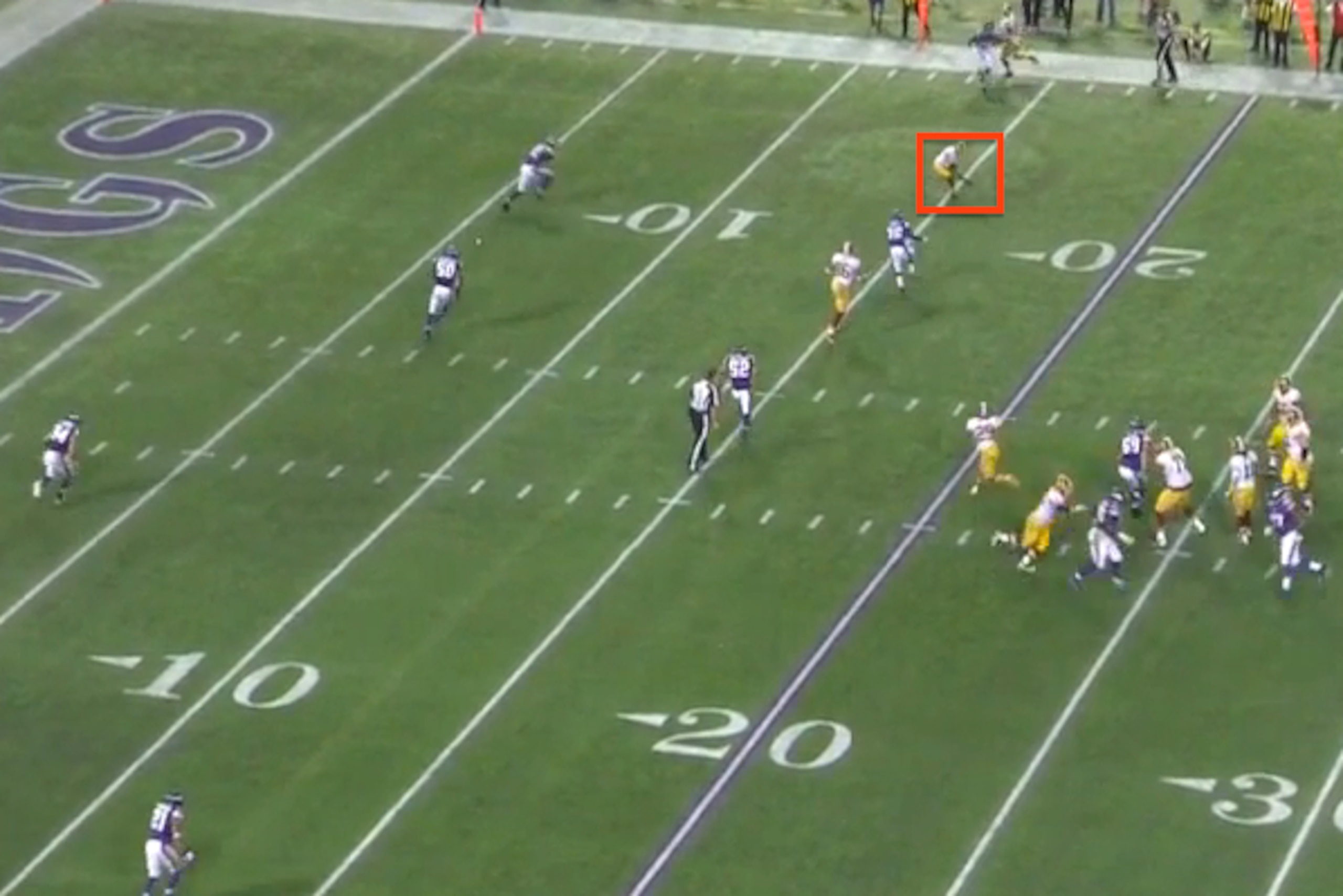
This play worked so well because the trips look overwhelmed the deep safety on that side of the field. He was too busy spying Garcon to drop down and help out against Reed and Moss.
Meanwhile, linebacker Erin Henderson (50), who had bailed deep Tampa-2 style, was more concerned with vertical routes. Having Moss and Reed run comeback patterns rendered Henderson irrelevant.
By designing a scheme based on creative use of the bunch, stack and trips, Washington gave Griffin easy reads and quick throws to make. On three plays, he threw a trio of completions to three different receivers for 37 yards.

On a drive which ended with a one-yard scoring lob to tight end Logan Paulsen, Griffin had spread the ball around and made smart choices, quick throws and plays downfield.
Isn't that everything the Redskins want from their quarterback?
But these wrinkles aren't the only way Gruden and his coaches can get those things from Griffin.
The Pistol Shall Be His Weapon of Choice
Gruden can also revive another staple of the Shanahan playbook—the pistol formation. It's a short-shotgun look with the quarterback positioned three to five yards from center.
The Redskins actually did use it with some success when Griffin entered the game during Week 15's road loss to the New York Giants last season. On the first play, Griffin was in the pistol with Garcon and Andre Roberts stacked together on one side of the field:
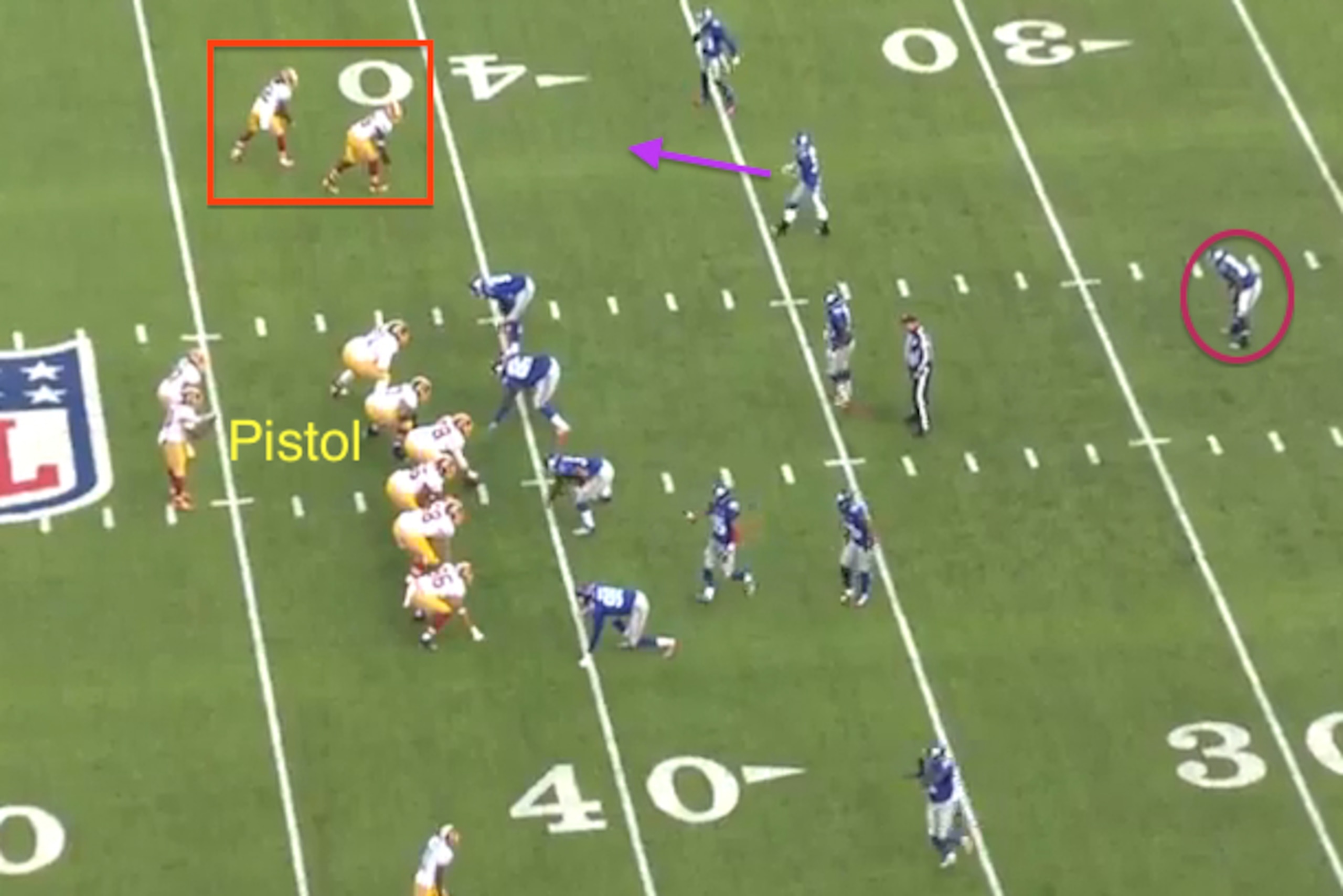
This forced the Giants into a Cover 1 look, man coverage underneath, with a single-high safety (boxed).
Once the ball was snapped, Garcon and Roberts pulled Big Blue's coverage structure apart with a route combination:
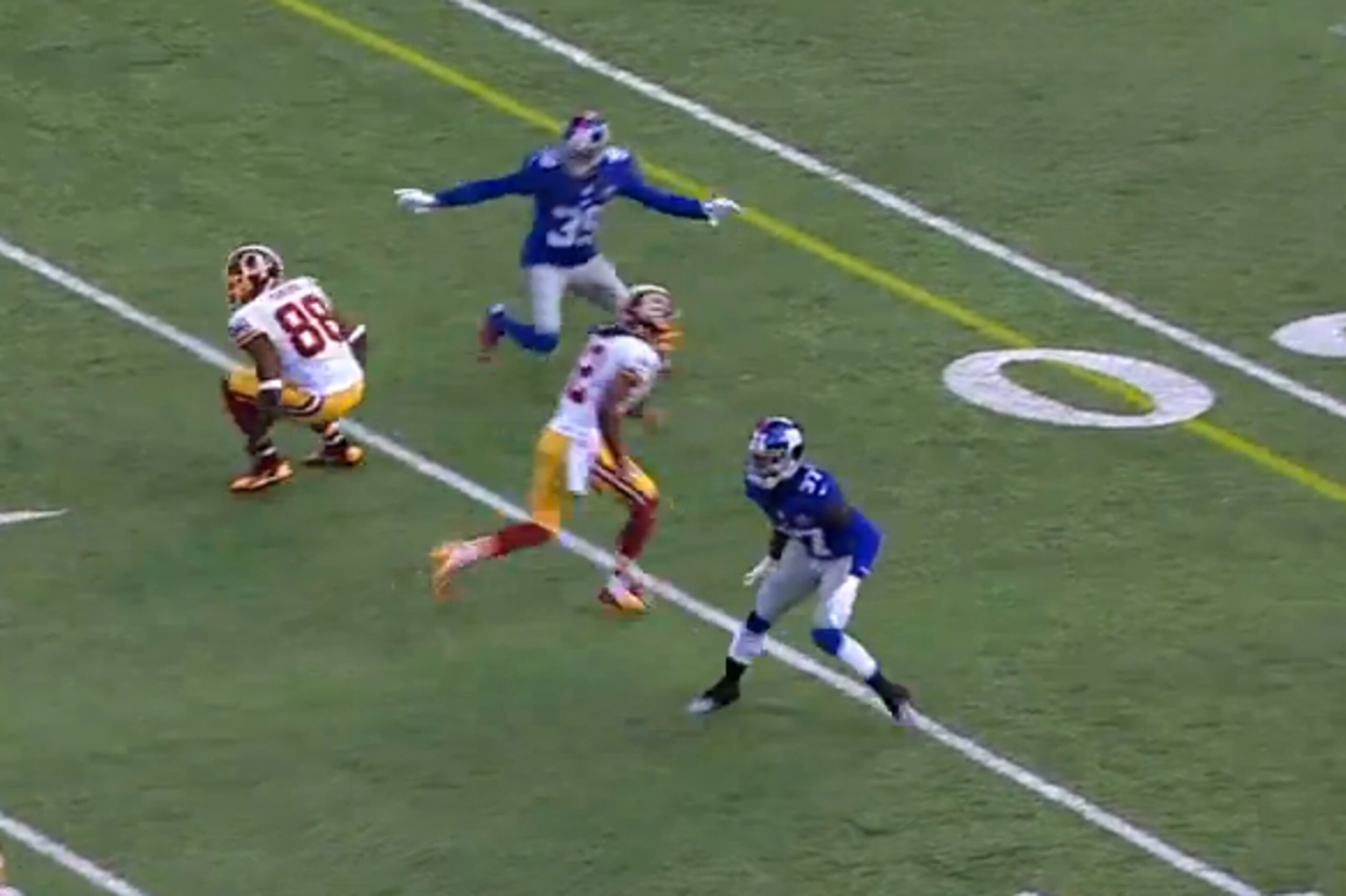
They ran a hi-lo concept with Garcon as the short-range receiver and Roberts attacking vertically:
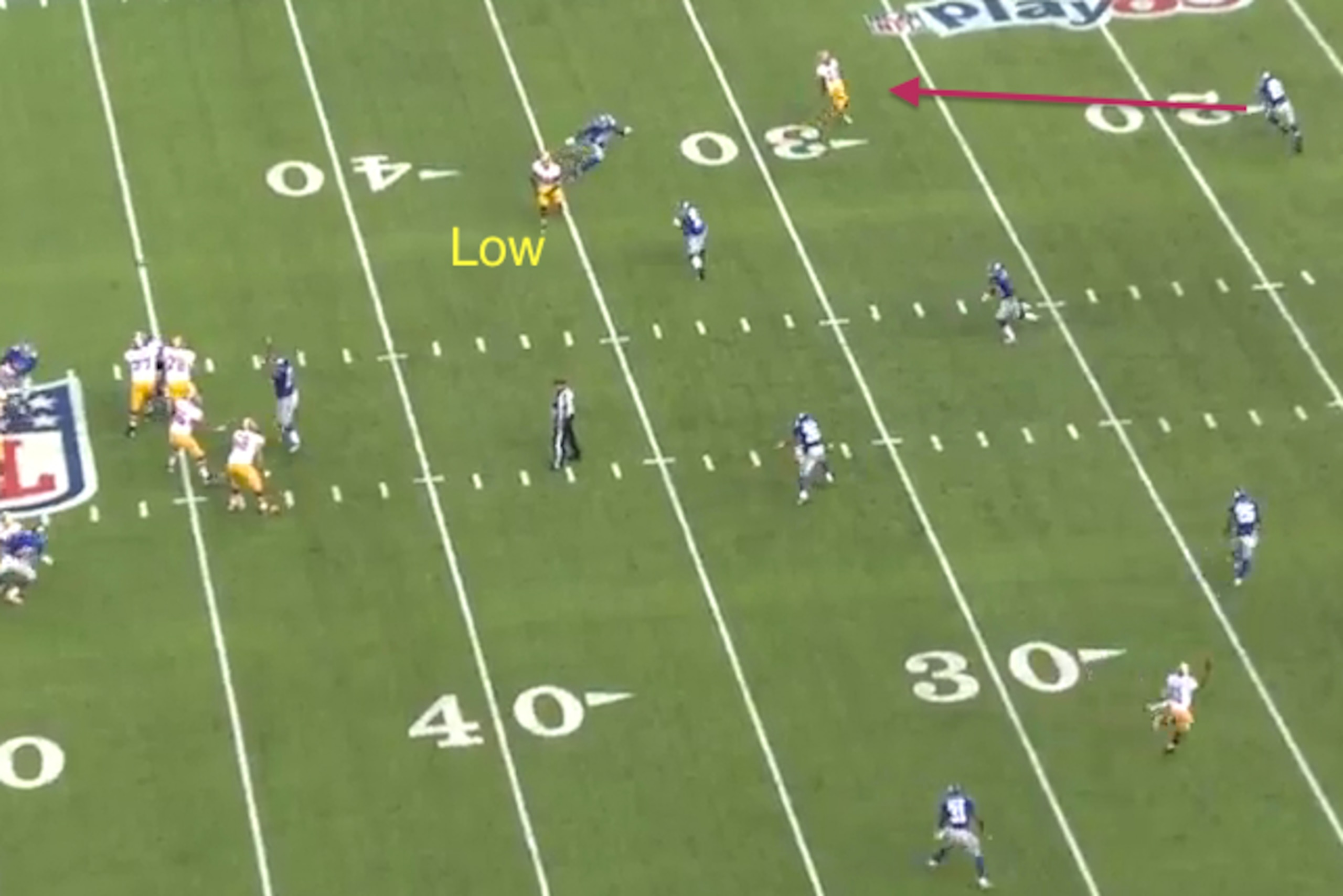
The idea was to challenge the lone deep safety. If he eyed Garcon for too long, he'd be too late getting across to Roberts to stop the vertical route.
That's just what happened, as the much-maligned receiver was left wide open to complete a 20-yard grab:
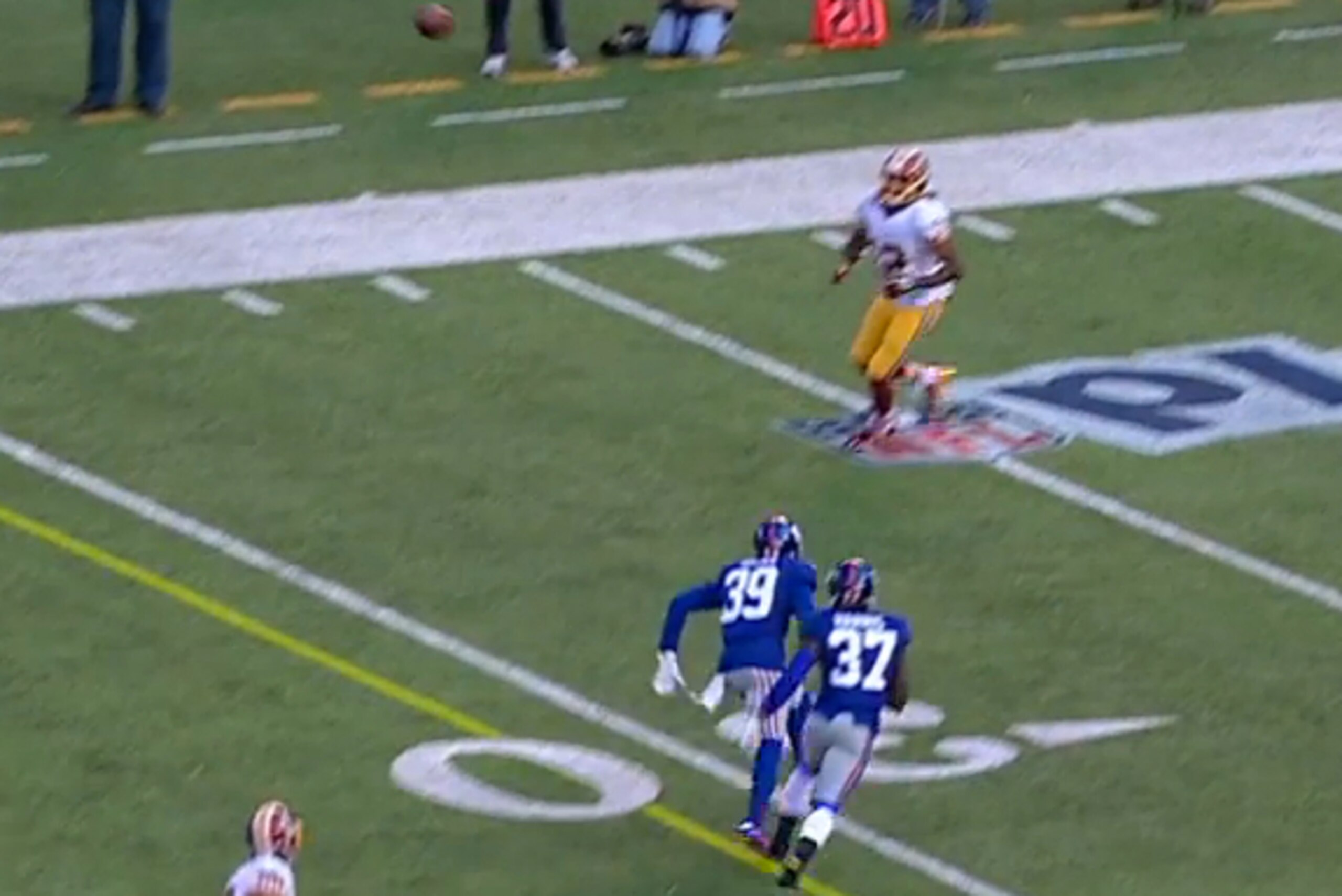
One thing that helped create this big gain was the fake in the backfield between Griffin and running back Chris Thompson. Griffin offered just a hint that he would stick the ball in Thompson's gut in classic read-option style:
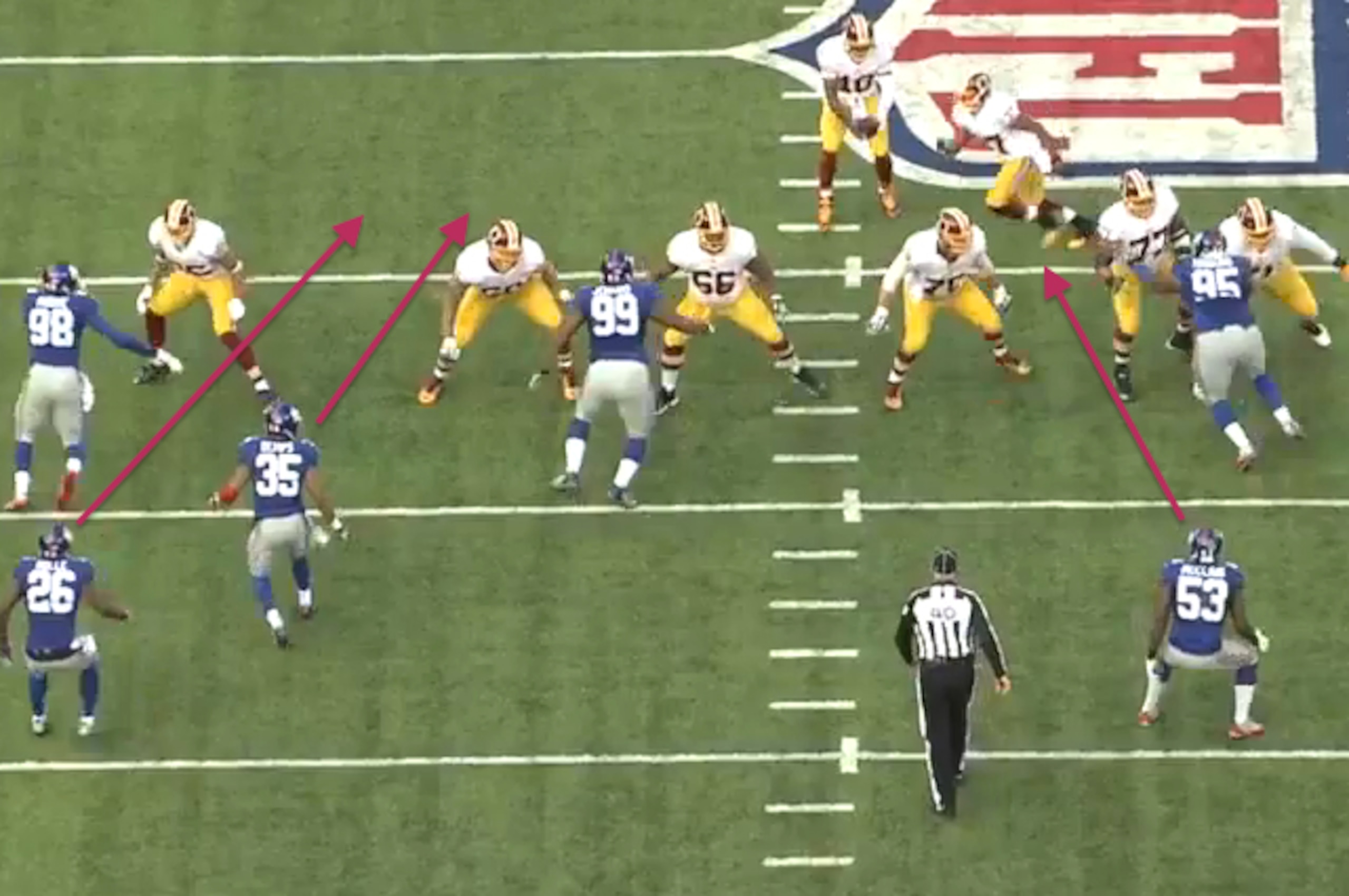
This deception got safeties Antrel Rolle and Quintin Demps, along with linebacker Jameel McClain, peeking into the backfield. Their lean toward the line of scrimmage created an obvious void behind the second level of the defense and its deep coverage:

That's the no-man's land any offense wants to attack.
By using the pistol, the Redskins worked in a fake that froze the defense and gave Griffin more time in the pocket. From his position detached off the line of scrimmage, he could see the whole field and make a quick read and easy throw.
But the pistol can also be the key to a revival of last season's 19th-ranked running game. It's important to note here that playing the pistol doesn't demand Griffin takes off running all the time on those frail and surgically repaired knees and ankles.
Still, using the pistol does at least keep the threat of Griffin's dual-threat skills alive. Keeping the idea he might run in the minds of defenders makes life easier for a running back.
Thompson proved that against the Giants. He again joined Griffin in the backfield in another classic pistol look:

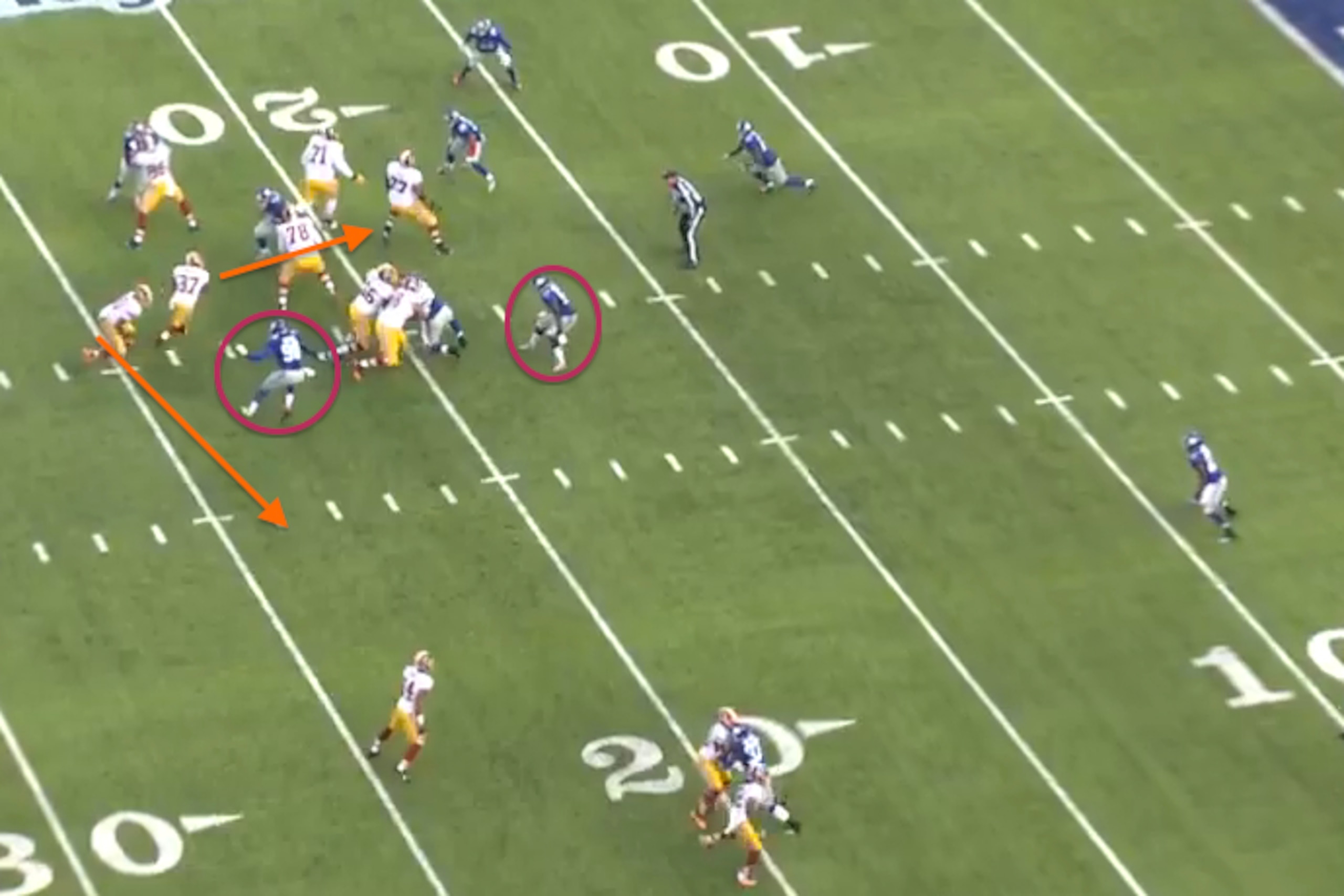
Once the ball was snapped, Griffin stuck the ball in Thompson's gut. Now players at the edge of New York's front seven had no clue who had the ball.
McClain and end Damontre Moore were baffled:
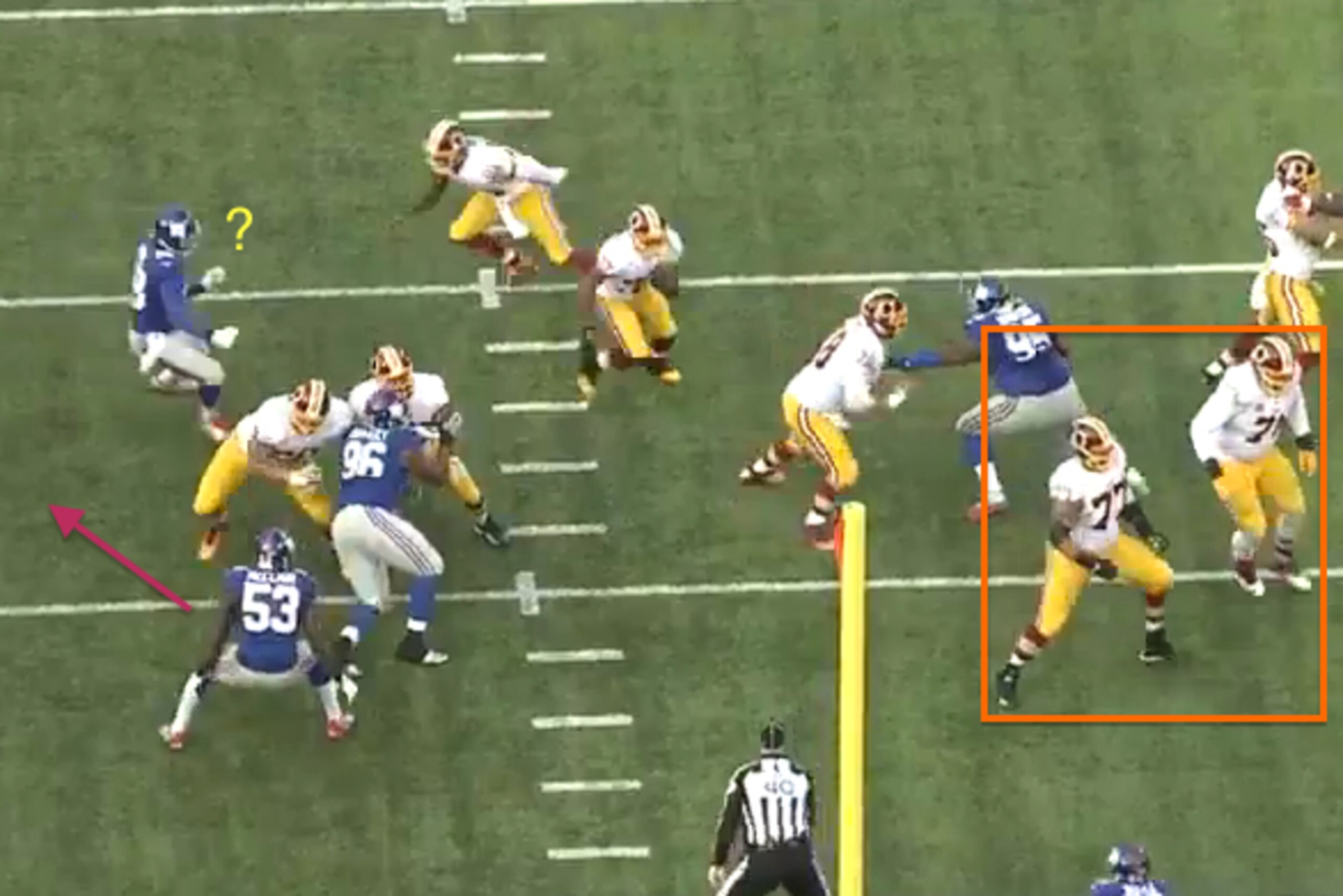
Both players were leaning toward the outside in case Griffin kept the ball and took off around the corner. This meant Thompson was unopposed through the middle, where McClain may have been waiting or where Moore may have cut him off.
Thompson scooted through as left guard Shawn Lauvao and left tackle Trent Williams released to form a convoy at the second level. Here's another look:
By the time Moore and McClain guessed right, it was too late. Right tackle Tom Compton was already releasing to absorb McClain while Lauvao and Williams were establishing their blocks:
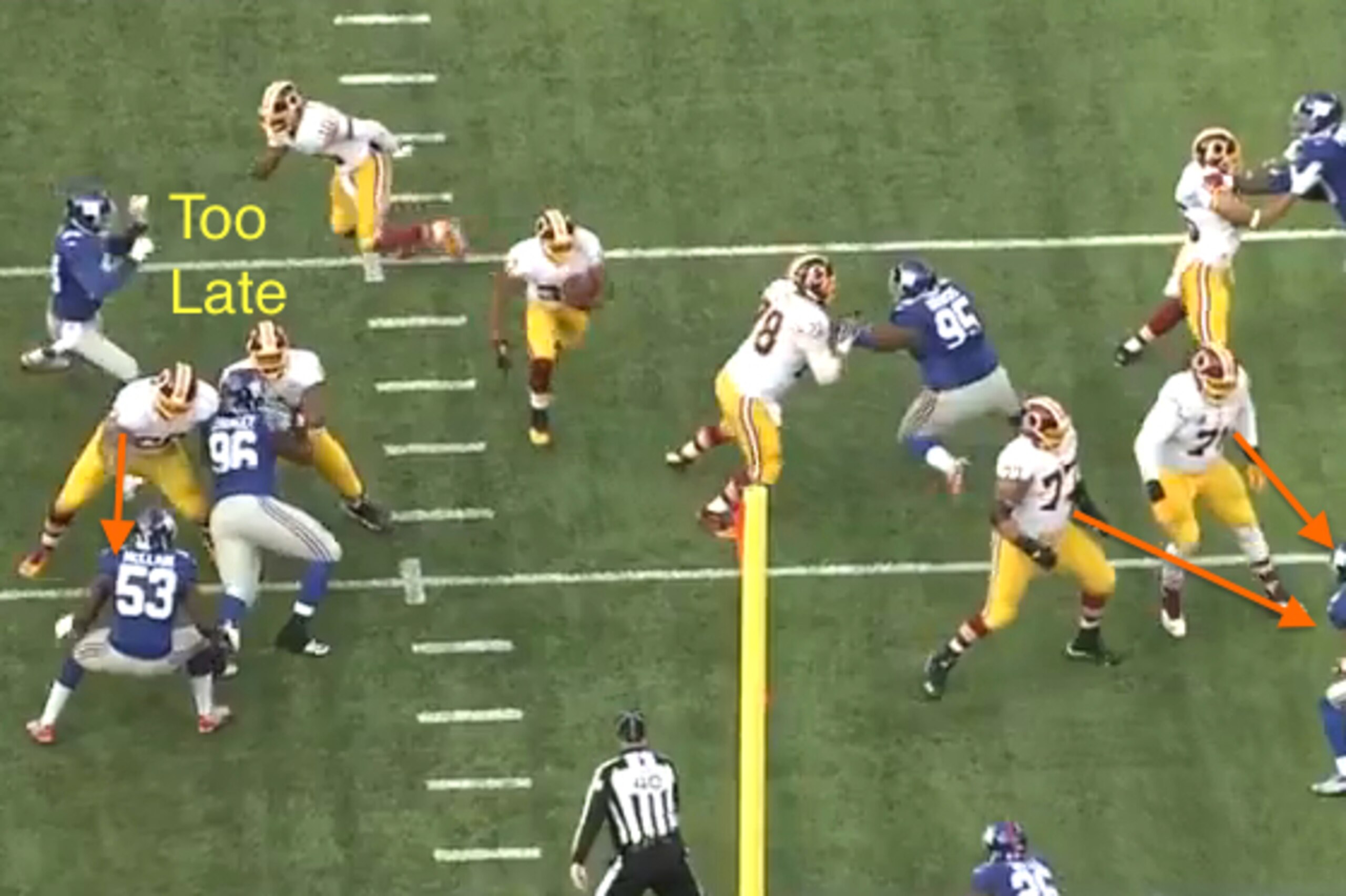
Meanwhile, Moore had taken himself completely out of the frame by overplaying the possible run from Griffin.
Thompson simply cut off the double-team by Lauvao and Williams to earn seven easy yards:

Regardless of Griffin's faults or positives, the running game needs to be the backbone of Washington's offense in 2015. Thankfully, that's a view shared by those who make the decisions at Redskins Park, according to ESPN.com's John Keim: "They know their quarterback situation—with Griffin or anyone else—demands they be a run-oriented offense."
Using the pistol and some zone-read principles can revive a ground attack that went stale in 2014. It will also force defenses to play passively and set up big-play opportunities.
Putting It All Together Means Big Plays
There are quite a few scheme wrinkles detailed here. But what does the picture look like for Griffin and Washington's offense when they put all of those things together?
Another play from the Giants game offers an enticing illustration. It began with the Redskins showing Big Blue a bunch set:
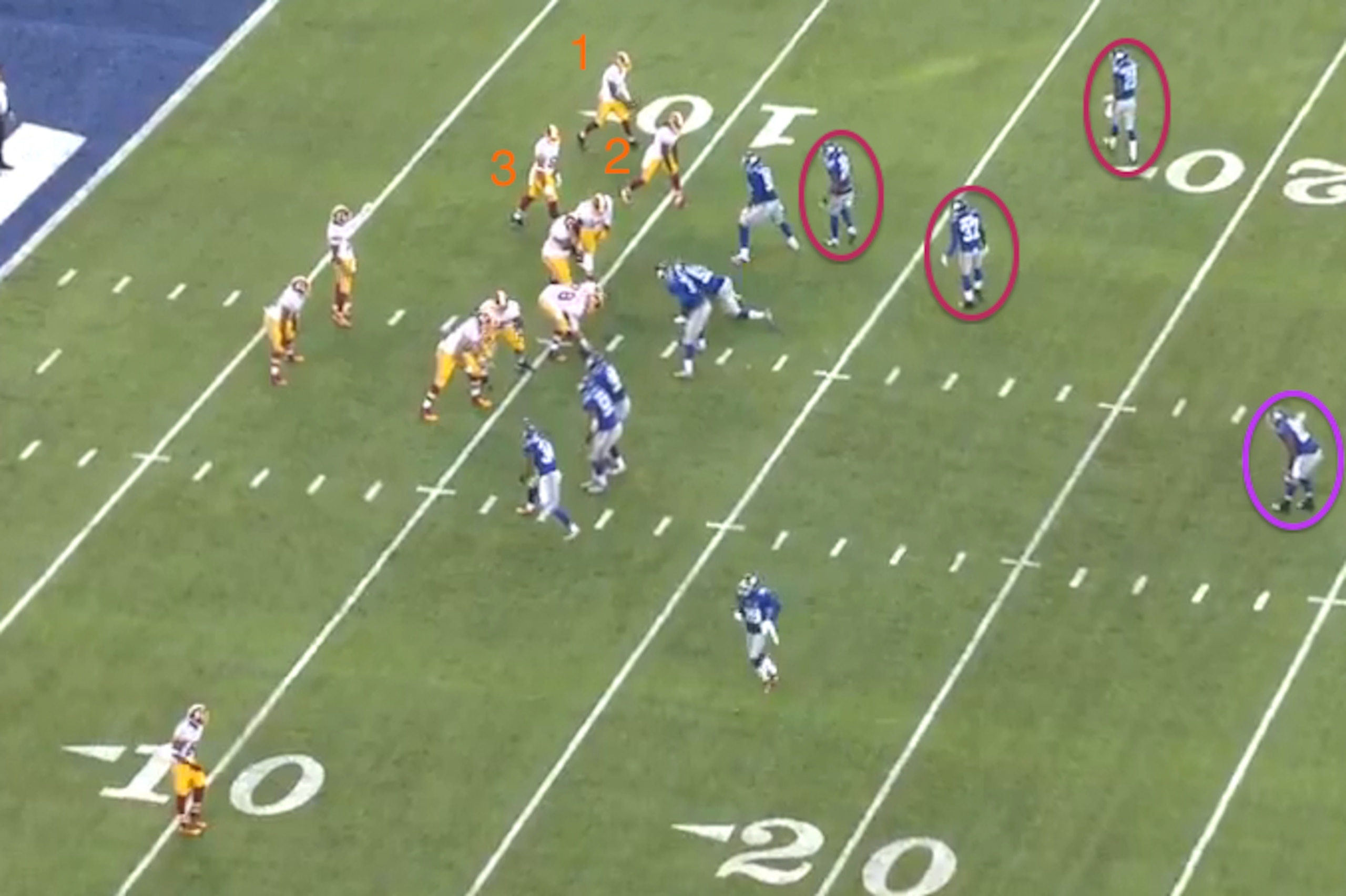
This again forced the Giants into a Cover 1 look. They brought Rolle down into the box to help match up with the bunch in man coverage.
But you can also see Griffin gesturing for one member of the bunch to come across the formation in motion.
He sent Reed across into the slot on the other side. Now Washington had a double stack:

Reed going in motion took Rolle out of the box. Once he rotated deep, the Giants were in an obvious Cover 2 shell.
At the snap, the Redskins again attacked with a hi-lo concept. DeSean Jackson ran a shallow cross underneath, while Roberts once again stretched the defense vertically:

With Jackson naturally drawing most of the attention, Roberts was soon running free. A late rotation by the deep safety left him open:
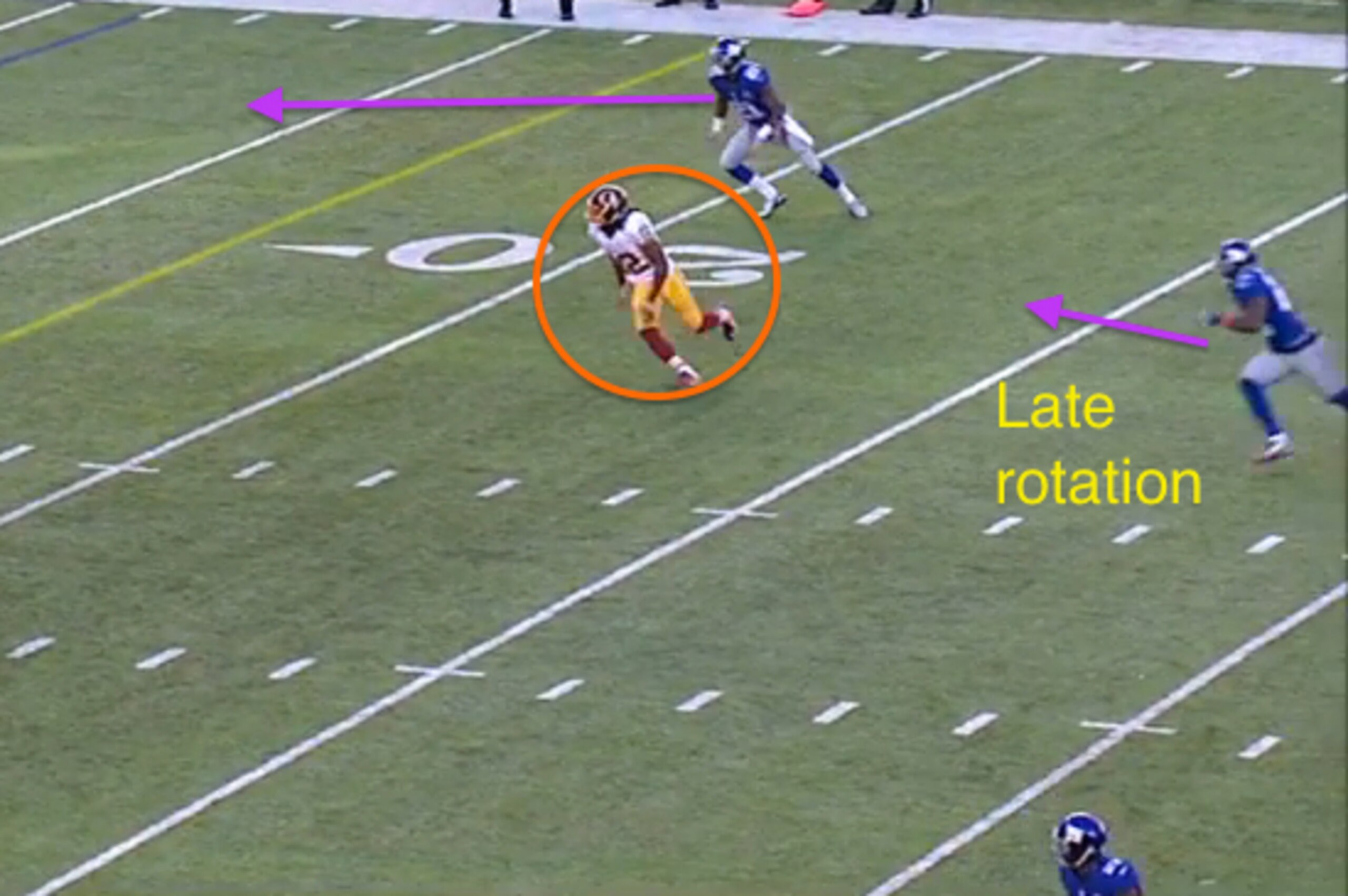
Not only was the safety late, he took a bad angle to the ball. Roberts snagged Griffin's pass with a nice grab, a rare occurrence in 2014, before spinning away for 61 yards:

These are the kinds of plays that are possible whenever scheme and coaching make life easier for the quarterback. Washington had used a bunch that became a double stack, one of which Griffin targeted from the pistol.
This sort of creativity lets Griffin play quickly. He's always been a passer by instinct, one who soon runs into trouble when defenses slow the game down and make him think.
That's why so many have tried to contain him in the pocket and take away the deep ball with simple zone structures that challenge him to stop and look for gaps underneath.
By using multiple bunch, stack and trips sets, especially from the pistol formation, the Redskins can almost do Griffin's thinking for him. They can create quick throws to players in space off easy reads against manipulated defenses.
Of course, that may not work all the time. All the plays here are taken from two-minute drills, where many defenses go no frills.
Griffin couldn't maintain strong starts against either the Vikings or the Giants. Consistent blitzing took away his quick reads and showed how quickly he abandons the scheme under pressure.
But better blocking up front and close coaching from Cavanaugh can change that.

At the moment, Griffin is a broken quarterback still struggling to push the dial past zero. But the story doesn't have to end that way.
Cleverly packaged schemes can create a framework in which he and the Redskins can still win in 2015.
All screen shots via Fox Sports, NFL Network and NFL.com Game Pass.
.jpg?w=2560 "Commanders Cowboys Football")

.jpg?w=2560 "WWE Raw Live Grades 🔠")

.jpg?w=2560 "Follow Raw As It Happens 👊")