
Oakland Raiders: Grading the Strength of Every Position Unit Before Camps Begin
Oakland Raiders' training camp is on the horizon, and certain positions are coming in strong while others limp into the next phase.
Let’s take the time out to grade each positional group based on their projected starters and depth. Each positional group will get a letter grade.
A strong unit with a lot of depth will get a plus, while a unit with unproven starters or little depth gets a minus. This rule of thumb clarifies any grading questions as to why a plus or minus is attached to the grade.
Where are the strengths and weaknesses within the roster? How does one unit affect another? We’ll discuss the overall shape of the roster heading into training camp.
Quarterbacks
1 of 9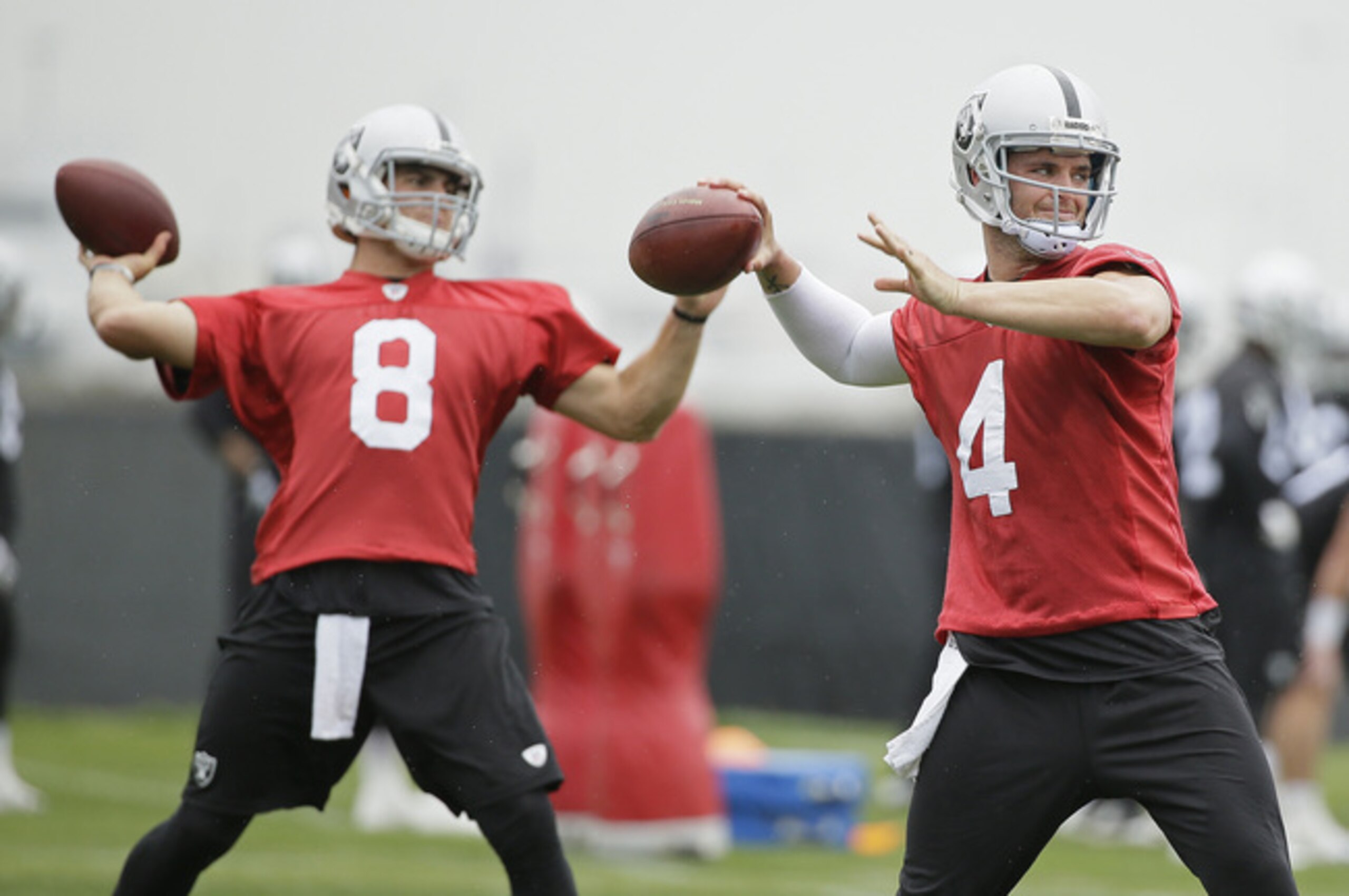
Starter
Derek Carr is putting a stronghold on the reins of the offense. The second-year quarterback made up for lost time during organized team activities and minicamp by hosting his own private minicamp, per CSN Bay Area reporter Scott Bair.
That’s exactly what you want to see out of your starting quarterback: hard work and accountability. Carr is well on his way to making a sophomore surge instead of a sophomore slump.
Depth
According to Bair in an interview with Bleacher Report’s Stephen Nelson, Christian Ponder didn’t finish minicamp on a good note. He’s familiar with offensive coordinator Bill Musgrave and got the nod for first-team reps over Matt McGloin.
McGloin, as a rookie, successfully moved the ball with lesser talent around him. Ponder struggled when equipped with Pro Bowl-caliber wide receivers Percy Harvin and Greg Jennings. Additionally, running back Adrian Peterson frequently faced a loaded defensive line to open routes for advantageous receiving matchups.
Hopefully Musgrave gets it right and elevates McGloin over Ponder. Either way, the Raiders' backup quarterbacks are far better than the average backups across the league.
Grade: B+
Running Back
2 of 9
Starter
The least experienced running back in the stable, Latavius Murray, enters training camp as the No. 1 guy, per Silver and Black Pride writer Levi Damien on Twitter.
Murray had a decent outbreak to end the 2014 season, but he’s far from a proven commodity, which explains the need to add Trent Richardson and Roy Helu. The upcoming season will highlight Murray’s small sample as either a fluke or a prelude to a 1,000-yard season. Nonetheless, his offseason development has garnered some optimism for the ground attack.
Depth
Ironically, Helu has the best combination of experience and upside among the three top running backs on the depth chart. Unfortunately, Helu will begin the season as the No. 3 running back.
In the offseason, Richardson envisioned himself competing for a starting job, relayed by ESPN (h/t Michael David Smith of NBC Sports). Richardson should be released if he falls to No. 3 on the depth chart. He’d probably sulk on the bench in that role without much of a chance to contribute on offense.
Michael Dyer is the wild card of the stable and becomes a viable option as the primary backup after an impressive showing during OTAs and minicamp, per ESPN’s Bill Williamson on Twitter. Marcel Reece will hopefully see an increase in targets in the passing attack as the H-back. Thus far, there’s no official word from Musgrave on his plans for Reece.
Oakland's ground attack still has plenty of questions going into training camp.
Grade: C
Wide Receivers
3 of 9
Starters
A combination of rookie Amari Cooper and Michael Crabtree or Rod Streater will serve as Carr’s primary weapons on the perimeter. Regardless of the combination, it’s an upgrade over the starters from the previous season.
Both Crabtree and Streater were present at Carr’s private minicamp, showing a high level of commitment to excellence. Cooper wasn’t present, but he also worked with Carr privately, per Bair: “While first-round pick Amari Cooper wasn't in Bakersfield, he and Carr worked out privately earlier in the offseason.”
Oakland enters training camp with one of the most talented wide receiver trios in the league.
Depth
The No. 4 wide receiver was the Raiders' primary option from the previous season. That alone says a lot about the depth at the position. Andre Holmes returns in a less prominent role but still serves as a big target for Carr in tight spots.
Veterans Kenbrell Thompkins and Brice Butler could potentially lose a spot on the roster with the influx of talent at wide receiver. Undrafted free agents Josh Harper and Austin Willis have a good chance of making the 53-man roster.
Harper’s link with Carr and Willis’ kick-returning skills add intriguing variables to the No. 5 and No. 6 wide receiver spots.
Grade: A
.jpg?w=2560 "Texans Titans Football")
.jpg?w=2560)
.jpg?w=2560 "Cardinals Giants Football")
Tight Ends
4 of 9
Starter
The battle for starting tight end is far from over, but third-round pick Clive Walford has an advantage based on his versatility. That doesn’t mean Mychal Rivera is automatically moved to the bench.
Rivera was one of the leading receivers in yards last season. He has enough talent to avoid being swept under the rug in complete favor of Walford.
The former Miami tight end could be a dynamic weapon for Carr on his own or as part of two-tight end sets alongside Rivera.
Depth
Either Walford or Rivera will serve as a solid No. 2 tight end on the depth chart. The Raiders also signed Lee Smith for added line protection. Oakland has transitioned from thin to deep at the tight end position over the course of the offseason.
Grade: B+
Offensive Line
5 of 9
Starters
The Raiders presented a strong pass-protecting offensive line in 2014. Carr was only sacked 24 times. On the flipside, run blocking ranked 30th in the league, per Pro Football Focus.
Most of the linemen from last season return as starters for the upcoming campaign with some added reinforcements. J'Marcus Webb leads the competition for the spot at right guard, per Williamson, but an experienced swingman such as Khalif Barnes should outperform him during training camp.
Austin Howard moves back to his natural position at tackle in a competition with Menelik Watson. Howard exhibited far better run-blocking skills than pass-blocking abilities at guard in 2014, per PFF. Howard should start, preferably at guard, in an effort to elevate the rushing attack.
The left side of the offensive line marks as a solid A. The right side grades as a D because of all the uncertainties and the gaping hole at right guard.
Depth
Aside from Barnes, none of the offensive linemen have extensive experience as utility reserves capable of playing multiple positions. Webb was a subpar tackle for five seasons before transitioning to guard during Raiders’ OTAs and minicamp.
Watson remains a question mark at his natural tackle position. Rookie Jon Feliciano needs a lot more reps before he's capable of taking the field. If Barnes starts at right guard, the best reserve lineman would be the loser of the right tackle competition, which isn’t saying much.
Matt McCants is an intriguing player to watch, as he took over second-team reps at right guard during mandatory minicamp.
Grade: B
Defensive Line
6 of 9
Starters
Justin Tuck is the leader of the defensive line. That’s fine in terms of vocal and spiritual leadership. However, the fact the leader has a low sack total signifies a major problem, which was the case in 2014.
The Raiders need second-round pick Mario Edwards Jr. to generate some type of pass rush opposite Tuck. Yes, Edwards could eat up blockers for outside linebacker Khalil Mack, but an outside linebacker in a 4-3 alignment also has pass-coverage duties, which makes constant blitz schemes risky.
Dan Williams transitions from nose tackle in a 3-4 to a defensive tackle in a 4-3 alongside Justin Ellis. Williams is capable of providing some pressure up the middle as an athletic 300-pounder. Oakland’s pass rush would receive a huge boost if one of the two defensive tackles can consistently beat an offensive lineman one on one.
Oakland’s projected starting defensive line should finish the season as one of the best run defenses in the league.
Depth
C.J. Wilson has the most experience behind the starters of the defensive line. Fortunately, he can play both positions but came up short as a defensive end for five seasons with 5.5 sacks.
Benson Mayowa and rookie Max Valles are the intriguing young players who could both establish themselves as the No. 2 pass-rusher on the defensive line. Footwork and technique are the keys to practicing without the pads during OTAs and minicamp. Training camp will shed more light on the talent behind the starters.
Grade: B-
Linebackers
7 of 9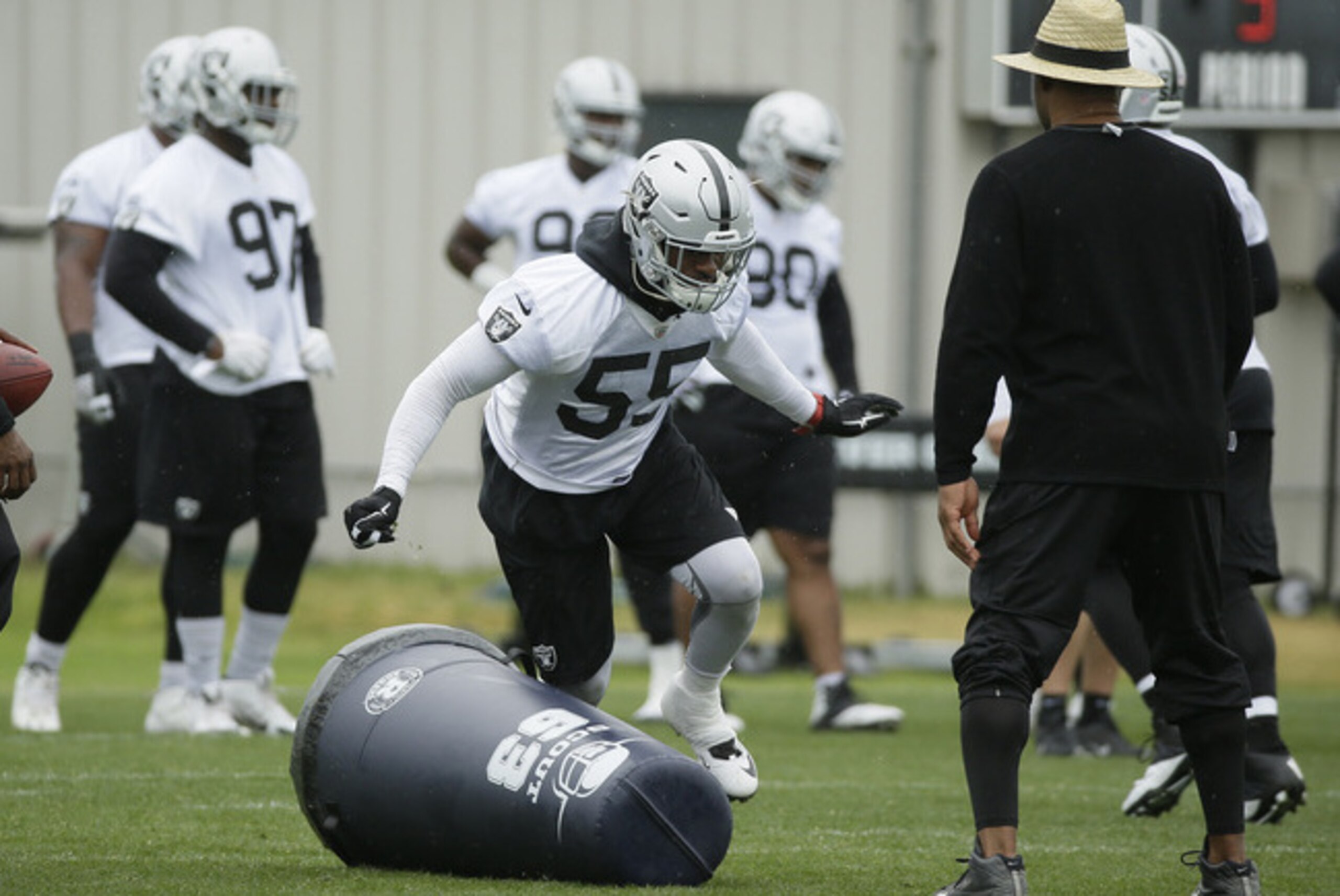
Starters
An expansion of Mack’s duties will spread him across the defensive front as an outside linebacker and pass-rusher. His pursuit of quarterbacks reduces Edwards' pass-rushing responsibilities at defensive end.
Mack will likely lead the team in sacks as a defensive wrecking ball. He spent the offseason bulking up and preparing himself for an expanded role, per ESPN’s Jeffri Chadiha.
Sio Moore recorded 7.5 sacks in two seasons and needs to stay on the field in 2015. Moore returned and participated in workout drills during mandatory minicamp after hip surgery, per Damien.
The addition of Curtis Lofton pays immediate dividends in the run defense and provides veteran leadership in setting up the defensive alignment. The inside linebacker in a 4-3 alignment serves as the quarterback and instinctive athletic playmaker in both pass and run situations. Lofton provides those qualities as a significant upgrade over Miles Burris.
Depth
Oakland decided to stock up on linebackers during free agency and the draft to supplement their linebacker corps. Ray-Ray Armstrong put together an impressive string of practices in Moore’s absence, per official team website writer Eddie Paskal.
The Raiders signed one-time Super Bowl MVP Malcolm Smith, who reunites with his former linebackers coach Ken Norton Jr. Smith is an athletic jewel at 6' and 226 pounds. He registered two interceptions, returned one for a touchdown with six passes defensed during the 2013 season. In that season, he started eight games.
Oakland picked up Neiron Ball and Ben Heeney in the fifth round of the draft. Ball projects as a sideline to sideline special teams player. Heeney impressed teammates by calling the defense as a starting middle linebacker, per Williamson:
“I think Heeney, a Kansas product, is safe. He has adjusting well to the pro game. Teammates have lauded him for intelligence and the way he is helping call the defense some in practice”
Heeney’s quick adjustment will allow Norton to use 3-4 alignments early in the upcoming season.
Grade: A
Secondary
8 of 9
Starters
There’s a lot of debate surrounding who starts as the No. 2 cornerback between D.J. Hayden and Keith McGill. Both players will get extensive snaps during the season as Norton tinkers with the pass defense. Unfortunately, all of his cornerbacks lack sustained success as starters.
Oakland doesn’t have the option of depending on a veteran as a backup in case the inexperienced cornerbacks falter. Travis Carrie projects as the best starter of the three based on his 2014 performance but remains an unknown after only four starts.
Charles Woodson and Nate Allen are the proven commodities that save the secondary. Allen comes over from the Philadelphia Eagles with the reputation as a ball hawk. Woodson led the secondary with four interceptions in 2014. The 18-year veteran can still play at a high level and should provide great tips for the young starters on the field with him.
Depth
Oakland’s No. 4 and No. 5 cornerbacks have the potential to develop into decent starters. Both Neiko Thorpe and Dexter McDonald profile as athletic, sizable pass defenders capable of getting physical and running with speedy receivers on the perimeter.
Brandian Ross serves as a solid backup at safety. He started 23 games over the past two seasons and performed well in spot duty. Ross is capable of stepping into the lineup as a solid starter in case Woodson or Allen miss time with injuries.
Grade: C+
Special Teams
9 of 9
Starters
Sebastian Janikowski enters his 15th year in a Raiders uniform with an 86 percent field-goal percentage. In a third of those years, he registered a season field-goal percentage below 75 percent.
The new point-after-attempt rules pushed the extra-point kick back to the 15-yard line for a 33-yard attempt. Fortunately, the majority of Janikowski’s field-goal misses have come from 40 to 49 yards out.
In 2014, Oakland led the league in punts. Marquette King handled his duties fairly well, landing 31 punts inside the 20-yard line. On average, Oakland’s special teams surrendered the fifth-most return yards (10.9) in punt coverage. The Raiders' revamped offense should take a significant amount of pressure off King and punt coverage.
Jon Condo is entrenched in his position as the long snapper, where he has been a constant for the past eight seasons.
Depth
The backup kicker and punter are tucked away on the depth chart and never heard from again unless the starters falter or get hurt.
In the event King cannot perform his punting duties, second-year punter Steven Clark would take over. Second-year kicker Giorgio Tavecchio would assume kicking duties for Janikowski if necessary. Tavecchio registered a career 75 percent field-goal percentage in four seasons at California.
Grade: B
How would you grade each position? All comments are welcome below. Follow Maurice Moton on Twitter for NFL and Raiders news.
All statistics are provided by Pro-Football-Reference.com, Sports-Reference.com and ESPN.com unless otherwise noted.
.jpg?w=2560 "Broncos Chargers Football")
.jpg?w=2560 "MHJ Bought Own Jugs Machine")