

Why Centre-Forward Is the Role Arsenal Must Hand Theo Walcott Next Season
Theo Walcott’s future at Arsenal is still up in the air. With 12 months of his contract left to run, there has been worryingly little news about an extension. If he does opt to remain with the Gunners, it should surely be as a centre-forward: After a decade of apprenticeship on the flank, Walcott is ready to assume a regular role as a striker.
It remains to be seen if he’ll stick around at Arsenal to see his evolution from peripheral winger to central star through. Speaking in the wake of the FA Cup final, Walcott warned, per Simon Rice of the Independent:
TOP NEWS
Alexia Wins Ballon d'Or 🏆

Live Ballon d'Or Ceremony Winners 🎉

Final Men's Ballon d'Or Rankings 📊
"I am sure things will get resolved. I just want to enjoy today.
I have got England coming up and then we can think about that process, but it will take time, I am sure."
It’s entirely possible that his regular position will be a factor in his contract negotiations. Walcott has never sought to hide his desire to play as a centre-forward, and Arsene Wenger is clearly keen to publicly talk up his potential in the role. According to Neil Moxley of the Mirror, Wenger recently said:
"It’s not too late for him. I think his position will be as a striker. I have worked with him in both situations, as a striker and as a wide player.
The quality of his runs is so fantastic with the pace he has, and he is a good finisher now.
When he was younger, he rushed in front of goal but he has improved now.
He can be transformed. He is naturally gifted and can play in this position. Olivier Giroud has different qualities: he can head a ball and he plays with his back to goal. Theo is a runner who is capable of going in behind.
"
It would be easy to dismiss Wenger’s words as merely a carrot to convince Walcott to extend his deal. However, actions speak louder than words, and Wenger made a bold move when he selected Walcott ahead of Giroud to start through the middle in the FA Cup final.
That decision was prompted by Walcott’s performance in the final game of the Premier League season, in which he bagged a hat-trick against a ragged West Bromwich Albion side. Following his opening goal of the cup final, there has been debate over whether or not Walcott is finally ready to take up the spot that he sees as his destiny.
If he is, it seems that patience has been a virtue for both Walcott and Wenger. The Arsenal boss has long insisted that he saw the No. 14 as a centre-forward, but the transition has simply taken longer than anticipated. Per the Mirror, Wenger said:
"I bought him from Southampton when he was 17 because I believe in his qualities as a finisher. The timing of his runs is very intelligent.
He is at the best age now. Being 26 to 32 as a striker is the best age and I would not like to miss that golden age.
"
So why has Wenger waited until now to shift Walcott infield? Well, one reason is necessity. At the back end of last season, Giroud looked short of form and freshness, and Danny Welbeck was absent with a knee injury. With Lukas Podolski, Joel Campbell and Yaya Sanogo all out on loan, Wenger had little option but to press Walcott into striking action.
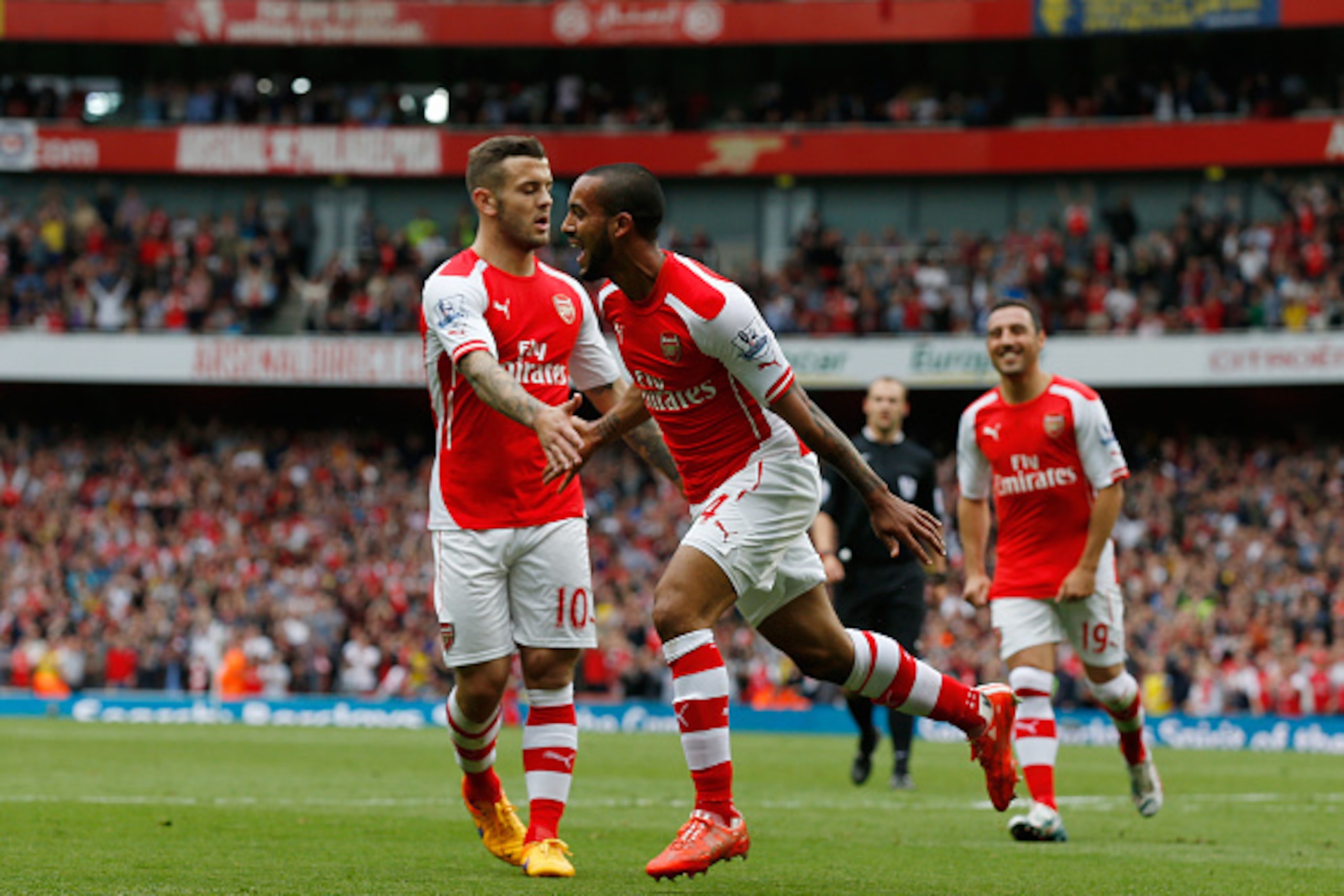
It’s also possible that Wenger no longer considers him a viable option on the flank. The Gunners boss has remodelled his team to include wide men who are industrious and as willing to track back as break forward. The simple fact is that Walcott lacks the defensive discipline and work rate of the likes of Danny Welbeck, Alex Oxlade-Chamberlain and Alexis Sanchez.
That much was evident in the 2014/15 north London derby at White Hart Lane, when Walcott switched off for long enough for Danny Rose to cross and create Tottenham Hotspur’s winner. Wenger may feel he has no choice but to use Walcott through the middle, where his defensive responsibilities are significantly reduced.
What Walcott does have over Welbeck and Alex Oxlade-Chamberlain is a predatory instinct. The other pair have struggled to convert their ability into tangible contributions in the final third, but that is not a problem Walcott has. Although he can be prone to disappearing for long periods of the game, he has a useful habit of popping up in the penalty area at the right time. When he does arrive on the spot, Walcott’s composure is impressive. With the exception of Alexis, he may be the most accomplished finisher at the club.

Walcott’s presence at centre-forward enables the team to play in a completely different manner. His explosive pace means there is a rapid roaming target for the likes of Mesut Ozil and Santi Cazorla to aim for. Selecting Walcott means Arsenal offer a perennial threat on the counter-attack and in behind.
That doesn’t mean it’ll necessarily be the right call to play him in every single game. Variety is important when it comes to attacking options, and there will be games that suit Giroud’s back-to-goal style better. He offers an aerial threat and protection at set pieces—two things Walcott is certainly unable to provide.
Nevertheless, he could still be a very useful for weapon for Arsenal in 2015/16. If Walcott remains at the Emirates Stadium, it will surely be as a striker. It’s time for the England international to come in from the wings and take centre-stage.
James McNicholas is Bleacher Report's lead Arsenal correspondent and is following the club from a London base throughout the 2015-16 season. Follow him on Twitter here.

.jpg?w=2560 "Chiefs, Steelers Eye WR Trades")






.jpg?w=2560 "Raiders Sticking with Cousins")