Why Centre-Back Is the Role Manchester United Must Hand Phil Jones Next Season
Phil Jones' Manchester United career has been an odd thing so far.
Like the player himself, it has verged from the sublime to the ridiculous. It is almost impossible to discuss the topic without bringing up Sir Alex Ferguson's infamous suggestion that Jones could go on to become United's greatest ever player, as covered by Sky Sports.
Two seasons on, it seems hard to believe that will come to pass.


Grandiose statements were the order of the day in Jones' early United career. Sir Bobby Charlton once compared Jones with Duncan Edwards, per Stuart Mathieson in the Manchester Evening News.
However, a series of injuries and a lot of apparent uncertainty over his best position has meant he has not grown into a superstar as yet.
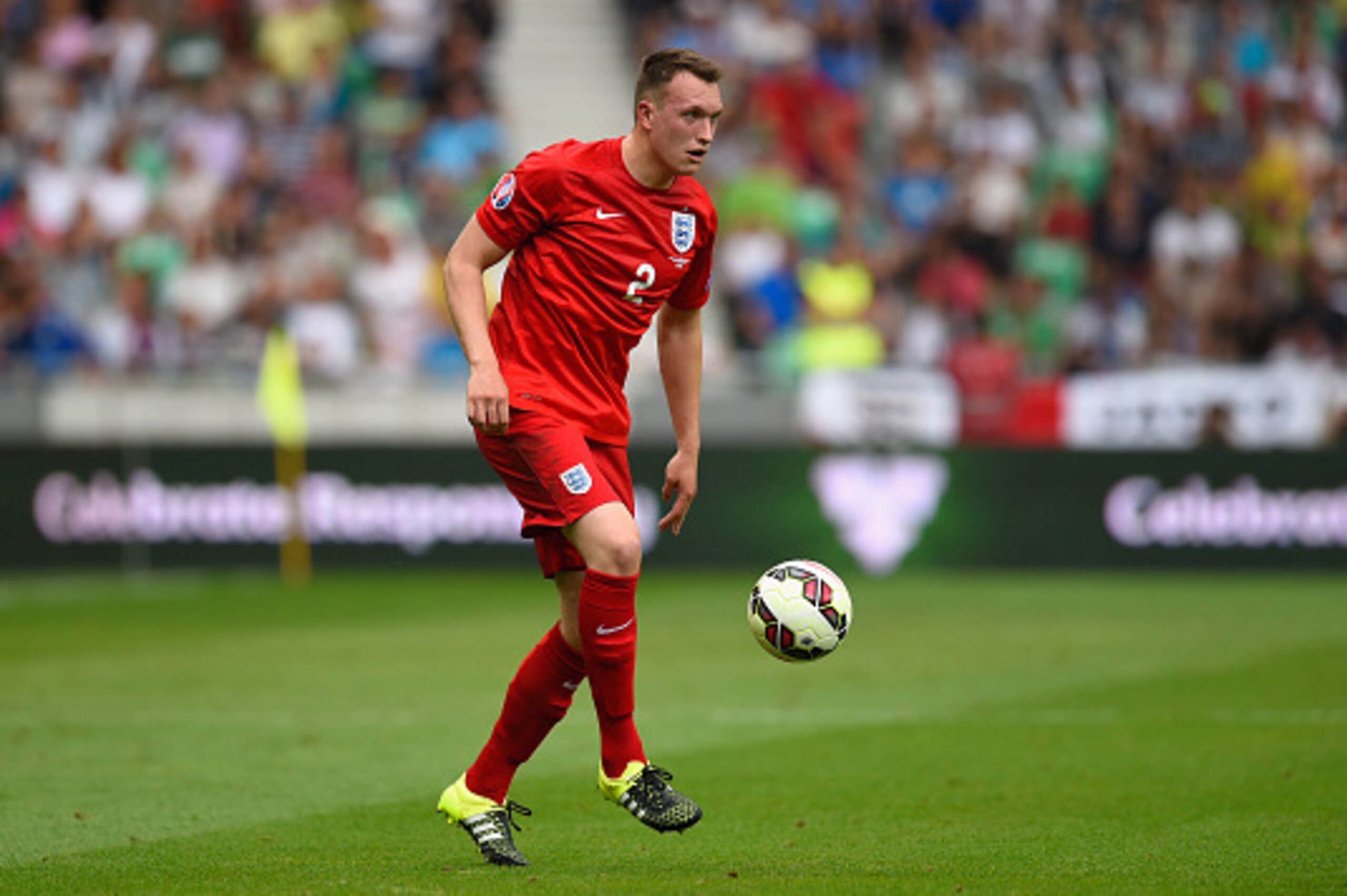
He has played centre-back, right-back, left-back, defensive midfield and central midfield.
Where David Moyes and Sir Alex Ferguson experimented with Jones' position before him, Louis van Gaal has not. Only a brief, injury-covering spell at left-back saw him move away from a centre-back berth.
It was the first season for which that has been the case for Jones at United. Sir Alex played him at right-back and in midfield fairly frequently. Perhaps it was part of a plan for the player's development or perhaps it was an experienced manager taking advantage of Jones' versatility to cover gaps in the squad.
Perhaps, like so many things in life, it was somewhere between the two. In whichever case, it meant Jones' time spent learning at the coalface of his position has been reduced.

During ITV's coverage of England's friendly with Ireland on 7 June, Paul Scholes attacked Jones' positional intelligence (h/t the Mirror): "I just think at centre-back, when he is playing against clever forwards, he tends to get dragged out of position quite easily."
Of course, having seen him up close for many years, Scholes would be well placed to know this, especially since he could certainly be described as a clever forward when he played in advanced positions.
However, that Jones has not yet mastered the role does not mean he will not grow into it. Indeed, some of that positional naivety Scholes accuses him of may well come down to his relative lack of playing time at centre-half.
He certainly has some assets that serve him well as a defender. When he acts on his instincts, he gets a good deal right. His tackling is often impressive—he has made plenty of important last-ditch interventions during his time at United.
He is brave, both in terms of his own physical well-being and his decision-making. If he thinks a tackle is on, he will make it even if it is in his own box and carries risk. He gets many more of those kind of split-second decisions right than he does wrong.

There is, of course, no better illustration of his physical courage than his ground-level headed tackle against Olivier Giroud at Old Trafford in May. This moment was pure Phil Jones—the clumsiness that led to his slip and the will and courage to do something about his own mistake.
The other key options for Jones, positionally speaking, are at defensive midfield or right-back. Neither seems a good fit for his abilities. His crossing would be a limitation at right-back. As a midfielder, his best performances have come when he has been tasked with a man-marking job.
In 2012/13, he was assigned to shadowing Marouane Fellaini from defensive midfield when Moyes brought Everton to Old Trafford. He shut the Belgian out of the game entirely. It was a practice run for a tougher test—man-marking Cristiano Ronaldo in the Champions League.
He did a superb job that day too, although in the end, almost inevitably, Ronaldo got on the scoresheet. Jones managed to limit the brilliant former United man, though, to whom he stuck like a shadow. Essentially, he was asked to play as a centre-half without the positional limitations and assigned very strict duties, and he stuck to them well.

With all that said, Van Gaal appears to be sold on the idea that Jones is a centre-back. In which case, the question becomes not so much about his position as his status within the squad.
Received wisdom suggests United need a new, commanding, experienced central defender to calm nerves across the back line and provide a more reliable platform from which their midfielders can build attacks.
Plenty of centre-backs have been linked with the Red Devils this summer. If a player of senior standing is brought into that position, there are important questions to be answered about the futures of Jones, Chris Smalling, Marcos Rojo and Jonny Evans. Evans is presumably the favourite to leave the club, given his lack of playing time under Van Gaal.
However, the position of the man who takes on the mantle as first choice alongside the prospective new signing is up for grabs. Will Jones be handed the role of second in command to the new man, or will Smalling's impressive late-season form put him ahead of his England colleague?
Back in August 2014, I looked at the same question of which of the two would be higher in Van Gaal's pecking order. At the time, I suggested Jones would probably nudge ahead of Smalling but that fundamentally they were well suited as partners.
What has come to pass is that Smalling is now probably ahead of Jones in the pecking order. As for their partnership, while they have complementary strengths, they are far from Rio Ferdinand-and-Nemanja Vidic or Gary Pallister-and-Steve Bruce levels yet.
They do seem to have some degree of understanding, but the tendencies Scholes spoke about have affected Jones' role in that. Smalling, of course, amply demonstrated his capacity for lapses in judgement last season when he was sent off at the Etihad Stadium against Manchester City.
However, he has barely put a foot wrong since.

Perhaps who gets to play alongside the hypothetical new signing will depend on what kind of player is brought in. Van Gaal has demonstrated a preference for a pairing comprising a left-footer and right-footer, so that could be a factor. Equally, the new man's stylistic approach could have an impact.
Ultimately, though, it is Smalling who demonstrated more consistent form last season. Van Gaal has been very loyal so far to the players that have served him well—witness Ashley Young's keeping Angel Di Maria out of the starting XI for such a long time.
That loyalty to Smalling may well mean that Jones will be handed the role of first understudy to the defence come the start of the new season. His versatility and quality mean United should certainly try to keep him around, particularly since he is still young and with plenty of potential growth ahead of him.
However, a new central-defensive signing should line up alongside Smalling at the start of the season.
Of course, the assumption in this question is that both Jones and Smalling will be fit at the same time, something that has not been the case for much of their time at United. First understudy to the defence at United has, in recent history, been a squad role that involves plenty of playing time.
Even if he is not first choice, Jones is unlikely to spend that much of the season on the bench.





.jpg?w=2560 "Latest Peyton-Colts Rumors")