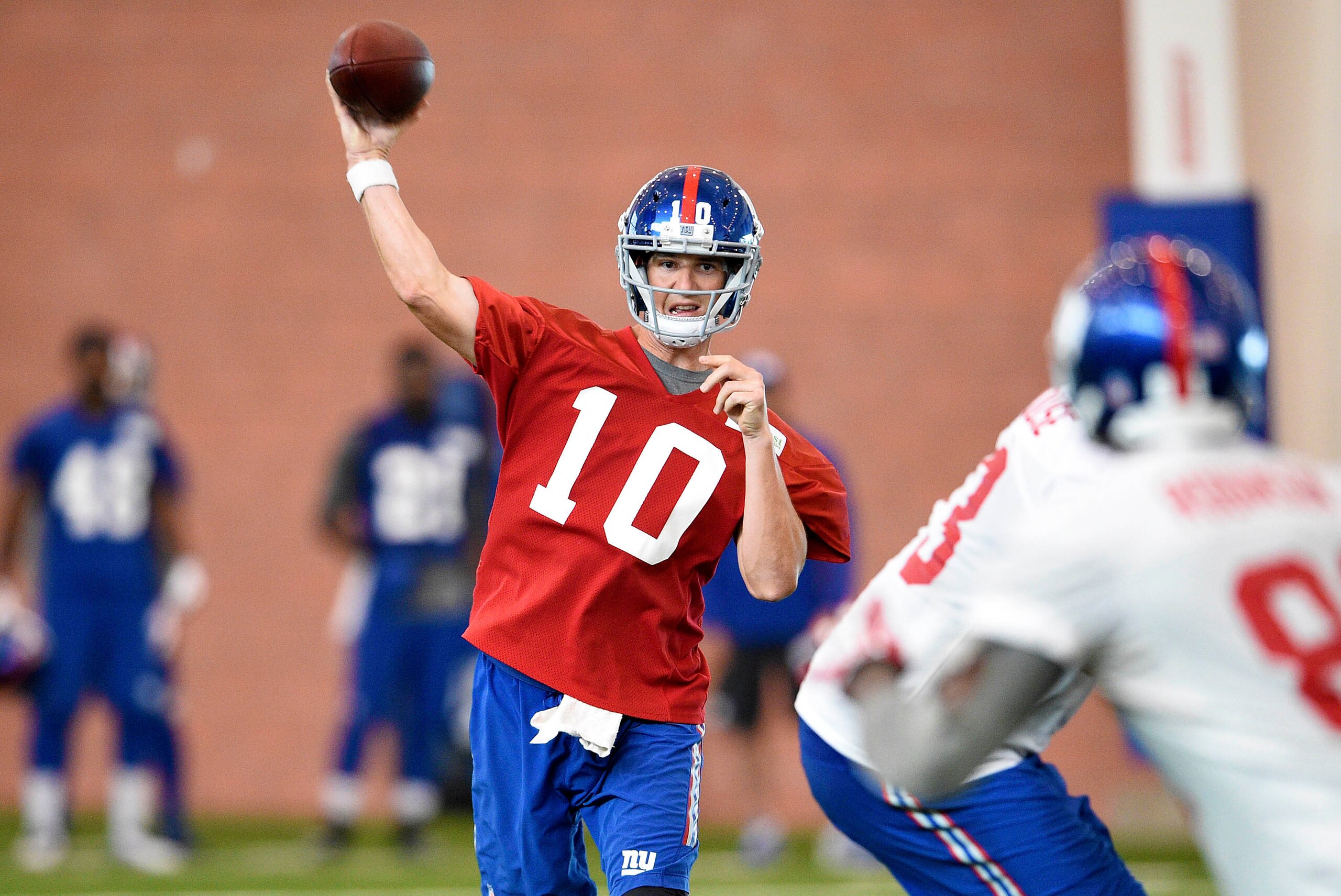

Fact or Fiction for New York Giants' Biggest Offseason Question Marks
With 10 OTA practices and a three-day mandatory minicamp now in the books, the New York Giants coaching staff should have a much better idea of where they stand regarding their personnel and whether they’ll be able to do what they want to do this season.
Of course, it needs to be said that there is only so much that can be gauged during the spring, a time when players are working in shorts and shells and there is no contact permitted in the drills.
This slideshow looks at some of the top stories that emerged from the spring. It also takes into consideration observations from the workout and other information obtained to form an opinion regarding the likelihood of the storyline.
Fact: The Safety Spot Is Still a Concern
1 of 5
While it is certainly a scary proposition to know that a unit on a football team lacks any kind of NFL experience, there can be some comfort, at least, in knowing who the personnel is.
Such is the case with the Giants safety position, which throughout the offseason has been one of the biggest question marks on the team.
After passing on bringing back at least one of the veterans from last year’s trio (Antrel Rolle, Stevie Brown and Quintin Demps), the Giants are going with three draft picks for the two open slots.
The first pick, obviously, is their highest one.
That would be Landon Collins, drafted at the top of the second round this year. Collins appears to be well on his way to earning a starting job in the defensive backfield despite the lack of pro experience.
Because he has played in a pro-style defense at Alabama, the coaches seem a little less squeamish about Collins starting Week 1. That doesn’t mean that the rookie is a finished product. But sometimes a more talented rookie is an upgrade from a veteran with years of experience who is on the decline.
The other safety spot is a little less defined because of a calf injury to 2014 fifth-round pick Nat Berhe, who missed the entire spring slate of workouts.
Safeties coach David Merritt told reporters that Berhe was definitely in line to receive a fair chunk of the reps with the first-team defense; unfortunately, that didn’t happen because of the injury.
“That hurts tremendously because all the reps that Cooper and Landon and Mykkele [Thompson] and some of the other guys have taken, Nat would have been right in there with all the other guys,” Merritt said.
With Berhe sidelined, the coaches had to go with another draft pick, Cooper Taylor, who was the team’s fifth-round pick in 2013.
“Cooper is coming along well,” Merritt said.
“Mentally, I never doubted Cooper would be able to pick up the defense. It is just now getting Cooper’s body to move in the proper direction once he receives the call and allows himself to line up and just see what is happening in front of him."
“The mental part, Cooper is fine, but it is now the physical part. We have to make sure the durability factor—he has to be durable for us because he has missed the past two seasons.”
With that all said, it's no wonder why Merritt is still a bit squeamish about the position which is responsible for making the calls in the defensive backfield.
“You are the extension of the defensive coordinator," he said. "Whatever call comes in, you need to be able to hear the call, accept the call and then spit it back out to your fellow teammates."
The talent is certainly there, but rarely do plays unfold the way they're drawn up. This is why there's a strong chance that whoever the Giants are eyeing for their starting safety duo, those players will be getting a lot of work this preseason.
Fiction: The Linebackers Are the Worst in the NFL
2 of 5
With all due respect to NFL.com’s Chris Wesseling, his analysis of the Giants linebacker unit is about as weak as his conclusion that the unit is the worst unit in the NFL.
Here is what Wesseling wrote:
"The linebackers have never been asked to do the heavy lifting on the defenses of the Tom Coughlin era. The disruption starts up-front with the defensive line instead.
This year's unit is heavily reliant upon middle linebacker Jon Beason, who simply can't stay healthy for 16 games. J.T. Thomas, a former special teamer in Jacksonville and Chicago, is penciled in on the weak side.
Strong-side linebacker Devon Kennard, a fifth-round pick last year, showed intriguing pass-rushing potential once he hit the starting lineup in November.
"
Yes, Beason’s injury history is well-documented, and yes, he is not necessarily the same player he was prior to suffering a string of lower body injuries, especially in coverage. Per Pro Football Focus, the last time Beason finished with a positive grade in that area was in 2010, his last 16-game season.
However, when he came to the Giants in 2013 via trade, he was healthy enough and showed that he was still a serviceable linebacker who turned out to be one of the better performers on that defense.
The problem with Beason is that he only has one speed, which is why the coaching staff rightfully limited his reps this spring.
They recognize the importance of having him on the field to help the defense become acclimated to the faster-paced and more aggressive defense being installed by Steve Spagnuolo.
Yes, Thomas is a journeyman. However, in having watched him during the OTAs and minicamp, he has already shown that he plays with more instincts than his predecessor, Jacquian Williams.
Whereas Williams often appeared to not always trust what he was seeing—this led to numerous tackles down field—Thomas plays with more certainty. He also has done a nice job affecting the flow of the ball carriers.
Kennard, whose injury history is starting to become a bit worrisome—he missed some spring practices with ankle and hamstring issues—is, as Wesseling said, “intriguing,” but he needs to stay on the field.
If the Giants can keep him and Beason on the field—a tall order, but not an impossible one—this unit is going to be worlds better than it was a year ago.
Here's one final point. The reason why the Giants relied so much on the defensive line to do the heavy lifting wasn’t just because of the pass rush, but because historically, they wanted the guys up front to stop the run.
When injuries and the declining play of defensive end Mathias Kiwanuka caught up to that unit, suddenly the entire run defense was exposed.
Well guess what? The defensive line that has to do the heavy lifting is far from being settled—the Giants still don’t know who will replace Kiwanuka at defensive end and the second defensive tackle spot alongside Johnathan Hankins is still unsettled.
The linebackers are smaller and can cover a lot more ground from sideline to sideline, which means that if the guys up front fail to set the edge, the linebackers should be able to stop the bleeding from reaching the secondary.
Fact: The Offensive Line Is Still Unsettled
3 of 5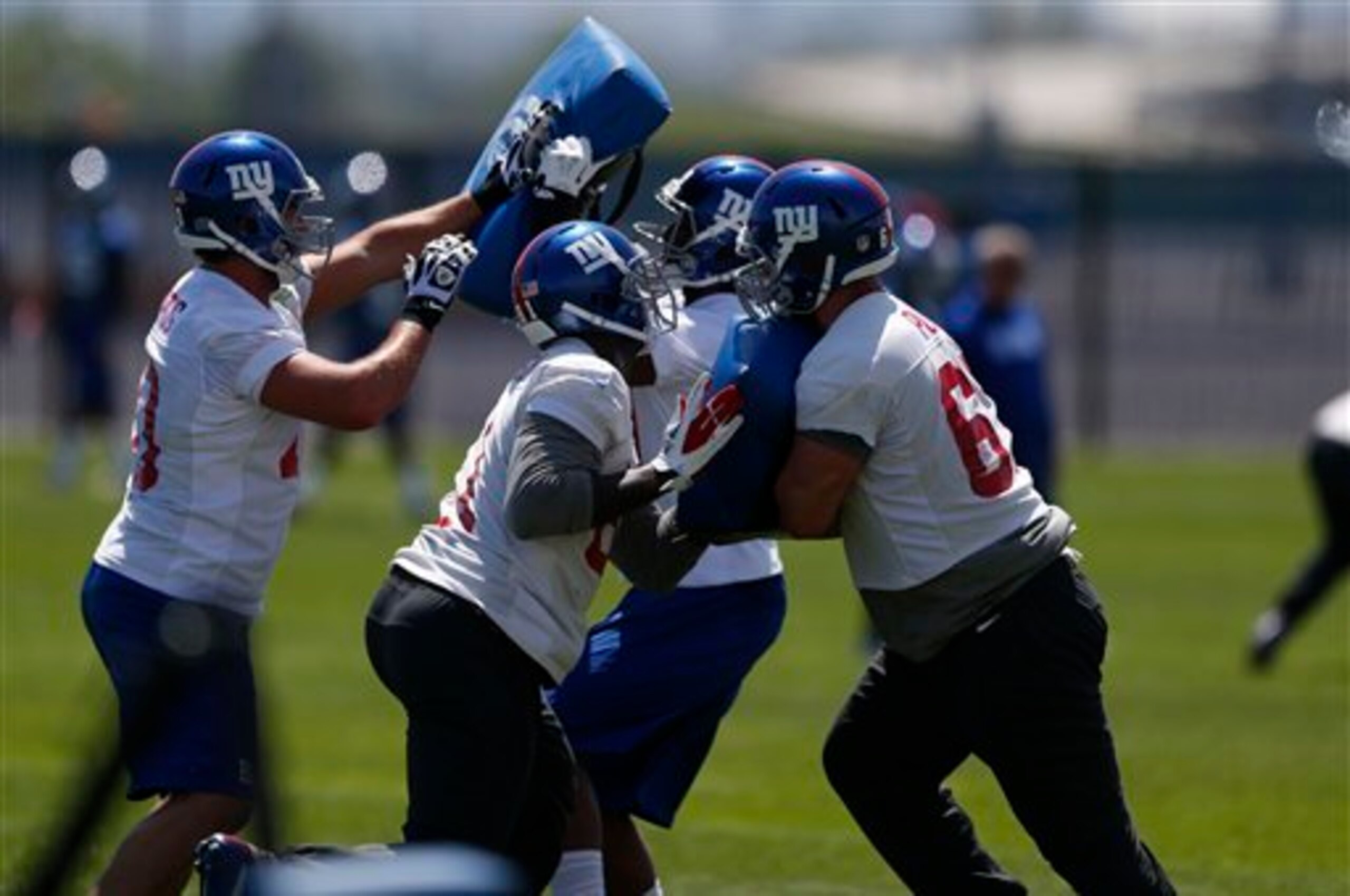
For the majority of the spring, the Giants used a first-string offensive line consisting of Ereck Flowers at left tackle, Justin Pugh at left guard, Weston Richburg at center, Geoff Schwartz at right guard and Marshall Newhouse at right tackle.
However, that particular combination still has a ways to go before it’s declared the best of the possible combinations by the coaching staff.
Head coach Tom Coughlin told reporters at the start of OTAs that the plan was to try different combinations.
While they didn’t really do that with the starting offensive line, it is worth mentioning that Pugh saw some snaps at left tackle with the second string unit. He was flanked by Brandon Mosley at left guard.
The significance of that is that the coaches obviously wanted to get a look at Pugh at left tackle, a position that he played at Syracuse.
They also undoubtedly wanted to see what they have in Mosley, a 2012 fourth-round draft pick who thus far has yet to establish a role on the team.
While it’s unfair to draw any conclusions based on the spring drills due to the non-contact nature of the practices, the “second team” configuration was interesting all the same.
This combination suggests that the coaches have not ruled out possibly putting Pugh at left tackle and flipping Flowers to right tackle, the position he was initially penciled in to play prior to Will Beatty's pectoral injury.
.jpg?w=2560 "Seahawks Chiefs Football")


Fiction: Victor Cruz Will Be Ready for Training Camp on Day 1
4 of 5
Although Victor Cruz has been a maniac about his rehab from a torn patellar tendon injury suffered in October, his expectation to avoid starting camp on the PUP list might be wishful thinking.
While the 28-year-old receiver has been relentlessly dedicated in his rehab to the point where he was spotted running at full speed on a side field and doing a little bit of cutting, all of that was done without the bulky pads that tend to weigh a player down.
The thing to remember about Cruz’s injury is that it’s worse than suffering a torn ACL, according to Rana Cash of The Sporting News.
"Cruz relies on power, speed and explosion, as much as technique, to be one of the better receivers in the league. But as [the] knee heals, the primary muscles that allow him to play at a high level are markedly weakened. The atrophy is much more notable than the resulting consequence after ACL surgery.
"
Will Cruz play again this coming season? Yes. Will he be able to avoid starting the summer on the PUP list? Coughlin left himself a little wiggle room there in his minicamp wrap-up press briefing with reporters.
“It is my understanding that he will be ready to participate,” he said. “How limited, I can’t tell you. We will see. We aren’t going to throw him right out there; I can tell you that.”
When asked point-blank if Cruz would start training camp on the PUP list, Coughlin said, “I’m not going to say. That is not the intent.”
It might not be the intent, but it certainly makes a lot of sense to take that road, especially if Coughlin and the team’s medical staff are in agreement that it’s not in Cruz’s best interest to get thrown out there right away (which would mean that he’s ready to go full speed).
By putting Cruz on the PUP list, they can take their time with him in making sure he’s fully recovered. This way, if his progress slows down, they don’t have to waste their lone annual temporary IR designation on Cruz, which would have to be the case if he is cleared to start training camp and has any kind of setback.
Fact: Eli Manning Has Thrown the Ball Well This Spring
5 of 5
Historically, quarterback Eli Manning has never been a strong performer in the spring.
Granted, he doesn’t have to be because the stats he’s accumulating don’t count toward anything nor can they be banked for future wins/losses.
However, this spring things are much different for the 34-year-old quarterback and that’s a good thing because whereas last year Manning was not only trying to recover from ankle surgery, he was also trying to learn a brand-new system that completely changed his mechanics from his first 10 years in the league.
“I think he is a lot more comfortable having that year under his belt,” quarterbacks coach Mike Sullivan told reporters.
“It’s one thing when you review cut-ups and you are seeing yourself, it is another if you are learning a system and it is another team. He can actually go through and have a good dialogue about the reasons of why this or why that. ... I agree he is definitely throwing the ball well.”
Besides being more comfortable and healthy, Manning, who is currently in the final year of his contract, told Steve Serby of the New York Post that he worked with a baseball pitching coach to help stave off any problems that might result from those days where Manning has to throw more out of necessity.
"Just trying to strengthen during the offseason, a lot of rotator cuff, and warming up, the way to warm up and cool down, and just try to pick some minds and see if there’s a way to get a little more strength and endurance … and keeping it strong the whole time after four days in a row of throwing and that. I think I got a good plan that should keep [his arm] strong the whole season.
"
That’s probably not a bad idea for Manning moving forward. According to his game-by-game statistical breakdown, Manning completed 67.1 percent of his passes when he had to throw the ball less than 40 times per game, which was 10 times last season.
In the six games where he had 40 or more pass attempts, his completion percentage dropped to 58.3 percent.
This spring, Manning’s passes have been on a rope, which is a good thing. The ball is coming out of his hand much faster, thereby making it more difficult for opposing defenders to knock his passes down or tip them as they arrive to the receivers.
The quicker release should help keep his sack totals down behind a work-in-progress offensive line, and keep the Giants out of long yardage situations. The passes thrown on a rope should also aid the offense in running an up-tempo operation that should keep opposing defenses on their heels.
Patricia Traina covers the Giants for Inside Football, the Journal Inquirer and Sports Xchange. Unless otherwise noted, all quotes, observations and information were obtained firsthand. Follow me on Twitter.