Why Yards After the Catch Are Crucial for the Pittsburgh Steelers Offense
Pittsburgh Steelers quarterback Ben Roethlisberger had a career year in 2014. He posted personal bests in completion percentage, passing yardage and sack percentage, and tied his top passing touchdown total with 32.
But, like any successful quarterback, he couldn't have done it alone—and he couldn't have done it with just any group of receivers. Thanks to a combination of savvy drafting and a little bit of luck, Roethlisberger has the exact perfect group of receivers that play to his strengths, as well as the strengths of offensive coordinator Todd Haley's system.
| Antonio Brown | 129 | 568 |
| Le'Veon Bell | 83 | 723 |
| Heath Miller | 66 | 338 |
| Martavis Bryant | 26 | 164 |
| Markus Wheaton | 53 | 161 |


.jpg?w=2560 "Seahawks Chiefs Football")
That system has Roethlisberger throwing the football more quickly than he did under former coordinator Bruce Arians. It relies not on Roethlisberger taking frequent shots deep down the field, but instead getting the ball into the hands of his receiving targets and allowing them to create yards after the catch.
In fact, Roethlisberger spelled it out himself when he spoke to the Pittsburgh Post-Gazette's Ed Bouchette after the start of the Steelers' latest OTAs:
"I haven't changed my game at all. I think when you call plays that are shorter-routed plays—Bruce Arians was known to go down the field and take shots. So you are going to have to hold onto the ball. We call a lot of plays that get the ball out quick to receivers. Todd Haley's offense is a lot about catching the ball, running and putting up yards after the catch. So I think that's what it is more than me changing or anyone changing.
"
Though the Steelers, and by extension Roethlisberger, tied for the third-highest yards per pass attempt in 2014, and Roethlisberger threw the second-most deep passes in the league, according to Pro Football Focus, those deep passes actually accounted for just 13 percent of his total passing output. And of those 79 attempts of 20 or more yards, he completed only 31 of them.
Ultimately, only five quarterbacks got the football out faster than Roethlisberger's average of 2.5 seconds last year. Of his 639 dropbacks, he passed the ball in 2.5 seconds or less on 381 of them, completing 72.1 percent of those passes. In comparison, when throwing after 2.6 seconds or more—which he did on 258 of his dropbacks—he completed only 61.3 percent of his attempts.
| 2011 | 564 | 2.7 | 299 | 53.0% | 63.8% | 265 | 47.0% | 62.8% |
| 2014 | 639 | 2.5 | 381 | 59.6% | 72.1% | 258 | 40.4% | 61.3% |
While the deep ball still has a place in Haley's offense, Roethlisberger's greatest successes are coming on quick throws that allow his dynamic group of receivers to make plays after the catch. They include wide receiver Antonio Brown, who not only led the NFL in receiving yards last year, but also had the sixth-most yards after the catch with 568.
Running back Le'Veon Bell not only surpassed 1,300 rushing yards last year, but also had 854 receiving yards. He also had the second-most yards after the catch of any player in the NFL regardless of position with 723. Tight end Heath Miller added 338 yards after the catch, receiver Markus Wheaton 161, and 2014 rookie wideout Martavis Bryant had 164 yards after the catch on just 26 receptions.
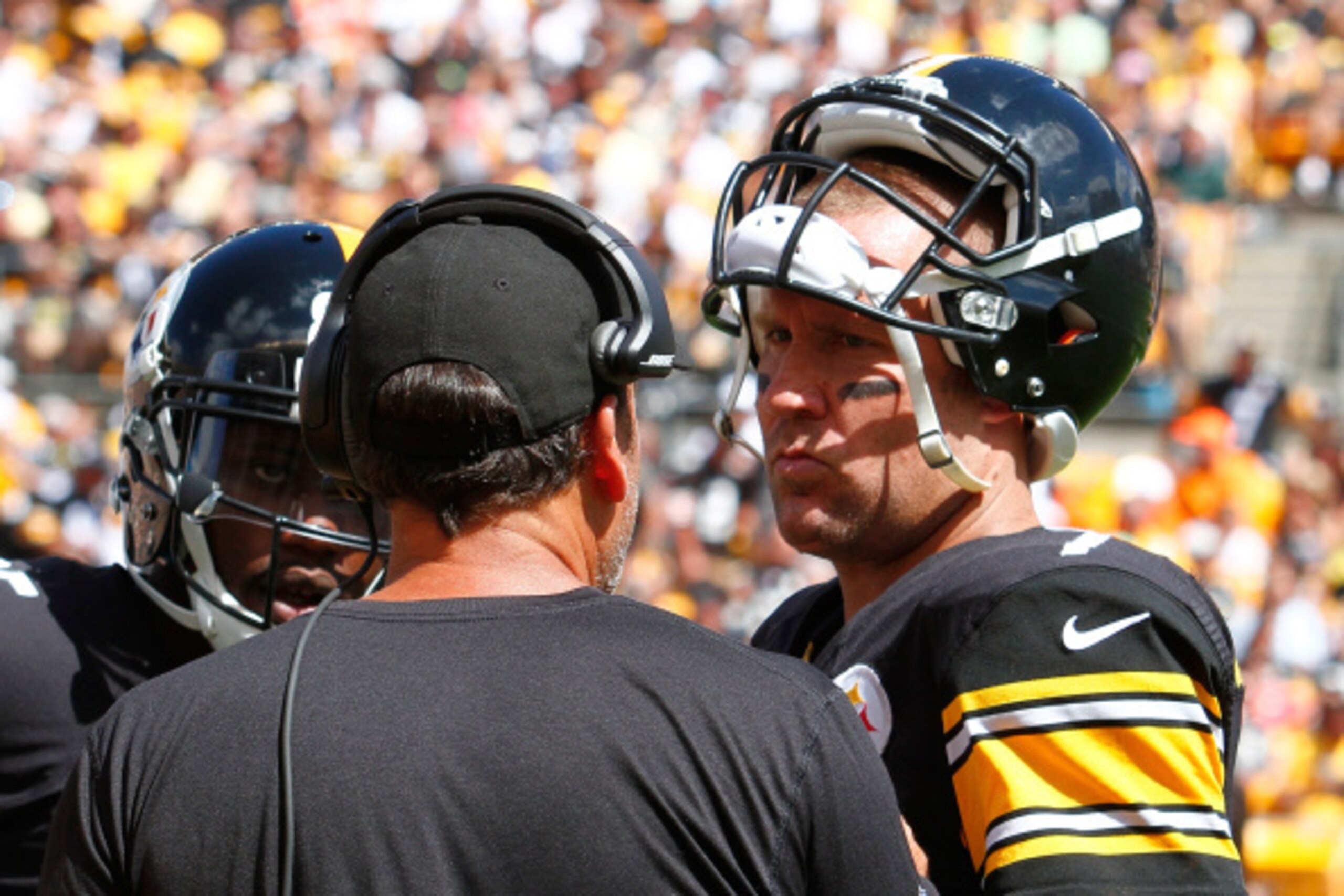
An offense that relies on short, quick passes needs not only an accurate quarterback with impeccable timing, but it also requires receivers who can do more than just get tackled where they catch their passes. Without the speed and dynamism of the Steelers' offensive skill position players, Roethlisberger's 2014 wouldn't have been as good as it was.
As Roethlisberger said, it's not as though the quarterback has morphed into a different person. It's just that finally quarterback, receivers and coordinator are all comfortable with one another, and the results are making themselves known on the field. No longer does Roethlisberger have to rely on receivers catching deep passes in order to make significant gains in the passing game.
While the system plays a part in this, Roethlisberger's great yards-after-the-catch receiving corps has helped him evolve into the $21 million-a-year man he is today. Finally, personnel and system have lined up in a way that brings out Roethlisberger's greatest strengths as a passer.



.jpg?w=2560 "Latest Peyton-Colts Rumors")